MAT 142: Inverse Functions
June 3, 2026
Reminders
At our last meeting, we discussed each of the following:
- Book functions and committing their shapes to memory.
- Vertical and horizontal shifts, stretches, compressions, and reflections.
- Combining transformations to build graphs of more general functions.
- Landmarks on graphs: roots, \(y\)-intercept, local maxima/minima, intervals of increase/decrease.
Try the following warm-up problems.
Problem 1: Consider \(\displaystyle{f\left(x\right) = \frac{x - 5}{4}}\) and \(g\left(x\right) = 4x + 5\).
- Describe, in words, how the function \(f\) acts on its inputs.
- Describe, in words, how the function \(g\) acts on its inputs
- Find \(f\left(g\left(x\right)\right)\) and \(g\left(f\left(x\right)\right)\).
Problem 2: Consider \(j\left(x\right) = 2x^3 + 8\) and \(\displaystyle{k\left(x\right) = \left(\frac{x - 8}{2}\right)^{1/3}}\).
- Describe, in words, how the function \(j\) acts on its inputs.
- Describe, in words, how the function \(k\) acts on its inputs
- Find \(j\left(k\left(x\right)\right)\) and \(k\left(j\left(x\right)\right)\).
What do you notice about each of these pairs?
Motivating Application
A function \(f\left(c\right)\) converts temperatures from degrees Celsius to degrees Fahrenheit:
\[f\left(c\right) = \frac{9}{5}c + 32\]
Find a function that converts temperatures from degrees Fahrenheit back to degrees Celsius.
Before we work through this, consider the following:
- What does \(f\left(0\right) = 32\) tell you? Does it give you any information about a function that converts Fahrenheit back to Celsius?
- What does the solution to \(f\left(c\right) = 40\) mean?
We’ll return to this application at the end of today’s class.
Objectives
After today’s class meeting, you should be able to:
- Define what it means for two functions to be inverses of one another.
- Use composition to determine whether two functions are inverses.
- Identify which functions have inverses using the horizontal line test.
- Use the swap-and-solve method to find the inverse of an invertible function.
What is an Inverse?
Definition (Inverse Functions): The functions \(f\left(x\right)\) and \(g\left(x\right)\) are inverses of one another if
\[f\left(g\left(x\right)\right) = x \qquad \text{and} \qquad g\left(f\left(x\right)\right) = x\]
In intuitive terms, \(f\) and \(g\) are inverses if \(f\) undoes whatever \(g\) does to its inputs, and vice-versa.
Think of it this way:
\[x \longrightarrow \boxed{~~g~~} \longrightarrow g\left(x\right) \longrightarrow \boxed{~~f~~} \longrightarrow x\]
We write the inverse of \(f\) as \(f^{-1}\).
Overloaded Notation Warning
\(f^{-1}\left(x\right)\) means the inverse of \(f\), not \(\displaystyle{\frac{1}{f\left(x\right)}}\). The superscript \(-1\) is notation for “inverse”, not an exponent. You’ll need to use context to infer the meaning of the “\(-1\)” superscript.
Completed Example 1
Problem: Determine whether \(f\left(x\right) = 2x + 10\) and \(\displaystyle{g\left(x\right) = \frac{1}{2}x - 10}\) are inverses of one another.
Solution. We check both compositions.
\[\begin{align} f\left(g\left(x\right)\right) &= f\left(\frac{1}{2}x - 10\right) \end{align}\]
Completed Example 1
Problem: Determine whether \(f\left(x\right) = 2x + 10\) and \(\displaystyle{g\left(x\right) = \frac{1}{2}x - 10}\) are inverses of one another.
Solution. We check both compositions.
\[\begin{align} f\left(g\left(x\right)\right) &= f\left(\frac{1}{2}x - 10\right)\\ &= 2\left(\frac{1}{2}x - 10\right) + 10 \end{align}\]
Completed Example 1
Problem: Determine whether \(f\left(x\right) = 2x + 10\) and \(\displaystyle{g\left(x\right) = \frac{1}{2}x - 10}\) are inverses of one another.
Solution. We check both compositions.
\[\begin{align} f\left(g\left(x\right)\right) &= f\left(\frac{1}{2}x - 10\right)\\ &= 2\left(\frac{1}{2}x - 10\right) + 10\\ &= \left(x - 20\right) + 10 \end{align}\]
Completed Example 1
Problem: Determine whether \(f\left(x\right) = 2x + 10\) and \(\displaystyle{g\left(x\right) = \frac{1}{2}x - 10}\) are inverses of one another.
Solution. We check both compositions.
\[\begin{align} f\left(g\left(x\right)\right) &= f\left(\frac{1}{2}x - 10\right)\\ &= 2\left(\frac{1}{2}x - 10\right) + 10\\ &= \left(x - 20\right) + 10\\ &= x - 10 \end{align}\]
Completed Example 1
Problem: Determine whether \(f\left(x\right) = 2x + 10\) and \(\displaystyle{g\left(x\right) = \frac{1}{2}x - 10}\) are inverses of one another.
Solution. We check both compositions.
\[\begin{align} f\left(g\left(x\right)\right) &= f\left(\frac{1}{2}x - 10\right)\\ &= 2\left(\frac{1}{2}x - 10\right) + 10\\ &= \left(x - 20\right) + 10\\ &= x - 10\\ &\neq x \end{align}\]
Since \(f\left(g\left(x\right)\right) \neq x\), we conclude that \(f\) and \(g\) are not inverses of one another. There is no need to check the other composition.
Completed Example 2
Problem: Determine whether \(\displaystyle{f\left(x\right) = \frac{x + 5}{x}}\) and \(\displaystyle{g\left(x\right) = \frac{5}{x - 1}}\) are inverses of one another.
Solution. We check \(f\left(g\left(x\right)\right)\) first.
\[\begin{align} f\left(g\left(x\right)\right) &= f\left(\frac{5}{x - 1}\right) \end{align}\]
Completed Example 2
Problem: Determine whether \(\displaystyle{f\left(x\right) = \frac{x + 5}{x}}\) and \(\displaystyle{g\left(x\right) = \frac{5}{x - 1}}\) are inverses of one another.
Solution. We check \(f\left(g\left(x\right)\right)\) first.
\[\begin{align} f\left(g\left(x\right)\right) &= f\left(\frac{5}{x - 1}\right)\\ &= \frac{\left(\frac{5}{x - 1}\right) + 5}{\left(\frac{5}{x - 1}\right)} \end{align}\]
Completed Example 2
Problem: Determine whether \(\displaystyle{f\left(x\right) = \frac{x + 5}{x}}\) and \(\displaystyle{g\left(x\right) = \frac{5}{x - 1}}\) are inverses of one another.
Solution. We check \(f\left(g\left(x\right)\right)\) first.
\[\begin{align} f\left(g\left(x\right)\right) &= f\left(\frac{5}{x - 1}\right)\\ &= \frac{\left(\frac{5}{x - 1}\right) + 5}{\left(\frac{5}{x - 1}\right)}\\ &= \frac{\frac{5}{x - 1} + \frac{5\left(x - 1\right)}{x - 1}}{\frac{5}{x - 1}} \end{align}\]
Completed Example 2
Problem: Determine whether \(\displaystyle{f\left(x\right) = \frac{x + 5}{x}}\) and \(\displaystyle{g\left(x\right) = \frac{5}{x - 1}}\) are inverses of one another.
Solution. We check \(f\left(g\left(x\right)\right)\) first.
\[\begin{align} f\left(g\left(x\right)\right) &= f\left(\frac{5}{x - 1}\right)\\ &= \frac{\left(\frac{5}{x - 1}\right) + 5}{\left(\frac{5}{x - 1}\right)}\\ &= \frac{\frac{5}{x - 1} + \frac{5\left(x - 1\right)}{x - 1}}{\frac{5}{x - 1}}\\ &= \frac{\frac{5 + 5x - 5}{x - 1}}{\frac{5}{x - 1}} \end{align}\]
Completed Example 2
Problem: Determine whether \(\displaystyle{f\left(x\right) = \frac{x + 5}{x}}\) and \(\displaystyle{g\left(x\right) = \frac{5}{x - 1}}\) are inverses of one another.
Solution. We check \(f\left(g\left(x\right)\right)\) first.
\[\begin{align} f\left(g\left(x\right)\right) &= f\left(\frac{5}{x - 1}\right)\\ &= \frac{\left(\frac{5}{x - 1}\right) + 5}{\left(\frac{5}{x - 1}\right)}\\ &= \frac{\frac{5}{x - 1} + \frac{5\left(x - 1\right)}{x - 1}}{\frac{5}{x - 1}}\\ &= \frac{\frac{5 + 5x - 5}{x - 1}}{\frac{5}{x - 1}}\\ &= \frac{\frac{5x}{x - 1}}{\frac{5}{x - 1}} \end{align}\]
Completed Example 2
Problem: Determine whether \(\displaystyle{f\left(x\right) = \frac{x + 5}{x}}\) and \(\displaystyle{g\left(x\right) = \frac{5}{x - 1}}\) are inverses of one another.
Solution. We check \(f\left(g\left(x\right)\right)\) first.
\[\begin{align} f\left(g\left(x\right)\right) &= f\left(\frac{5}{x - 1}\right)\\ &= \frac{\left(\frac{5}{x - 1}\right) + 5}{\left(\frac{5}{x - 1}\right)}\\ &= \frac{\frac{5}{x - 1} + \frac{5\left(x - 1\right)}{x - 1}}{\frac{5}{x - 1}}\\ &= \frac{\frac{5 + 5x - 5}{x - 1}}{\frac{5}{x - 1}}\\ &= \frac{\frac{5x}{x - 1}}{\frac{5}{x - 1}}\\ &= \left(\frac{5x}{x - 1}\right)\cdot \left(\frac{x - 1}{5}\right) \end{align}\]
Completed Example 2
Problem: Determine whether \(\displaystyle{f\left(x\right) = \frac{x + 5}{x}}\) and \(\displaystyle{g\left(x\right) = \frac{5}{x - 1}}\) are inverses of one another.
Solution. We check \(f\left(g\left(x\right)\right)\) first.
\[\begin{align} f\left(g\left(x\right)\right) &= f\left(\frac{5}{x - 1}\right)\\ &= \frac{\left(\frac{5}{x - 1}\right) + 5}{\left(\frac{5}{x - 1}\right)}\\ &= \frac{\frac{5}{x - 1} + \frac{5\left(x - 1\right)}{x - 1}}{\frac{5}{x - 1}}\\ &= \frac{\frac{5 + 5x - 5}{x - 1}}{\frac{5}{x - 1}}\\ &= \frac{\frac{5x}{x - 1}}{\frac{5}{x - 1}}\\ &= \left(\frac{5x}{x - 1}\right)\cdot \left(\frac{x - 1}{5}\right)\\ &= x~\checkmark \end{align}\]
Completed Example 2
Problem: Determine whether \(\displaystyle{f\left(x\right) = \frac{x + 5}{x}}\) and \(\displaystyle{g\left(x\right) = \frac{5}{x - 1}}\) are inverses of one another.
Solution. We check \(f\left(g\left(x\right)\right)\) first.
Now we check \(g\left(f\left(x\right)\right)\).
\[\begin{align} f\left(g\left(x\right)\right) &= f\left(\frac{5}{x - 1}\right)\\ &= \frac{\left(\frac{5}{x - 1}\right) + 5}{\left(\frac{5}{x - 1}\right)}\\ &= \frac{\frac{5}{x - 1} + \frac{5\left(x - 1\right)}{x - 1}}{\frac{5}{x - 1}}\\ &= \frac{\frac{5 + 5x - 5}{x - 1}}{\frac{5}{x - 1}}\\ &= \frac{\frac{5x}{x - 1}}{\frac{5}{x - 1}}\\ &= \left(\frac{5x}{x - 1}\right)\cdot \left(\frac{x - 1}{5}\right)\\ &= x~\checkmark \end{align}\]
Completed Example 2
Problem: Determine whether \(\displaystyle{f\left(x\right) = \frac{x + 5}{x}}\) and \(\displaystyle{g\left(x\right) = \frac{5}{x - 1}}\) are inverses of one another.
Solution. We check \(f\left(g\left(x\right)\right)\) first.
Now we check \(g\left(f\left(x\right)\right)\).
\[\begin{align} f\left(g\left(x\right)\right) &= f\left(\frac{5}{x - 1}\right)\\ &= \frac{\left(\frac{5}{x - 1}\right) + 5}{\left(\frac{5}{x - 1}\right)}\\ &= \frac{\frac{5}{x - 1} + \frac{5\left(x - 1\right)}{x - 1}}{\frac{5}{x - 1}}\\ &= \frac{\frac{5 + 5x - 5}{x - 1}}{\frac{5}{x - 1}}\\ &= \frac{\frac{5x}{x - 1}}{\frac{5}{x - 1}}\\ &= \left(\frac{5x}{x - 1}\right)\cdot \left(\frac{x - 1}{5}\right)\\ &= x~\checkmark \end{align}\]
\[\begin{align} g\left(f\left(x\right)\right) &= g\left(\frac{x + 5}{x}\right) \end{align}\]
Completed Example 2
Problem: Determine whether \(\displaystyle{f\left(x\right) = \frac{x + 5}{x}}\) and \(\displaystyle{g\left(x\right) = \frac{5}{x - 1}}\) are inverses of one another.
Solution. We check \(f\left(g\left(x\right)\right)\) first.
Now we check \(g\left(f\left(x\right)\right)\).
\[\begin{align} f\left(g\left(x\right)\right) &= f\left(\frac{5}{x - 1}\right)\\ &= \frac{\left(\frac{5}{x - 1}\right) + 5}{\left(\frac{5}{x - 1}\right)}\\ &= \frac{\frac{5}{x - 1} + \frac{5\left(x - 1\right)}{x - 1}}{\frac{5}{x - 1}}\\ &= \frac{\frac{5 + 5x - 5}{x - 1}}{\frac{5}{x - 1}}\\ &= \frac{\frac{5x}{x - 1}}{\frac{5}{x - 1}}\\ &= \left(\frac{5x}{x - 1}\right)\cdot \left(\frac{x - 1}{5}\right)\\ &= x~\checkmark \end{align}\]
\[\begin{align} g\left(f\left(x\right)\right) &= g\left(\frac{x + 5}{x}\right)\\ &= \frac{5}{\left(\frac{x + 5}{x}\right) - 1} \end{align}\]
Completed Example 2
Problem: Determine whether \(\displaystyle{f\left(x\right) = \frac{x + 5}{x}}\) and \(\displaystyle{g\left(x\right) = \frac{5}{x - 1}}\) are inverses of one another.
Solution. We check \(f\left(g\left(x\right)\right)\) first.
Now we check \(g\left(f\left(x\right)\right)\).
\[\begin{align} f\left(g\left(x\right)\right) &= f\left(\frac{5}{x - 1}\right)\\ &= \frac{\left(\frac{5}{x - 1}\right) + 5}{\left(\frac{5}{x - 1}\right)}\\ &= \frac{\frac{5}{x - 1} + \frac{5\left(x - 1\right)}{x - 1}}{\frac{5}{x - 1}}\\ &= \frac{\frac{5 + 5x - 5}{x - 1}}{\frac{5}{x - 1}}\\ &= \frac{\frac{5x}{x - 1}}{\frac{5}{x - 1}}\\ &= \left(\frac{5x}{x - 1}\right)\cdot \left(\frac{x - 1}{5}\right)\\ &= x~\checkmark \end{align}\]
\[\begin{align} g\left(f\left(x\right)\right) &= g\left(\frac{x + 5}{x}\right)\\ &= \frac{5}{\left(\frac{x + 5}{x}\right) - 1}\\ &= \frac{5}{\frac{x + 5}{x} - \frac{x}{x}} \end{align}\]
Completed Example 2
Problem: Determine whether \(\displaystyle{f\left(x\right) = \frac{x + 5}{x}}\) and \(\displaystyle{g\left(x\right) = \frac{5}{x - 1}}\) are inverses of one another.
Solution. We check \(f\left(g\left(x\right)\right)\) first.
Now we check \(g\left(f\left(x\right)\right)\).
\[\begin{align} f\left(g\left(x\right)\right) &= f\left(\frac{5}{x - 1}\right)\\ &= \frac{\left(\frac{5}{x - 1}\right) + 5}{\left(\frac{5}{x - 1}\right)}\\ &= \frac{\frac{5}{x - 1} + \frac{5\left(x - 1\right)}{x - 1}}{\frac{5}{x - 1}}\\ &= \frac{\frac{5 + 5x - 5}{x - 1}}{\frac{5}{x - 1}}\\ &= \frac{\frac{5x}{x - 1}}{\frac{5}{x - 1}}\\ &= \left(\frac{5x}{x - 1}\right)\cdot \left(\frac{x - 1}{5}\right)\\ &= x~\checkmark \end{align}\]
\[\begin{align} g\left(f\left(x\right)\right) &= g\left(\frac{x + 5}{x}\right)\\ &= \frac{5}{\left(\frac{x + 5}{x}\right) - 1}\\ &= \frac{5}{\frac{x + 5}{x} - \frac{x}{x}}\\ &= \frac{5}{\frac{x + 5 - x}{x}} \end{align}\]
Completed Example 2
Problem: Determine whether \(\displaystyle{f\left(x\right) = \frac{x + 5}{x}}\) and \(\displaystyle{g\left(x\right) = \frac{5}{x - 1}}\) are inverses of one another.
Solution. We check \(f\left(g\left(x\right)\right)\) first.
Now we check \(g\left(f\left(x\right)\right)\).
\[\begin{align} f\left(g\left(x\right)\right) &= f\left(\frac{5}{x - 1}\right)\\ &= \frac{\left(\frac{5}{x - 1}\right) + 5}{\left(\frac{5}{x - 1}\right)}\\ &= \frac{\frac{5}{x - 1} + \frac{5\left(x - 1\right)}{x - 1}}{\frac{5}{x - 1}}\\ &= \frac{\frac{5 + 5x - 5}{x - 1}}{\frac{5}{x - 1}}\\ &= \frac{\frac{5x}{x - 1}}{\frac{5}{x - 1}}\\ &= \left(\frac{5x}{x - 1}\right)\cdot \left(\frac{x - 1}{5}\right)\\ &= x~\checkmark \end{align}\]
\[\begin{align} g\left(f\left(x\right)\right) &= g\left(\frac{x + 5}{x}\right)\\ &= \frac{5}{\left(\frac{x + 5}{x}\right) - 1}\\ &= \frac{5}{\frac{x + 5}{x} - \frac{x}{x}}\\ &= \frac{5}{\frac{x + 5 - x}{x}}\\ &= \frac{5}{\frac{5}{x}} \end{align}\]
Completed Example 2
Problem: Determine whether \(\displaystyle{f\left(x\right) = \frac{x + 5}{x}}\) and \(\displaystyle{g\left(x\right) = \frac{5}{x - 1}}\) are inverses of one another.
Solution. We check \(f\left(g\left(x\right)\right)\) first.
Now we check \(g\left(f\left(x\right)\right)\).
\[\begin{align} f\left(g\left(x\right)\right) &= f\left(\frac{5}{x - 1}\right)\\ &= \frac{\left(\frac{5}{x - 1}\right) + 5}{\left(\frac{5}{x - 1}\right)}\\ &= \frac{\frac{5}{x - 1} + \frac{5\left(x - 1\right)}{x - 1}}{\frac{5}{x - 1}}\\ &= \frac{\frac{5 + 5x - 5}{x - 1}}{\frac{5}{x - 1}}\\ &= \frac{\frac{5x}{x - 1}}{\frac{5}{x - 1}}\\ &= \left(\frac{5x}{x - 1}\right)\cdot \left(\frac{x - 1}{5}\right)\\ &= x~\checkmark \end{align}\]
\[\begin{align} g\left(f\left(x\right)\right) &= g\left(\frac{x + 5}{x}\right)\\ &= \frac{5}{\left(\frac{x + 5}{x}\right) - 1}\\ &= \frac{5}{\frac{x + 5}{x} - \frac{x}{x}}\\ &= \frac{5}{\frac{x + 5 - x}{x}}\\ &= \frac{5}{\frac{5}{x}}\\ &= 5\cdot\left(\frac{x}{5}\right) \end{align}\]
Completed Example 2
Problem: Determine whether \(\displaystyle{f\left(x\right) = \frac{x + 5}{x}}\) and \(\displaystyle{g\left(x\right) = \frac{5}{x - 1}}\) are inverses of one another.
Solution. We check \(f\left(g\left(x\right)\right)\) first.
Now we check \(g\left(f\left(x\right)\right)\).
\[\begin{align} f\left(g\left(x\right)\right) &= f\left(\frac{5}{x - 1}\right)\\ &= \frac{\left(\frac{5}{x - 1}\right) + 5}{\left(\frac{5}{x - 1}\right)}\\ &= \frac{\frac{5}{x - 1} + \frac{5\left(x - 1\right)}{x - 1}}{\frac{5}{x - 1}}\\ &= \frac{\frac{5 + 5x - 5}{x - 1}}{\frac{5}{x - 1}}\\ &= \frac{\frac{5x}{x - 1}}{\frac{5}{x - 1}}\\ &= \left(\frac{5x}{x - 1}\right)\cdot \left(\frac{x - 1}{5}\right)\\ &= x~\checkmark \end{align}\]
\[\begin{align} g\left(f\left(x\right)\right) &= g\left(\frac{x + 5}{x}\right)\\ &= \frac{5}{\left(\frac{x + 5}{x}\right) - 1}\\ &= \frac{5}{\frac{x + 5}{x} - \frac{x}{x}}\\ &= \frac{5}{\frac{x + 5 - x}{x}}\\ &= \frac{5}{\frac{5}{x}}\\ &= 5\cdot\left(\frac{x}{5}\right)\\ &= x~\checkmark \end{align}\]
Since \(f\left(g\left(x\right)\right) = x\) and \(g\left(f\left(x\right)\right) = x\), we have \(g = f^{-1}\).
Verifying Inverses Practice
Try It! 1: Show that \(\displaystyle{f\left(x\right) = 2x + 7}\) and \(\displaystyle{g\left(x\right) = \frac{x - 7}{2}}\) are inverses of one another.
Try It! 2: Show that \(\displaystyle{f\left(x\right) = \frac{8x + 2}{5}}\) and \(\displaystyle{g\left(x\right) = \frac{5x - 2}{8}}\) are inverses of one another.
Reminder: You need to verify both \(f\left(g\left(x\right)\right) = x\) and \(g\left(f\left(x\right)\right) = x\).
Which Functions Have Inverses?
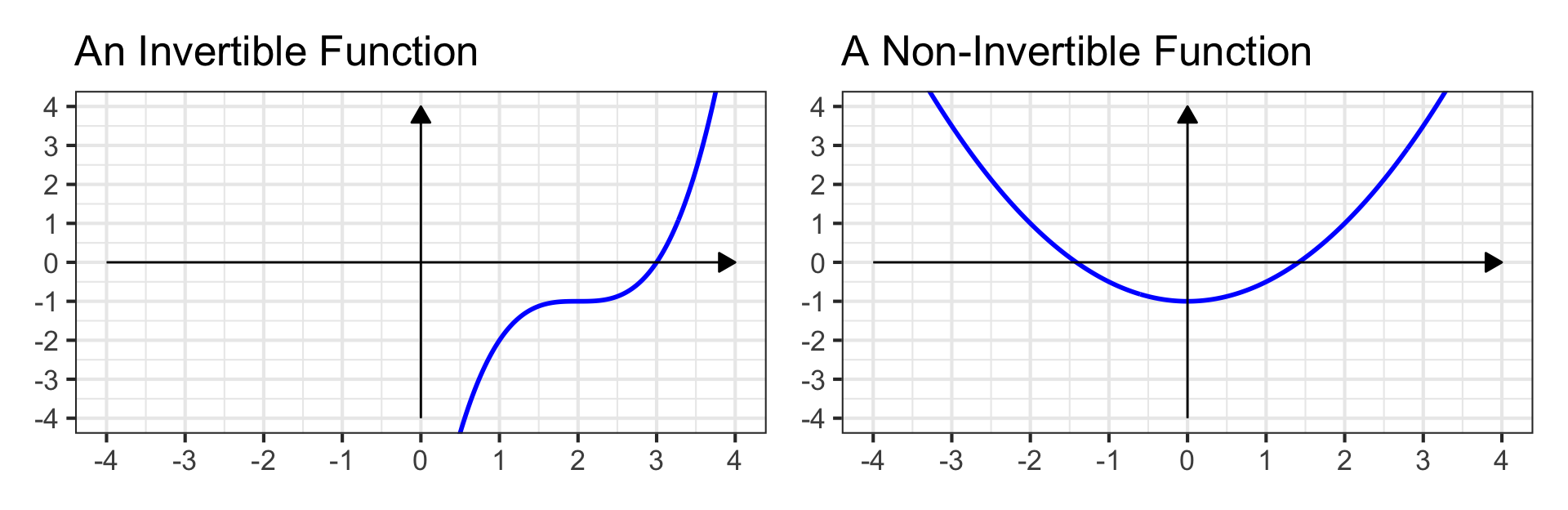
The inverse of a function must itself be a function. That is, the “inverse” must pass the vertical line test.
This means only functions whose graphs pass both the vertical line test and the horizontal line test are invertible.
Definition (Horizontal Line Test): A function is invertible if every horizontal line drawn intersects its graph at most once.
Which Functions Have Inverses?
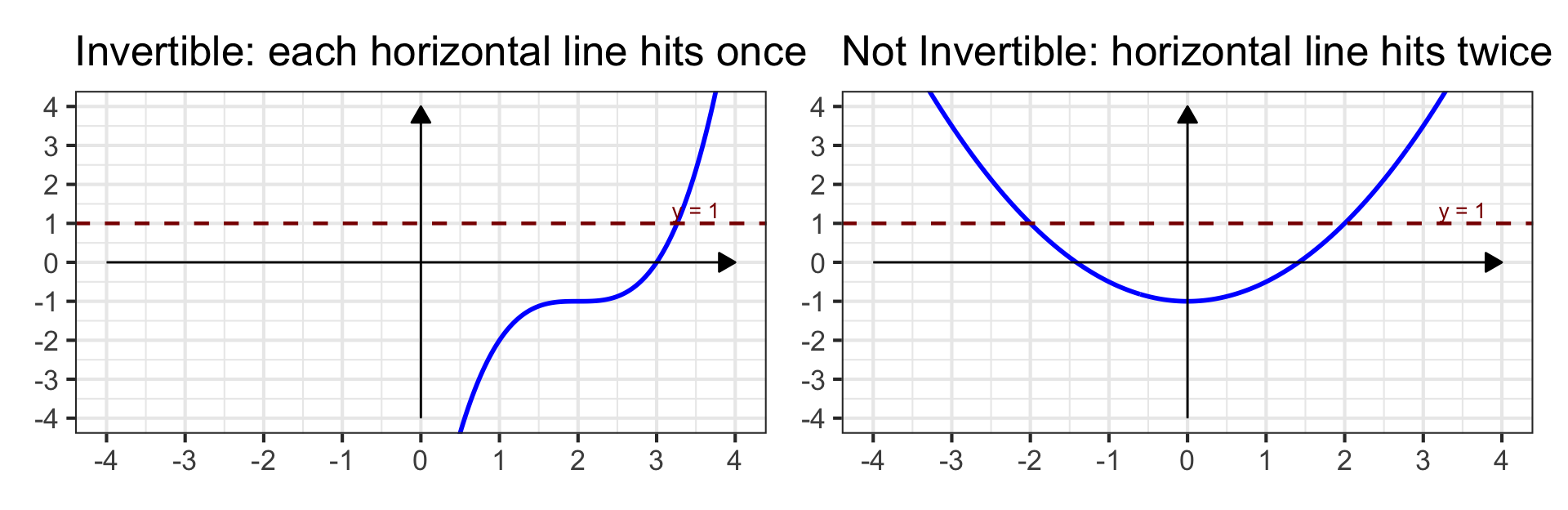
The dashed red line \(y = 1\) intersects the left graph exactly once – that output value corresponds to exactly one input. On the right graph it intersects twice – so the “inverse” would need to assign two outputs to one input, which violates the definition of a function.
Graphs of a Function and Its Inverse
There is a beautiful geometric relationship between a function and its inverse: their graphs are reflections of one another across the line \(y = x\).
We’ll leverage this geometric relationship when we introduce our procedure for finding the inverse of a function next. We’ll literally swap the roles of the \(x\) and \(y\) variables, which is exactly what reflection across \(y = x\) does to a point \(\left(a, b\right)\) by sending it to \(\left(b, a\right)\).
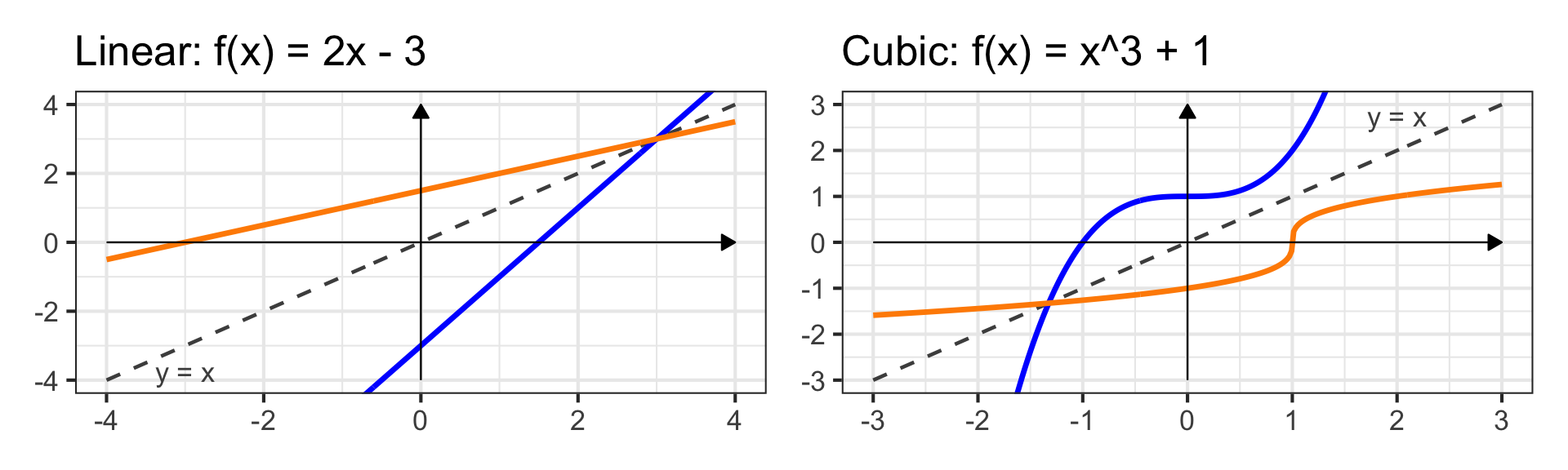
Notice that every point \(\left(a, b\right)\) on \(f\) (blue) has a corresponding point \(\left(b, a\right)\) on \(f^{-1}\) (orange) – and both lie symmetrically on either side of the dashed line \(y = x\).
The Swap-and-Solve Method
Strategy (Swap-and-Solve): To find the inverse of an invertible function \(f\left(x\right)\):
- Replace \(f\left(x\right)\) with \(y\).
- Swap every \(x\) with \(y\) and every \(y\) with \(x\).
- Solve the resulting equation for \(y\), if possible.
- Replace \(y\) with \(f^{-1}\left(x\right)\).
Example: Use the swap-and-solve method to find the inverse of \(f\left(x\right) = 3x + 6\).
Solution.
\[\begin{align} f\left(x\right) &= 3x + 6 \end{align}\]
The Swap-and-Solve Method
Strategy (Swap-and-Solve): To find the inverse of an invertible function \(f\left(x\right)\):
- Replace \(f\left(x\right)\) with \(y\).
- Swap every \(x\) with \(y\) and every \(y\) with \(x\).
- Solve the resulting equation for \(y\), if possible.
- Replace \(y\) with \(f^{-1}\left(x\right)\).
Example: Use the swap-and-solve method to find the inverse of \(f\left(x\right) = 3x + 6\).
Solution.
\[\begin{align} f\left(x\right) &= 3x + 6\\ \implies y &= 3x + 6 \end{align}\]
The Swap-and-Solve Method
Strategy (Swap-and-Solve): To find the inverse of an invertible function \(f\left(x\right)\):
- Replace \(f\left(x\right)\) with \(y\).
- Swap every \(x\) with \(y\) and every \(y\) with \(x\).
- Solve the resulting equation for \(y\), if possible.
- Replace \(y\) with \(f^{-1}\left(x\right)\).
Example: Use the swap-and-solve method to find the inverse of \(f\left(x\right) = 3x + 6\).
Solution.
\[\begin{align} f\left(x\right) &= 3x + 6\\ \implies y &= 3x + 6\\ \stackrel{\text{Swap and Solve}}{\implies} \color{blue}{x} &= 3\color{blue}{y} + 6 \end{align}\]
The Swap-and-Solve Method
Strategy (Swap-and-Solve): To find the inverse of an invertible function \(f\left(x\right)\):
- Replace \(f\left(x\right)\) with \(y\).
- Swap every \(x\) with \(y\) and every \(y\) with \(x\).
- Solve the resulting equation for \(y\), if possible.
- Replace \(y\) with \(f^{-1}\left(x\right)\).
Example: Use the swap-and-solve method to find the inverse of \(f\left(x\right) = 3x + 6\).
Solution.
\[\begin{align} f\left(x\right) &= 3x + 6\\ \implies y &= 3x + 6\\ \stackrel{\text{Swap and Solve}}{\implies} \color{blue}{x} &= 3\color{blue}{y} + 6\\ \implies 3y + 6 &= x \end{align}\]
The Swap-and-Solve Method
Strategy (Swap-and-Solve): To find the inverse of an invertible function \(f\left(x\right)\):
- Replace \(f\left(x\right)\) with \(y\).
- Swap every \(x\) with \(y\) and every \(y\) with \(x\).
- Solve the resulting equation for \(y\), if possible.
- Replace \(y\) with \(f^{-1}\left(x\right)\).
Example: Use the swap-and-solve method to find the inverse of \(f\left(x\right) = 3x + 6\).
Solution.
\[\begin{align} f\left(x\right) &= 3x + 6\\ \implies y &= 3x + 6\\ \stackrel{\text{Swap and Solve}}{\implies} \color{blue}{x} &= 3\color{blue}{y} + 6\\ \implies 3y + 6 &= x\\ \implies 3y &= x - 6 \end{align}\]
The Swap-and-Solve Method
Strategy (Swap-and-Solve): To find the inverse of an invertible function \(f\left(x\right)\):
- Replace \(f\left(x\right)\) with \(y\).
- Swap every \(x\) with \(y\) and every \(y\) with \(x\).
- Solve the resulting equation for \(y\), if possible.
- Replace \(y\) with \(f^{-1}\left(x\right)\).
Example: Use the swap-and-solve method to find the inverse of \(f\left(x\right) = 3x + 6\).
Solution.
\[\begin{align} f\left(x\right) &= 3x + 6\\ \implies y &= 3x + 6\\ \stackrel{\text{Swap and Solve}}{\implies} \color{blue}{x} &= 3\color{blue}{y} + 6\\ \implies 3y + 6 &= x\\ \implies 3y &= x - 6\\ \implies y &= \frac{x - 6}{3} \end{align}\]
So \(\boxed{~\displaystyle{f^{-1}\left(x\right) = \frac{x - 6}{3}}~}\).
Completed Example 4
Example: Use the swap-and-solve method to find the inverse of \(\displaystyle{f\left(x\right) = \frac{2x}{x + 4}}\).
Solution.
\[\begin{align} f\left(x\right) &= \frac{2x}{x + 4} \end{align}\]
Completed Example 4
Example: Use the swap-and-solve method to find the inverse of \(\displaystyle{f\left(x\right) = \frac{2x}{x + 4}}\).
Solution.
\[\begin{align} f\left(x\right) &= \frac{2x}{x + 4}\\ \implies y &= \frac{2x}{x + 4} \end{align}\]
Completed Example 4
Example: Use the swap-and-solve method to find the inverse of \(\displaystyle{f\left(x\right) = \frac{2x}{x + 4}}\).
Solution.
\[\begin{align} f\left(x\right) &= \frac{2x}{x + 4}\\ \implies y &= \frac{2x}{x + 4}\\ \stackrel{\text{Swap x and y}}{\implies} \color{blue}{x} &= \frac{2\color{blue}{y}}{\color{blue}{y} + 4} \end{align}\]
Completed Example 4
Example: Use the swap-and-solve method to find the inverse of \(\displaystyle{f\left(x\right) = \frac{2x}{x + 4}}\).
Solution.
\[\begin{align} f\left(x\right) &= \frac{2x}{x + 4}\\ \implies y &= \frac{2x}{x + 4}\\ \stackrel{\text{Swap x and y}}{\implies} \color{blue}{x} &= \frac{2\color{blue}{y}}{\color{blue}{y} + 4}\\ \implies x\left(y + 4\right) &= 2y \end{align}\]
Completed Example 4
Example: Use the swap-and-solve method to find the inverse of \(\displaystyle{f\left(x\right) = \frac{2x}{x + 4}}\).
Solution.
\[\begin{align} f\left(x\right) &= \frac{2x}{x + 4}\\ \implies y &= \frac{2x}{x + 4}\\ \stackrel{\text{Swap x and y}}{\implies} \color{blue}{x} &= \frac{2\color{blue}{y}}{\color{blue}{y} + 4}\\ \implies x\left(y + 4\right) &= 2y\\ \implies xy + 4x &= 2y \end{align}\]
Completed Example 4
Example: Use the swap-and-solve method to find the inverse of \(\displaystyle{f\left(x\right) = \frac{2x}{x + 4}}\).
Solution.
\[\begin{align} f\left(x\right) &= \frac{2x}{x + 4}\\ \implies y &= \frac{2x}{x + 4}\\ \stackrel{\text{Swap x and y}}{\implies} \color{blue}{x} &= \frac{2\color{blue}{y}}{\color{blue}{y} + 4}\\ \implies x\left(y + 4\right) &= 2y\\ \implies xy + 4x &= 2y\\ \implies xy &= 2y - 4x \end{align}\]
Completed Example 4
Example: Use the swap-and-solve method to find the inverse of \(\displaystyle{f\left(x\right) = \frac{2x}{x + 4}}\).
Solution.
\[\begin{align} f\left(x\right) &= \frac{2x}{x + 4}\\ \implies y &= \frac{2x}{x + 4}\\ \stackrel{\text{Swap x and y}}{\implies} \color{blue}{x} &= \frac{2\color{blue}{y}}{\color{blue}{y} + 4}\\ \implies x\left(y + 4\right) &= 2y\\ \implies xy + 4x &= 2y\\ \implies xy &= 2y - 4x\\ \implies xy - 2y &= -4x \end{align}\]
Completed Example 4
Example: Use the swap-and-solve method to find the inverse of \(\displaystyle{f\left(x\right) = \frac{2x}{x + 4}}\).
Solution.
\[\begin{align} f\left(x\right) &= \frac{2x}{x + 4}\\ \implies y &= \frac{2x}{x + 4}\\ \stackrel{\text{Swap x and y}}{\implies} \color{blue}{x} &= \frac{2\color{blue}{y}}{\color{blue}{y} + 4}\\ \implies x\left(y + 4\right) &= 2y\\ \implies xy + 4x &= 2y\\ \implies xy &= 2y - 4x\\ \implies xy - 2y &= -4x\\ \implies y\left(x - 2\right) &= -4x \end{align}\]
Completed Example 4
Example: Use the swap-and-solve method to find the inverse of \(\displaystyle{f\left(x\right) = \frac{2x}{x + 4}}\).
Solution.
\[\begin{align} f\left(x\right) &= \frac{2x}{x + 4}\\ \implies y &= \frac{2x}{x + 4}\\ \stackrel{\text{Swap x and y}}{\implies} \color{blue}{x} &= \frac{2\color{blue}{y}}{\color{blue}{y} + 4}\\ \implies x\left(y + 4\right) &= 2y\\ \implies xy + 4x &= 2y\\ \implies xy &= 2y - 4x\\ \implies xy - 2y &= -4x\\ \implies y\left(x - 2\right) &= -4x\\ \implies y &= \frac{-4x}{x - 2} \end{align}\]
So \(\boxed{~\displaystyle{f^{-1}\left(x\right) = \frac{-4x}{x - 2}}~}\).
Finding Inverses Algebraically Practice
Try It! 3: Use the swap-and-solve method to find \(g^{-1}\left(x\right)\) if \(\displaystyle{g\left(x\right) = \frac{x - 3}{9}}\).
Try It! 4: Use the swap-and-solve method to find \(h^{-1}\left(x\right)\) if \(\displaystyle{h\left(x\right) = \frac{2x - 5}{x + 2}}\).
Applied Problem
Problem: To convert \(x\) degrees Celsius to \(y\) degrees Fahrenheit, we use
\[f\left(x\right) = \frac{9}{5}x + 32\]
Find \(f^{-1}\left(x\right)\), if it exists, and explain what it means.
Solution.
\[\begin{align} f\left(x\right) &= \frac{9}{5}x + 32 \end{align}\]
Applied Problem
Problem: To convert \(x\) degrees Celsius to \(y\) degrees Fahrenheit, we use
\[f\left(x\right) = \frac{9}{5}x + 32\]
Find \(f^{-1}\left(x\right)\), if it exists, and explain what it means.
Solution.
\[\begin{align} f\left(x\right) &= \frac{9}{5}x + 32\\ \implies y &= \frac{9}{5}x + 32 \end{align}\]
Applied Problem
Problem: To convert \(x\) degrees Celsius to \(y\) degrees Fahrenheit, we use
\[f\left(x\right) = \frac{9}{5}x + 32\]
Find \(f^{-1}\left(x\right)\), if it exists, and explain what it means.
Solution.
\[\begin{align} f\left(x\right) &= \frac{9}{5}x + 32\\ \implies y &= \frac{9}{5}x + 32\\ \stackrel{\text{Swap x and y}}{\implies} \color{blue}{x} &= \frac{9}{5}\color{blue}{y} + 32 \end{align}\]
Applied Problem
Problem: To convert \(x\) degrees Celsius to \(y\) degrees Fahrenheit, we use
\[f\left(x\right) = \frac{9}{5}x + 32\]
Find \(f^{-1}\left(x\right)\), if it exists, and explain what it means.
Solution.
\[\begin{align} f\left(x\right) &= \frac{9}{5}x + 32\\ \implies y &= \frac{9}{5}x + 32\\ \stackrel{\text{Swap x and y}}{\implies} \color{blue}{x} &= \frac{9}{5}\color{blue}{y} + 32\\ \implies \frac{9}{5}y + 32 &= x \end{align}\]
Applied Problem
Problem: To convert \(x\) degrees Celsius to \(y\) degrees Fahrenheit, we use
\[f\left(x\right) = \frac{9}{5}x + 32\]
Find \(f^{-1}\left(x\right)\), if it exists, and explain what it means.
Solution.
\[\begin{align} f\left(x\right) &= \frac{9}{5}x + 32\\ \implies y &= \frac{9}{5}x + 32\\ \stackrel{\text{Swap x and y}}{\implies} \color{blue}{x} &= \frac{9}{5}\color{blue}{y} + 32\\ \implies \frac{9}{5}y + 32 &= x\\ \implies \frac{9}{5}y &= x - 32 \end{align}\]
Applied Problem
Problem: To convert \(x\) degrees Celsius to \(y\) degrees Fahrenheit, we use
\[f\left(x\right) = \frac{9}{5}x + 32\]
Find \(f^{-1}\left(x\right)\), if it exists, and explain what it means.
Solution.
\[\begin{align} f\left(x\right) &= \frac{9}{5}x + 32\\ \implies y &= \frac{9}{5}x + 32\\ \stackrel{\text{Swap x and y}}{\implies} \color{blue}{x} &= \frac{9}{5}\color{blue}{y} + 32\\ \implies \frac{9}{5}y + 32 &= x\\ \implies \frac{9}{5}y &= x - 32\\ \implies y &= \frac{5}{9}\left(x - 32\right) \end{align}\]
Interpretation: \(f^{-1}\left(x\right)\) converts \(x\) degrees Fahrenheit back to degrees Celsius. For example, \(f^{-1}\left(212\right) = \frac{5}{9}\left(212 - 32\right) = \frac{5}{9}\left(180\right) = 100\) degrees Celsius – the boiling point of water, as expected.
This also answers our motivating questions from the start of class: since \(f\left(0\right) = 32\), we have \(f^{-1}\left(32\right) = 0\) – freezing point in Fahrenheit corresponds to \(0°C\). And solving \(f\left(c\right) = 40\) gives the Celsius temperature that corresponds to \(40°F\).
Exit Ticket Task
Navigate to our MAT142 Exit Ticket Form, answer the questions, and complete the task below.
Note. Today’s discussion is listed as 7. Inverses of Functions

Task: Use the swap-and-solve method to find the inverse of \(\displaystyle{f\left(x\right) = 4x - 8}\). Then verify your answer by checking that \(f\left(f^{-1}\left(x\right)\right) = x\).
Summary and Next Time…
- \(f\) and \(g\) are inverses if \(f\left(g\left(x\right)\right) = x\) and \(g\left(f\left(x\right)\right) = x\).
- Check invertibility using the horizontal line test – each output value must correspond to exactly one input.
- Use swap-and-solve to find \(f^{-1}\): replace \(f\left(x\right)\) with \(y\), swap \(x\) and \(y\), solve for \(y\).
- \(f^{-1}\left(x\right)\) means the inverse of \(f\), not \(\frac{1}{f\left(x\right)}\).
- Inverse functions arise naturally whenever we need to reverse a process – like converting units back to their original form.
- Inverse functions will appear throughout the rest of the course. For every function class we study, we will ask whether and how to invert functions of that class.
- You have all the tools you need to find inverses of linear, polynomial, and rational functions at this time. Some classes of function will require special inverses though.
- The inverse of an exponential function is a logarithm and the inverse of a trigonometric function requires special inverse-trigonometric functions, for example.
Linear Functions and Linear Equations
Complete Homework 5 on MyOpenMath