MAT 142: Book Functions, Transformations, and Landmarks

Dr. Gilbert

June 2, 2026

Reminders

Welcome back from Exam I!

Over those first few weeks of our course, we focused on truly foundational items.

  • Shoring up our algebra background
  • Interval notation
  • Domain and range
  • Composition of functions

We also encountered the notion of the limit, which will be a foundational tool in Calculus as well as one we work to become comfortable with here in PreCalculus.

We’ll continue with a few more foundational topics before moving into exploring specific function classes for the remainder of our semester.

Try the following warm-up problems to get your algebra legs back.

Problem 1: Consider \(f\left(x\right) = x^2\). Find each of the following.

  • \(f\left(3\right)\)
  • \(f\left(4\right) - 6\)
  • \(2 \cdot f\left(3\right) + 1\)
  • \(f\left(2x\right)\)
  • \(f\left(x - h\right)\)
  • \(f\left(x - h\right) + k\)

Motivating Application

A chemist is running an experiment with a theoretical model \(f\left(t\right)\) measuring the expected temperature (°C) of a liquid at time \(t\) (minutes) into a reaction.

They start a second reaction 5 minutes later. In this second reaction, the temperature at any given time into the reaction is expected to be triple the temperature in the original reaction at that same elapsed time.

Construct a function related to \(f\left(t\right)\) which models the temperature of the second reaction at \(t\) minutes after the start of the initial reaction.

Before we work through this, consider the following:

  • What is the practical domain of \(f\left(t\right)\)?
  • What is the practical domain of the function you are constructing?
  • How do you expect the shape of the new function to relate to the shape of \(f\left(t\right)\)?

We’ll return to this application at the end of today’s class.

Objectives

Today has two connected halves.

First half – Book Functions and Transformations:

  • Store mental images of the graphs of several foundational function classes.
  • Develop the notions of vertical and horizontal shifts, stretches, compressions, and reflections.
  • Combine several transformations to construct graphs of more general functions.

Second half – Landmarks on Graphs:

  • Identify roots (\(x\)-intercepts) and the \(y\)-intercept from a graph.
  • Identify local minima and maxima.
  • Identify intervals of increase, decrease, and constancy.

While this second half consists of things we’ve seen/done earlier this semester, we’ll bring it all back as a refresher.

Book Functions

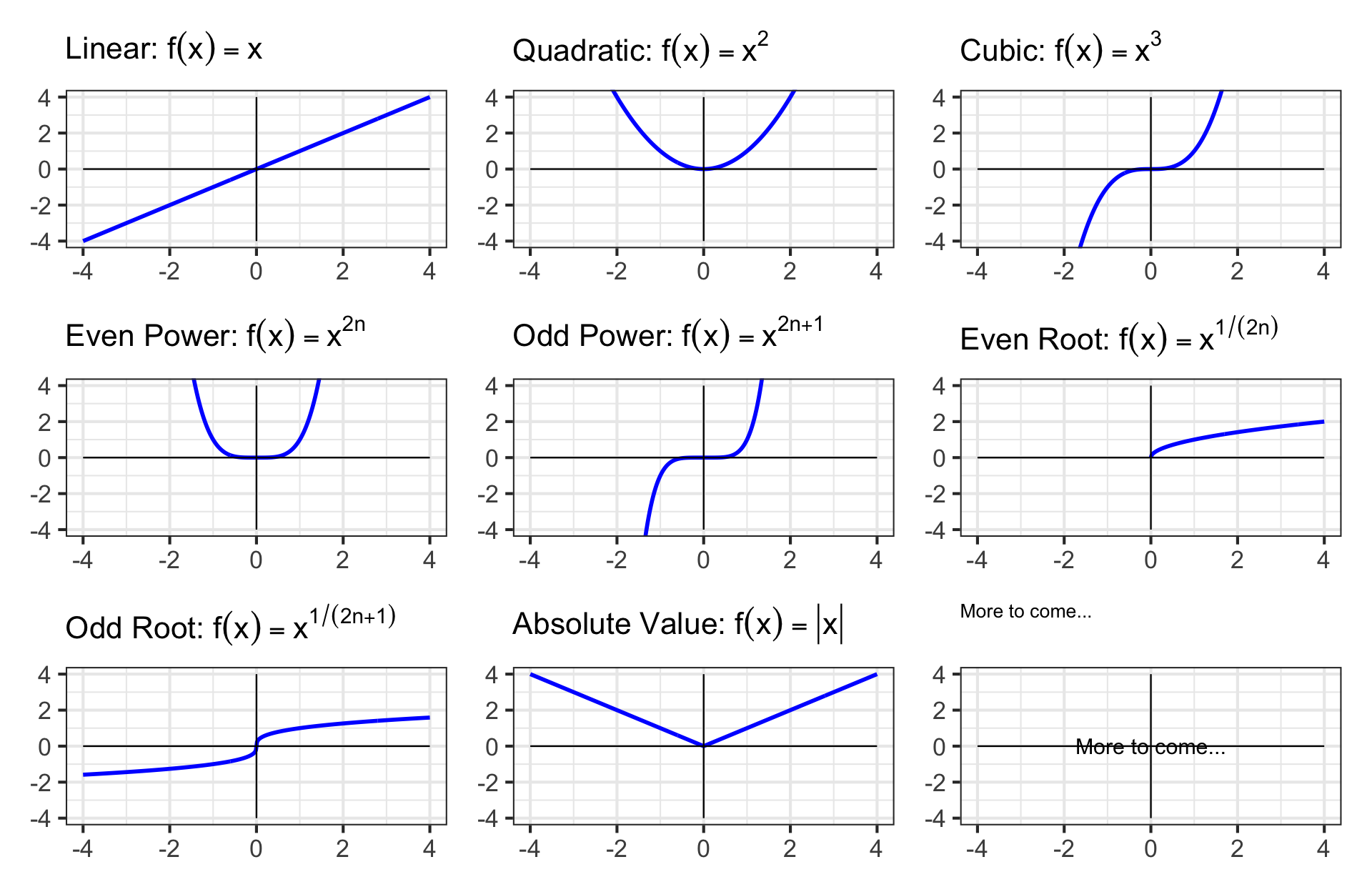
As we explore functions in greater depth, it is helpful to have the general shape of a function’s graph committed to memory.

We’ll refer to these foundational functions as book functions – they are the basic building blocks from which more general functions are constructed.

The graphs of our current book functions appear on the next slide. You should commit these shapes to memory. We will add to this list later in the course.

Book Functions

Book Functions – Patterns to Notice

  • Any linear function has a graph that is a straight line.
  • Any power function with even exponent (\(x^{2n}\)) has a “U”-shaped graph, symmetric about the \(y\)-axis.
  • Any power function with odd exponent (\(x^{2n+1}\)) has an elongated shape similar to \(f\left(x\right) = x^3\), symmetric about the origin.
  • Any even root function (\(x^{1/(2n)}\)) has domain \(\left[0, \infty\right)\) and a “half-bowl” shape.
  • Any odd root function (\(x^{1/(2n+1)}\)) has an elongated “S”-shape defined on all of \(\mathbb{R}\).
  • The absolute value function has a “V”-shape with vertex at the origin.

This knowledge gives us great leverage in understanding the shapes of more general functions via transformations.

Transformations of Functions

We can modify a book function in four fundamental ways:

  • Vertical shift: move the graph up or down
  • Horizontal shift: move the graph left or right
  • Vertical stretch/compression/reflection: make the graph taller/shorter, or flip it over the \(x\)-axis
  • Horizontal stretch/compression/reflection: speed up or slow down the function, or flip it over the \(y\)-axis

We’ll use \(f\left(x\right) = x^3\) as our running example throughout.

Vertical Shifts

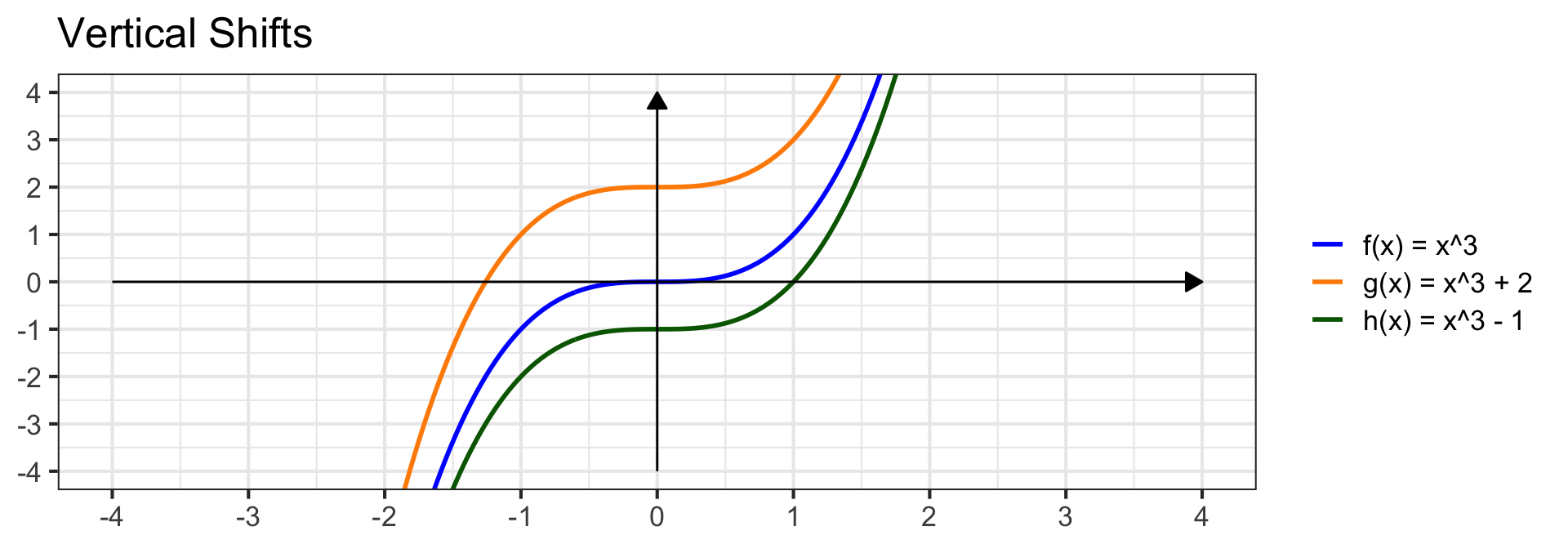
Definition (Vertical Shift): If \(g\left(x\right) = f\left(x\right) + k\), then the graph of \(g\) is the graph of \(f\) shifted up by \(k\) units (or down if \(k < 0\)).

Completed Example 1: Consider \(f\left(x\right) = x^3\), \(g\left(x\right) = x^3 + 2\), and \(h\left(x\right) = x^3 - 1\).

An interactive version of this plot is available on Desmos.
Horizontal Shifts

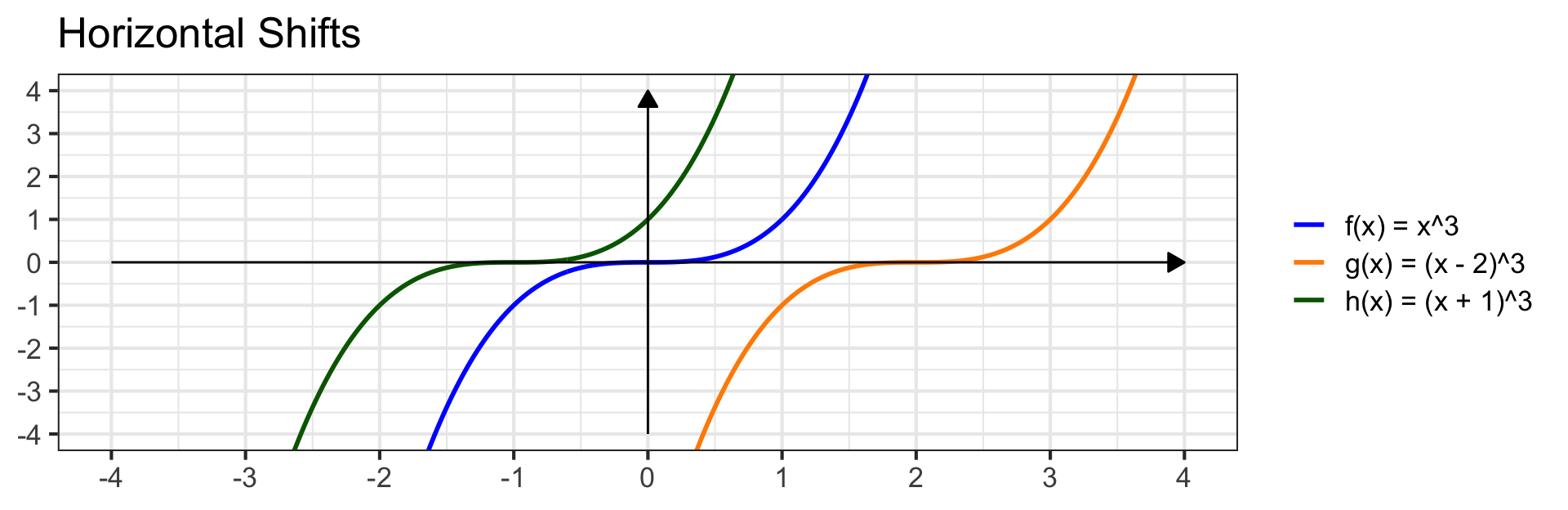
Definition (Horizontal Shift): If \(g\left(x\right) = f\left(x - h\right)\), then the graph of \(g\) is the graph of \(f\) shifted right by \(h\) units (or left if \(h < 0\)).

Horizontal Shifts are Counter-Intuitive

This is counterintuitive – subtracting inside the argument shifts right, adding shifts left.

Completed Example 2: Consider \(f\left(x\right) = x^3\), \(g\left(x\right) = \left(x - 2\right)^3\), and \(h\left(x\right) = \left(x + 1\right)^3\).

An interactive version is available on Desmos.
Vertical Stretches, Compressions, and Reflections

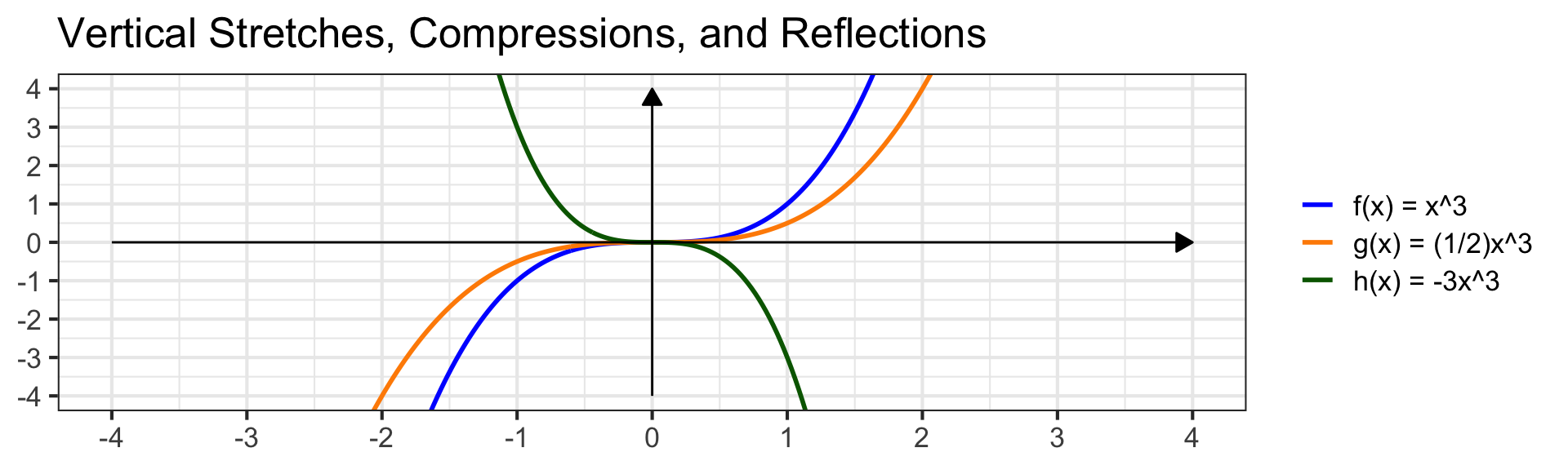
Definition (Vertical Stretch): If \(g\left(x\right) = a \cdot f\left(x\right)\), then:

  • If \(a > 1\): graph is stretched taller and narrower by factor \(a\).
  • If \(0 < a < 1\): graph is compressed shorter and wider by factor \(a\).
  • If \(a < 0\): graph is reflected over the \(x\)-axis, then stretched/compressed by \(\left|a\right|\).

Completed Example 3: Consider \(f\left(x\right) = x^3\), \(\displaystyle{g\left(x\right) = \frac{1}{2}x^3}\), and \(h\left(x\right) = -3x^3\).

An interactive version is available on Desmos.
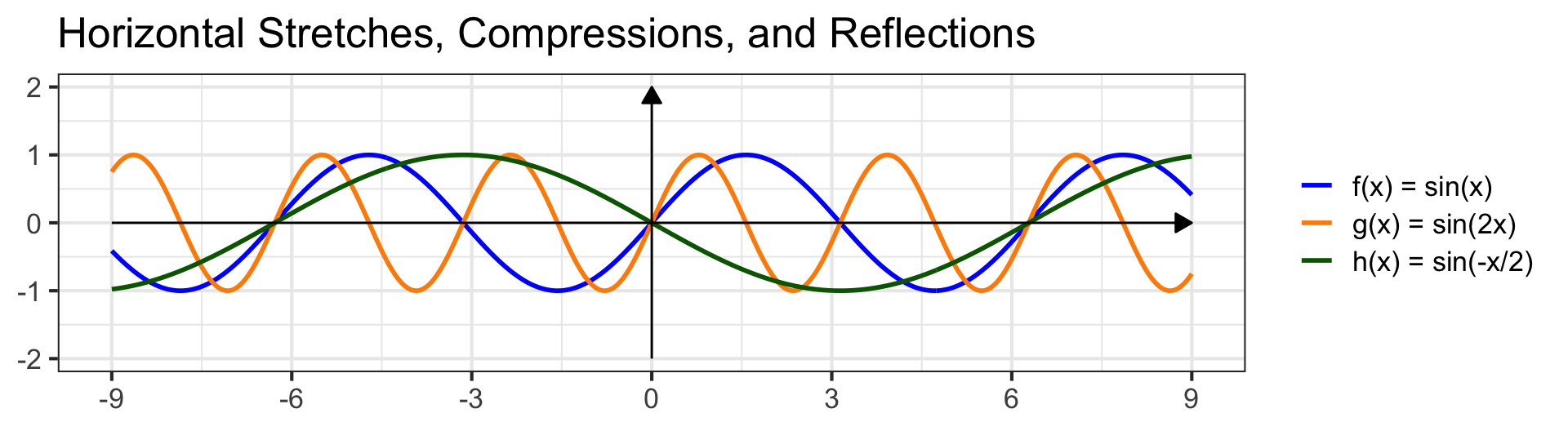
Horizontal Stretches, Compressions, and Reflections

Definition (Horizontal Stretch): If \(g\left(x\right) = f\left(b \cdot x\right)\), then:

  • If \(b > 1\): graph is compressed horizontally (the function “speeds up”).
  • If \(0 < b < 1\): graph is stretched horizontally (the function “slows down”).
  • If \(b < 0\): graph is reflected over the \(y\)-axis, then stretched/compressed by \(\left|b\right|\).

Completed Example 4: We use \(f\left(x\right) = \sin\left(x\right)\) as the base function here since the horizontal effects are easier to see. Compare \(g\left(x\right) = \sin\left(2x\right)\) and \(h\left(x\right) = \sin\!\left(-\frac{1}{2}x\right)\).

An interactive version is available on Desmos.
Putting It All Together

We aren’t restricted to a single transformation at a time. We can combine transformations. The order in which they are applied follows the order of operations.

Completed Example 5: Use transformations to plot \(g\left(x\right) = -2\left(x + 3\right)^2 + 4\).

Solution. Compare to the book function \(f\left(x\right) = x^2\). The transformations occur in this order:

  1. Shift left by \(3\) units: \(f\left(x + 3\right) = \left(x + 3\right)^2\)
  2. Reflect over \(x\)-axis and stretch vertically by \(2\): \(-2\left(x + 3\right)^2\)
  3. Shift up by \(4\) units: \(g\left(x\right) = -2\left(x + 3\right)^2 + 4\)
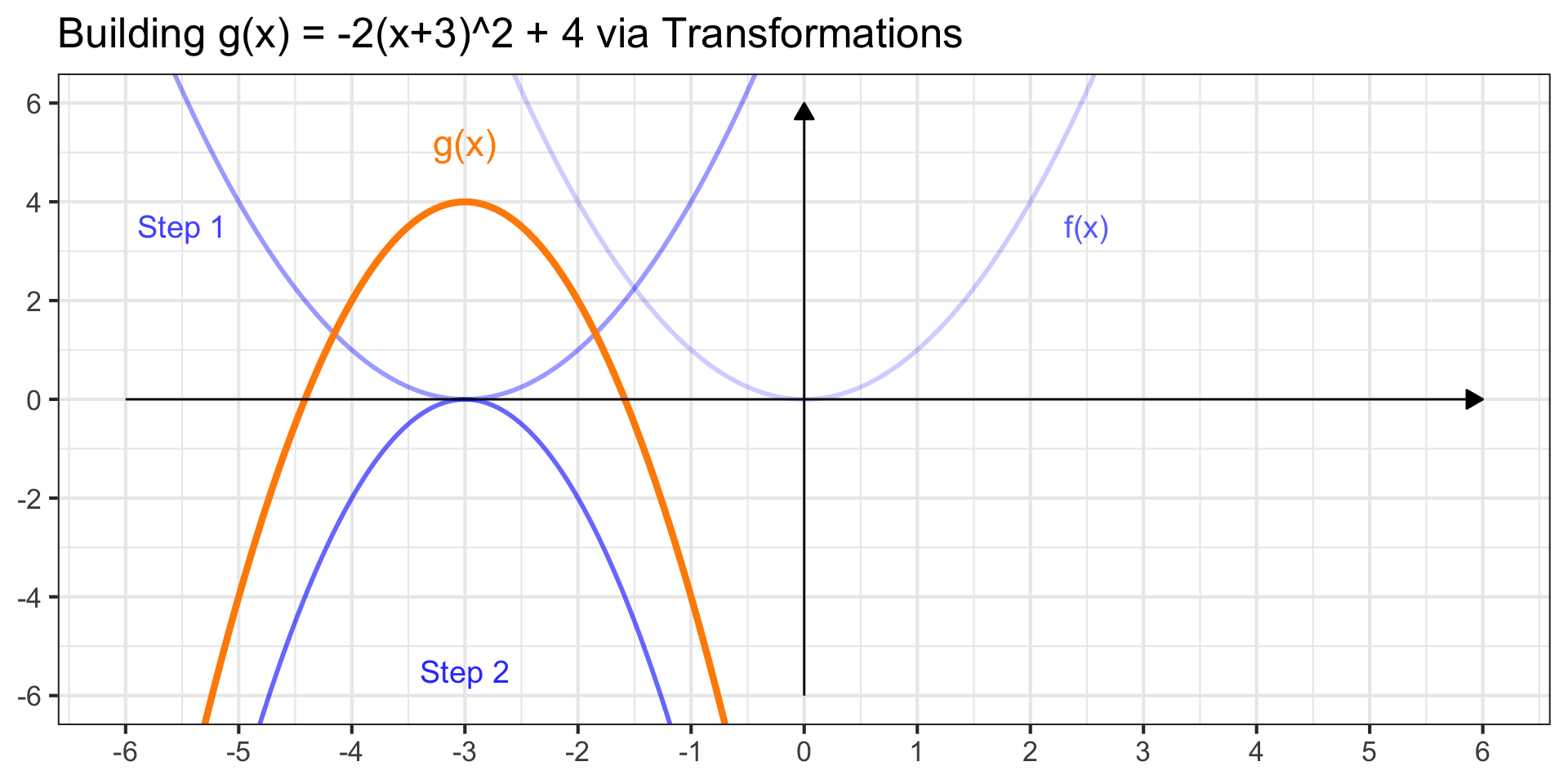
The faded blue curves show the intermediate stages. The final function \(g\left(x\right)\) is in orange. Notice the vertex is now at \(\left(-3, 4\right)\).

Important

Order of operations determines the way in which the transformations are applied. That order matters.

Transformations Practice

Try It! 1: Use your knowledge of transformations to sketch the graph of \(\displaystyle{g\left(x\right) = 5\sqrt{\left(x + 4\right)} + 2}\).

Identify the book function, describe each transformation in order, and sketch the result.

Try It! 2: Construct a function \(g\left(x\right)\) whose graph looks like \(f\left(x\right) = x^{1/3}\), but:

  • Shifted right by \(2\) units
  • Compressed vertically by a factor of \(\displaystyle{\frac{1}{4}}\)
  • Shifted down by \(5\) units

Provide both the algebraic definition of \(g\left(x\right)\) and sketch an approximate graph.

Landmarks on Graphs of Functions

We’ve seen function landmarks before (Day 3), but we’ll revisit them here since they now have a richer context with transformations in mind.

For any function, we want to be able to identify:

  • Roots (\(x\)-intercepts): inputs where \(f\left(x\right) = 0\)
  • \(y\)-intercept: the point \(\left(0, f\left(0\right)\right)\)
  • Local maxima: peaks where the function transitions from increasing to decreasing
  • Local minima: valleys where the function transitions from decreasing to increasing
  • Intervals of increase/decrease: where the graph is rising or falling (left to right)

Completed Example 6

Problem: Find the roots, \(y\)-intercept, local maxima and minima, and intervals of increase and decrease for \(f\left(x\right)\).
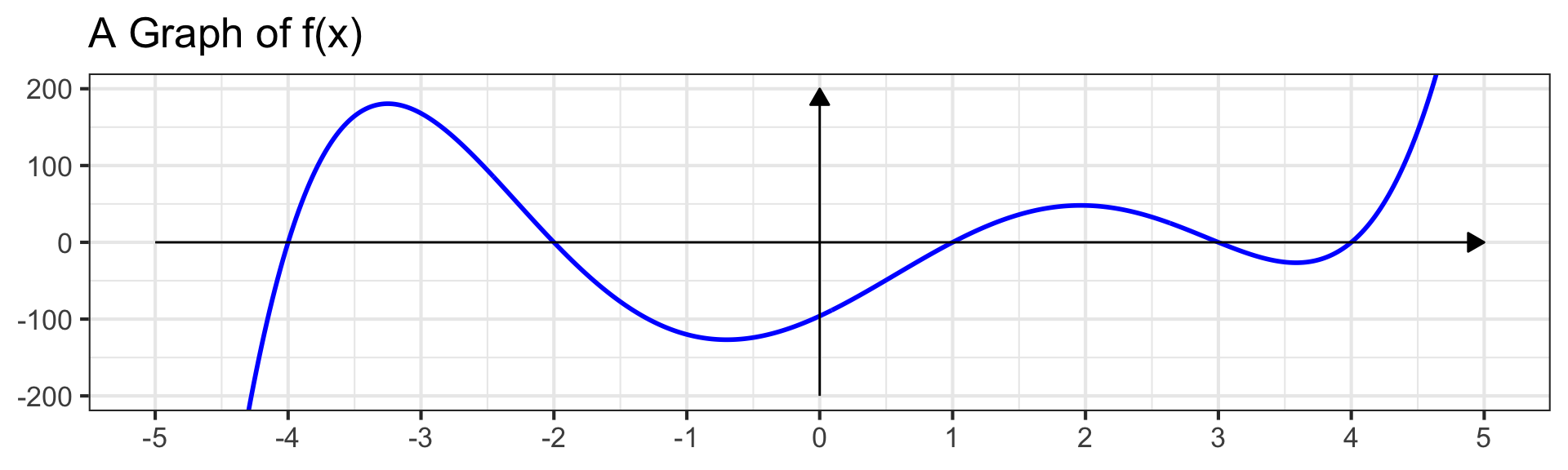
Completed Example 6

Problem: Find the roots, \(y\)-intercept, local maxima and minima, and intervals of increase and decrease for \(f\left(x\right)\).
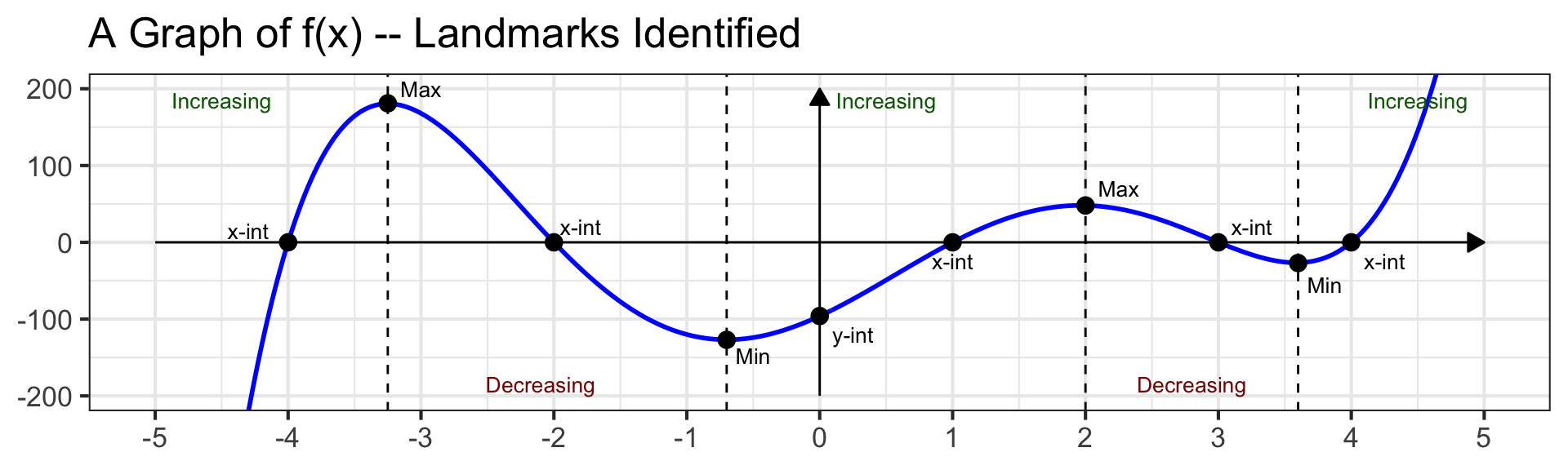
Solution. By inspecting the annotated graph (approximations, not exact values):

  • Roots: \(\left(-4, 0\right)\), \(\left(-2, 0\right)\), \(\left(1, 0\right)\), \(\left(3, 0\right)\), \(\left(4, 0\right)\)
  • \(y\)-intercept: \(\left(0, -96\right)\)
  • Increasing on approximately \(\left(-\infty, -3.25\right)\cup\left(-0.75, 2\right)\cup\left(3.6, \infty\right)\)
  • Decreasing on approximately \(\left(-3.25, -0.75\right)\cup\left(2, 3.6\right)\)
  • Local maxima near \(\left(-3.25, 181\right)\) and \(\left(2, 48\right)\)
  • Local minima near \(\left(-0.75, -127\right)\) and \(\left(3.6, -27\right)\)

Motivating Application – Revisited

Problem: A chemist has model \(f\left(t\right)\) for a reaction’s temperature. A second reaction starts 5 minutes later, and its temperature is expected to be triple the first reaction’s temperature at each time point into the reaction.

Construct a function modeling the second reaction’s temperature at time \(t\) minutes after the start of the first reaction.

Solution. We need two transformations applied to \(f\):

  1. The second reaction starts 5 minutes later, so we shift right by 5: the time into the second reaction at clock-time \(t\) is \(t - 5\), giving \(f\left(t - 5\right)\).
  2. The temperature is triple at each time point, so we stretch vertically by \(3\), resulting in \(3f\left(t - 5\right)\).

\[\boxed{~g\left(t\right) = 3f\left(t - 5\right)~}\]

The practical domain is \(t \geq 5\), and the shape of \(g\) is the same as \(f\), just shifted right and stretched vertically.

Exit Ticket Task

Navigate to our MAT142 Exit Ticket Form, answer the questions, and complete the task below.


Note. Today’s discussion is listed as 6. Graphing: Book Functions and Transformations

Task: Describe the transformations applied to the book function \(f\left(x\right) = \sqrt{x}\) to obtain \(g\left(x\right) = -3\sqrt{\left(x - 2\right)} + 1\). List them in order and describe the effect of each on the graph.

Summary and Next Time…

Ideas From Today
  • Book functions are foundational shapes to memorize: linear, quadratic, cubic, even/odd powers, even/odd roots, and absolute value.
  • \(f\left(x\right) + k\): vertical shift up by \(k\)
  • \(f\left(x - h\right)\): horizontal shift right by \(h\)
  • \(a \cdot f\left(x\right)\): vertical stretch (\(a > 1\)), compression (\(0 < a < 1\)), or reflection (\(a < 0\))
  • \(f\left(b \cdot x\right)\): horizontal compression (\(b > 1\)), stretch (\(0 < b < 1\)), or reflection (\(b < 0\))
  • Transformations combine following the order of operations.
  • Landmarks: roots, \(y\)-intercept, local maxima/minima, intervals of increase/decrease.
Next Time:
Inverse Functions
Homework:
Start Homework 5 on MyOpenMath