MAT 142: Composition of Functions

Dr. Gilbert

June 2, 2026

Reminders

At our last meeting, we discussed each of the following:

  • The limit of a function as a generalization of function evaluation.
  • Reading limits from a graph, including one-sided limits.
  • Evaluating limits algebraically via direct substitution and the factor-and-reduce technique, when possible.
  • The slope of the secant line as an average rate of change.
  • The derivative as the limit of the difference quotient.

Try the following warm-up problems.

Problem 1: Consider \(f\left(x\right) = 8 - x^2\). Find \(f\left(0\right)\), \(f\left(5\right)\), \(f\left(-2\right)\), \(f\left(x + h\right)\), and \(f\left(x^2 - 5\right)\).


Problem 2: Consider \(\displaystyle{g\left(x\right) = \frac{x^2 + x}{x + 1}}\). Find \(g\left(0\right)\), \(g\left(5\right)\), \(g\left(-2\right)\), \(g\left(x + h\right)\), and \(g\left(2 - x\right)\).

Motivating Application

A forest fire leaves behind an area of burned grass in an expanding circular pattern. The radius of the circle is increasing with time according to

\[r\left(t\right) = 2t + 1\]

where \(t\) is in minutes and \(r\) is in feet.

Express the area burned as a function of time \(t\). Find the total area burned after 10 minutes.

Before we work through this, consider the following:

  • What is the formula for the burned area in terms of the radius?
  • Is the radius truly the independent variable for the area function?
  • What is the radius of the burn after 5 minutes? What is the area burned at that point?

We’ll return to this application at the end of today’s class.

Objectives

Today we introduce a powerful new way to combine functions.

After today’s class meeting, you should be able to:

  • Understand what it means to compose two functions.
  • Construct the algebraic definition of a composed function \(\left(f \circ g\right)\left(x\right)\).
  • Evaluate a composed function at a given input value.
  • Read composed function values from graphs.
  • Recognize when composition arises naturally in applied settings.

Composition of Functions

Definition (Composition of Functions): Given two functions \(f\left(x\right)\) and \(g\left(x\right)\), as long as the range of \(g\) is a subset of the domain of \(f\), we define the composition of \(f\) and \(g\) as:

\[\left(f \circ g\right)\left(x\right) = f\left(g\left(x\right)\right)\]

The input \(x\) is first transformed by \(g\), and then the output of \(g\) becomes the input for \(f\).

Think of it as a two-stage machine:

\[x \longrightarrow \boxed{~~g~~} \longrightarrow g\left(x\right) \longrightarrow \boxed{~~f~~} \longrightarrow f\left(g\left(x\right)\right)\]

Order of Composition Matters

Order matters. \(\left(f \circ g\right)\left(x\right)\) and \(\left(g \circ f\right)\left(x\right)\) are generally not equal – applying \(g\) first then \(f\) is different from applying \(f\) first then \(g\).

Completed Example 1

Problem: Consider \(f\left(x\right) = x + 4\) and \(g\left(x\right) = x^2\).

\(\left(a\right)\) Determine \(\left(f \circ g\right)\left(-7\right)\) by first computing \(g\left(-7\right)\), then using the result as the input to \(f\).

\(\left(b\right)\) Find the algebraic definition of \(\left(f \circ g\right)\left(x\right)\) by simplifying \(f\left(g\left(x\right)\right)\), then evaluate \(\left(f \circ g\right)\left(-7\right)\) directly.

Solution to \(\left(a\right)\). First, evaluate \(g\) at \(-7\):

\[\begin{align} g\left(-7\right) &= \left(-7\right)^2 = 49 \end{align}\]

Now use \(49\) as the input to \(f\):

\[\begin{align} f\left(49\right) &= 49 + 4 = \boxed{~53~} \end{align}\]

Completed Example 1 (Cont’d)

Problem: Consider \(f\left(x\right) = x + 4\) and \(g\left(x\right) = x^2\). Find \(\left(f \circ g\right)\left(x\right)\) algebraically, then evaluate at \(x = -7\).

Solution to \(\left(b\right)\). Substitute \(g\left(x\right)\) in place of every \(x\) in \(f\left(x\right)\):

\[\begin{align} \left(f \circ g\right)\left(x\right) &= f\left(g\left(x\right)\right) \end{align}\]

Completed Example 1 (Cont’d)

Problem: Consider \(f\left(x\right) = x + 4\) and \(g\left(x\right) = x^2\). Find \(\left(f \circ g\right)\left(x\right)\) algebraically, then evaluate at \(x = -7\).

Solution to \(\left(b\right)\). Substitute \(g\left(x\right)\) in place of every \(x\) in \(f\left(x\right)\):

\[\begin{align} \left(f \circ g\right)\left(x\right) &= f\left(g\left(x\right)\right)\\ &= f\left(x^2\right) \end{align}\]

Completed Example 1 (Cont’d)

Problem: Consider \(f\left(x\right) = x + 4\) and \(g\left(x\right) = x^2\). Find \(\left(f \circ g\right)\left(x\right)\) algebraically, then evaluate at \(x = -7\).

Solution to \(\left(b\right)\). Substitute \(g\left(x\right)\) in place of every \(x\) in \(f\left(x\right)\):

\[\begin{align} \left(f \circ g\right)\left(x\right) &= f\left(g\left(x\right)\right)\\ &= f\left(x^2\right)\\ &= x^2 + 4 \end{align}\]

Completed Example 1 (Cont’d)

Problem: Consider \(f\left(x\right) = x + 4\) and \(g\left(x\right) = x^2\). Find \(\left(f \circ g\right)\left(x\right)\) algebraically, then evaluate at \(x = -7\).

Solution to \(\left(b\right)\). Substitute \(g\left(x\right)\) in place of every \(x\) in \(f\left(x\right)\):

\[\begin{align} \left(f \circ g\right)\left(x\right) &= f\left(g\left(x\right)\right)\\ &= f\left(x^2\right)\\ &= x^2 + 4 \end{align}\]

Now evaluate at \(x = -7\):

\[\begin{align} \left(f \circ g\right)\left(-7\right) &= \left(-7\right)^2 + 4 = 49 + 4 = \boxed{~53~} \end{align}\]

Both methods give the same result – this will always be the case.

Composition of Functions Practice I

Try It! 1: Using the same functions \(f\left(x\right) = x + 4\) and \(g\left(x\right) = x^2\), evaluate \(\left(g \circ f\right)\left(-7\right)\) using both methods.

What do you notice? What does this tell us about the order in which we compose functions?

Reminder for method 1: Start by evaluating \(f\left(-7\right)\), then use that result as the input to \(g\).

Reminder for method 2: Find \(\left(g \circ f\right)\left(x\right) = g\left(f\left(x\right)\right)\) algebraically first, then plug in \(-7\).

Completed Example 2

Problem: Consider \(\displaystyle{f\left(x\right) = \frac{x}{x - 5}}\) and \(g\left(x\right) = x^2 - 5\).

Construct \(\left(f \circ g\right)\left(x\right)\) and evaluate it at \(x = 0\), \(x = 5\), and \(x = \sqrt{5}\).

Solution. We substitute \(g\left(x\right)\) into \(f\):

\[\begin{align} \left(f \circ g\right)\left(x\right) &= f\left(g\left(x\right)\right) \end{align}\]

Completed Example 2

Problem: Consider \(\displaystyle{f\left(x\right) = \frac{x}{x - 5}}\) and \(g\left(x\right) = x^2 - 5\).

Construct \(\left(f \circ g\right)\left(x\right)\) and evaluate it at \(x = 0\), \(x = 5\), and \(x = \sqrt{5}\).

Solution. We substitute \(g\left(x\right)\) into \(f\):

\[\begin{align} \left(f \circ g\right)\left(x\right) &= f\left(g\left(x\right)\right)\\ &= f\left(x^2 - 5\right) \end{align}\]

Completed Example 2

Problem: Consider \(\displaystyle{f\left(x\right) = \frac{x}{x - 5}}\) and \(g\left(x\right) = x^2 - 5\).

Construct \(\left(f \circ g\right)\left(x\right)\) and evaluate it at \(x = 0\), \(x = 5\), and \(x = \sqrt{5}\).

Solution. We substitute \(g\left(x\right)\) into \(f\):

\[\begin{align} \left(f \circ g\right)\left(x\right) &= f\left(g\left(x\right)\right)\\ &= f\left(x^2 - 5\right)\\ &= \frac{x^2 - 5}{\left(x^2 - 5\right) - 5} \end{align}\]

Completed Example 2

Problem: Consider \(\displaystyle{f\left(x\right) = \frac{x}{x - 5}}\) and \(g\left(x\right) = x^2 - 5\).

Construct \(\left(f \circ g\right)\left(x\right)\) and evaluate it at \(x = 0\), \(x = 5\), and \(x = \sqrt{5}\).

Solution. We substitute \(g\left(x\right)\) into \(f\):

\[\begin{align} \left(f \circ g\right)\left(x\right) &= f\left(g\left(x\right)\right)\\ &= f\left(x^2 - 5\right)\\ &= \frac{x^2 - 5}{\left(x^2 - 5\right) - 5}\\ &= \frac{x^2 - 5}{x^2 - 10} \end{align}\]

Completed Example 2

Problem: Consider \(\displaystyle{f\left(x\right) = \frac{x}{x - 5}}\) and \(g\left(x\right) = x^2 - 5\).

Construct \(\left(f \circ g\right)\left(x\right)\) and evaluate it at \(x = 0\), \(x = 5\), and \(x = \sqrt{5}\).

Solution.

\[\left(f \circ g\right)\left(x\right) = \frac{x^2 - 5}{x^2 - 10}\]

Now evaluate at each input:

\[\begin{align} \left(f \circ g\right)\left(0\right) &= \frac{0 - 5}{0 - 10} = \frac{-5}{-10} = \boxed{~\frac{1}{2}~} \end{align}\]

\[\begin{align} \left(f \circ g\right)\left(5\right) &= \frac{25 - 5}{25 - 10} = \frac{20}{15} = \boxed{~\frac{4}{3}~} \end{align}\]

\[\begin{align} \left(f \circ g\right)\left(\sqrt{5}\right) &= \frac{5 - 5}{5 - 10} = \frac{0}{-5} = \boxed{~0~} \end{align}\]

Composition of Functions Practice II

Try It! 2: Consider the functions \(f\left(x\right) = 3x + 8\), \(\displaystyle{g\left(x\right) = \frac{x - 8}{3}}\), and \(\displaystyle{h\left(x\right) = x^2 - 5}\).

  • Construct \(\left(f\circ g\right)\left(x\right)\), and use it to evaluate:

    • \(\left(f\circ g\right)\left(0\right)\)
    • \(\left(f\circ g\right)\left(-8\right)\)
    • \(\left(f\circ g\right)\left(\sqrt{2}\right)\)
  • Construct \(\left(g\circ f\right)\left(x\right)\), and use it to evaluate:

    • \(\left(g\circ f\right)\left(-12\right)\)
    • \(\left(g\circ f\right)\left(\frac{3}{4}\right)\)
    • \(\left(g\circ f\right)\left(\pi\right)\)
  • What does this tell you about the functions \(f\) and \(g\)?

  • Construct \(\left(f\circ h\right)\left(x\right)\), and use it to evaluate:

    • \(\left(f\circ h\right)\left(0\right)\)
    • \(\left(f\circ h\right)\left(-8\right)\)
    • \(\left(f\circ h\right)\left(\sqrt{2}\right)\)
  • Construct \(\left(h\circ f\right)\left(x\right)\), and use it to evaluate:

    • \(\left(h\circ f\right)\left(-12\right)\)
    • \(\left(h\circ f\right)\left(\frac{3}{4}\right)\)
    • \(\left(h\circ f\right)\left(\pi\right)\)
  • Construct \(\left(g\circ g\right)\left(x\right)\), and use it to evaluate:

    • \(\left(g\circ g\right)\left(0\right)\)
    • \(\left(g\circ g\right)\left(5\right)\)
    • \(\left(g\circ g\right)\left(\sqrt{5}\right)\)

Composition from Graphs

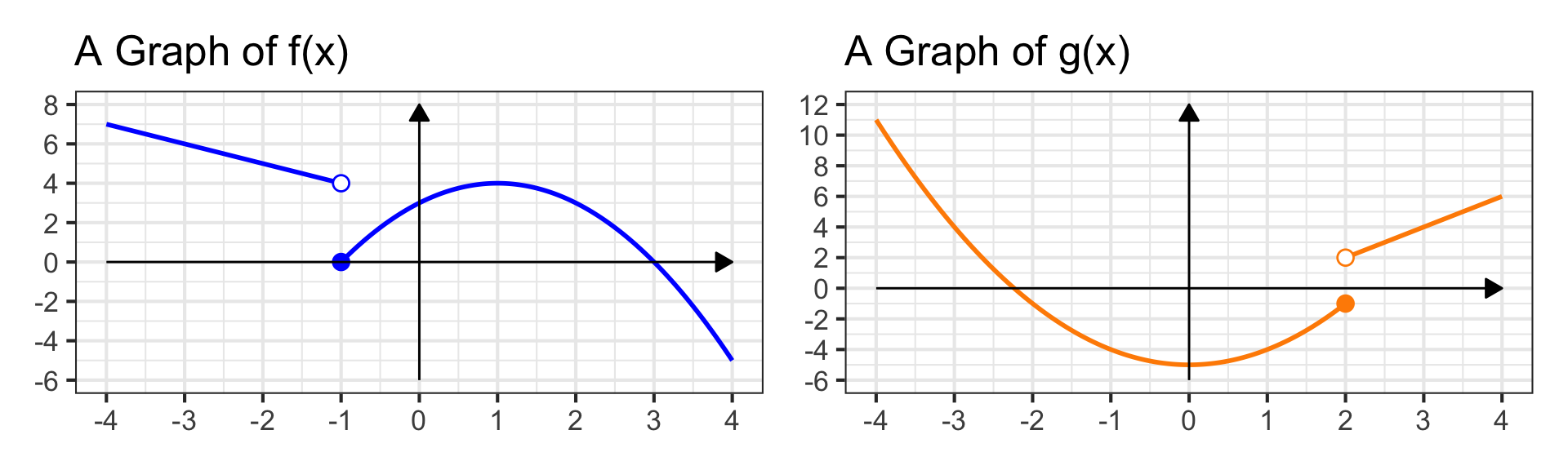
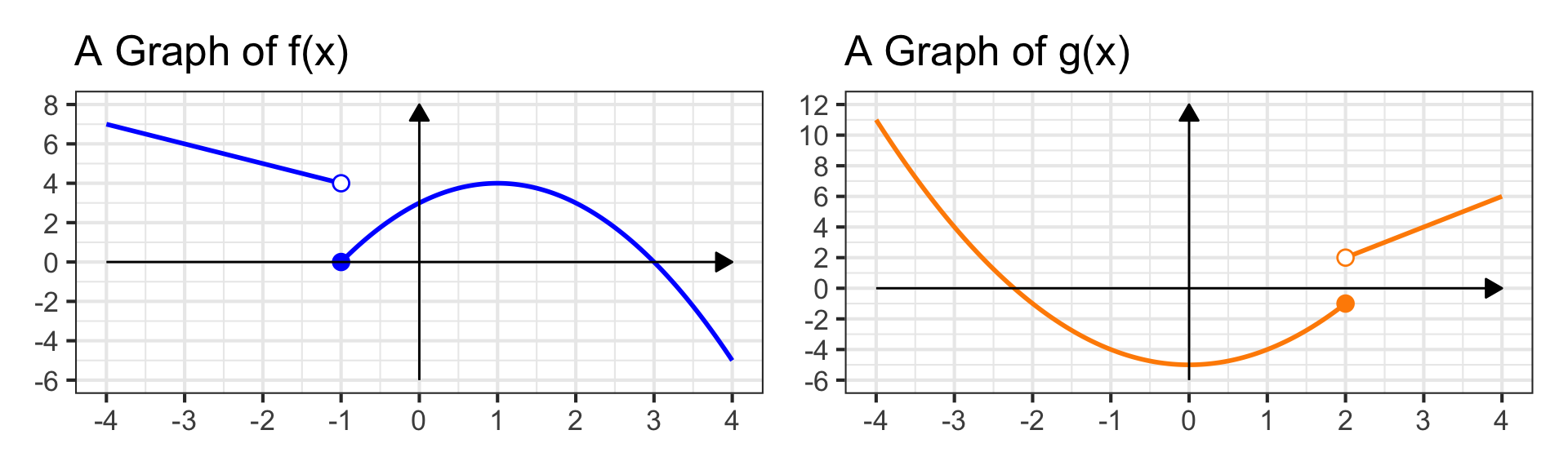
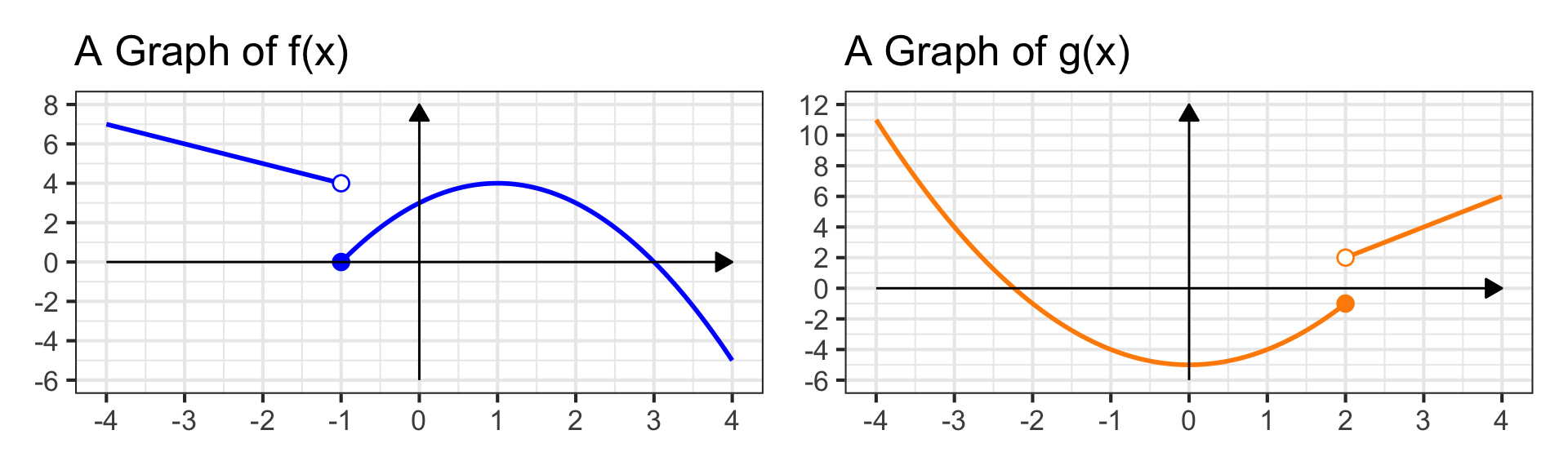
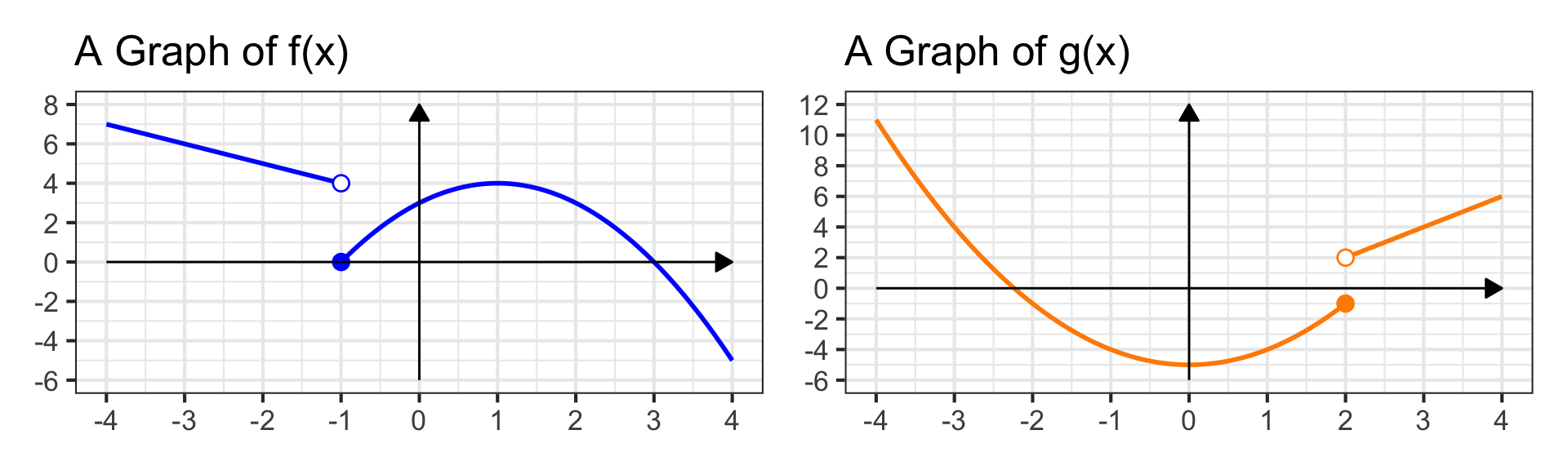
We can also evaluate compositions from graphs. The key is working from the inside out: evaluate the inner function first, then use the result as the input to the outer function.

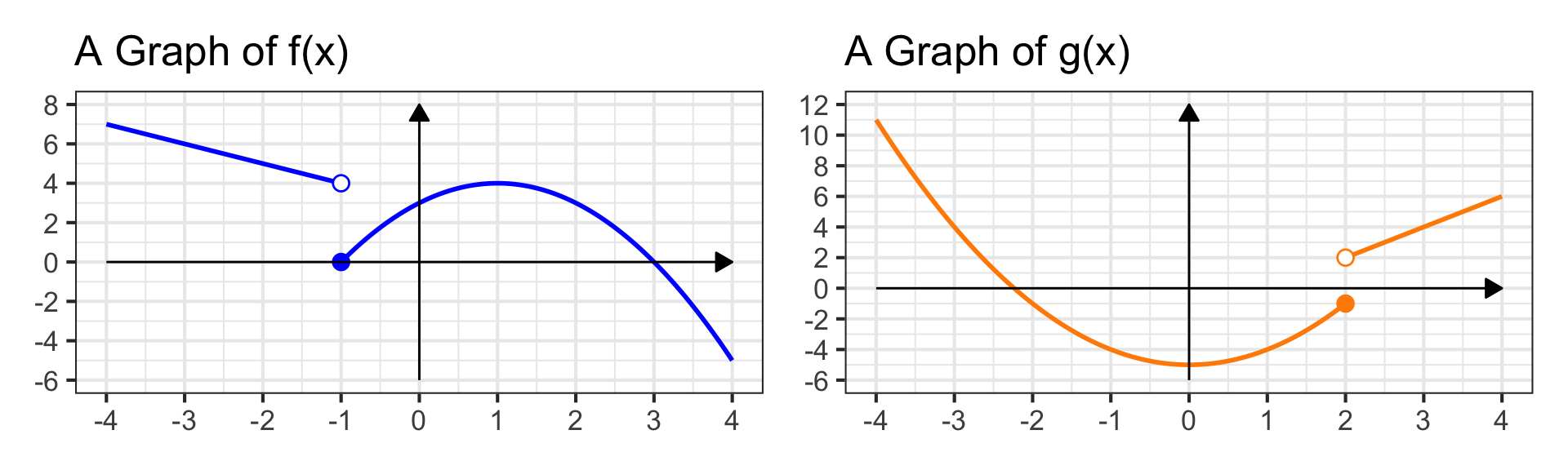
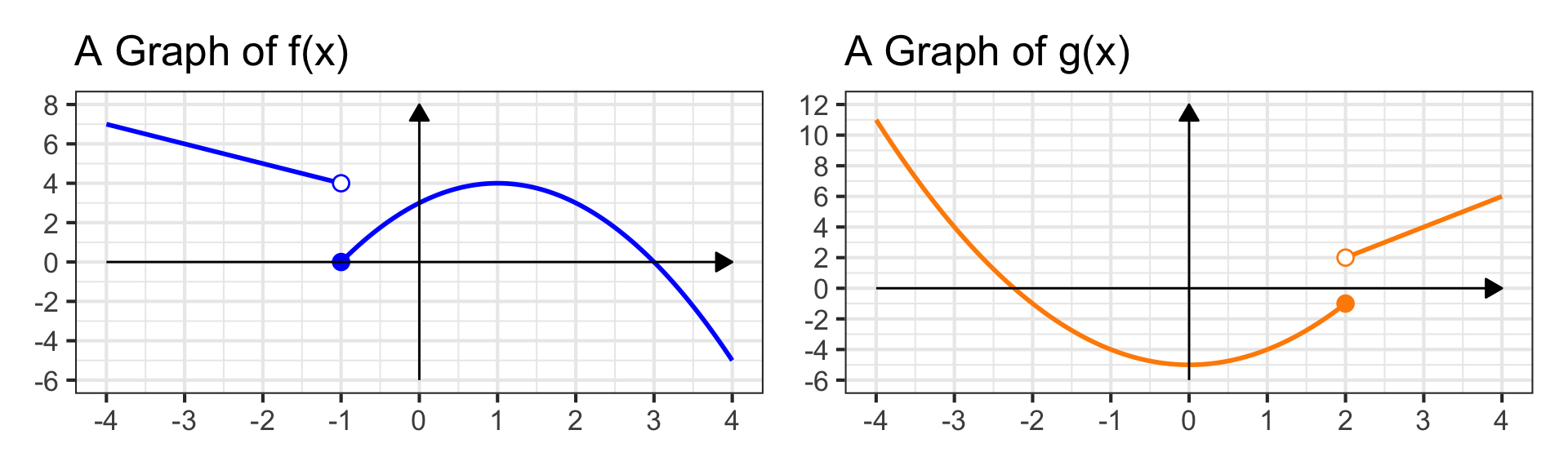
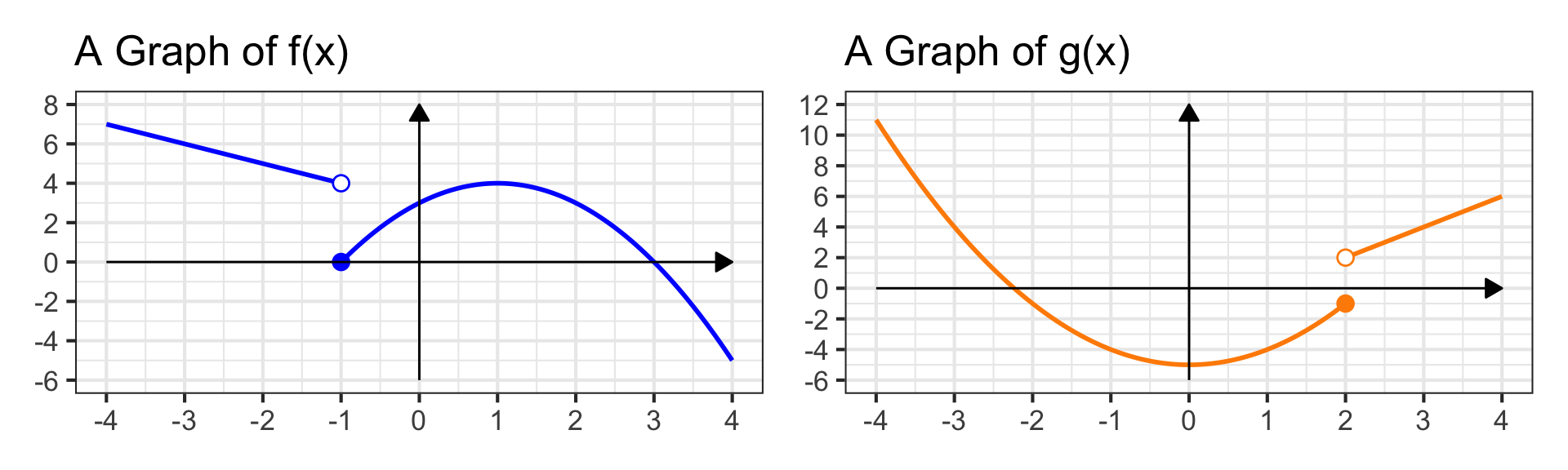
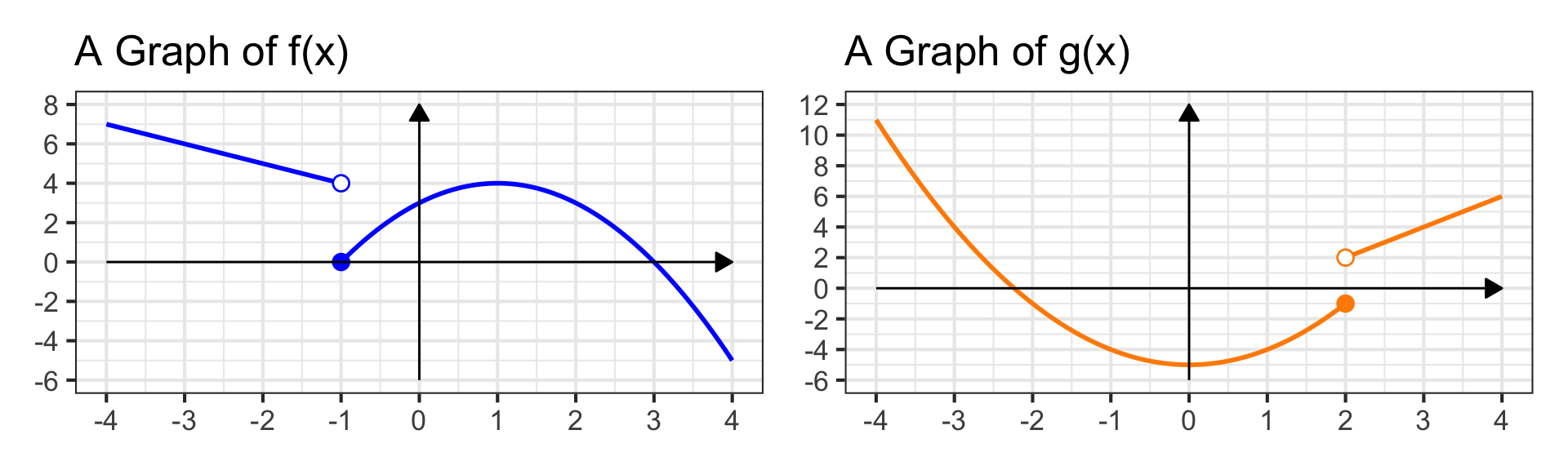
Problem: The graphs of \(f\left(x\right)\) and \(g\left(x\right)\) appear below. Use them to evaluate each of the following.

\[\left(a\right)~\left(f \circ g\right)\left(2\right) \qquad \left(b\right)~f\left(g\left(-1\right)\right) \qquad \left(c\right)~\left(g \circ f\right)\left(0\right) \qquad \left(d\right)~\left(g \circ f\right)\left(-1\right)\] \[\left(e\right)~\left(g \circ g\right)\left(-3\right) \qquad \left(f\right)~\left(f \circ f\right)\left(-1\right) \qquad \left(g\right)~f\left(g\left(f\left(2\right)\right)\right) \qquad \left(h\right)~g\left(f\left(g\left(2\right)\right)\right)\]
Solution. Working from the inside out in each case:

  • \(\left(f \circ g\right)\left(2\right) = f\left(g\left(2\right)\right) = f\left(-1\right) = \boxed{~0~}\)   (closed dot at \(x=-1\) on \(f\))

Composition from Graphs

We can also evaluate compositions from graphs. The key is working from the inside out: evaluate the inner function first, then use the result as the input to the outer function.

Problem: The graphs of \(f\left(x\right)\) and \(g\left(x\right)\) appear below. Use them to evaluate each of the following.

\[\left(a\right)~\left(f \circ g\right)\left(2\right) \qquad \left(b\right)~f\left(g\left(-1\right)\right) \qquad \left(c\right)~\left(g \circ f\right)\left(0\right) \qquad \left(d\right)~\left(g \circ f\right)\left(-1\right)\] \[\left(e\right)~\left(g \circ g\right)\left(-3\right) \qquad \left(f\right)~\left(f \circ f\right)\left(-1\right) \qquad \left(g\right)~f\left(g\left(f\left(2\right)\right)\right) \qquad \left(h\right)~g\left(f\left(g\left(2\right)\right)\right)\]
Solution. Working from the inside out in each case:

  • \(f\left(g\left(-1\right)\right) = f\left(-4\right) = \boxed{~7~}\)

Composition from Graphs

We can also evaluate compositions from graphs. The key is working from the inside out: evaluate the inner function first, then use the result as the input to the outer function.

Problem: The graphs of \(f\left(x\right)\) and \(g\left(x\right)\) appear below. Use them to evaluate each of the following.

\[\left(a\right)~\left(f \circ g\right)\left(2\right) \qquad \left(b\right)~f\left(g\left(-1\right)\right) \qquad \left(c\right)~\left(g \circ f\right)\left(0\right) \qquad \left(d\right)~\left(g \circ f\right)\left(-1\right)\] \[\left(e\right)~\left(g \circ g\right)\left(-3\right) \qquad \left(f\right)~\left(f \circ f\right)\left(-1\right) \qquad \left(g\right)~f\left(g\left(f\left(2\right)\right)\right) \qquad \left(h\right)~g\left(f\left(g\left(2\right)\right)\right)\]
Solution. Working from the inside out in each case:

  • \(\left(g \circ f\right)\left(0\right) = g\left(f\left(0\right)\right) = g\left(3\right) = \boxed{~4~}\)

Composition from Graphs

We can also evaluate compositions from graphs. The key is working from the inside out: evaluate the inner function first, then use the result as the input to the outer function.

Problem: The graphs of \(f\left(x\right)\) and \(g\left(x\right)\) appear below. Use them to evaluate each of the following.

\[\left(a\right)~\left(f \circ g\right)\left(2\right) \qquad \left(b\right)~f\left(g\left(-1\right)\right) \qquad \left(c\right)~\left(g \circ f\right)\left(0\right) \qquad \left(d\right)~\left(g \circ f\right)\left(-1\right)\] \[\left(e\right)~\left(g \circ g\right)\left(-3\right) \qquad \left(f\right)~\left(f \circ f\right)\left(-1\right) \qquad \left(g\right)~f\left(g\left(f\left(2\right)\right)\right) \qquad \left(h\right)~g\left(f\left(g\left(2\right)\right)\right)\]
Solution. Working from the inside out in each case:

  • \(\left(g \circ f\right)\left(-1\right) = g\left(f\left(-1\right)\right) = g\left(0\right) = \boxed{~-5~}\)

Composition from Graphs

We can also evaluate compositions from graphs. The key is working from the inside out: evaluate the inner function first, then use the result as the input to the outer function.

Problem: The graphs of \(f\left(x\right)\) and \(g\left(x\right)\) appear below. Use them to evaluate each of the following.

\[\left(a\right)~\left(f \circ g\right)\left(2\right) \qquad \left(b\right)~f\left(g\left(-1\right)\right) \qquad \left(c\right)~\left(g \circ f\right)\left(0\right) \qquad \left(d\right)~\left(g \circ f\right)\left(-1\right)\] \[\left(e\right)~\left(g \circ g\right)\left(-3\right) \qquad \left(f\right)~\left(f \circ f\right)\left(-1\right) \qquad \left(g\right)~f\left(g\left(f\left(2\right)\right)\right) \qquad \left(h\right)~g\left(f\left(g\left(2\right)\right)\right)\]
Solution. Working from the inside out in each case:

  • \(\left(g \circ g\right)\left(-3\right) = g\left(g\left(-3\right)\right) = g\left(4\right) = \boxed{~6~}\)

Composition from Graphs

We can also evaluate compositions from graphs. The key is working from the inside out: evaluate the inner function first, then use the result as the input to the outer function.

Problem: The graphs of \(f\left(x\right)\) and \(g\left(x\right)\) appear below. Use them to evaluate each of the following.

\[\left(a\right)~\left(f \circ g\right)\left(2\right) \qquad \left(b\right)~f\left(g\left(-1\right)\right) \qquad \left(c\right)~\left(g \circ f\right)\left(0\right) \qquad \left(d\right)~\left(g \circ f\right)\left(-1\right)\] \[\left(e\right)~\left(g \circ g\right)\left(-3\right) \qquad \left(f\right)~\left(f \circ f\right)\left(-1\right) \qquad \left(g\right)~f\left(g\left(f\left(2\right)\right)\right) \qquad \left(h\right)~g\left(f\left(g\left(2\right)\right)\right)\]
Solution. Working from the inside out in each case:

  • \(\left(f \circ f\right)\left(-1\right) = f\left(f\left(-1\right)\right) = f\left(0\right) = \boxed{~3~}\)

Composition from Graphs

We can also evaluate compositions from graphs. The key is working from the inside out: evaluate the inner function first, then use the result as the input to the outer function.

Problem: The graphs of \(f\left(x\right)\) and \(g\left(x\right)\) appear below. Use them to evaluate each of the following.

\[\left(a\right)~\left(f \circ g\right)\left(2\right) \qquad \left(b\right)~f\left(g\left(-1\right)\right) \qquad \left(c\right)~\left(g \circ f\right)\left(0\right) \qquad \left(d\right)~\left(g \circ f\right)\left(-1\right)\] \[\left(e\right)~\left(g \circ g\right)\left(-3\right) \qquad \left(f\right)~\left(f \circ f\right)\left(-1\right) \qquad \left(g\right)~f\left(g\left(f\left(2\right)\right)\right) \qquad \left(h\right)~g\left(f\left(g\left(2\right)\right)\right)\]
Solution. Working from the inside out in each case:

  • \(f\left(g\left(f\left(2\right)\right)\right) = f\left(g\left(3\right)\right) = f\left(4\right) = \boxed{~-5~}\)

Composition from Graphs

We can also evaluate compositions from graphs. The key is working from the inside out: evaluate the inner function first, then use the result as the input to the outer function.

Problem: The graphs of \(f\left(x\right)\) and \(g\left(x\right)\) appear below. Use them to evaluate each of the following.

\[\left(a\right)~\left(f \circ g\right)\left(2\right) \qquad \left(b\right)~f\left(g\left(-1\right)\right) \qquad \left(c\right)~\left(g \circ f\right)\left(0\right) \qquad \left(d\right)~\left(g \circ f\right)\left(-1\right)\] \[\left(e\right)~\left(g \circ g\right)\left(-3\right) \qquad \left(f\right)~\left(f \circ f\right)\left(-1\right) \qquad \left(g\right)~f\left(g\left(f\left(2\right)\right)\right) \qquad \left(h\right)~g\left(f\left(g\left(2\right)\right)\right)\]
Solution. Working from the inside out in each case:

  • \(g\left(f\left(g\left(2\right)\right)\right) = g\left(f\left(-1\right)\right) = g\left(0\right) = \boxed{~-5~}\)

Composition from Graphs Practice

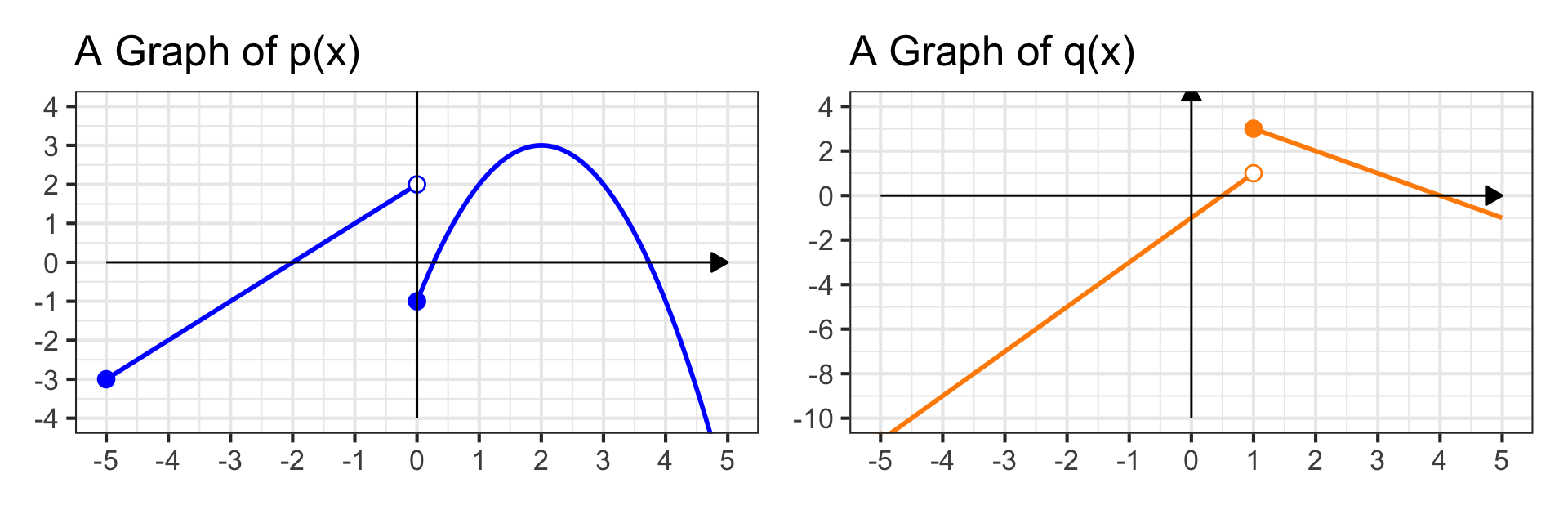
Try It! 3: The graphs of \(p\left(x\right)\) and \(q\left(x\right)\) appear below. Use them to evaluate each of the following.

\[\left(a\right)~\left(p \circ q\right)\left(2\right) \qquad \left(b\right)~q\left(p\left(-2\right)\right) \qquad \left(c\right)~\left(q \circ p\right)\left(0\right) \qquad \left(d\right)~\left(p \circ p\right)\left(3\right) \qquad \left(e\right)~\left(q \circ q\right)\left(-1\right) \qquad \left(f\right)~p\left(q\left(p\left(2\right)\right)\right)\]
Applied Problems

Applied Problem 1: A forest fire leaves behind an expanding circular burn. The radius is increasing at rate \(r\left(t\right) = 2t + 1\) (feet, \(t\) in minutes).

Express the area burned as a function of time \(t\), and find the total area burned after 10 minutes.

Solution. The area of a circle is \(A = \pi r^2\), so \(A\left(r\right) = \pi r^2\). We substitute \(r\left(t\right)\) in place of \(r\):

\[\begin{align} A\left(r\left(t\right)\right) &= \pi\left(r\left(t\right)\right)^2 \end{align}\]

Applied Problems

Applied Problem 1: A forest fire leaves behind an expanding circular burn. The radius is increasing at rate \(r\left(t\right) = 2t + 1\) (feet, \(t\) in minutes).

Express the area burned as a function of time \(t\), and find the total area burned after 10 minutes.

Solution. The area of a circle is \(A = \pi r^2\), so \(A\left(r\right) = \pi r^2\). We substitute \(r\left(t\right)\) in place of \(r\):

\[\begin{align} A\left(r\left(t\right)\right) &= \pi\left(r\left(t\right)\right)^2\\ &= \pi\left(2t + 1\right)^2 \end{align}\]

Applied Problems

Applied Problem 1: A forest fire leaves behind an expanding circular burn. The radius is increasing at rate \(r\left(t\right) = 2t + 1\) (feet, \(t\) in minutes).

Express the area burned as a function of time \(t\), and find the total area burned after 10 minutes.

Solution. The area of a circle is \(A = \pi r^2\), so \(A\left(r\right) = \pi r^2\). We substitute \(r\left(t\right)\) in place of \(r\):

\[\begin{align} A\left(r\left(t\right)\right) &= \pi\left(r\left(t\right)\right)^2\\ &= \pi\left(2t + 1\right)^2\\ &= \pi\left(4t^2 + 4t + 1\right) \end{align}\]

Applied Problems

Applied Problem 1: A forest fire leaves behind an expanding circular burn. The radius is increasing at rate \(r\left(t\right) = 2t + 1\) (feet, \(t\) in minutes).

Express the area burned as a function of time \(t\), and find the total area burned after 10 minutes.

Solution. The area of a circle is \(A = \pi r^2\), so \(A\left(r\right) = \pi r^2\). We substitute \(r\left(t\right)\) in place of \(r\):

\[\begin{align} A\left(r\left(t\right)\right) &= \pi\left(r\left(t\right)\right)^2\\ &= \pi\left(2t + 1\right)^2\\ &= \pi\left(4t^2 + 4t + 1\right) \end{align}\]

After \(10\) minutes: \(A\left(r\left(10\right)\right) = \pi\left(4\left(100\right) + 4\left(10\right) + 1\right) = \boxed{~441\pi \approx 1385.4 \text{ sq. ft.}~}\)

Applied Problems (Cont’d)

Applied Problem 2: The number of bacteria in a refrigerated food product is given by

\[N\left(T\right) = 23T^2 - 56T + 1 \qquad 3 < T < 33\]

where \(T\) is the temperature (°F). After the food is removed from the refrigerator, the temperature is given by \(T\left(t\right) = 5t + 1.5\), where \(t\) is time in hours.

\(\left(a\right)\) Find the composite function \(N\left(T\left(t\right)\right)\).

\(\left(b\right)\) Find the time (to two decimal places) when the bacteria count reaches \(6{,}752\).

Solution to \(\left(a\right)\). Substitute \(T\left(t\right) = 5t + 1.5\) into \(N\left(T\right)\):

\[\begin{align} N\left(T\left(t\right)\right) &= 23\left(5t + 1.5\right)^2 - 56\left(5t + 1.5\right) + 1 \end{align}\]

Applied Problems (Cont’d)

Applied Problem 2: The number of bacteria in a refrigerated food product is given by

\[N\left(T\right) = 23T^2 - 56T + 1 \qquad 3 < T < 33\]

where \(T\) is the temperature (°F). After the food is removed from the refrigerator, the temperature is given by \(T\left(t\right) = 5t + 1.5\), where \(t\) is time in hours.

\(\left(a\right)\) Find the composite function \(N\left(T\left(t\right)\right)\).

\(\left(b\right)\) Find the time (to two decimal places) when the bacteria count reaches \(6{,}752\).

Solution to \(\left(a\right)\). Substitute \(T\left(t\right) = 5t + 1.5\) into \(N\left(T\right)\):

\[\begin{align} N\left(T\left(t\right)\right) &= 23\left(5t + 1.5\right)^2 - 56\left(5t + 1.5\right) + 1\\ &= 23\left(25t^2 + 15t + 2.25\right) - 280t - 84 + 1 \end{align}\]

Applied Problems (Cont’d)

Applied Problem 2: The number of bacteria in a refrigerated food product is given by

\[N\left(T\right) = 23T^2 - 56T + 1 \qquad 3 < T < 33\]

where \(T\) is the temperature (°F). After the food is removed from the refrigerator, the temperature is given by \(T\left(t\right) = 5t + 1.5\), where \(t\) is time in hours.

\(\left(a\right)\) Find the composite function \(N\left(T\left(t\right)\right)\).

\(\left(b\right)\) Find the time (to two decimal places) when the bacteria count reaches \(6{,}752\).

Solution to \(\left(a\right)\). Substitute \(T\left(t\right) = 5t + 1.5\) into \(N\left(T\right)\):

\[\begin{align} N\left(T\left(t\right)\right) &= 23\left(5t + 1.5\right)^2 - 56\left(5t + 1.5\right) + 1\\ &= 23\left(25t^2 + 15t + 2.25\right) - 280t - 84 + 1\\ &= 575t^2 + 345t + 51.75 - 280t - 83 \end{align}\]

Applied Problems (Cont’d)

Applied Problem 2: The number of bacteria in a refrigerated food product is given by

\[N\left(T\right) = 23T^2 - 56T + 1 \qquad 3 < T < 33\]

where \(T\) is the temperature (°F). After the food is removed from the refrigerator, the temperature is given by \(T\left(t\right) = 5t + 1.5\), where \(t\) is time in hours.

\(\left(a\right)\) Find the composite function \(N\left(T\left(t\right)\right)\).

\(\left(b\right)\) Find the time (to two decimal places) when the bacteria count reaches \(6{,}752\).

Solution to \(\left(a\right)\). Substitute \(T\left(t\right) = 5t + 1.5\) into \(N\left(T\right)\):

\[\begin{align} N\left(T\left(t\right)\right) &= 23\left(5t + 1.5\right)^2 - 56\left(5t + 1.5\right) + 1\\ &= 23\left(25t^2 + 15t + 2.25\right) - 280t - 84 + 1\\ &= 575t^2 + 345t + 51.75 - 280t - 83\\ &= \boxed{~575t^2 + 65t - 31.25~} \end{align}\]

Applied Problems (Cont’d)

Applied Problem 2 (Cont’d): Find the time when \(N\left(T\left(t\right)\right) = 6{,}752\).

Solution to \(\left(b\right)\). Set \(575t^2 + 65t - 31.25 = 6{,}752\) and solve.

Quadratic Formula

As a reminder, one way to solve a quadratic equation of the form \(ax^2 + bx + c = 0\) is via the quadratic formula, which yields \(\displaystyle{x = \frac{-b \pm \sqrt{\left(b^2 - 4ac\right)}}{2a}}\).

\[\begin{align} 575t^2 + 65t - 31.25 &= 6752 \end{align}\]

Applied Problems (Cont’d)

Applied Problem 2 (Cont’d): Find the time when \(N\left(T\left(t\right)\right) = 6{,}752\).

Solution to \(\left(b\right)\). Set \(575t^2 + 65t - 31.25 = 6{,}752\) and solve.

Quadratic Formula

As a reminder, one way to solve a quadratic equation of the form \(ax^2 + bx + c = 0\) is via the quadratic formula, which yields \(\displaystyle{x = \frac{-b \pm \sqrt{\left(b^2 - 4ac\right)}}{2a}}\).

\[\begin{align} 575t^2 + 65t - 31.25 &= 6752\\ \implies 575t^2 + 65t - 6783.25 &= 0 \end{align}\]

Applied Problems (Cont’d)

Applied Problem 2 (Cont’d): Find the time when \(N\left(T\left(t\right)\right) = 6{,}752\).

Solution to \(\left(b\right)\). Set \(575t^2 + 65t - 31.25 = 6{,}752\) and solve.

Quadratic Formula

As a reminder, one way to solve a quadratic equation of the form \(ax^2 + bx + c = 0\) is via the quadratic formula, which yields \(\displaystyle{x = \frac{-b \pm \sqrt{\left(b^2 - 4ac\right)}}{2a}}\).

\[\begin{align} 575t^2 + 65t - 31.25 &= 6752\\ \implies 575t^2 + 65t - 6783.25 &= 0\\ \implies t &= \frac{-65 \pm \sqrt{65^2 + 4\left(575\right)\left(6783.25\right)}}{2\left(575\right)} \end{align}\]

Applied Problems (Cont’d)

Applied Problem 2 (Cont’d): Find the time when \(N\left(T\left(t\right)\right) = 6{,}752\).

Solution to \(\left(b\right)\). Set \(575t^2 + 65t - 31.25 = 6{,}752\) and solve.

Quadratic Formula

As a reminder, one way to solve a quadratic equation of the form \(ax^2 + bx + c = 0\) is via the quadratic formula, which yields \(\displaystyle{x = \frac{-b \pm \sqrt{\left(b^2 - 4ac\right)}}{2a}}\).

\[\begin{align} 575t^2 + 65t - 31.25 &= 6752\\ \implies 575t^2 + 65t - 6783.25 &= 0\\ \implies t &= \frac{-65 \pm \sqrt{65^2 + 4\left(575\right)\left(6783.25\right)}}{2\left(575\right)}\\ &= \frac{-65 \pm \sqrt{4225 + 15{,}601{,}475}}{1150}\\ &\approx \frac{-65 \pm 3950.5}{1150} \end{align}\]

Taking the positive root (since \(t \geq 0\)): \(\displaystyle{t \approx \frac{3885.5}{1150} \approx \boxed{~3.38 \text{ hours}~}}\)

Exit Ticket Task

Navigate to our MAT142 Exit Ticket Form, answer the questions, and complete the task below.


Note. Today’s discussion is listed as 5. Composition of Functions

Task: Consider \(f\left(x\right) = 2x - 1\) and \(g\left(x\right) = x^2 + 3\).

\(\left(a\right)\) Find \(\left(f \circ g\right)\left(x\right)\) and evaluate at \(x = 2\).

\(\left(b\right)\) Find \(\left(g \circ f\right)\left(x\right)\) and evaluate at \(x = 2\).

Summary and Next Time…

Ideas From Today
  • The composition \(\left(f \circ g\right)\left(x\right) = f\left(g\left(x\right)\right)\) chains two functions together – \(g\) acts first, then \(f\) acts on the result.
  • Order matters: \(\left(f \circ g\right)\left(x\right)\) and \(\left(g \circ f\right)\left(x\right)\) are generally different functions.
  • We can evaluate compositions numerically (step by step) or algebraically (substitute \(g\left(x\right)\) into \(f\)) – both give the same result.
  • We can evaluate compositions from graphs by reading output values and using them as the next input.
  • Composition arises naturally in applied settings whenever one quantity depends on another that is itself changing.
Looking Ahead
  • Try It! 2 previewed something important. When \(\left(f \circ g\right)\left(x\right) = x\) and \(\left(g \circ f\right)\left(x\right) = x\), we say \(f\) and \(g\) are inverses of each other.
  • That idea – invertibility – is something we’ll encounter later in our course.
Next Time:
Exam I
Homework:
Complete Homework 4 on MyOpenMath