MAT 142: Limits and Rates of Change
September 18, 2026
Motivating Application
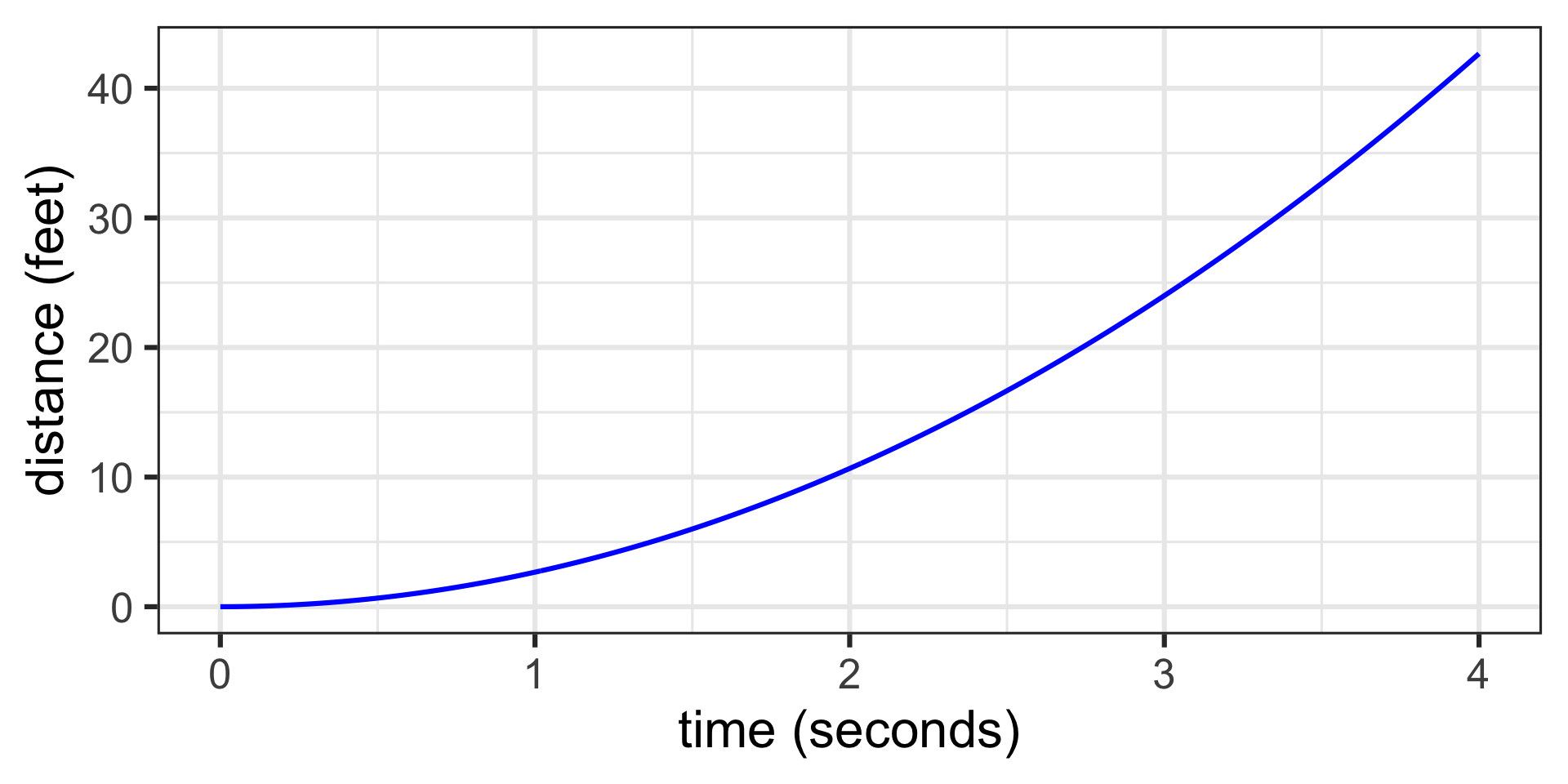
Near the surface of the moon, the distance a falling object travels is given by
\[d\left(t\right) = 2.6667t^2\]
where \(t\) is in seconds and \(d\left(t\right)\) is in feet.
Approximate the velocity of the object at time \(t = 1.5\) seconds by using the average velocity from \(t = 1\) to \(t = 2\).
Before we work through this, consider the following questions:
- Does this object fall at a constant rate?
- You’ve discussed slopes of linear functions before. Do non-linear functions have slope?
- What strategy might help us approximate an “instantaneous” rate of change?
We’ll revisit this application at the end of today’s class.
Reminder (Evaluating Functions)
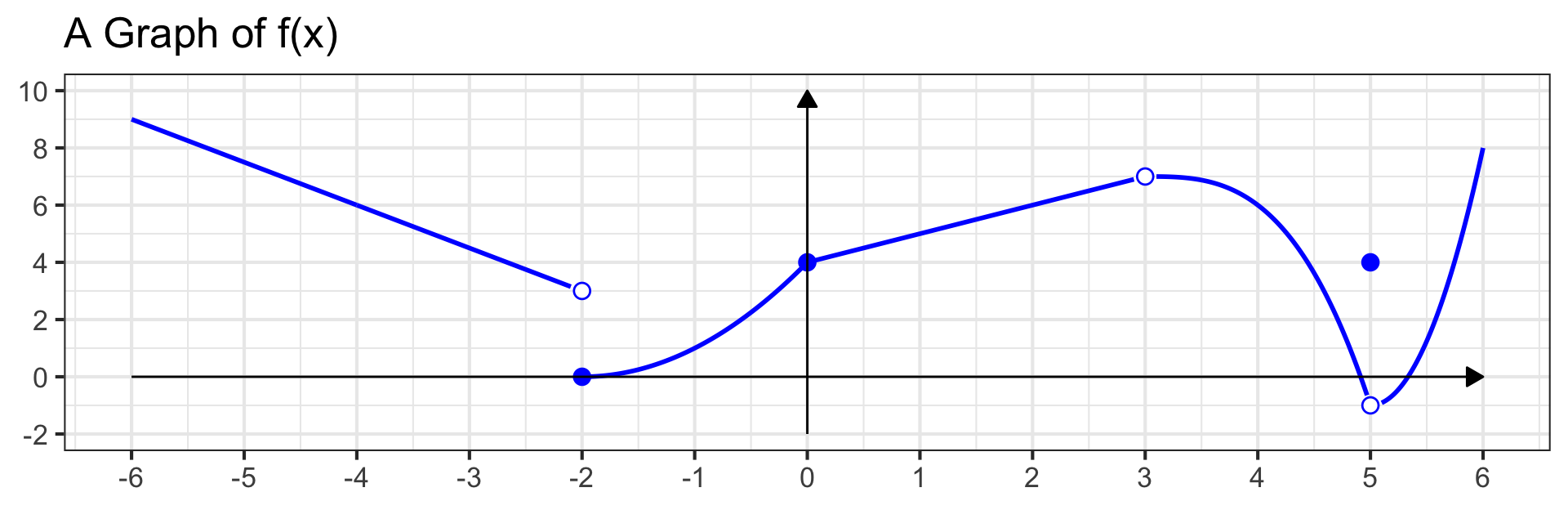
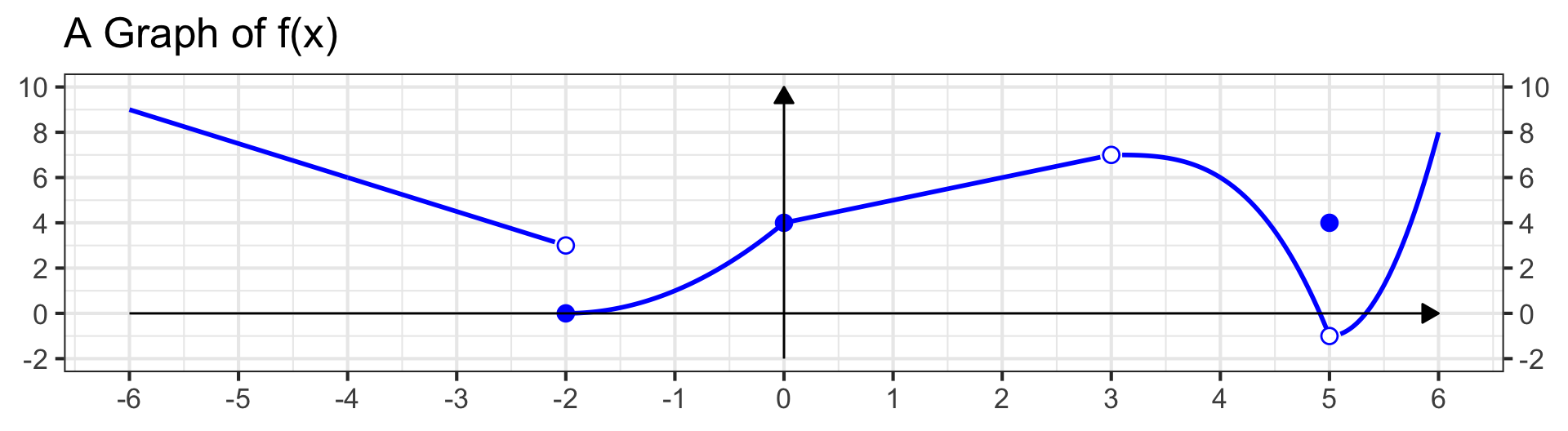
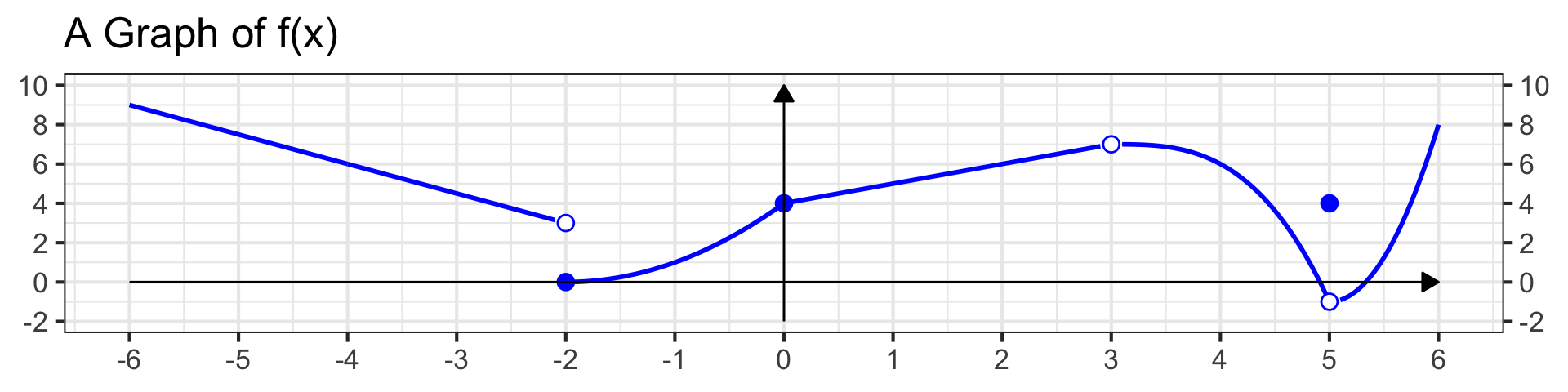
Try It!: Consider the function \(f\left(x\right)\) whose graph appears below. Evaluate each of the following, if possible.
\[\left(a\right)~f\left(-4\right) \qquad \left(b\right)~f\left(-2\right) \qquad \left(c\right)~f\left(0\right) \qquad \left(d\right)~f\left(3\right) \qquad \left(e\right)~f\left(5\right)\]
Completed Example 1
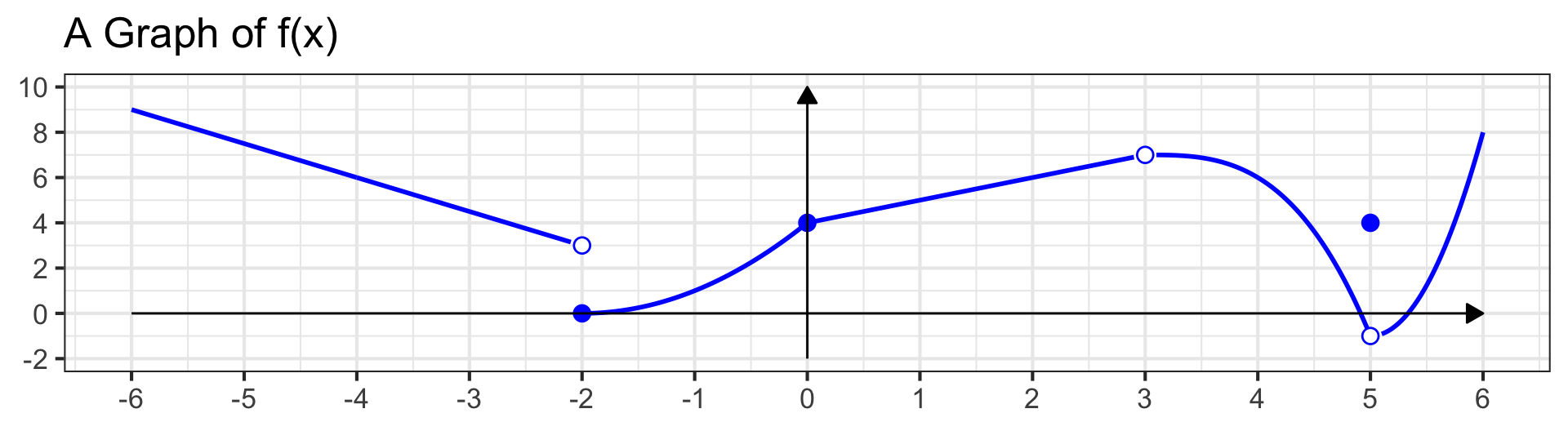
Problem: Consider the function \(f\left(x\right)\) whose graph appears below. Determine each of the following limits, if they exist.
\[\left(a\right)~\lim_{x\to -4}{f\left(x\right)} \qquad \left(b\right)~\lim_{x\to -2}{f\left(x\right)} \qquad \left(c\right)~\lim_{x\to 0}{f\left(x\right)} \qquad \left(d\right)~\lim_{x\to 3}{f\left(x\right)} \qquad \left(e\right)~\lim_{x\to 5}{f\left(x\right)}\]
Completed Example 1
Problem: Consider the function \(f\left(x\right)\) whose graph appears below. Determine each of the following limits, if they exist.
\[\left(a\right)~\lim_{x\to -4}{f\left(x\right)} \qquad \left(b\right)~\lim_{x\to -2}{f\left(x\right)} \qquad \left(c\right)~\lim_{x\to 0}{f\left(x\right)} \qquad \left(d\right)~\lim_{x\to 3}{f\left(x\right)} \qquad \left(e\right)~\lim_{x\to 5}{f\left(x\right)}\]
Solution.
- \(\displaystyle{\lim_{x\to -4}{f\left(x\right)}}\)
Completed Example 1
Problem: Consider the function \(f\left(x\right)\) whose graph appears below. Determine each of the following limits, if they exist.
\[\left(a\right)~\lim_{x\to -4}{f\left(x\right)} \qquad \left(b\right)~\lim_{x\to -2}{f\left(x\right)} \qquad \left(c\right)~\lim_{x\to 0}{f\left(x\right)} \qquad \left(d\right)~\lim_{x\to 3}{f\left(x\right)} \qquad \left(e\right)~\lim_{x\to 5}{f\left(x\right)}\]
Solution.
- \(\displaystyle{\lim_{x\to -4}{f\left(x\right)}}\)
Completed Example 1
Problem: Consider the function \(f\left(x\right)\) whose graph appears below. Determine each of the following limits, if they exist.
\[\left(a\right)~\lim_{x\to -4}{f\left(x\right)} \qquad \left(b\right)~\lim_{x\to -2}{f\left(x\right)} \qquad \left(c\right)~\lim_{x\to 0}{f\left(x\right)} \qquad \left(d\right)~\lim_{x\to 3}{f\left(x\right)} \qquad \left(e\right)~\lim_{x\to 5}{f\left(x\right)}\]
Solution.
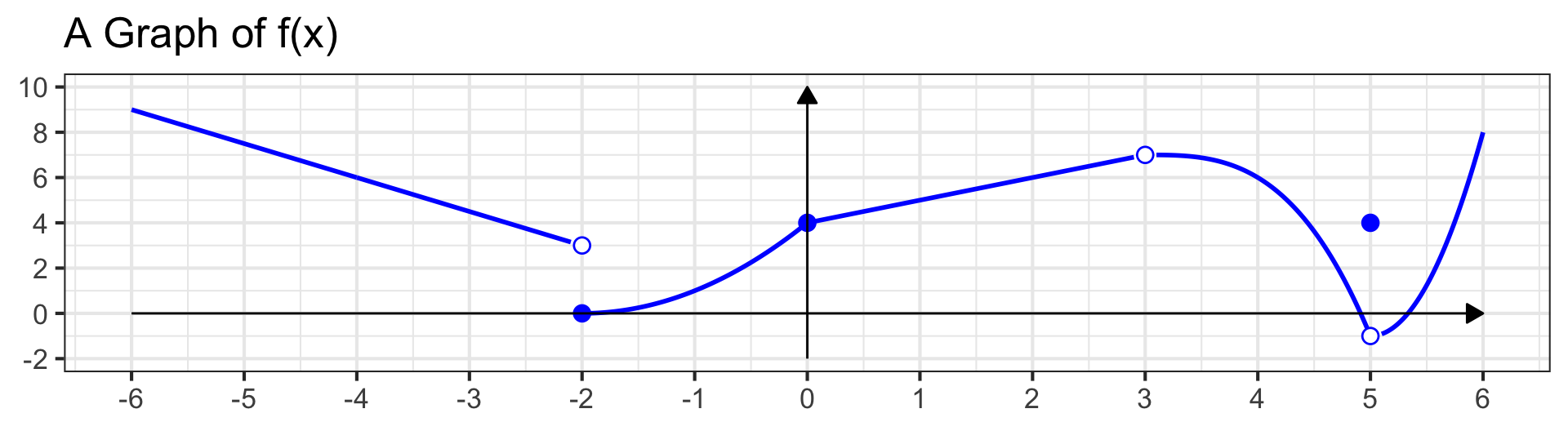
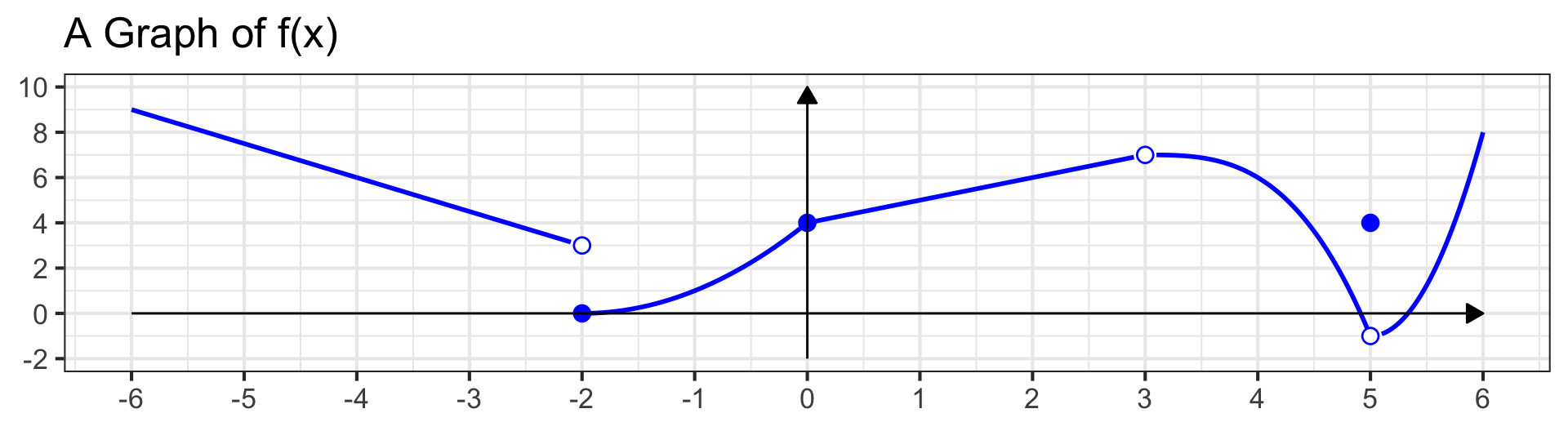
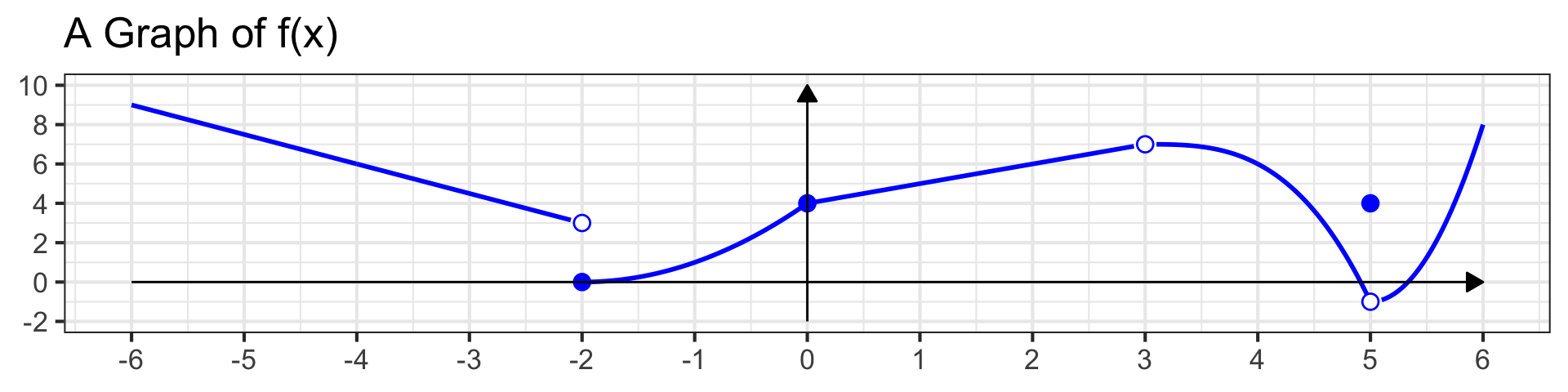
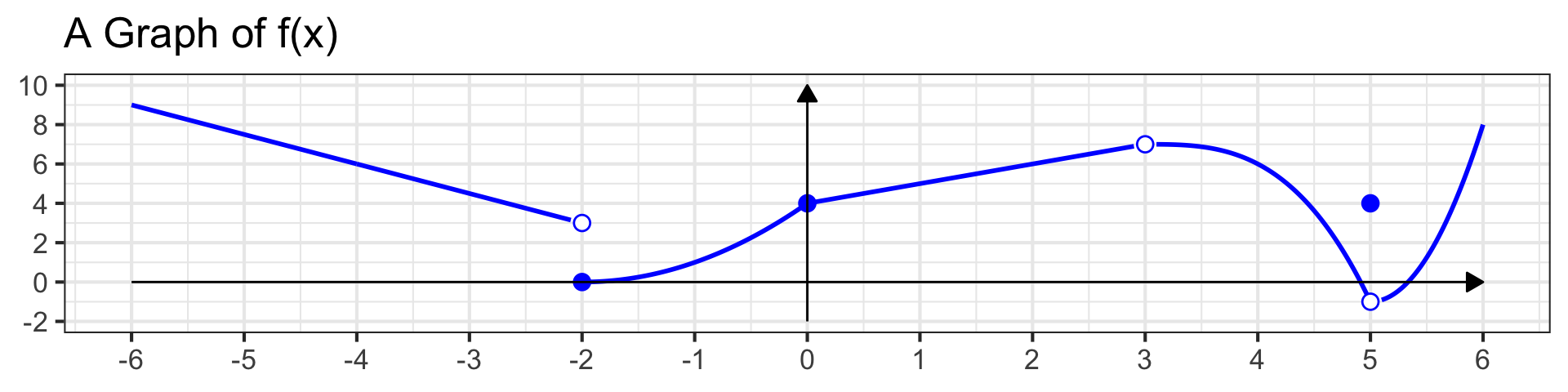
- \(\displaystyle{\lim_{x\to -4}{f\left(x\right)} = \boxed{~6~}}\) – no different than evaluating \(f\left(-4\right)\) since \(f\) is defined and well-behaved there.
Completed Example 1
Problem: Consider the function \(f\left(x\right)\) whose graph appears below. Determine each of the following limits, if they exist.
\[\left(a\right)~\lim_{x\to -4}{f\left(x\right)} \qquad \left(b\right)~\lim_{x\to -2}{f\left(x\right)} \qquad \left(c\right)~\lim_{x\to 0}{f\left(x\right)} \qquad \left(d\right)~\lim_{x\to 3}{f\left(x\right)} \qquad \left(e\right)~\lim_{x\to 5}{f\left(x\right)}\]
Solution.
- \(\displaystyle{\lim_{x\to -4}{f\left(x\right)} = \boxed{~6~}}\) – no different than evaluating \(f\left(-4\right)\) since \(f\) is defined and well-behaved there.
- \(\displaystyle{\lim_{x\to - 2}{f\left(x\right)}}\)
Completed Example 1
Problem: Consider the function \(f\left(x\right)\) whose graph appears below. Determine each of the following limits, if they exist.
\[\left(a\right)~\lim_{x\to -4}{f\left(x\right)} \qquad \left(b\right)~\lim_{x\to -2}{f\left(x\right)} \qquad \left(c\right)~\lim_{x\to 0}{f\left(x\right)} \qquad \left(d\right)~\lim_{x\to 3}{f\left(x\right)} \qquad \left(e\right)~\lim_{x\to 5}{f\left(x\right)}\]
Solution.
- \(\displaystyle{\lim_{x\to -4}{f\left(x\right)} = \boxed{~6~}}\) – no different than evaluating \(f\left(-4\right)\) since \(f\) is defined and well-behaved there.
- \(\displaystyle{\lim_{x\to - 2}{f\left(x\right)}}\)
Completed Example 1
Problem: Consider the function \(f\left(x\right)\) whose graph appears below. Determine each of the following limits, if they exist.
\[\left(a\right)~\lim_{x\to -4}{f\left(x\right)} \qquad \left(b\right)~\lim_{x\to -2}{f\left(x\right)} \qquad \left(c\right)~\lim_{x\to 0}{f\left(x\right)} \qquad \left(d\right)~\lim_{x\to 3}{f\left(x\right)} \qquad \left(e\right)~\lim_{x\to 5}{f\left(x\right)}\]
Solution.
- \(\displaystyle{\lim_{x\to -4}{f\left(x\right)} = \boxed{~6~}}\) – no different than evaluating \(f\left(-4\right)\) since \(f\) is defined and well-behaved there.
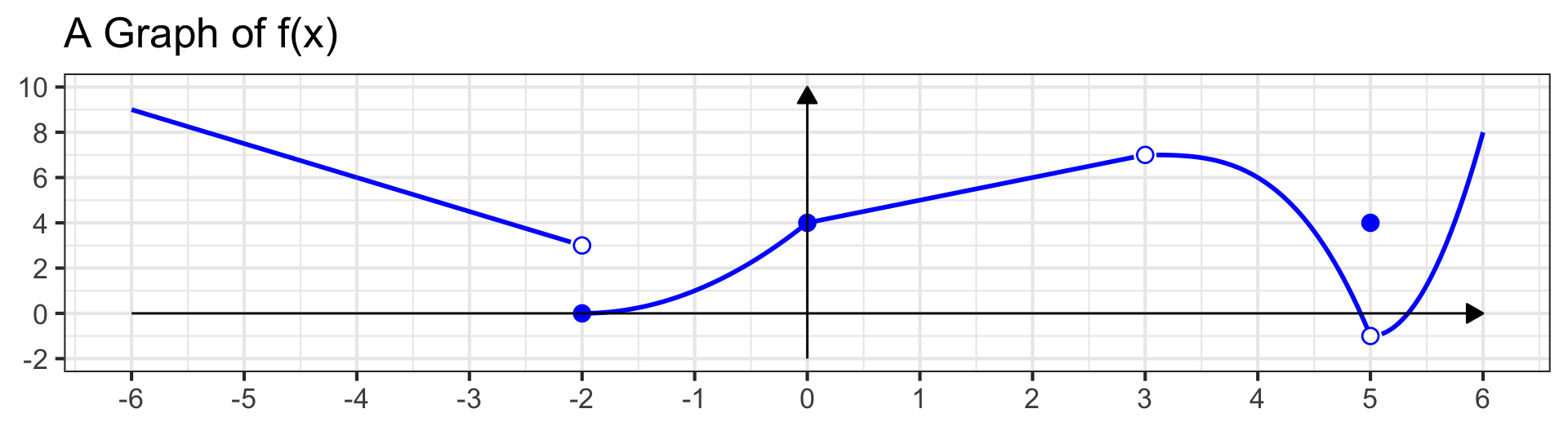
- \(\displaystyle{\lim_{x\to - 2}{f\left(x\right)}~~\boxed{~\text{Does Not Exist}~}}\) – as \(x\to -2\) from the left, \(f\left(x\right) \to 3\); from the right, \(f\left(x\right)\to 0\). These disagree.
Completed Example 1
Problem: Consider the function \(f\left(x\right)\) whose graph appears below. Determine each of the following limits, if they exist.
\[\left(a\right)~\lim_{x\to -4}{f\left(x\right)} \qquad \left(b\right)~\lim_{x\to -2}{f\left(x\right)} \qquad \left(c\right)~\lim_{x\to 0}{f\left(x\right)} \qquad \left(d\right)~\lim_{x\to 3}{f\left(x\right)} \qquad \left(e\right)~\lim_{x\to 5}{f\left(x\right)}\]
Solution.
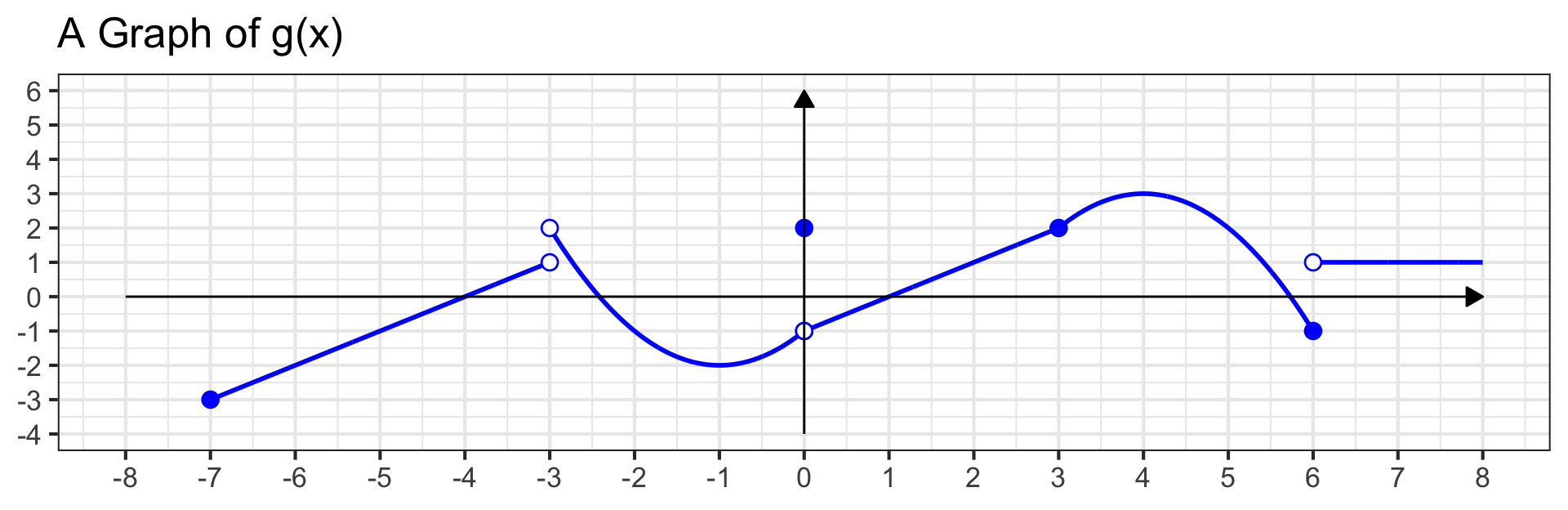
- \(\displaystyle{\lim_{x\to -4}{f\left(x\right)} = \boxed{~6~}}\) – no different than evaluating \(f\left(-4\right)\) since \(f\) is defined and well-behaved there.
- \(\displaystyle{\lim_{x\to - 2}{f\left(x\right)}~~\boxed{~\text{Does Not Exist}~}}\) – as \(x\to -2\) from the left, \(f\left(x\right) \to 3\); from the right, \(f\left(x\right)\to 0\). These disagree.
- \(\displaystyle{\lim_{x\to 0}{f\left(x\right)}}\)
Completed Example 1
Problem: Consider the function \(f\left(x\right)\) whose graph appears below. Determine each of the following limits, if they exist.
\[\left(a\right)~\lim_{x\to -4}{f\left(x\right)} \qquad \left(b\right)~\lim_{x\to -2}{f\left(x\right)} \qquad \left(c\right)~\lim_{x\to 0}{f\left(x\right)} \qquad \left(d\right)~\lim_{x\to 3}{f\left(x\right)} \qquad \left(e\right)~\lim_{x\to 5}{f\left(x\right)}\]
Solution.
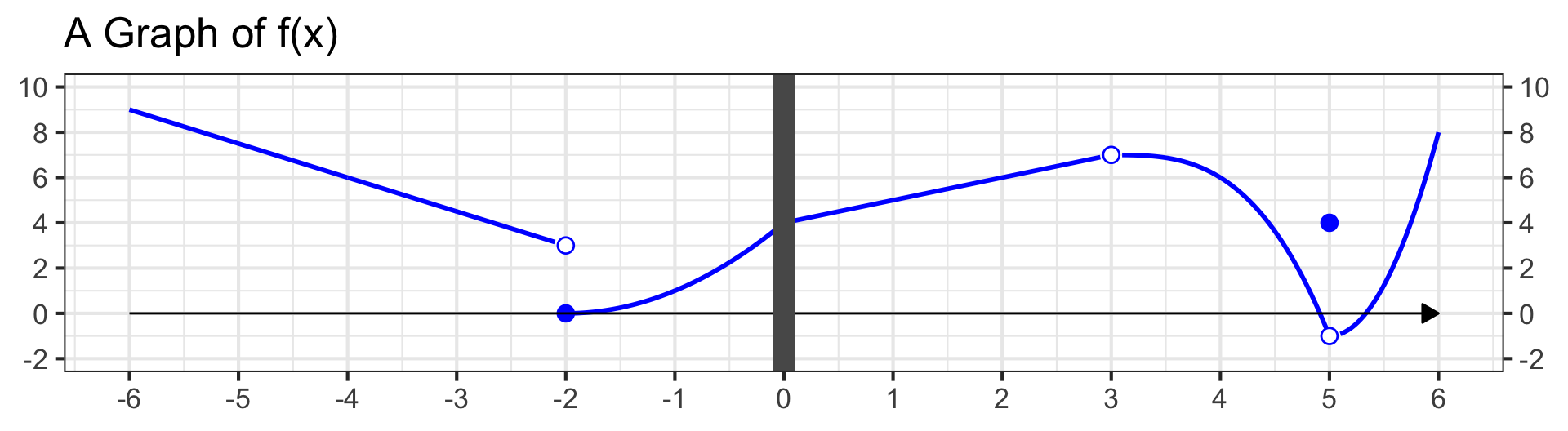
- \(\displaystyle{\lim_{x\to -4}{f\left(x\right)} = \boxed{~6~}}\) – no different than evaluating \(f\left(-4\right)\) since \(f\) is defined and well-behaved there.
- \(\displaystyle{\lim_{x\to - 2}{f\left(x\right)}~~\boxed{~\text{Does Not Exist}~}}\) – as \(x\to -2\) from the left, \(f\left(x\right) \to 3\); from the right, \(f\left(x\right)\to 0\). These disagree.
- \(\displaystyle{\lim_{x\to 0}{f\left(x\right)}}\)
Completed Example 1
Problem: Consider the function \(f\left(x\right)\) whose graph appears below. Determine each of the following limits, if they exist.
\[\left(a\right)~\lim_{x\to -4}{f\left(x\right)} \qquad \left(b\right)~\lim_{x\to -2}{f\left(x\right)} \qquad \left(c\right)~\lim_{x\to 0}{f\left(x\right)} \qquad \left(d\right)~\lim_{x\to 3}{f\left(x\right)} \qquad \left(e\right)~\lim_{x\to 5}{f\left(x\right)}\]
Solution.
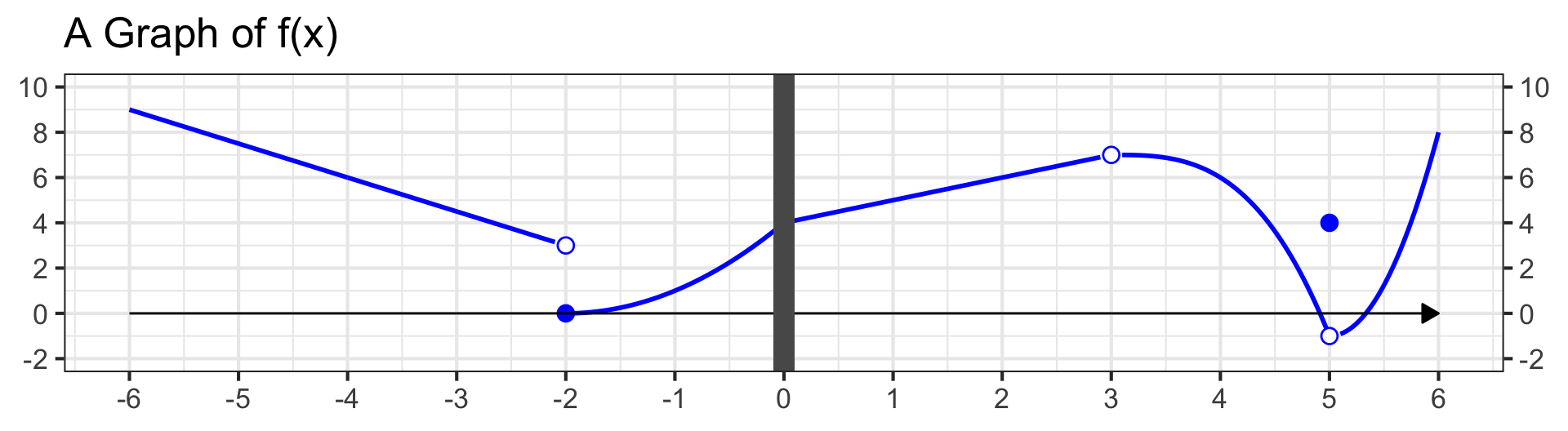
- \(\displaystyle{\lim_{x\to -4}{f\left(x\right)} = \boxed{~6~}}\) – no different than evaluating \(f\left(-4\right)\) since \(f\) is defined and well-behaved there.
- \(\displaystyle{\lim_{x\to - 2}{f\left(x\right)}~~\boxed{~\text{Does Not Exist}~}}\) – as \(x\to -2\) from the left, \(f\left(x\right) \to 3\); from the right, \(f\left(x\right)\to 0\). These disagree.
- \(\displaystyle{\lim_{x\to 0}{f\left(x\right)} = \boxed{~4~}}\) – no different than evaluating \(f\left(0\right)\).
Completed Example 1
Problem: Consider the function \(f\left(x\right)\) whose graph appears below. Determine each of the following limits, if they exist.
\[\left(a\right)~\lim_{x\to -4}{f\left(x\right)} \qquad \left(b\right)~\lim_{x\to -2}{f\left(x\right)} \qquad \left(c\right)~\lim_{x\to 0}{f\left(x\right)} \qquad \left(d\right)~\lim_{x\to 3}{f\left(x\right)} \qquad \left(e\right)~\lim_{x\to 5}{f\left(x\right)}\]
Solution.
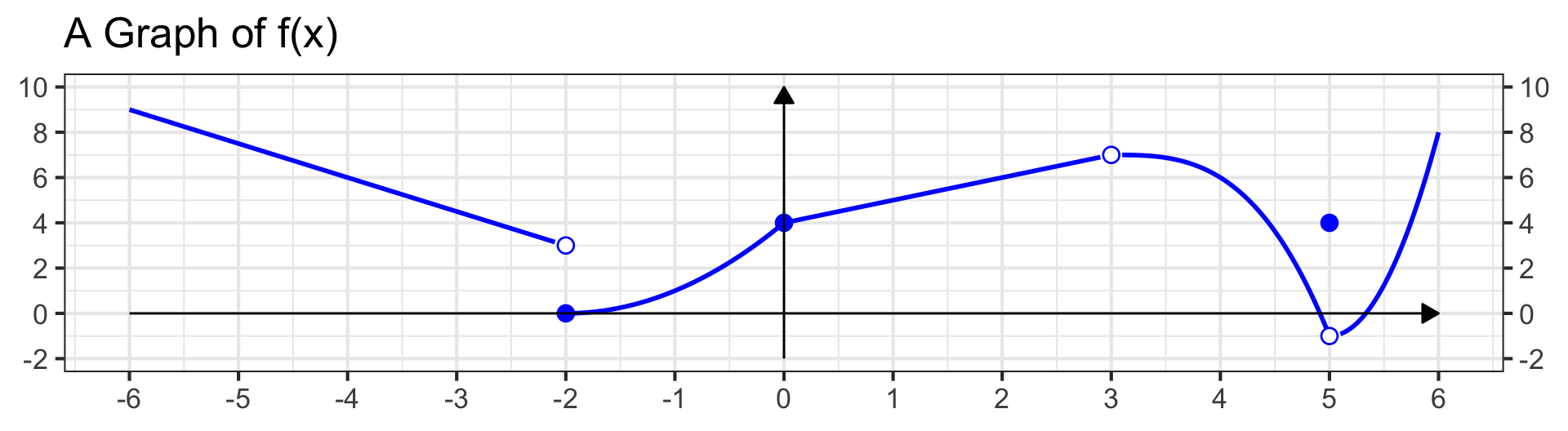
- \(\displaystyle{\lim_{x\to -4}{f\left(x\right)} = \boxed{~6~}}\) – no different than evaluating \(f\left(-4\right)\) since \(f\) is defined and well-behaved there.
- \(\displaystyle{\lim_{x\to - 2}{f\left(x\right)}~~\boxed{~\text{Does Not Exist}~}}\) – as \(x\to -2\) from the left, \(f\left(x\right) \to 3\); from the right, \(f\left(x\right)\to 0\). These disagree.
- \(\displaystyle{\lim_{x\to 0}{f\left(x\right)} = \boxed{~4~}}\) – no different than evaluating \(f\left(0\right)\).
Completed Example 1
Problem: Consider the function \(f\left(x\right)\) whose graph appears below. Determine each of the following limits, if they exist.
\[\left(a\right)~\lim_{x\to -4}{f\left(x\right)} \qquad \left(b\right)~\lim_{x\to -2}{f\left(x\right)} \qquad \left(c\right)~\lim_{x\to 0}{f\left(x\right)} \qquad \left(d\right)~\lim_{x\to 3}{f\left(x\right)} \qquad \left(e\right)~\lim_{x\to 5}{f\left(x\right)}\]
- \(\displaystyle{\lim_{x\to 3}{f\left(x\right)}}\)
Completed Example 1
Problem: Consider the function \(f\left(x\right)\) whose graph appears below. Determine each of the following limits, if they exist.
\[\left(a\right)~\lim_{x\to -4}{f\left(x\right)} \qquad \left(b\right)~\lim_{x\to -2}{f\left(x\right)} \qquad \left(c\right)~\lim_{x\to 0}{f\left(x\right)} \qquad \left(d\right)~\lim_{x\to 3}{f\left(x\right)} \qquad \left(e\right)~\lim_{x\to 5}{f\left(x\right)}\]
- \(\displaystyle{\lim_{x\to 3}{f\left(x\right)}}\)
Completed Example 1
Problem: Consider the function \(f\left(x\right)\) whose graph appears below. Determine each of the following limits, if they exist.
\[\left(a\right)~\lim_{x\to -4}{f\left(x\right)} \qquad \left(b\right)~\lim_{x\to -2}{f\left(x\right)} \qquad \left(c\right)~\lim_{x\to 0}{f\left(x\right)} \qquad \left(d\right)~\lim_{x\to 3}{f\left(x\right)} \qquad \left(e\right)~\lim_{x\to 5}{f\left(x\right)}\]
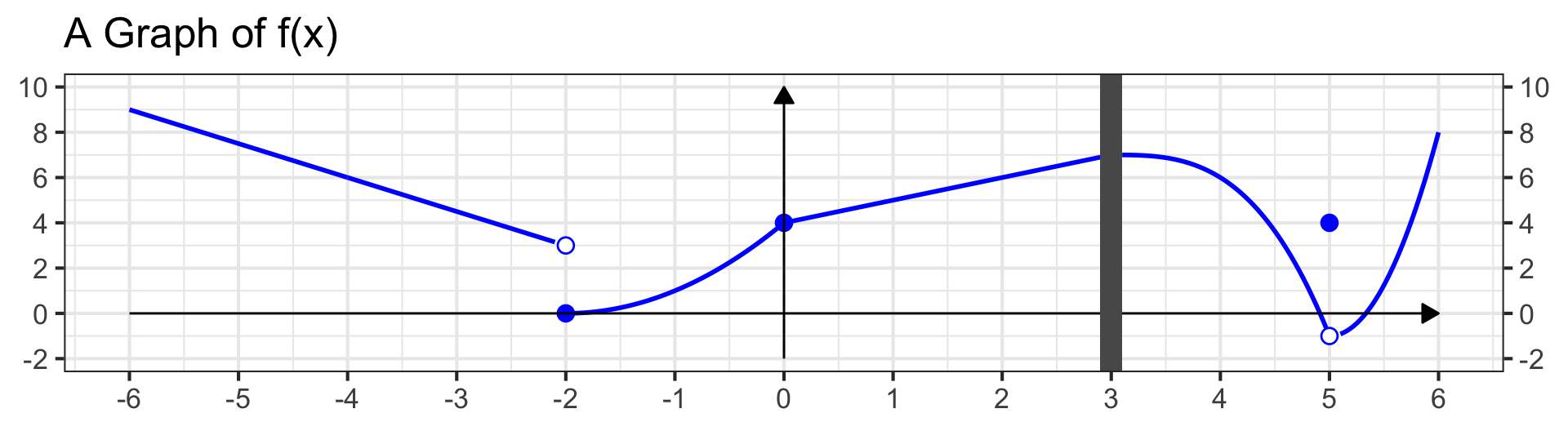
- \(\displaystyle{\lim_{x\to 3}{f\left(x\right)} = \boxed{~7~}}\) – as \(x\to 3\) from either side, \(f\left(x\right)\to 7\), even though \(f\left(3\right)\) is undefined. If we could assign \(f\left(3\right) = 7\), the function would be “fixed” there.
Completed Example 1
Problem: Consider the function \(f\left(x\right)\) whose graph appears below. Determine each of the following limits, if they exist.
\[\left(a\right)~\lim_{x\to -4}{f\left(x\right)} \qquad \left(b\right)~\lim_{x\to -2}{f\left(x\right)} \qquad \left(c\right)~\lim_{x\to 0}{f\left(x\right)} \qquad \left(d\right)~\lim_{x\to 3}{f\left(x\right)} \qquad \left(e\right)~\lim_{x\to 5}{f\left(x\right)}\]
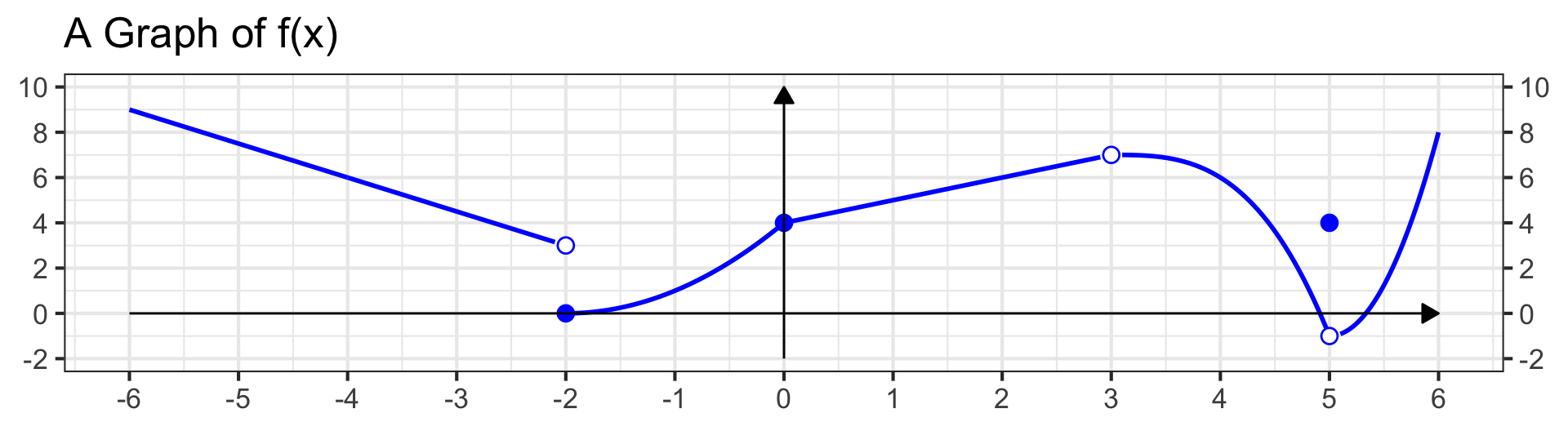
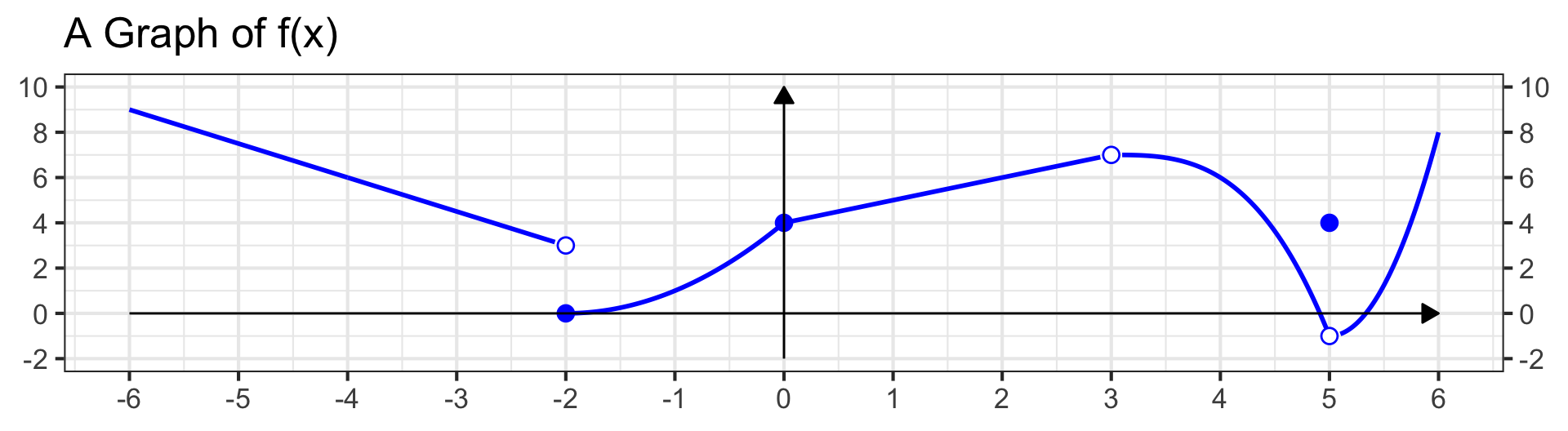
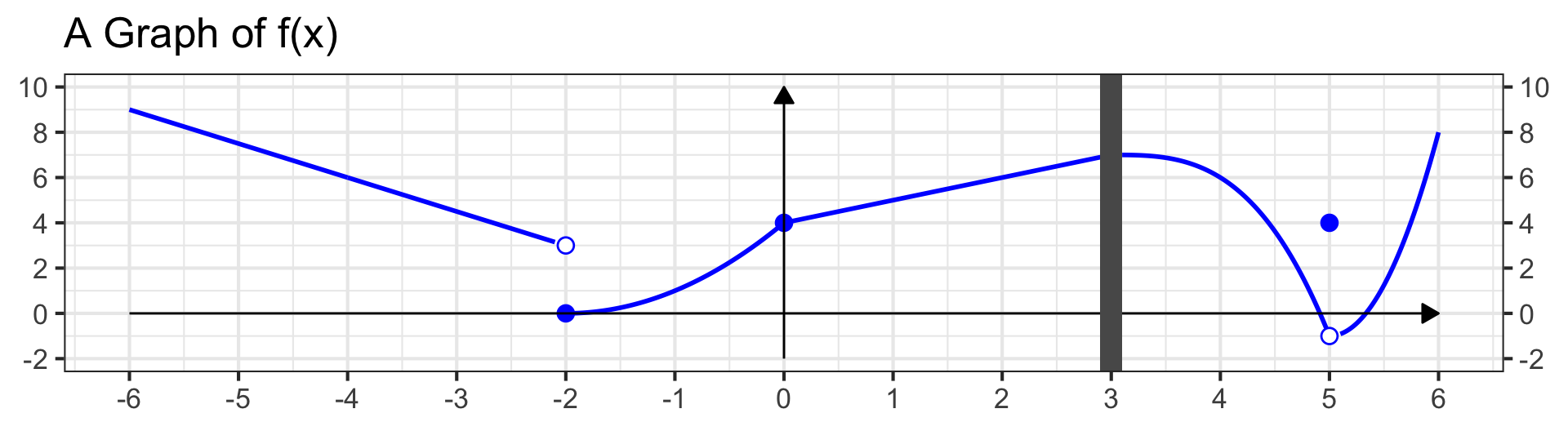
- \(\displaystyle{\lim_{x\to 3}{f\left(x\right)} = \boxed{~7~}}\) – as \(x\to 3\) from either side, \(f\left(x\right)\to 7\), even though \(f\left(3\right)\) is undefined. If we could assign \(f\left(3\right) = 7\), the function would be “fixed” there.
- \(\displaystyle{\lim_{x\to 5}{f\left(x\right)}}\)
Completed Example 1
Problem: Consider the function \(f\left(x\right)\) whose graph appears below. Determine each of the following limits, if they exist.
\[\left(a\right)~\lim_{x\to -4}{f\left(x\right)} \qquad \left(b\right)~\lim_{x\to -2}{f\left(x\right)} \qquad \left(c\right)~\lim_{x\to 0}{f\left(x\right)} \qquad \left(d\right)~\lim_{x\to 3}{f\left(x\right)} \qquad \left(e\right)~\lim_{x\to 5}{f\left(x\right)}\]
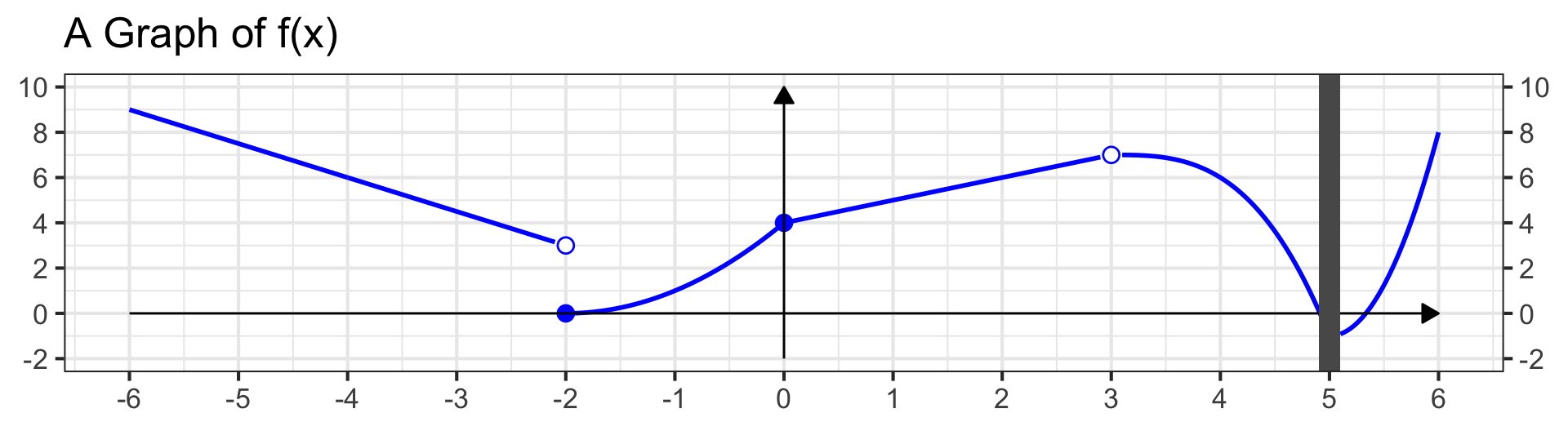
- \(\displaystyle{\lim_{x\to 3}{f\left(x\right)} = \boxed{~7~}}\) – as \(x\to 3\) from either side, \(f\left(x\right)\to 7\), even though \(f\left(3\right)\) is undefined. If we could assign \(f\left(3\right) = 7\), the function would be “fixed” there.
- \(\displaystyle{\lim_{x\to 5}{f\left(x\right)}}\)
Completed Example 1
Problem: Consider the function \(f\left(x\right)\) whose graph appears below. Determine each of the following limits, if they exist.
\[\left(a\right)~\lim_{x\to -4}{f\left(x\right)} \qquad \left(b\right)~\lim_{x\to -2}{f\left(x\right)} \qquad \left(c\right)~\lim_{x\to 0}{f\left(x\right)} \qquad \left(d\right)~\lim_{x\to 3}{f\left(x\right)} \qquad \left(e\right)~\lim_{x\to 5}{f\left(x\right)}\]
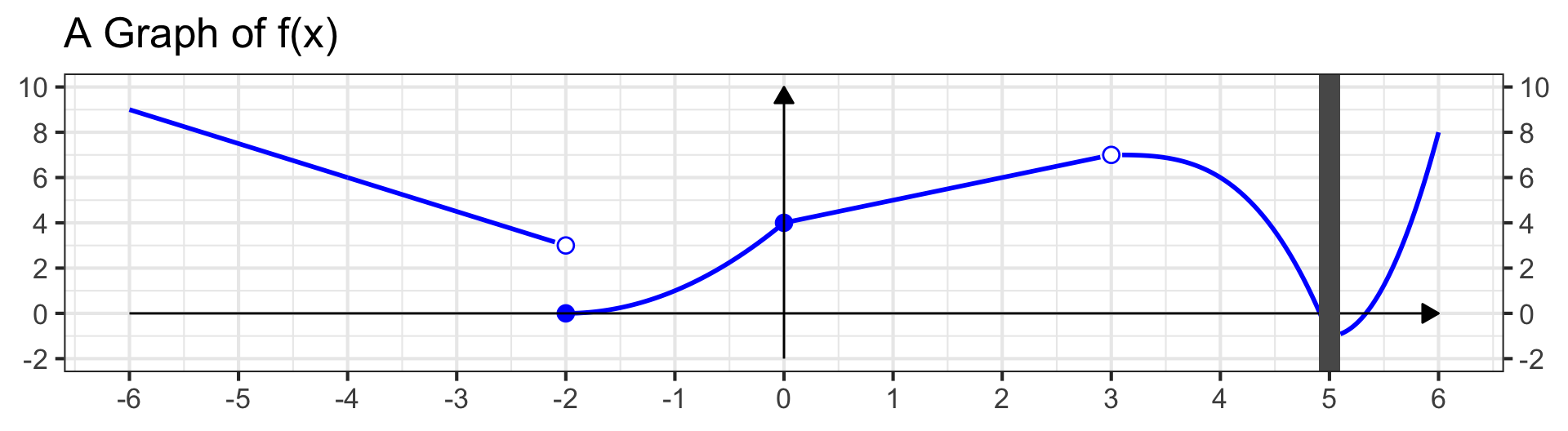
- \(\displaystyle{\lim_{x\to 3}{f\left(x\right)} = \boxed{~7~}}\) – as \(x\to 3\) from either side, \(f\left(x\right)\to 7\), even though \(f\left(3\right)\) is undefined. If we could assign \(f\left(3\right) = 7\), the function would be “fixed” there.
- \(\displaystyle{\lim_{x\to 5}{f\left(x\right)} = \boxed{~-1~}}\) – as \(x\to 5\) from either side, \(f\left(x\right) \to -1\) even though \(f\left(5\right) = 4\). The limit does not ask what happens at \(x = 5\), only near it.
Completed Example 1
Problem: Consider the function \(f\left(x\right)\) whose graph appears below. Determine each of the following limits, if they exist.
\[\left(a\right)~\lim_{x\to -4}{f\left(x\right)} \qquad \left(b\right)~\lim_{x\to -2}{f\left(x\right)} \qquad \left(c\right)~\lim_{x\to 0}{f\left(x\right)} \qquad \left(d\right)~\lim_{x\to 3}{f\left(x\right)} \qquad \left(e\right)~\lim_{x\to 5}{f\left(x\right)}\]
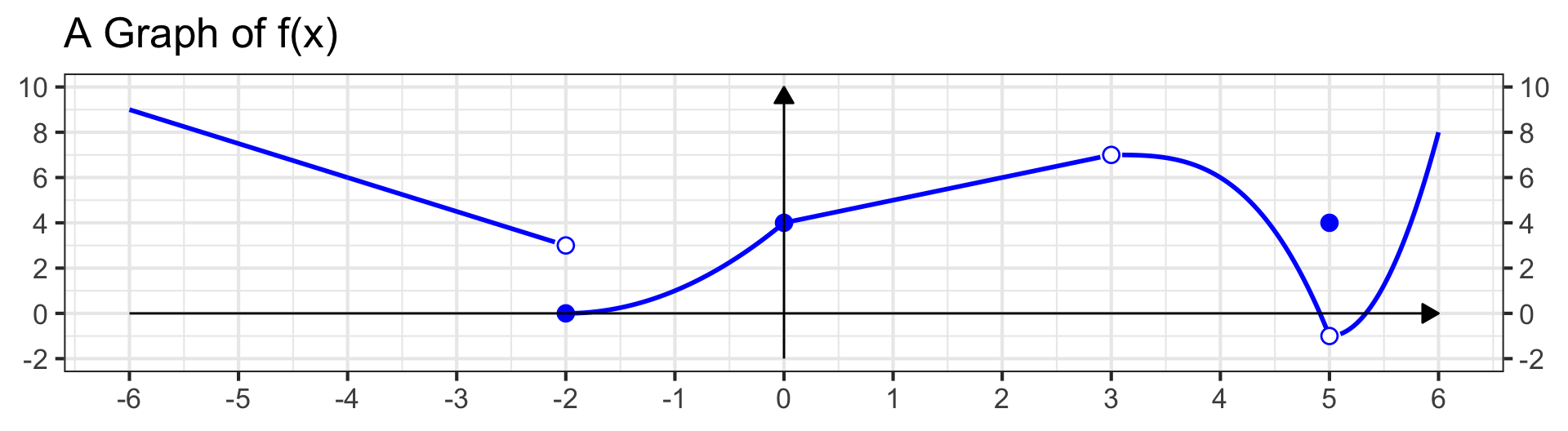
- \(\displaystyle{\lim_{x\to 3}{f\left(x\right)} = \boxed{~7~}}\) – as \(x\to 3\) from either side, \(f\left(x\right)\to 7\), even though \(f\left(3\right)\) is undefined. If we could assign \(f\left(3\right) = 7\), the function would be “fixed” there.
- \(\displaystyle{\lim_{x\to 5}{f\left(x\right)} = \boxed{~-1~}}\) – as \(x\to 5\) from either side, \(f\left(x\right) \to -1\) even though \(f\left(5\right) = 4\). The limit does not ask what happens at \(x = 5\), only near it. Similarly, if we could re-define \(f\left(5\right) = -1\), the function would be “fixed” here.
Completed Example 1
Problem: Consider the function \(f\left(x\right)\) whose graph appears below. Determine each of the following limits, if they exist.
\[\left(a\right)~\lim_{x\to -4}{f\left(x\right)} \qquad \left(b\right)~\lim_{x\to -2}{f\left(x\right)} \qquad \left(c\right)~\lim_{x\to 0}{f\left(x\right)} \qquad \left(d\right)~\lim_{x\to 3}{f\left(x\right)} \qquad \left(e\right)~\lim_{x\to 5}{f\left(x\right)}\]
Key Takeaway
Limits provide a way to evaluate functions near a point, not necessarily at it. If a limit exists at a point of discontinuity, the discontinuity is removable – it could be fixed by simply reassigning the function value at that one point. If the limit does not exist, the discontinuity is more severe.
Limits from Graphs Practice I
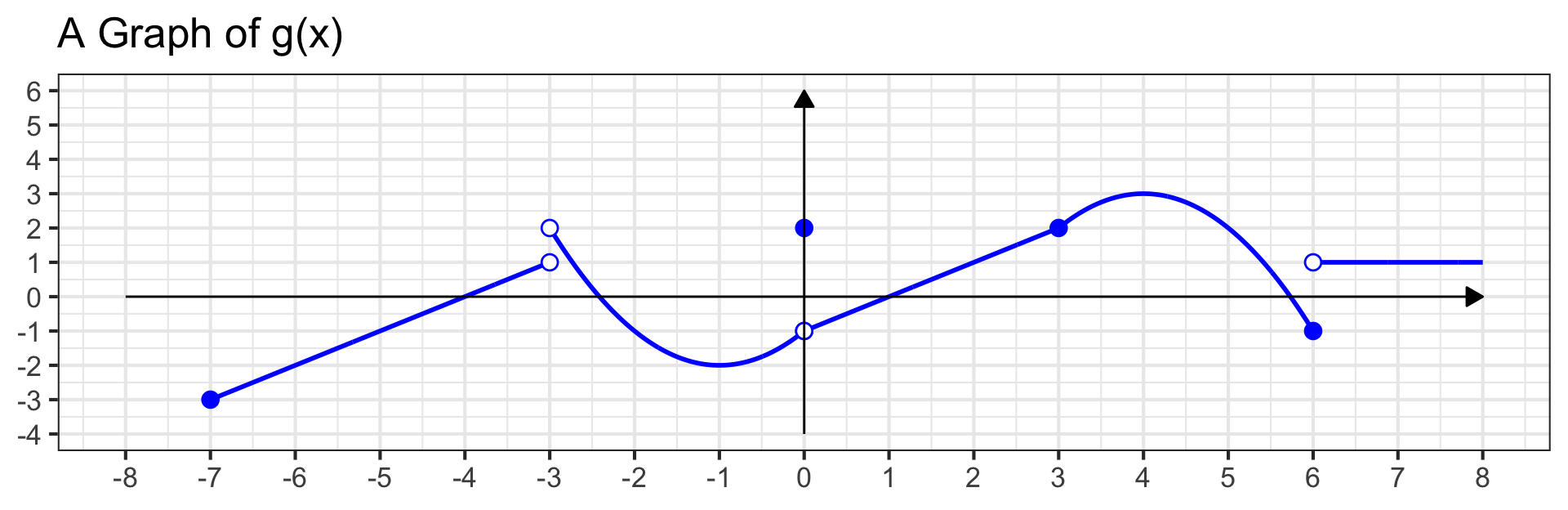
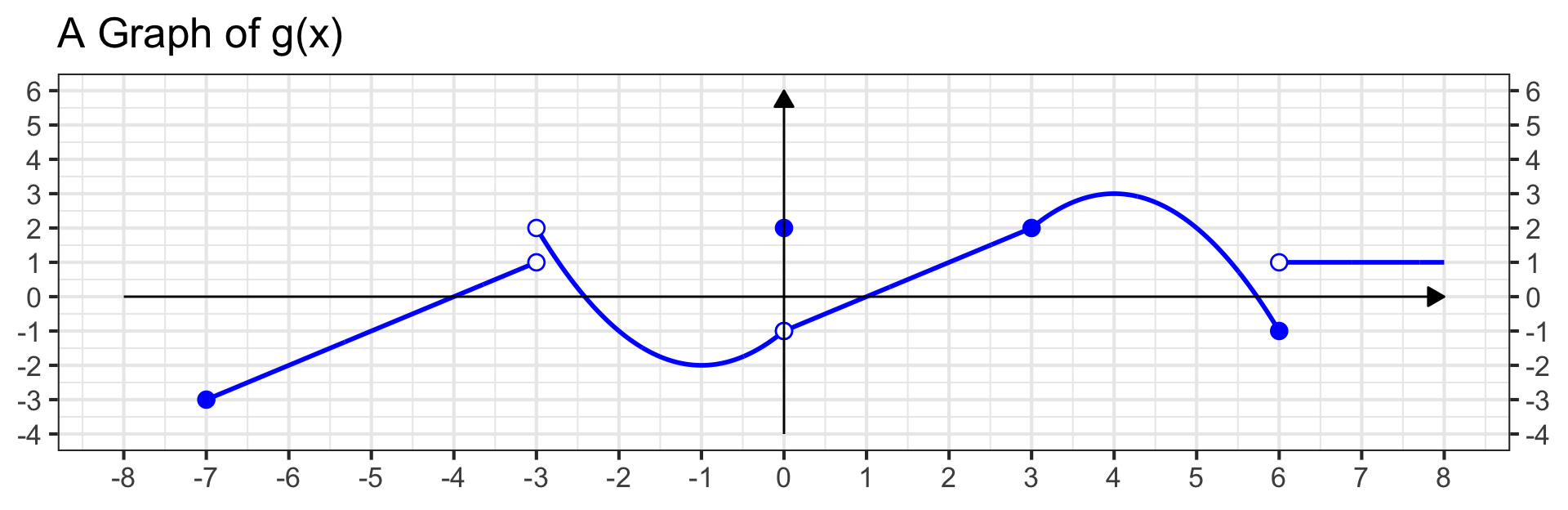
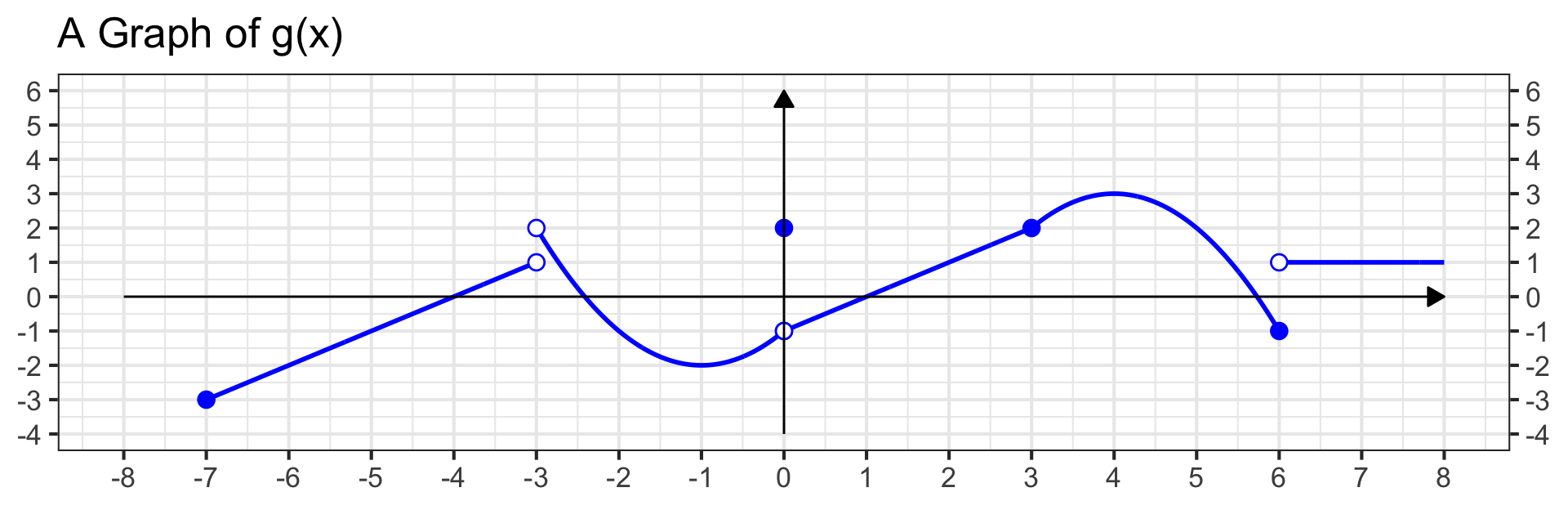
Try It! 1: Consider the function \(g\left(x\right)\) whose graph appears below. Determine each of the following limits, if they exist.
\[\left(a\right)~\lim_{x\to -3}{g\left(x\right)} \qquad \left(b\right)~\lim_{x\to 0}{g\left(x\right)} \qquad \left(c\right)~\lim_{x\to 3}{g\left(x\right)} \qquad \left(d\right)~\lim_{x\to 6}{g\left(x\right)}\]
Completed Example 2
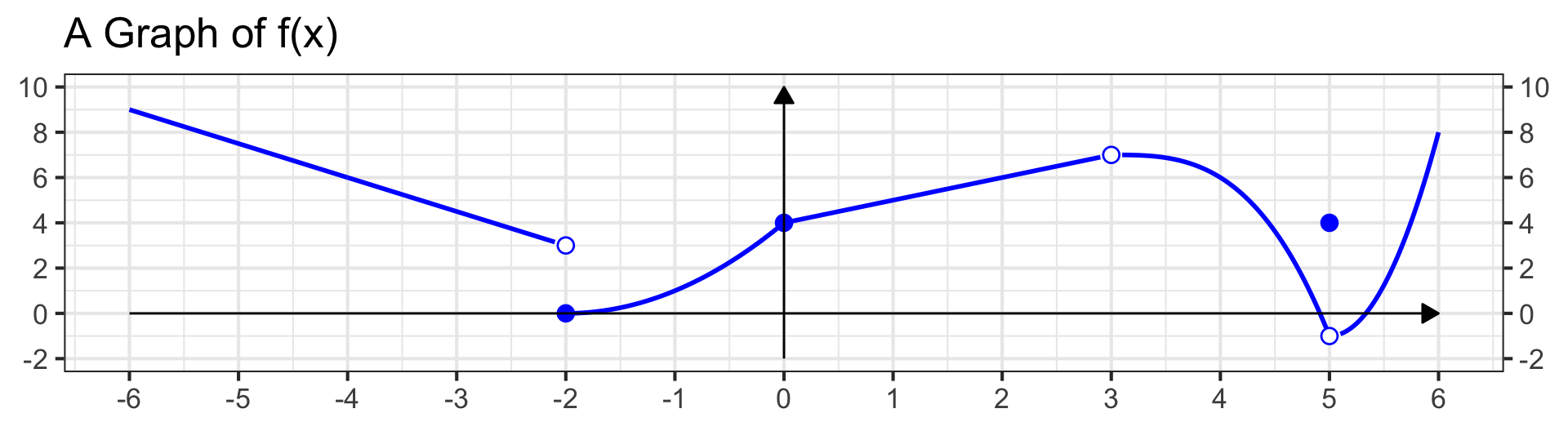
Problem: Using the same graph of \(f\left(x\right)\), determine each of the following one-sided limits.
\[\left(a\right)~\lim_{x\to -6^{+}}{f\left(x\right)} \qquad \left(b\right)~\lim_{x\to -2^{-}}{f\left(x\right)} \qquad \left(c\right)~\lim_{x\to -2^{+}}{f\left(x\right)} \qquad \left(d\right)~\lim_{x\to 5^{-}}{f\left(x\right)} \qquad \left(e\right)~\lim_{x\to 5^{+}}{f\left(x\right)} \qquad \left(f\right)~\lim_{x\to 6^{-}}{f\left(x\right)}\]
Completed Example 2
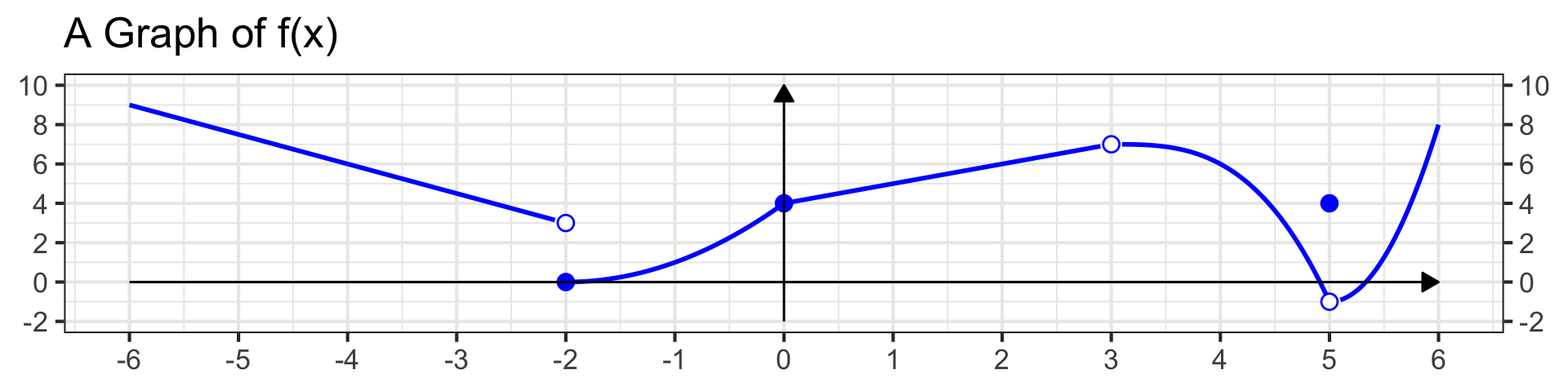
Problem: Using the same graph of \(f\left(x\right)\), determine each of the following one-sided limits.
\[\left(a\right)~\lim_{x\to -6^{+}}{f\left(x\right)} \qquad \left(b\right)~\lim_{x\to -2^{-}}{f\left(x\right)} \qquad \left(c\right)~\lim_{x\to -2^{+}}{f\left(x\right)} \qquad \left(d\right)~\lim_{x\to 5^{-}}{f\left(x\right)} \qquad \left(e\right)~\lim_{x\to 5^{+}}{f\left(x\right)} \qquad \left(f\right)~\lim_{x\to 6^{-}}{f\left(x\right)}\]
Solution.
- \(\displaystyle{\lim_{x\to -6^{+}}{f\left(x\right)} = \boxed{~9~}}\) – approaching from the right, heights grow toward \(9\).
- \(\displaystyle{\lim_{x\to -2^{-}}{f\left(x\right)} = \boxed{~3~}}\) – approaching from the left, heights drop toward \(3\).
- \(\displaystyle{\lim_{x\to -2^{+}}{f\left(x\right)} = \boxed{~0~}}\) – approaching from the right, heights approach \(0\). Since \(3 \neq 0\), \(\displaystyle{\lim_{x\to -2}{f\left(x\right)}}\) does not exist.
Completed Example 2
Problem: Using the same graph of \(f\left(x\right)\), determine each of the following one-sided limits.
\[\left(a\right)~\lim_{x\to -6^{+}}{f\left(x\right)} \qquad \left(b\right)~\lim_{x\to -2^{-}}{f\left(x\right)} \qquad \left(c\right)~\lim_{x\to -2^{+}}{f\left(x\right)} \qquad \left(d\right)~\lim_{x\to 5^{-}}{f\left(x\right)} \qquad \left(e\right)~\lim_{x\to 5^{+}}{f\left(x\right)} \qquad \left(f\right)~\lim_{x\to 6^{-}}{f\left(x\right)}\]
Solution.
- \(\displaystyle{\lim_{x\to 5^{-}}{f\left(x\right)} = \boxed{~-1~}}\) and \(\displaystyle{\lim_{x\to 5^{+}}{f\left(x\right)} = \boxed{~-1~}}\) – since these agree, \(\displaystyle{\lim_{x\to 5}{f\left(x\right)} = -1}\).
- \(\displaystyle{\lim_{x\to 6^{-}}{f\left(x\right)} = \boxed{~8~}}\).
Limits from Graphs Practice II
Try It! 2: Consider the function \(g\left(x\right)\) whose graph appears below. Determine each of the following one-sided limits, if they exist.
\[\left(a\right)~\lim_{x\to -7^{+}}{g\left(x\right)} \qquad \left(b\right)~\lim_{x\to -3^{-}}{g\left(x\right)} \qquad \left(c\right)~\lim_{x\to -3^{+}}{g\left(x\right)} \qquad \left(d\right)~\lim_{x\to 6^{-}}{g\left(x\right)} \qquad \left(e\right)~\lim_{x\to 6^{+}}{g\left(x\right)} \qquad \left(f\right)~\lim_{x\to 8^{-}}{g\left(x\right)}\]
Exit Ticket Task
Navigate to our MAT142 Exit Ticket Form, answer the questions, and complete the task below.
Note. Today’s discussion is listed as 4. Limits and Rates of Change

Task: Evaluate \(\displaystyle{\lim_{x\to 3}{\frac{x^2 - 9}{x - 3}}}\) and describe what the result tells you about the function \(\displaystyle{f\left(x\right) = \frac{x^2 - 9}{x - 3}}\) near \(x = 3\).