MAT 142: Domain and Range of Functions

Dr. Gilbert

June 1, 2026

Reminders

At our last meeting, we discussed each of the following:

  • Reading landmarks from a function’s graph.
  • Interval notation.
  • The definition of a function and the vertical line test.
  • Function notation and evaluating functions.
  • Piecewise-defined functions.

Try the following warm-up problems.

Problem 1: Simplify \(\displaystyle{\frac{x}{x - 8} + \frac{\frac{1}{x + 1} - \frac{1}{x}}{x - 8}}\)

Problem 2: Simplify \(\displaystyle{\frac{x^2 - 12x + 32}{x^2 - 4x}}\)

Problem 3: Evaluate \(f\left(5\right)\) for \(\displaystyle{f\left(x\right) = \sqrt{\left(x^2 - 9\right)}}\)

Problem 4: Evaluate \(f\left(1\right)\) for \(\displaystyle{f\left(x\right) = \sqrt{\left(x^2 - 9\right)}}\)

Problem 5: Consider \(f\left(x\right) = \left\{\begin{array}{rcl} x^2 - x & ; & x \leq -3\\ x & ; & -3 < x < 7\\ \sqrt{2 + x} & ; & x \geq 7\end{array}\right.\)

Evaluate \(f\left(-4\right)\), \(f\left(0\right)\), \(f\left(7\right)\), and \(f\left(-3\right)\).

Objectives

Today, we’ll develop the ideas of domain and range for functions.

After today’s class meeting, you should be able to:

  • Identify the domain of a function from its graph.
  • Determine the domain of a function from its algebraic definition.
  • Identify the range of a function from its graph.
  • Express the domain of a function and the range of a function using interval notation.

Domain

Definition (Domain): Given a function \(f\left(x\right)\), the domain of \(f\) is the set of all permissible inputs.

In PreCalculus, we assume the domain is all real numbers \(\left(\mathbb{R}\right)\) unless the function forces us to restrict it.

There are two common situations that force domain restrictions (though we’ll encounter more later):

  • Rational expressions: the denominator cannot be \(0\), so we exclude any inputs that make the denominator \(0\).
  • Even-index radicals (square roots, fourth roots, etc.): the expression under the radical cannot be negative, so we require it to be \(\geq 0\).

For a video overview, check out this video from The Organic Chemistry Tutor (reading domain from a graph) and this one from patrickJMT (finding domain algebraically).

Completed Example 1

Problem: Determine the domain of \(f\left(x\right) = 10x - 20\).

Solution. You might recognize this as a linear function. There are no variables in denominators and no radicals. The function is defined for any real number input.

\[\text{Domain of } f: \left(-\infty, \infty\right)\]

Completed Example 2

Problem: Determine the domain of \(\displaystyle{g\left(x\right) = \frac{x}{x^2 - 9}}\).

Solution. This function contains a rational expression, so we must exclude any inputs that make the denominator \(0\).

\[\begin{align} x^2 - 9 &\neq 0 \end{align}\]

Completed Example 2

Problem: Determine the domain of \(\displaystyle{g\left(x\right) = \frac{x}{x^2 - 9}}\).

Solution. This function contains a rational expression, so we must exclude any inputs that make the denominator \(0\).

\[\begin{align} x^2 - 9 &\neq 0\\ \implies \left(x + 3\right)\left(x - 3\right) &\neq 0 \end{align}\]

Completed Example 2

Problem: Determine the domain of \(\displaystyle{g\left(x\right) = \frac{x}{x^2 - 9}}\).

Solution. This function contains a rational expression, so we must exclude any inputs that make the denominator \(0\).

\[\begin{align} x^2 - 9 &\neq 0\\ \implies \left(x + 3\right)\left(x - 3\right) &\neq 0\\ \implies x + 3 \neq 0 &\text{ and } x - 3 \neq 0 \end{align}\]

Completed Example 2

Problem: Determine the domain of \(\displaystyle{g\left(x\right) = \frac{x}{x^2 - 9}}\).

Solution. This function contains a rational expression, so we must exclude any inputs that make the denominator \(0\).

\[\begin{align} x^2 - 9 &\neq 0\\ \implies \left(x + 3\right)\left(x - 3\right) &\neq 0\\ \implies x + 3 \neq 0 &\text{ and } x - 3 \neq 0\\ \implies x \neq -3 &\text{ and } x \neq 3 \end{align}\]

Completed Example 2

Problem: Determine the domain of \(\displaystyle{g\left(x\right) = \frac{x}{x^2 - 9}}\).

Solution. This function contains a rational expression, so we must exclude any inputs that make the denominator \(0\).

\[\begin{align} x^2 - 9 &\neq 0\\ \implies \left(x + 3\right)\left(x - 3\right) &\neq 0\\ \implies x + 3 \neq 0 &\text{ and } x - 3 \neq 0\\ \implies x \neq -3 &\text{ and } x \neq 3 \end{align}\]

\[\text{Domain of } g: \boxed{~\left(-\infty, -3\right)\cup\left(-3, 3\right)\cup\left(3, \infty\right)~}\]

Completed Example 3

Problem: Determine the domain of \(\displaystyle{h\left(x\right) = \sqrt{\left(30 - 5x\right)}}\).

Solution. This function contains a square root, so the expression under the radical must be at least \(0\).

\[\begin{align} 30 - 5x &\geq 0 \end{align}\]

Completed Example 3

Problem: Determine the domain of \(\displaystyle{h\left(x\right) = \sqrt{\left(30 - 5x\right)}}\).

Solution. This function contains a square root, so the expression under the radical must be \(\geq 0\).

\[\begin{align} 30 - 5x &\geq 0\\ \implies -5x &\geq -30 \end{align}\]

Completed Example 3

Problem: Determine the domain of \(\displaystyle{h\left(x\right) = \sqrt{\left(30 - 5x\right)}}\).

Solution. This function contains a square root, so the expression under the radical must be \(\geq 0\).

\[\begin{align} 30 - 5x &\geq 0\\ \implies -5x &\geq -30\\ \implies x &\leq 6 \end{align}\]

Completed Example 3

Problem: Determine the domain of \(\displaystyle{h\left(x\right) = \sqrt{\left(30 - 5x\right)}}\).

Solution. This function contains a square root, so the expression under the radical must be \(\geq 0\).

\[\begin{align} 30 - 5x &\geq 0\\ \implies -5x &\geq -30\\ \implies x &\leq 6 \end{align}\]

\[\text{Domain of } h: \boxed{~\left(-\infty, 6\right]~}\]

Solving Inequalities

When dividing or multiplying both sides of an inequality by a negative number, the direction of the inequality must flip. Forgetting this is a common error. Watch for it carefully.

Domain from a Graph

We can also identify the domain of a function directly from its graph.

The domain corresponds to the set of all \(x\)-values for which the graph exists – that is, all inputs that have a corresponding output on the graph.

Two things to watch carefully:

  • Open dots (hollow circles) indicate that the particular point is not part of the graph.
  • Closed dots (filled circles) indicate that a particular point is part of the graph.

Completed Example 4

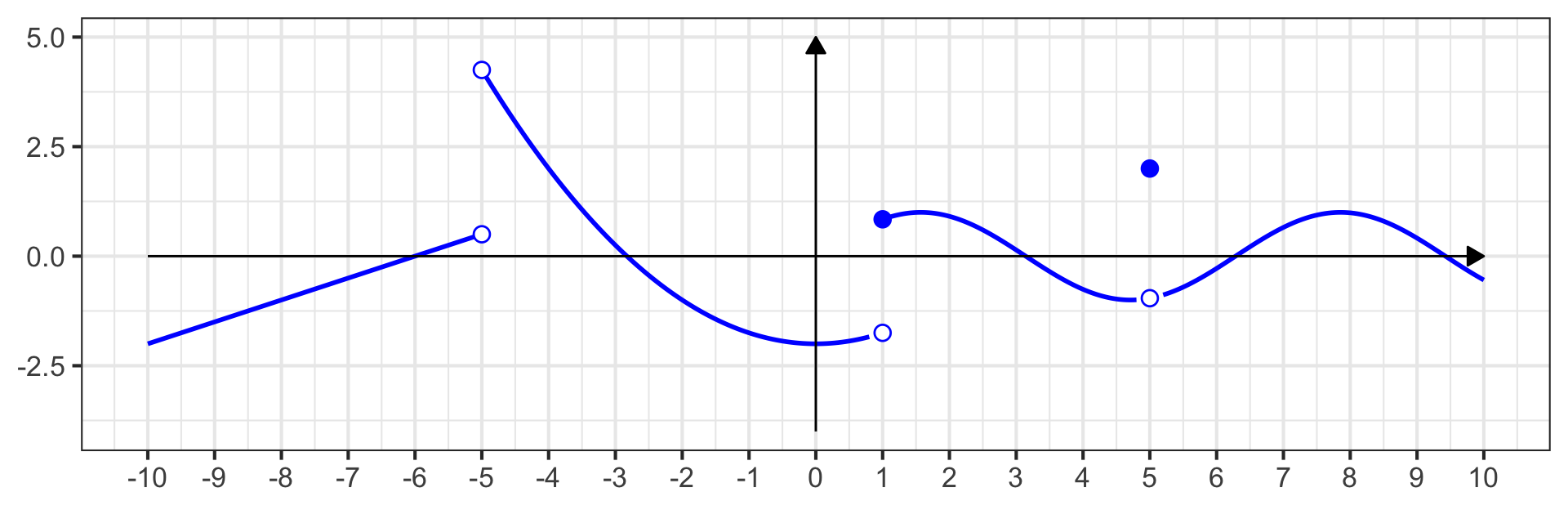
Problem: Identify the domain of \(j\left(x\right)\) from its graph below. Assume the graph extends infinitely left and right, and that all domain restrictions are visible.
Completed Example 4

Problem: Identify the domain of \(j\left(x\right)\) from its graph below. Assume the graph extends infinitely left and right, and that all domain restrictions are visible.
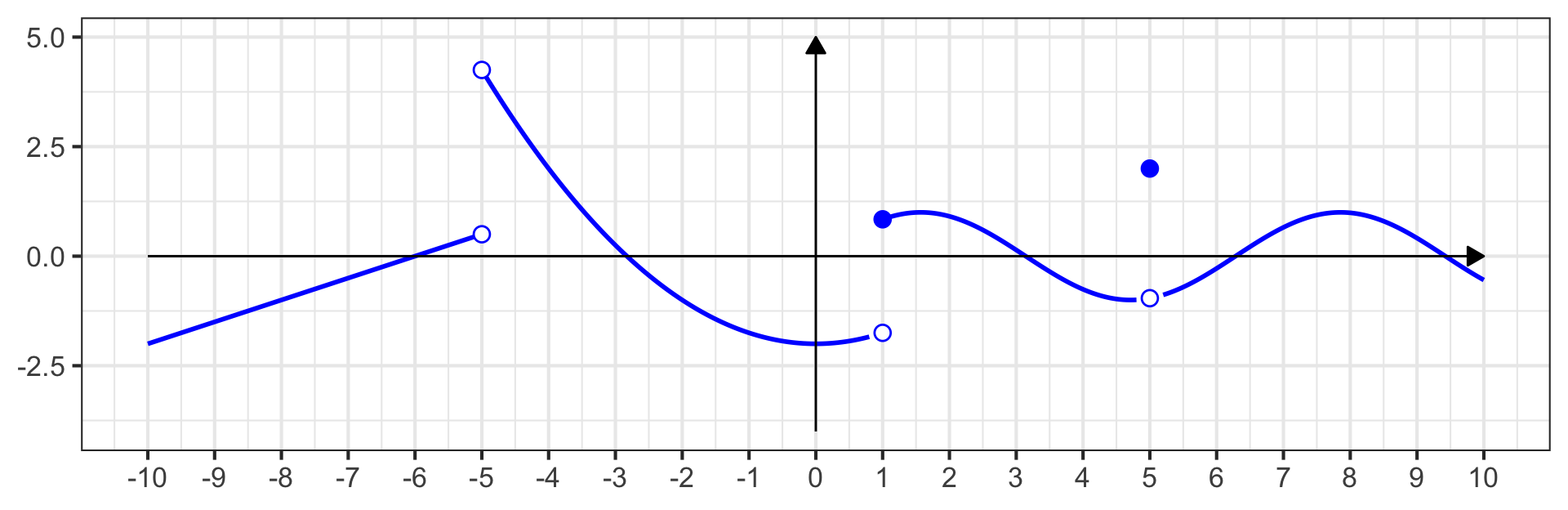
Solution. The graph has open dots at \(x = -5\) and no closed dot. The function is undefined there. At \(x = 1\) and \(x = 5\), open dots on one piece are matched by closed dots on another, so both values are included. The graph exists for all other \(x\) and we’ll assume the graph extends in the positive and negative \(x\) direction since there are no closed dot indicators at the \(x = \pm 10\).

\[\text{Domain of } j: \boxed{~\left(-\infty, -5\right)\cup\left(-5, \infty\right)~}\]

Range

Definition (Range): Given a function \(f\left(x\right)\), the range of \(f\) is the set of all attainable output values.

The range is generally harder to identify algebraically. Later in our course we’ll use:

  • Transformations of known base functions to determine the range.
  • Asymptotic behavior to identify outputs the function may never reach.

For now, we’ll identify the range of a function from its graph by asking: “what \(y\)-values does the graph actually reach?

Completed Example 5

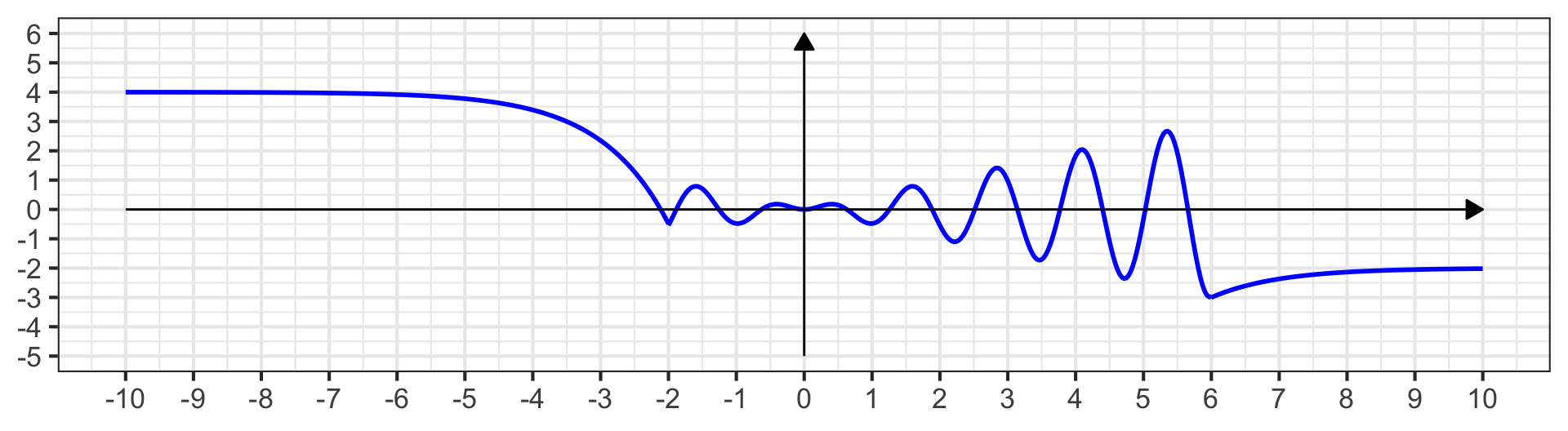
Problem: Determine the range of \(g\left(x\right)\) by analyzing its graph below.
Completed Example 5

Problem: Determine the range of \(g\left(x\right)\) by analyzing its graph below.
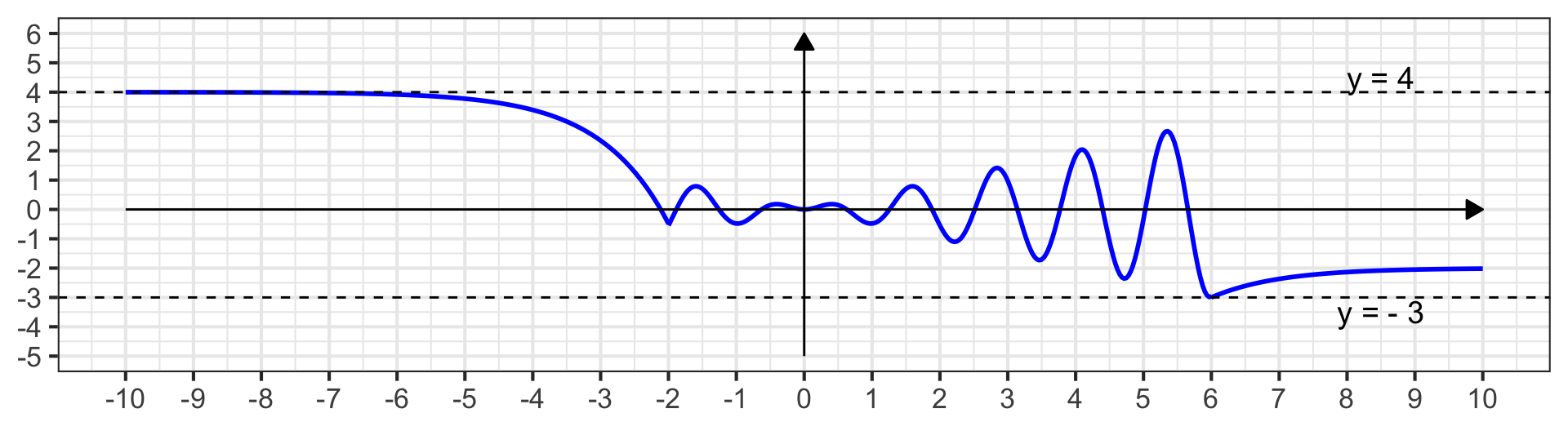
Solution. The graph appears to attain output values between \(y \approx -3\) and \(y \approx 4\).

This means the range is one of the following – but from the graph alone, we cannot determine which:

\[\left[-3, 4\right] \qquad \left(-3, 4\right] \qquad \left[-3, 4\right) \qquad \left(-3, 4\right)\]

Key Idea

Whether an endpoint is included in the range depends on whether the function actually attains that output value. A graph can suggest approximate bounds, but confirming whether endpoints are reached requires more algebraic analysis via tools we’ll develop later in our course.

Domain and Range Practice

Determine the domain of each of the following functions from their algebraic definitions.

Try It! 1: Find the domain of the function \(f\left(x\right) = \sqrt{\left(x - 10\right)}\)

Try It! 2: Find the domain of the function \(g\left(x\right) = 2 + 5x + 3x^2\)

Try It! 3: Find the domain of the function \(h\left(x\right) = \displaystyle{\frac{x^2 - 16}{5x}}\)

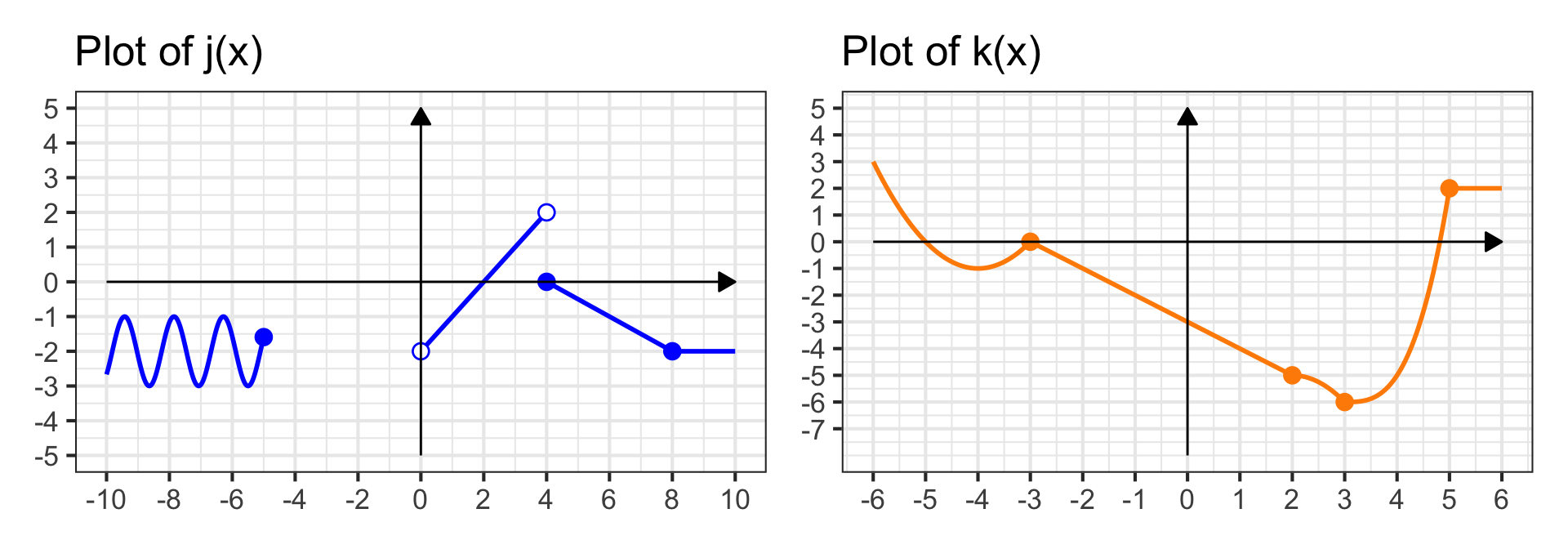
Try It! 4 and 5: Determine the domain and range of each function from its graph. Assume the behavior continues off to the left or right following the patterns shown.
Domain and Range Practice

Determine the domain of each of the following functions from their algebraic definitions.

Try It! 6: Find the domain of the function \(\ell\left(x\right) = \displaystyle{\frac{x^2 - 36}{x + 6}}\)

Try It! 7: Find the domain of the function \(m\left(x\right) = \displaystyle{\frac{x + 5}{\sqrt{\left(x^2 - 25\right)}}}\)

Try It! 8: Find the domain of the function \(n\left(x\right) = \displaystyle{\frac{x^2 - 5x + 12}{x^2 + 4}}\)

Building Intuition

That last function shows the value of thinking carefully before diving into algebra. What can you say about \(x^2 + 4\) for any real number \(x\)?

Applied Problem

Problem: The height \(h\) (in feet) of a projectile is a function of the time \(t\) (in seconds) it has been in the air:

\[h\left(t\right) = -16t^2 + 96t\]

What is the domain of this function? What does the domain mean in the context of the problem?

Solution. Algebraically, \(h\left(t\right)\) is a polynomial and is defined for all real numbers. But in the context of a projectile in the air, negative time doesn’t make physical sense, and the projectile hits the ground when \(h\left(t\right) = 0\).

\[\begin{align} -16t^2 + 96t &= 0 \end{align}\]

Applied Problem

Problem: The height \(h\) (in feet) of a projectile is a function of the time \(t\) (in seconds) it has been in the air:

\[h\left(t\right) = -16t^2 + 96t\]

What is the domain of this function? What does the domain mean in the context of the problem?

Solution. Algebraically, \(h\left(t\right)\) is a polynomial and is defined for all real numbers. But in the context of a projectile in the air, negative time doesn’t make physical sense, and the projectile hits the ground when \(h\left(t\right) = 0\).

\[\begin{align} -16t^2 + 96t &= 0\\ \implies -16t\left(t - 6\right) &= 0 \end{align}\]

Applied Problem

Problem: The height \(h\) (in feet) of a projectile is a function of the time \(t\) (in seconds) it has been in the air:

\[h\left(t\right) = -16t^2 + 96t\]

What is the domain of this function? What does the domain mean in the context of the problem?

Solution. Algebraically, \(h\left(t\right)\) is a polynomial and is defined for all real numbers. But in the context of a projectile in the air, negative time doesn’t make physical sense, and the projectile hits the ground when \(h\left(t\right) = 0\).

\[\begin{align} -16t^2 + 96t &= 0\\ \implies -16t\left(t - 6\right) &= 0\\ \implies -16t = 0 &\text{ or } t - 6 = 0 \end{align}\]

Applied Problem

Problem: The height \(h\) (in feet) of a projectile is a function of the time \(t\) (in seconds) it has been in the air:

\[h\left(t\right) = -16t^2 + 96t\]

What is the domain of this function? What does the domain mean in the context of the problem?

Solution. Algebraically, \(h\left(t\right)\) is a polynomial and is defined for all real numbers. But in the context of a projectile in the air, negative time doesn’t make physical sense, and the projectile hits the ground when \(h\left(t\right) = 0\).

\[\begin{align} -16t^2 + 96t &= 0\\ \implies -16t\left(t - 6\right) &= 0\\ \implies -16t = 0 &\text{ or } t - 6 = 0\\ \implies t = 0 &\text{ or } t = 6 \end{align}\]

Applied Problem

Problem: The height \(h\) (in feet) of a projectile is a function of the time \(t\) (in seconds) it has been in the air:

\[h\left(t\right) = -16t^2 + 96t\]

What is the domain of this function? What does the domain mean in the context of the problem?

Solution. Algebraically, \(h\left(t\right)\) is a polynomial and is defined for all real numbers. But in the context of a projectile in the air, negative time doesn’t make physical sense, and the projectile hits the ground when \(h\left(t\right) = 0\).

\[\begin{align} -16t^2 + 96t &= 0\\ \implies -16t\left(t - 6\right) &= 0\\ \implies -16t = 0 &\text{ or } t - 6 = 0\\ \implies t = 0 &\text{ or } t = 6 \end{align}\]

The projectile is in the air from \(t = 0\) to \(t = 6\) seconds. The contextual domain is \(\boxed{~\left[0, 6\right]~}\).

Exit Ticket Task

Navigate to our MAT142 Exit Ticket Form, answer the questions, and complete the task below.


Note. Today’s discussion is listed as 3. Domain and Range

Task: Determine the domain of each of the following functions.

\[\left(a\right)~f\left(x\right) = \frac{3x}{\sqrt{\left(x - 4\right)}} \qquad \left(b\right)~g\left(x\right) = \frac{x^2 + 1}{x^2 - 4}\]

Summary and Next Time…

Ideas From Today
  • The domain of a function is the set of all permissible inputs.
  • Domain restrictions arise from denominators (can’t be \(0\)) and even-index radicals (argument must be at least \(0\)).
  • To find the domain from a graph, identify the set of all \(x\)-values where the graph exists. Watch for open and closed dots.
  • The range of a function is the set of all attainable outputs.
  • To find the range from a graph, identify the set of all \(y\)-values the graph reaches. Graphs alone may not tell us whether endpoints of the range intervals are included though.
Resources
Next Time:
Limits and Rates of Change
Homework:
Finish Homework 2 on MyOpenMath