MAT 142: Intervals and Introduction to Functions
September 9, 2026
Completed Example 1
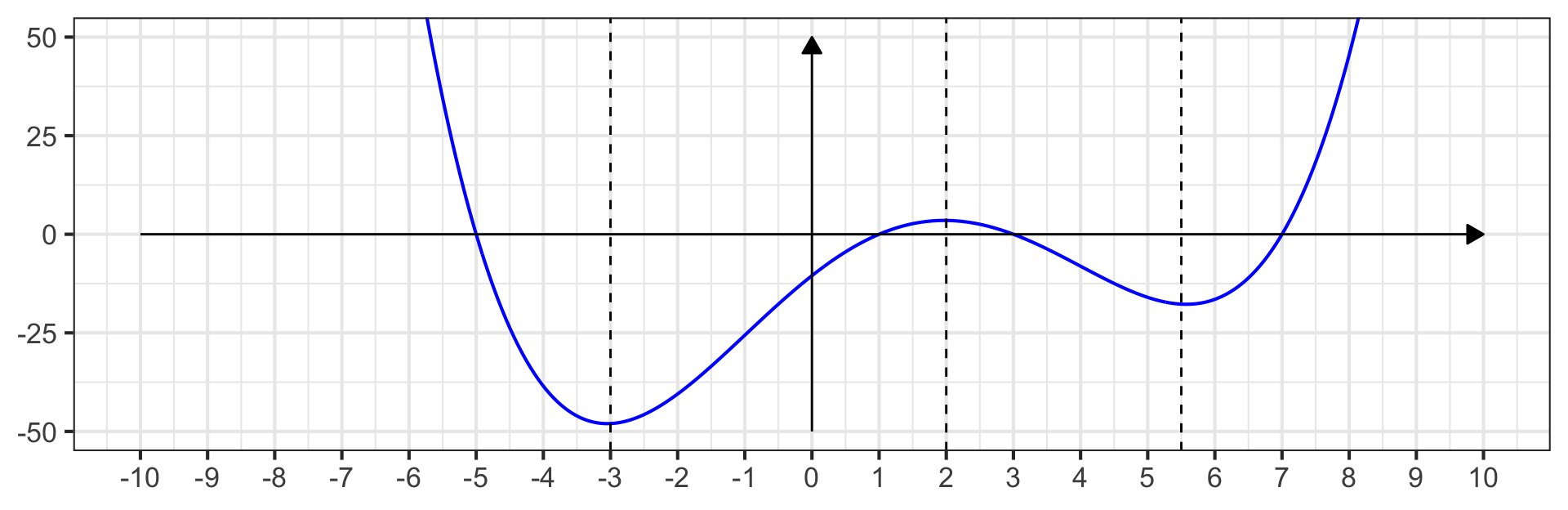
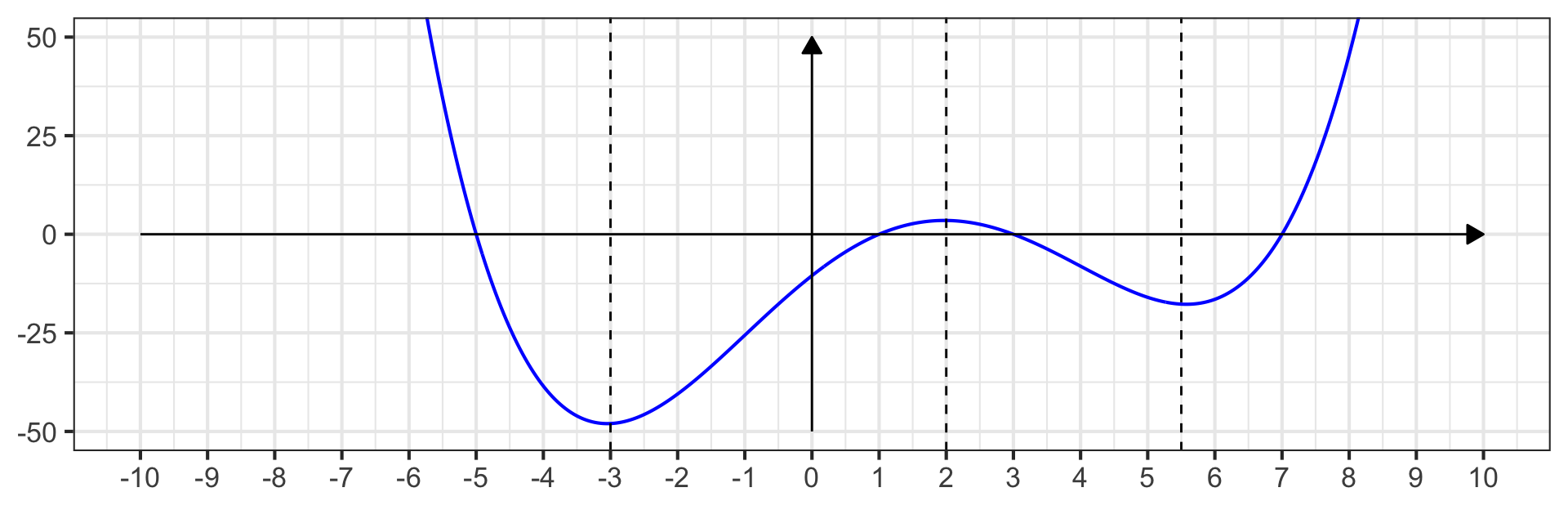
Consider the function graphed on the right. Answer each of the following.
- Identify the locations of all roots (\(x\)-intercepts).
- Identify the \(y\)-intercept.
- Identify the \(x\)-coordinates of any local minima or maxima.
- Describe the interval(s) over which the function is increasing.
- Describe the interval(s) over which the function is decreasing.
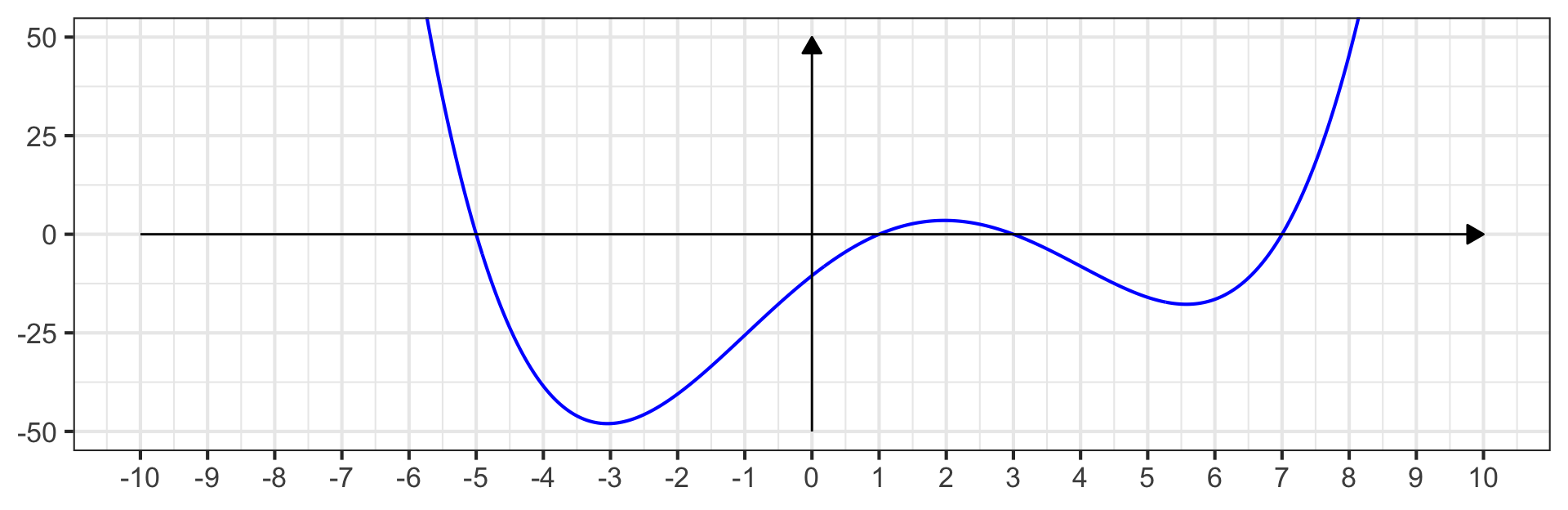
Solutions. By inspecting the graph (we’ll develop exact methods later in the course).
Completed Example 1
Consider the function graphed on the right. Answer each of the following.
- Roots: approximately \(\left(-5, 0\right)\), \(\left(1, 0\right)\), \(\left(3, 0\right)\), and \(\left(7, 0\right)\)
- Identify the \(y\)-intercept.
- Identify the \(x\)-coordinates of any local minima or maxima.
- Describe the interval(s) over which the function is increasing.
- Describe the interval(s) over which the function is decreasing.
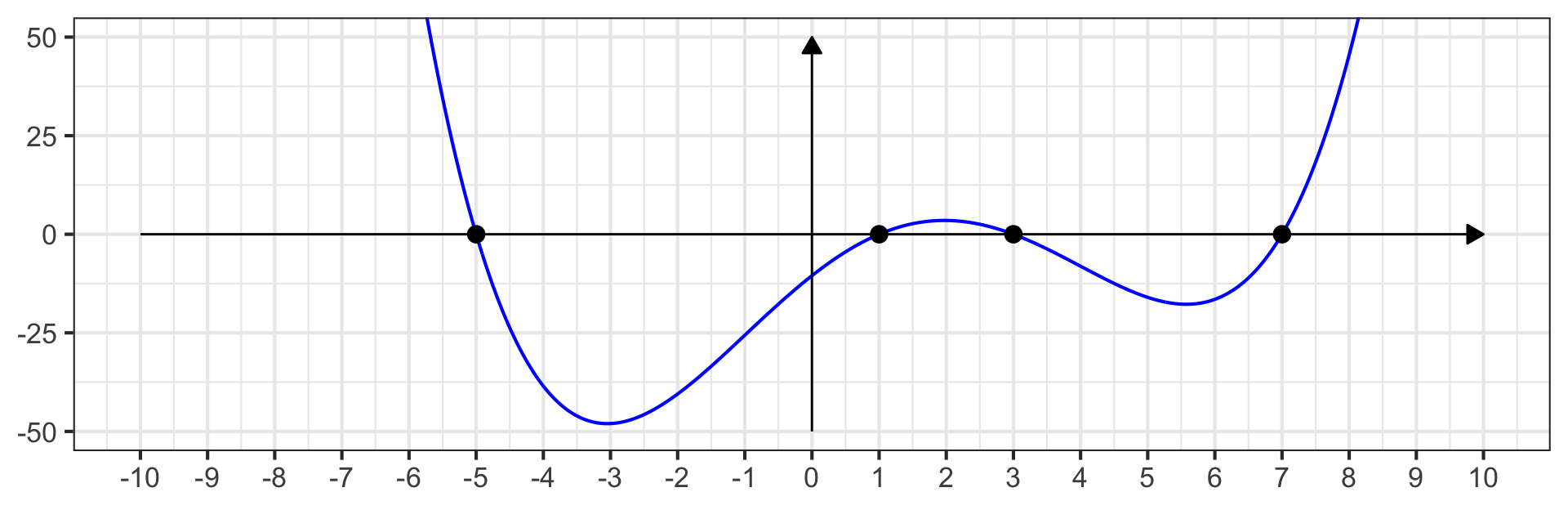
Solutions. By inspecting the graph (we’ll develop exact methods later in the course).
Completed Example 1
Consider the function graphed on the right. Answer each of the following.
- Roots: approximately \(\left(-5, 0\right)\), \(\left(1, 0\right)\), \(\left(3, 0\right)\), and \(\left(7, 0\right)\)
- \(y\)-intercept: approximately \(\left(0, -10\right)\)
- Identify the \(x\)-coordinates of any local minima or maxima.
- Describe the interval(s) over which the function is increasing.
- Describe the interval(s) over which the function is decreasing.
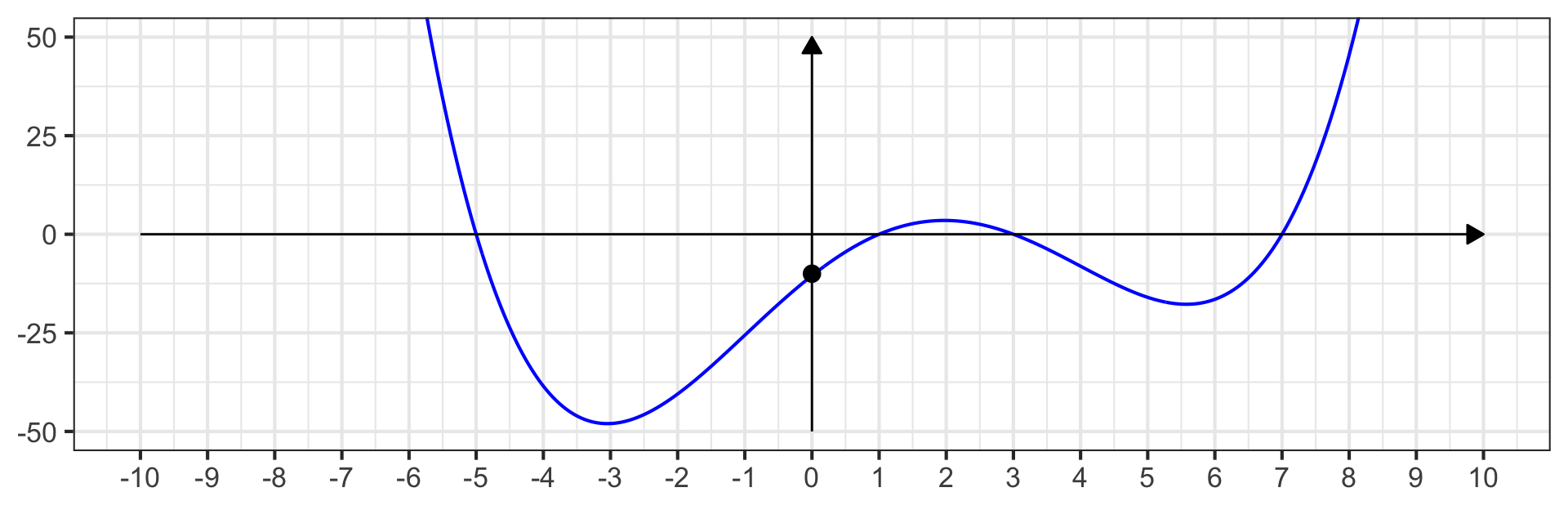
Solutions. By inspecting the graph (we’ll develop exact methods later in the course).
Completed Example 1
Consider the function graphed on the right. Answer each of the following.
- Roots: approximately \(\left(-5, 0\right)\), \(\left(1, 0\right)\), \(\left(3, 0\right)\), and \(\left(7, 0\right)\)
- \(y\)-intercept: approximately \(\left(0, -10\right)\)
- Local minima near \(x \approx -3\) and \(x \approx 5.5\); local maximum near \(x \approx 2\)
- Describe the interval(s) over which the function is increasing.
- Describe the interval(s) over which the function is decreasing.
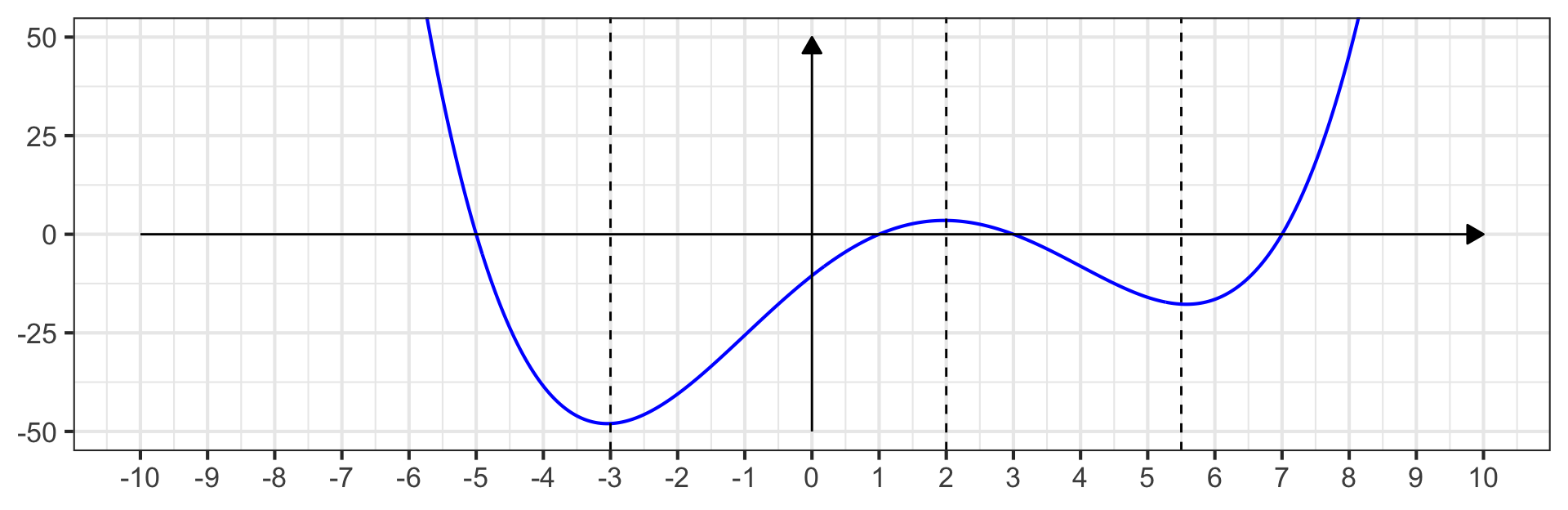
Solutions. By inspecting the graph (we’ll develop exact methods later in the course).
Completed Example 1
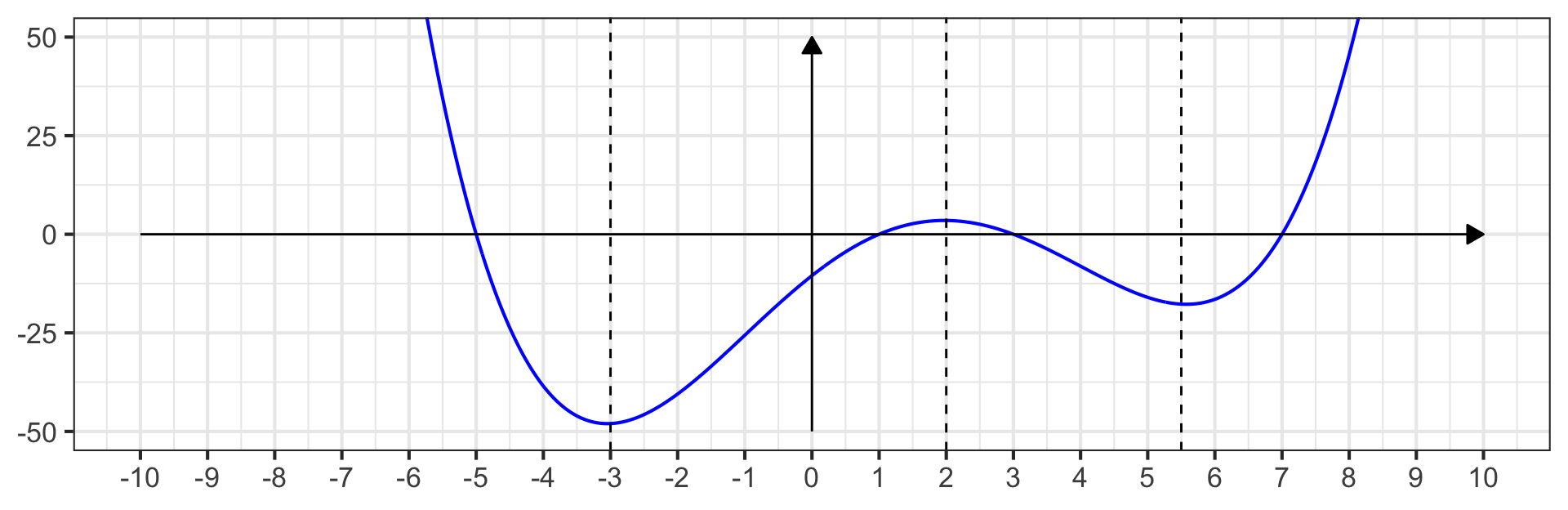
Consider the function graphed on the right. Answer each of the following.
- Roots: approximately \(\left(-5, 0\right)\), \(\left(1, 0\right)\), \(\left(3, 0\right)\), and \(\left(7, 0\right)\)
- \(y\)-intercept: approximately \(\left(0, -10\right)\)
- Local minima near \(x \approx -3\) and \(x \approx 5.5\); local maximum near \(x \approx 2\)
- Increasing between approximately \(x = -3\) and \(x = 2\) and also beyond \(x = 5.5\)
- Describe the interval(s) over which the function is decreasing.
Solutions. By inspecting the graph (we’ll develop exact methods later in the course).
Completed Example 1
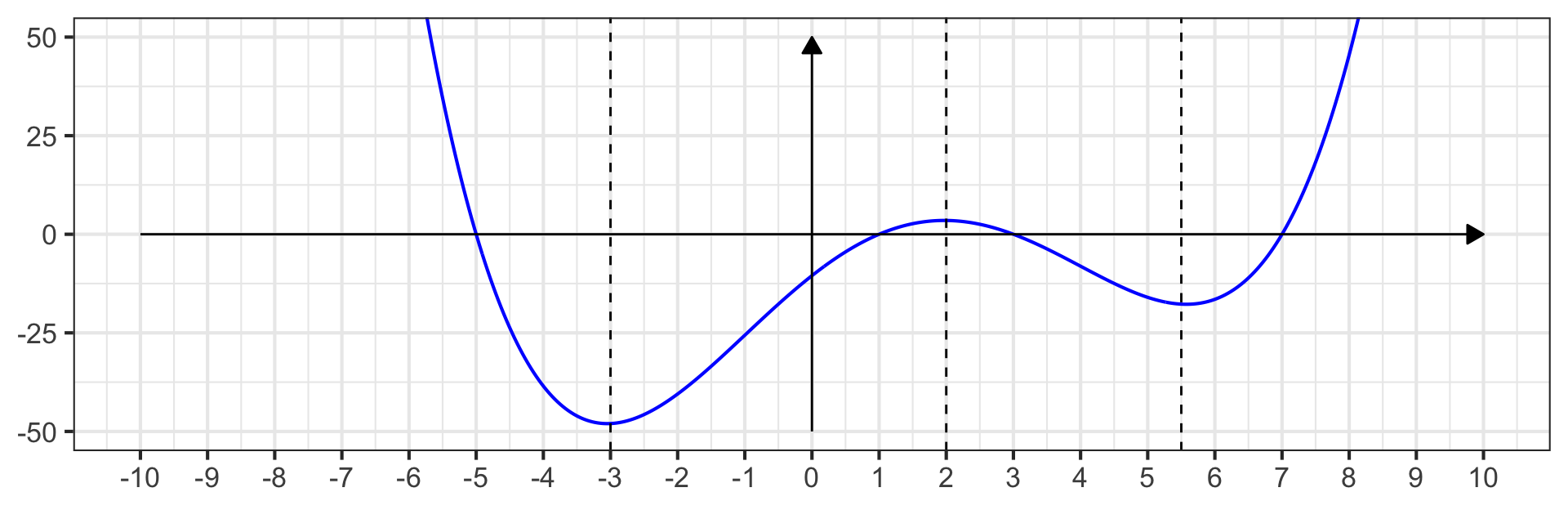
Consider the function graphed on the right. Answer each of the following.
- Roots: approximately \(\left(-5, 0\right)\), \(\left(1, 0\right)\), \(\left(3, 0\right)\), and \(\left(7, 0\right)\)
- \(y\)-intercept: approximately \(\left(0, -10\right)\)
- Local minima near \(x \approx -3\) and \(x \approx 5.5\); local maximum near \(x \approx 2\)
- Increasing between approximately \(x = -3\) and \(x = 2\) and also beyond \(x = 5.5\)
- Decreasing prior to \(x = -3\) as well as between \(x = 2\) and \(x = 5.5\).
Solutions. By inspecting the graph (we’ll develop exact methods later in the course).
Try It! 1
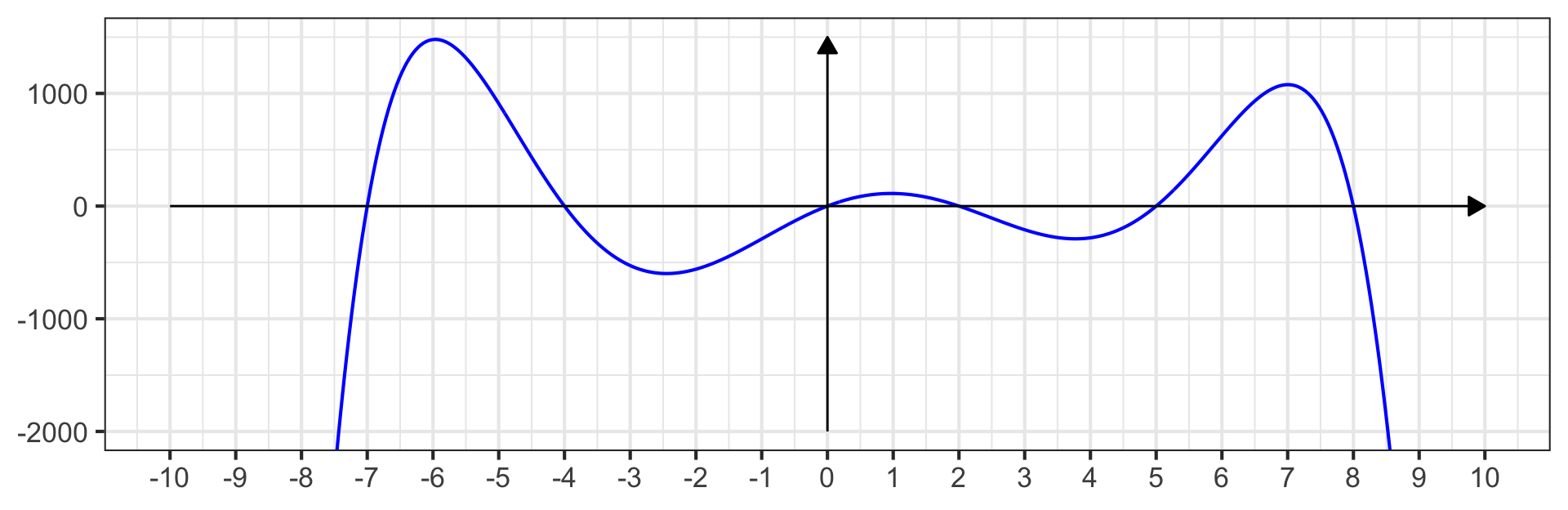
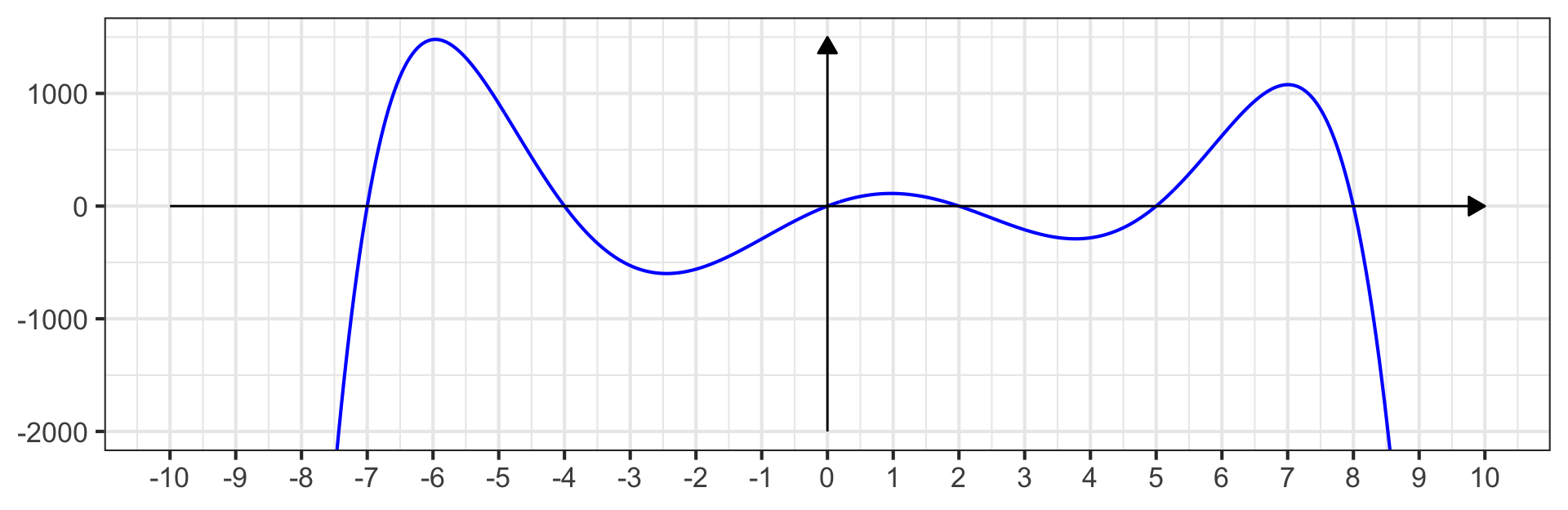
Consider the function graphed below. Answer each of the following.
- Identify the locations of all roots (\(x\)-intercepts).
- Identify the \(y\)-intercept.
- Identify the \(x\)-coordinates of any local minima or maxima.
- Describe the interval(s) over which the function is increasing.
- Describe the interval(s) over which the function is decreasing.
Completed Example 2
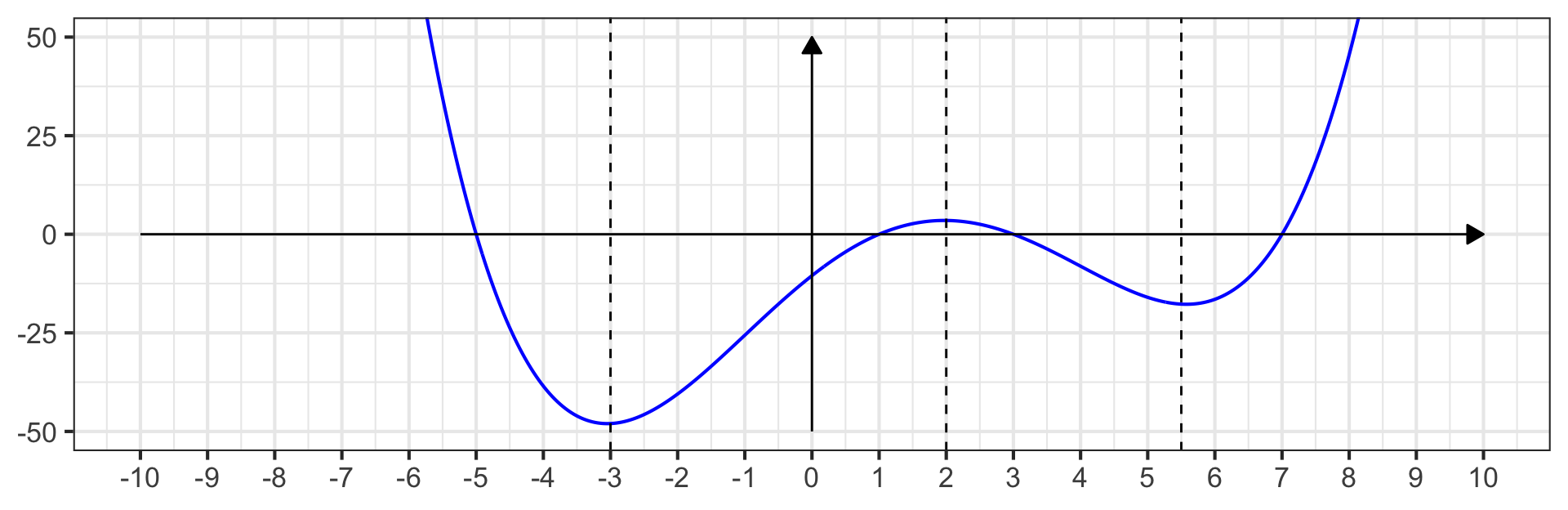
Rewrite your answers below, using interval notation where appropriate.
- Roots: approximately \(\left(-5, 0\right)\), \(\left(1, 0\right)\), \(\left(3, 0\right)\), and \(\left(7, 0\right)\)
- \(y\)-intercept: approximately \(\left(0, -10\right)\)
- Local minima near \(x \approx -3\) and \(x \approx 5.5\); local maximum near \(x \approx 2\)
- Increasing between approximately \(x = -3\) and \(x = 2\) and also beyond \(x = 5.5\)
- Decreasing prior to \(x = -3\) as well as between \(x = 2\) and \(x = 5.5\).
Solutions. By inspecting the graph (we’ll develop exact methods later in the course).
Completed Example 2
Rewrite your answers below, using interval notation where appropriate.
- Roots: approximately \(\left(-5, 0\right)\), \(\left(1, 0\right)\), \(\left(3, 0\right)\), and \(\left(7, 0\right)\)
- \(y\)-intercept: approximately \(\left(0, -10\right)\)
- Local minima near \(x \approx -3\) and \(x \approx 5.5\); local maximum near \(x \approx 2\)
- Increasing: \(\left(-3, 2\right)\cup \left(5.5, \infty\right)\)
- Decreasing prior to \(x = -3\) as well as between \(x = 2\) and \(x = 5.5\).
Solutions. By inspecting the graph (we’ll develop exact methods later in the course).
Completed Example 2
Rewrite your answers below, using interval notation where appropriate.
- Roots: approximately \(\left(-5, 0\right)\), \(\left(1, 0\right)\), \(\left(3, 0\right)\), and \(\left(7, 0\right)\)
- \(y\)-intercept: approximately \(\left(0, -10\right)\)
- Local minima near \(x \approx -3\) and \(x \approx 5.5\); local maximum near \(x \approx 2\)
- Increasing: \(\left(-3, 2\right)\cup \left(5.5, \infty\right)\)
- Decreasing: \(\left(-\infty, -3\right)\cup \left(2, 5.5\right)\)
Solutions. By inspecting the graph (we’ll develop exact methods later in the course).
Try It! 2
Rewrite your answers, using interval notation where appropriate.
- Identify the locations of all roots (\(x\)-intercepts).
- Identify the \(y\)-intercept.
- Identify the \(x\)-coordinates of any local minima or maxima.
- Describe the interval(s) over which the function is increasing.
- Describe the interval(s) over which the function is decreasing.
Introduction to Functions
Definition (Function): A function is a rule that assigns exactly one output for any given input value from its domain.
In PreCalculus, we’ll be interested in functions that take a real-valued input \(x\) and assign a real-valued output \(y\).
The key phrase is exactly one. For any input we plug in, there can only be one corresponding output.
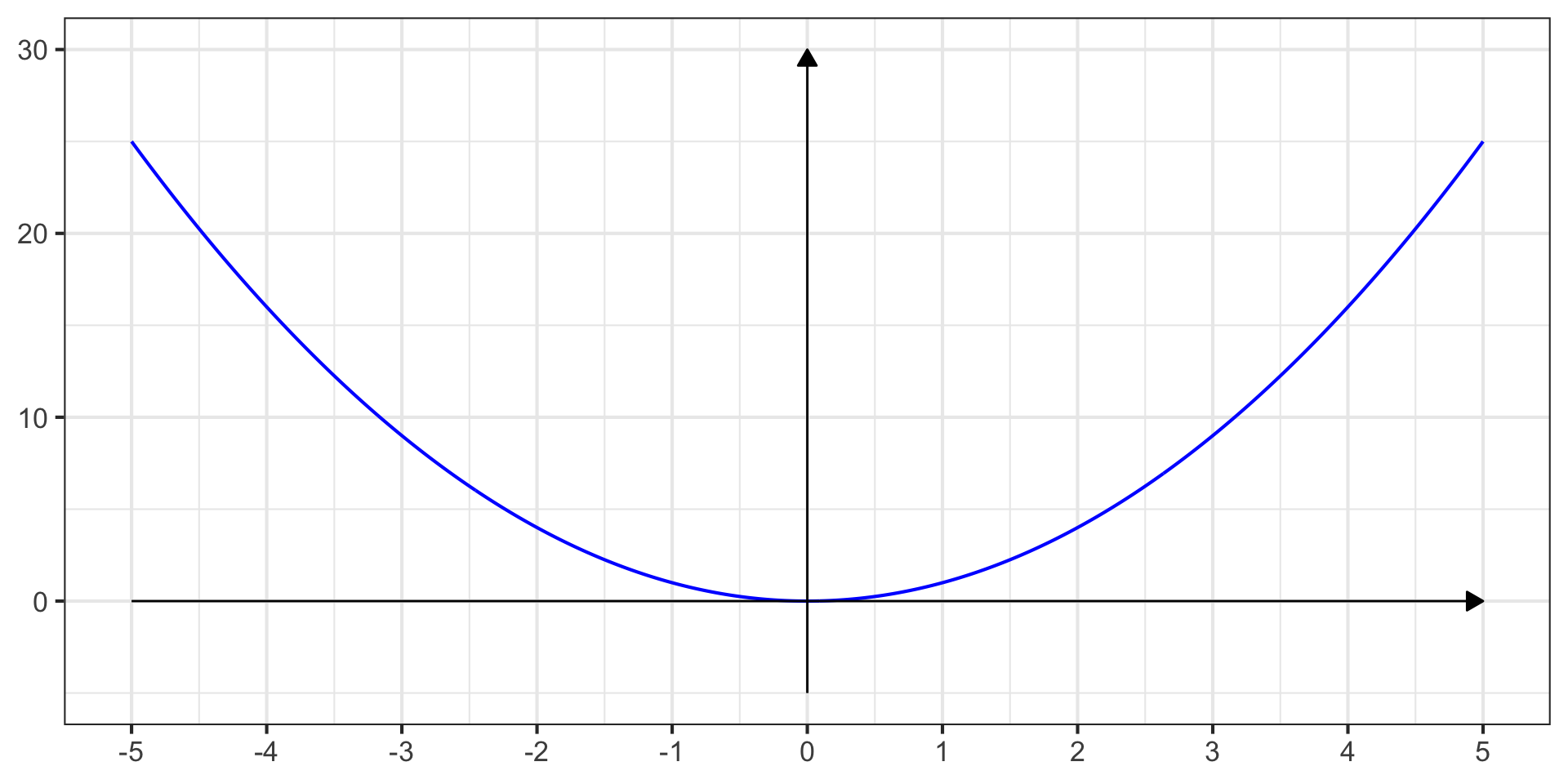
The graphs below illustrate the difference between a function and a non-function:
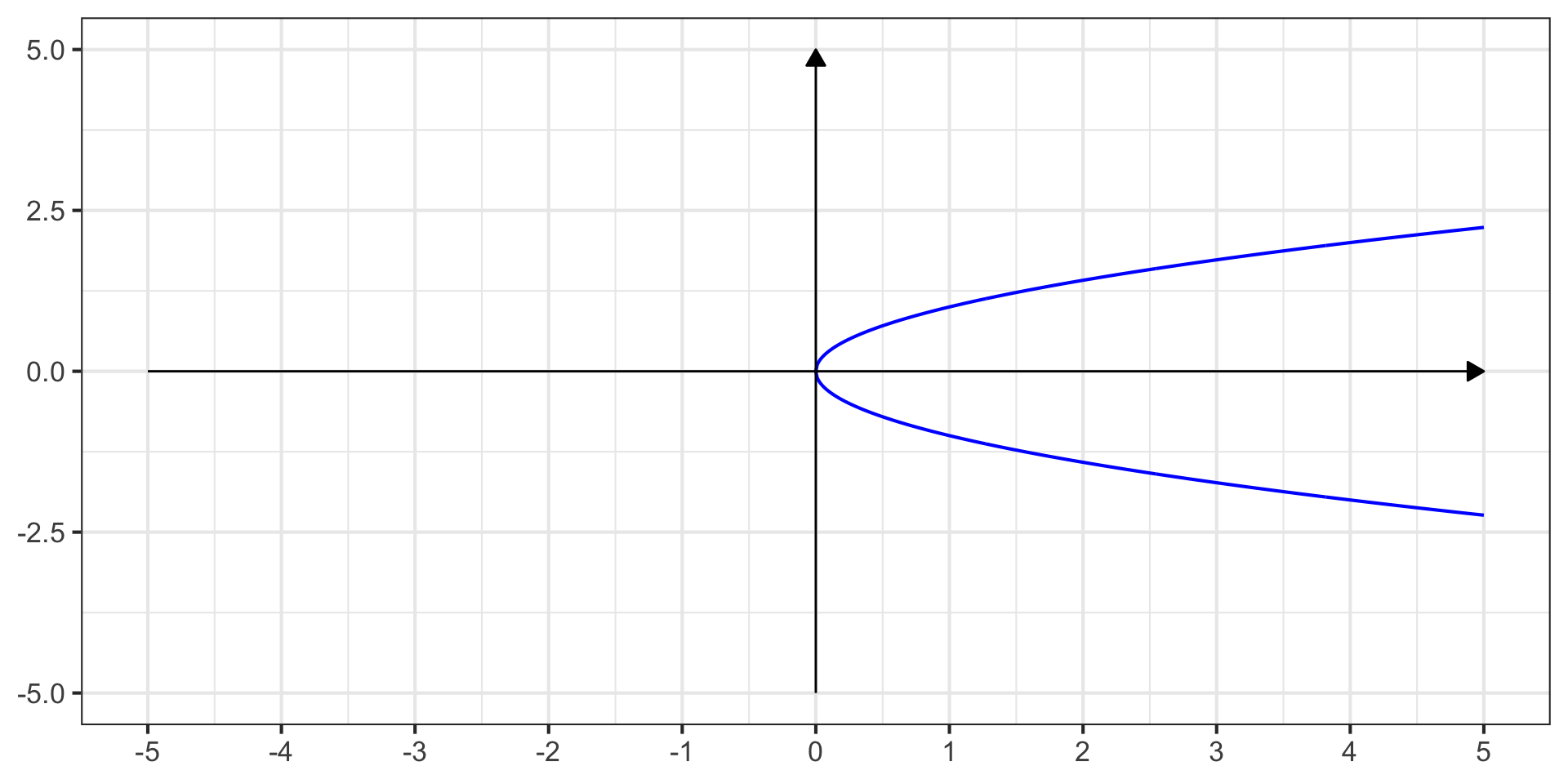
Introduction to Functions
Definition (Function): A function is a rule that assigns exactly one output for any given input value from its domain.
In PreCalculus, we’ll be interested in functions that take a real-valued input \(x\) and assign a real-valued output \(y\).
The key phrase is exactly one. For any input we plug in, there can only be one corresponding output.
The graphs below illustrate the difference between a function and a non-function:
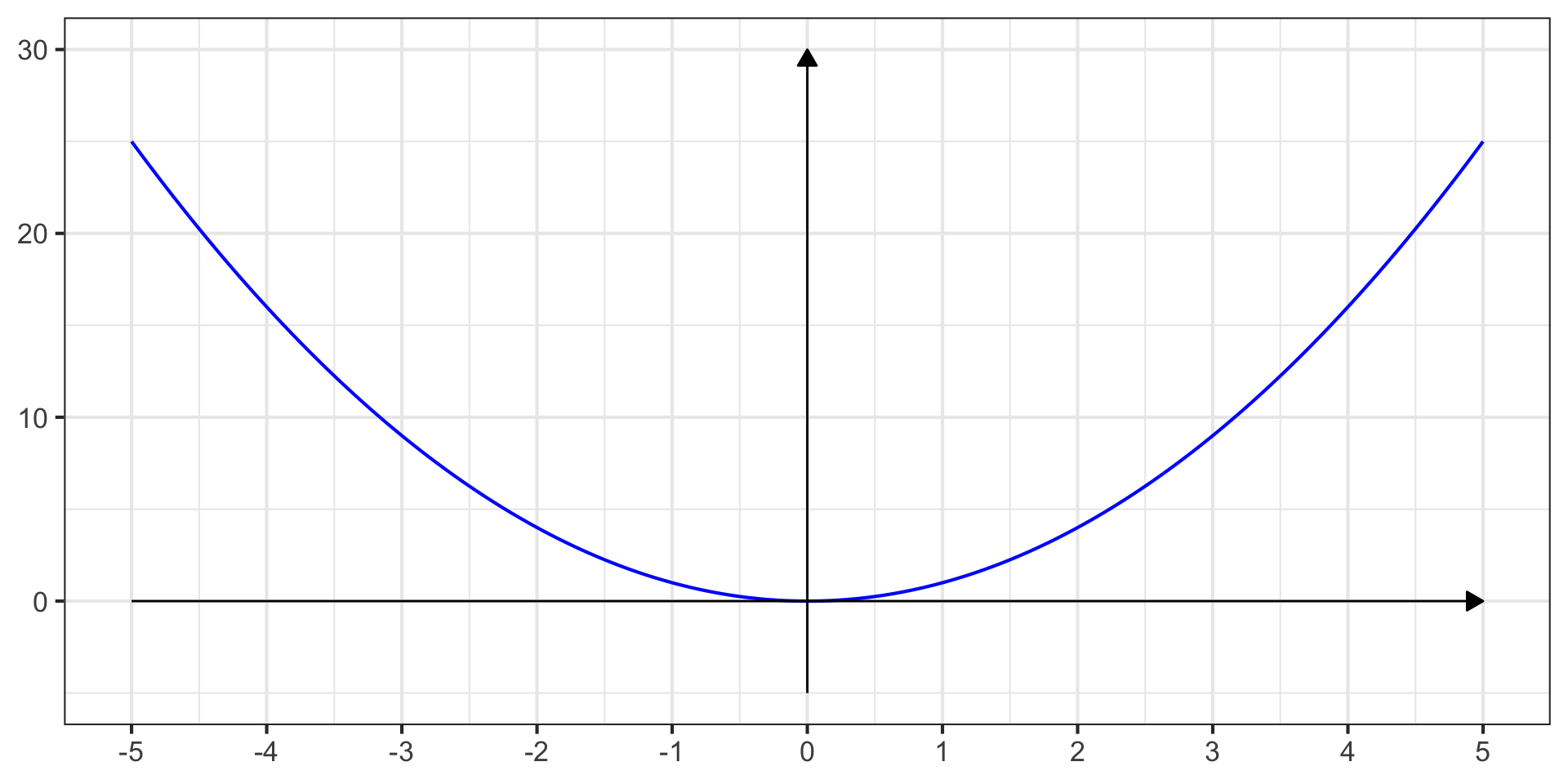
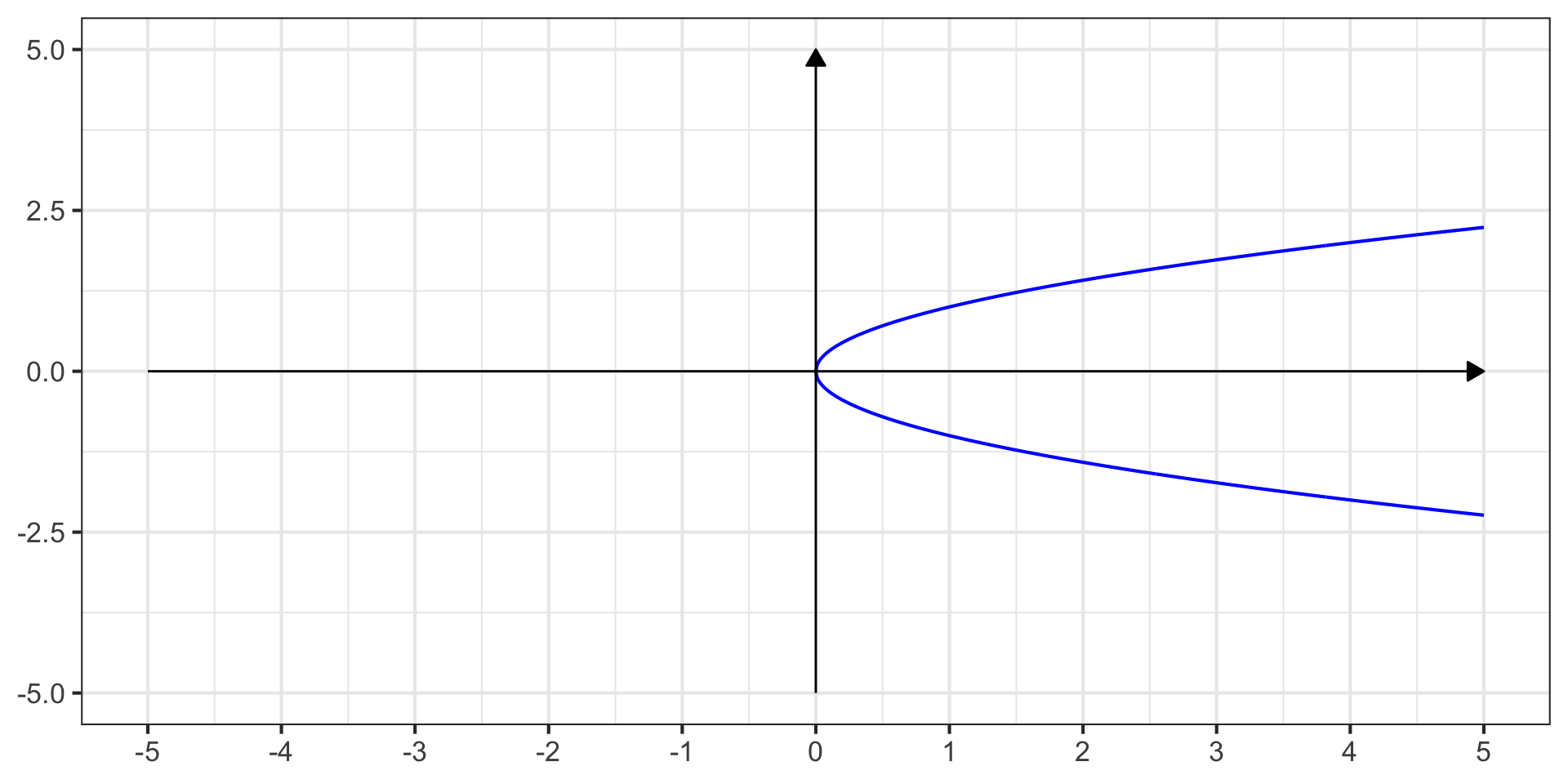
A common method for testing whether a graph corresponds to a function is called the vertical line test. A graph passes (and is a function) if any vertical line drawn intersects the function at most once.
Introduction to Functions
Definition (Function): A function is a rule that assigns exactly one output for any given input value from its domain.
In PreCalculus, we’ll be interested in functions that take a real-valued input \(x\) and assign a real-valued output \(y\).
The key phrase is exactly one. For any input we plug in, there can only be one corresponding output.
The graphs below illustrate the difference between a function and a non-function:
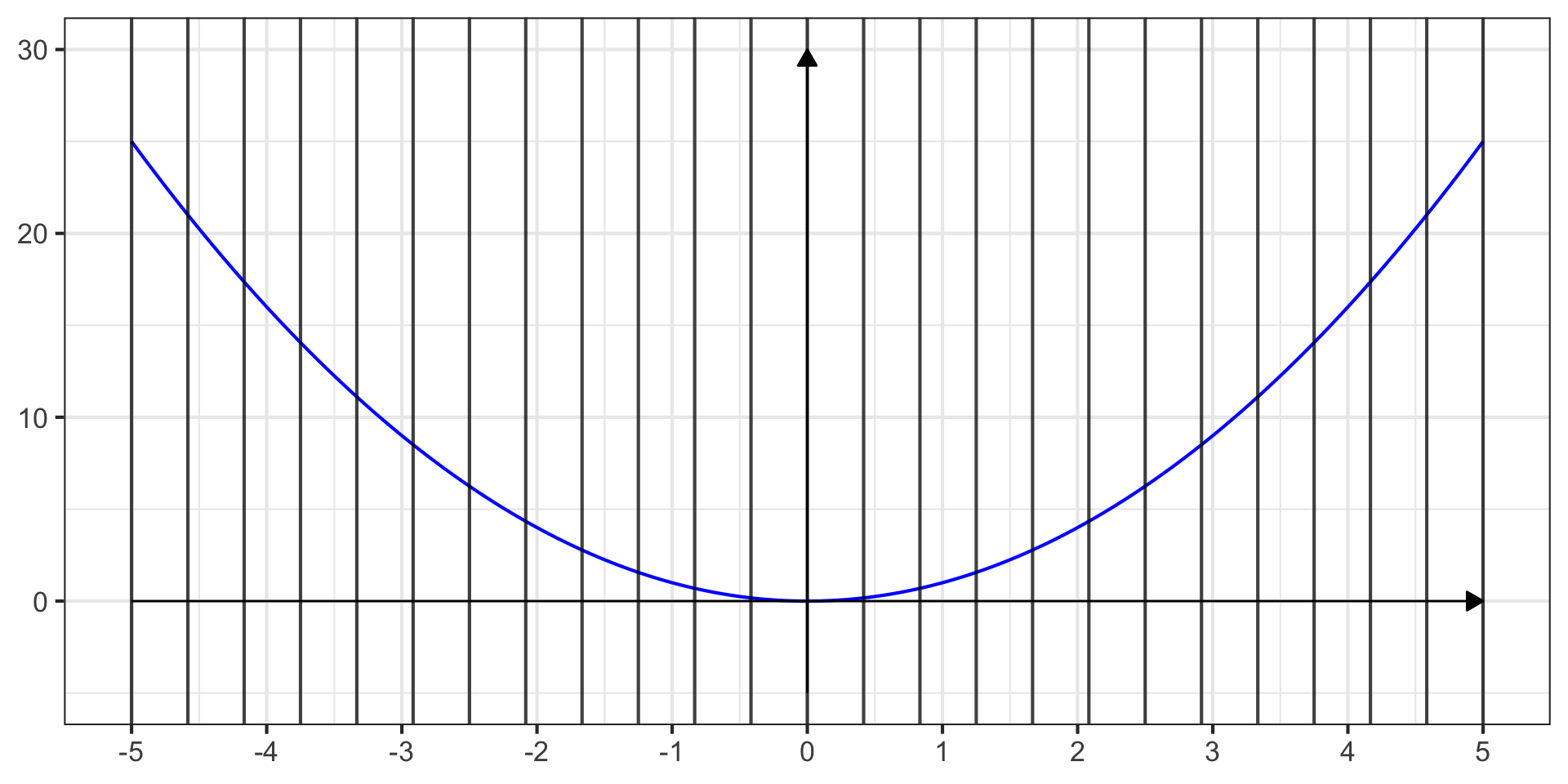
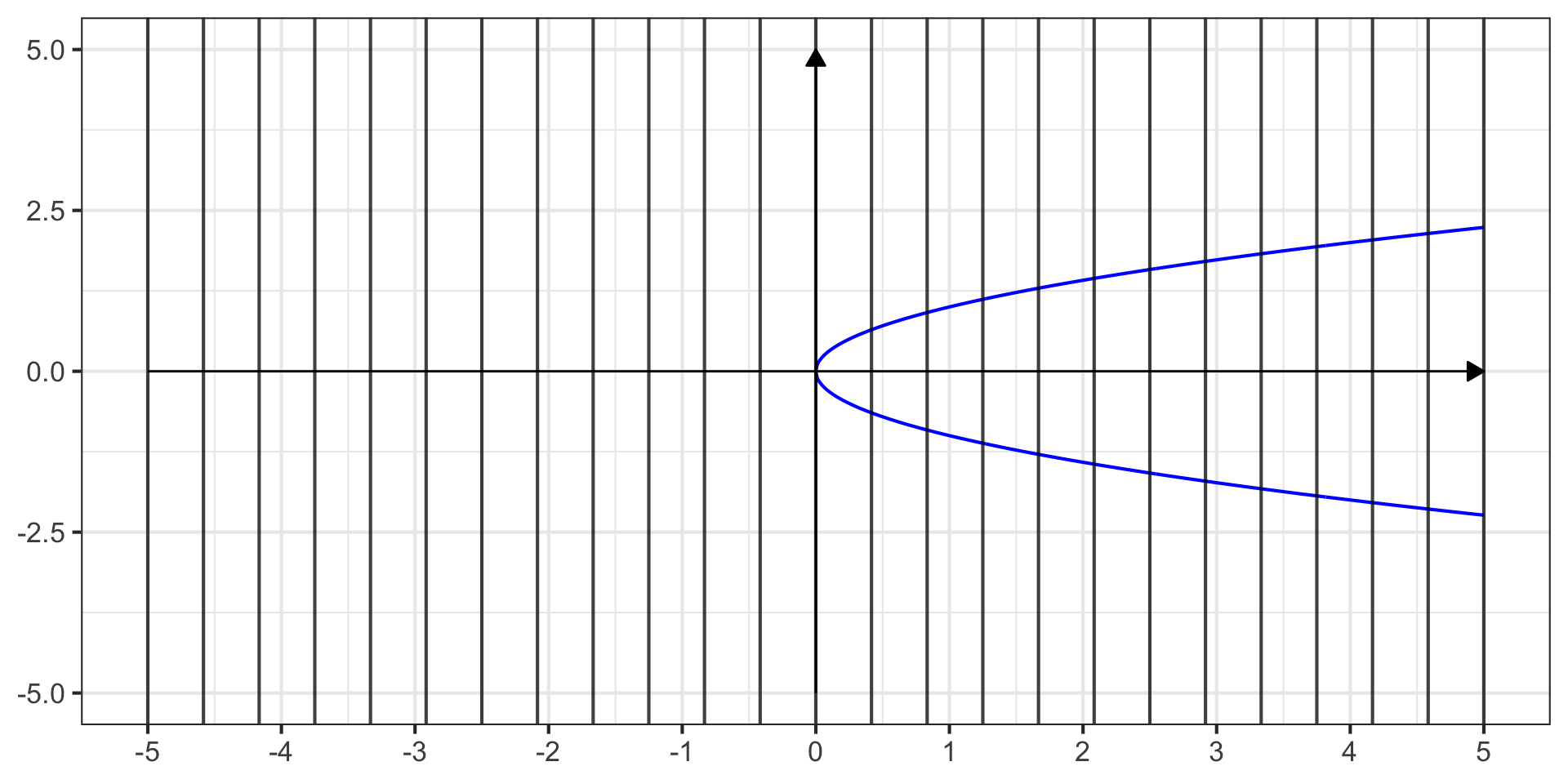
A common method for testing whether a graph corresponds to a function is called the vertical line test. A graph passes (and is a function) if any vertical line drawn intersects the function at most once.
Exit Ticket Task
Navigate to our MAT142 Exit Ticket Form, answer the questions, and complete the task below.
Note. Today’s discussion is listed as 2. Interval Notation and Functions

Task: Consider the function \(f\left(x\right) = 3x^2 - x + 5\). Evaluate \(f\left(0\right)\), \(f\left(-2\right)\), and \(f\left(x + h\right)\).