June 12, 2026
Last class we studied the graphs of trigonometric functions, inverse trigonometric functions, and solved trigonometric equations. Try the following warm-up problems.
Problem 1: Evaluate \(\displaystyle{\arccos\!\left(\frac{-1}{2}\right)}\) and \(\displaystyle{\arcsin\!\left(\frac{-1}{2}\right)}\).
Problem 2: Find all solutions to \(\displaystyle{\sqrt{3}\tan\!\left(5x - 3\right) + 1 = 0}\).
Today we close the loop. We return to the projectile problem from Day 23 — and now we have everything we need to finish it.
After today’s class meeting, you should be able to:
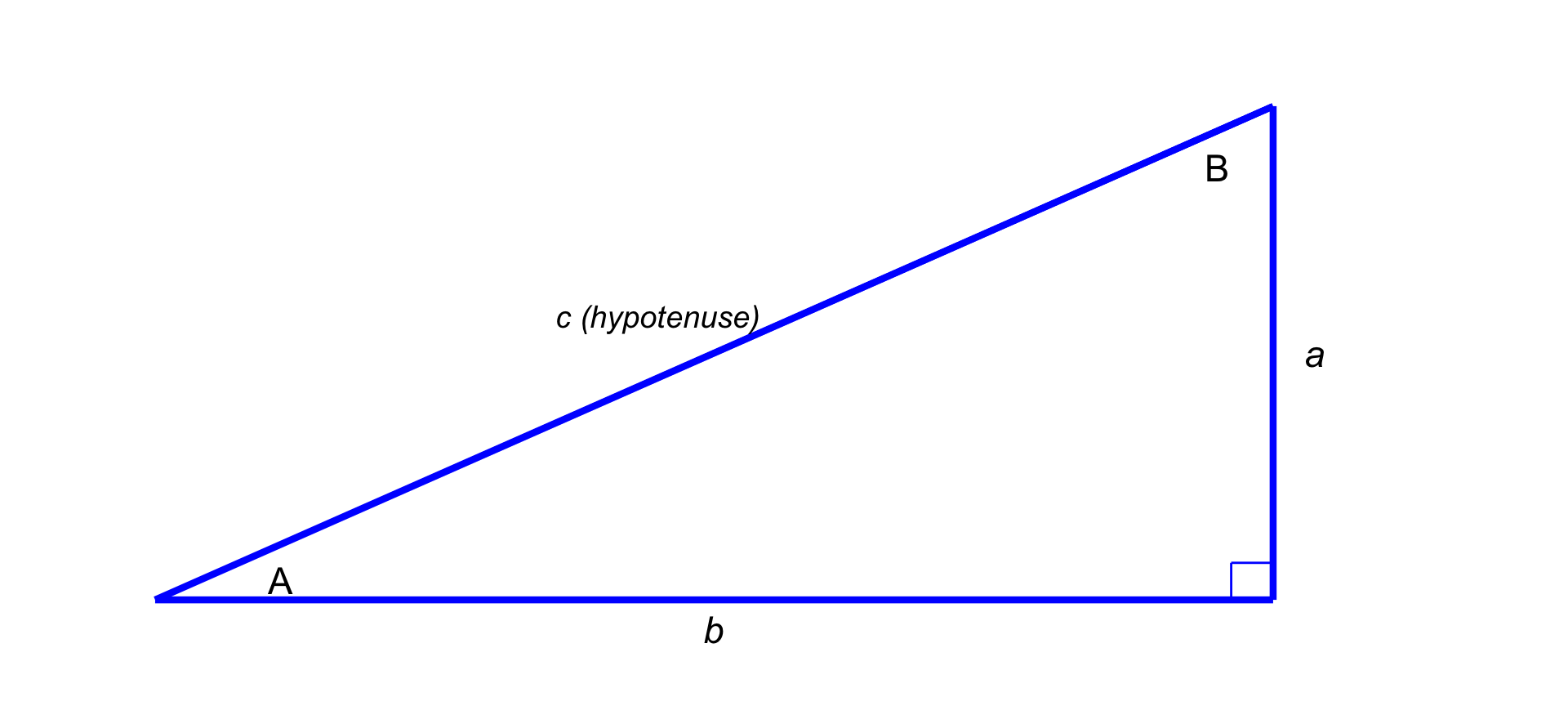
Convention: \(A\) and \(B\) denote the two non-right angles. Side \(a\) is opposite angle \(A\); side \(b\) is opposite angle \(B\); side \(c\) is the hypotenuse.
Theorem: For any right triangle with legs \(a\) and \(b\) and hypotenuse \(c\):
\[a^2 + b^2 = c^2\]
Example 1: Find the missing side length in each case.
\(\left(1\right)\) Legs \(a = 5\) and \(b = 7\). Find the hypotenuse \(c\).
\(\left(2\right)\) Leg \(a = 5\) and hypotenuse \(c = 10\). Find the missing leg \(b\).
(1)
\[\begin{align} a^2 + b^2 &= c^2 \end{align}\]
Theorem: For any right triangle with legs \(a\) and \(b\) and hypotenuse \(c\):
\[a^2 + b^2 = c^2\]
Example 1: Find the missing side length in each case.
\(\left(1\right)\) Legs \(a = 5\) and \(b = 7\). Find the hypotenuse \(c\).
\(\left(2\right)\) Leg \(a = 5\) and hypotenuse \(c = 10\). Find the missing leg \(b\).
(1)
\[\begin{align} a^2 + b^2 &= c^2\\ \implies 5^2 + 7^2 &= c^2 \end{align}\]
Theorem: For any right triangle with legs \(a\) and \(b\) and hypotenuse \(c\):
\[a^2 + b^2 = c^2\]
Example 1: Find the missing side length in each case.
\(\left(1\right)\) Legs \(a = 5\) and \(b = 7\). Find the hypotenuse \(c\).
\(\left(2\right)\) Leg \(a = 5\) and hypotenuse \(c = 10\). Find the missing leg \(b\).
(1)
\[\begin{align} a^2 + b^2 &= c^2\\ \implies 5^2 + 7^2 &= c^2\\ \implies 25 + 49 &= c^2 \end{align}\]
Theorem: For any right triangle with legs \(a\) and \(b\) and hypotenuse \(c\):
\[a^2 + b^2 = c^2\]
Example 1: Find the missing side length in each case.
\(\left(1\right)\) Legs \(a = 5\) and \(b = 7\). Find the hypotenuse \(c\).
\(\left(2\right)\) Leg \(a = 5\) and hypotenuse \(c = 10\). Find the missing leg \(b\).
(1)
\[\begin{align} a^2 + b^2 &= c^2\\ \implies 5^2 + 7^2 &= c^2\\ \implies 25 + 49 &= c^2\\ \implies c^2 &= 74 \end{align}\]
Theorem: For any right triangle with legs \(a\) and \(b\) and hypotenuse \(c\):
\[a^2 + b^2 = c^2\]
Example 1: Find the missing side length in each case.
\(\left(1\right)\) Legs \(a = 5\) and \(b = 7\). Find the hypotenuse \(c\).
\(\left(2\right)\) Leg \(a = 5\) and hypotenuse \(c = 10\). Find the missing leg \(b\).
(1)
\[\begin{align} a^2 + b^2 &= c^2\\ \implies 5^2 + 7^2 &= c^2\\ \implies 25 + 49 &= c^2\\ \implies c^2 &= 74\\ \implies c &= \boxed{~\sqrt{74}~} \end{align}\]
Note that we omit the “\(\pm\)” here since we know that \(c\) is a length.
(2)
\[\begin{align} a^2 + b^2 &= c^2 \end{align}\]
Theorem: For any right triangle with legs \(a\) and \(b\) and hypotenuse \(c\):
\[a^2 + b^2 = c^2\]
Example 1: Find the missing side length in each case.
\(\left(1\right)\) Legs \(a = 5\) and \(b = 7\). Find the hypotenuse \(c\).
\(\left(2\right)\) Leg \(a = 5\) and hypotenuse \(c = 10\). Find the missing leg \(b\).
(1)
\[\begin{align} a^2 + b^2 &= c^2\\ \implies 5^2 + 7^2 &= c^2\\ \implies 25 + 49 &= c^2\\ \implies c^2 &= 74\\ \implies c &= \boxed{~\sqrt{74}~} \end{align}\]
Note that we omit the “\(\pm\)” here since we know that \(c\) is a length.
(2)
\[\begin{align} a^2 + b^2 &= c^2\\ \implies 5^2 + b^2 &= 10^2 \end{align}\]
Theorem: For any right triangle with legs \(a\) and \(b\) and hypotenuse \(c\):
\[a^2 + b^2 = c^2\]
Example 1: Find the missing side length in each case.
\(\left(1\right)\) Legs \(a = 5\) and \(b = 7\). Find the hypotenuse \(c\).
\(\left(2\right)\) Leg \(a = 5\) and hypotenuse \(c = 10\). Find the missing leg \(b\).
(1)
\[\begin{align} a^2 + b^2 &= c^2\\ \implies 5^2 + 7^2 &= c^2\\ \implies 25 + 49 &= c^2\\ \implies c^2 &= 74\\ \implies c &= \boxed{~\sqrt{74}~} \end{align}\]
Note that we omit the “\(\pm\)” here since we know that \(c\) is a length.
(2)
\[\begin{align} a^2 + b^2 &= c^2\\ \implies 5^2 + b^2 &= 10^2\\ \implies 25 + b^2 &= 100 \end{align}\]
Theorem: For any right triangle with legs \(a\) and \(b\) and hypotenuse \(c\):
\[a^2 + b^2 = c^2\]
Example 1: Find the missing side length in each case.
\(\left(1\right)\) Legs \(a = 5\) and \(b = 7\). Find the hypotenuse \(c\).
\(\left(2\right)\) Leg \(a = 5\) and hypotenuse \(c = 10\). Find the missing leg \(b\).
(1)
\[\begin{align} a^2 + b^2 &= c^2\\ \implies 5^2 + 7^2 &= c^2\\ \implies 25 + 49 &= c^2\\ \implies c^2 &= 74\\ \implies c &= \boxed{~\sqrt{74}~} \end{align}\]
Note that we omit the “\(\pm\)” here since we know that \(c\) is a length.
(2)
\[\begin{align} a^2 + b^2 &= c^2\\ \implies 5^2 + b^2 &= 10^2\\ \implies 25 + b^2 &= 100\\ \implies b^2 &= 75 \end{align}\]
Theorem: For any right triangle with legs \(a\) and \(b\) and hypotenuse \(c\):
\[a^2 + b^2 = c^2\]
Example 1: Find the missing side length in each case.
\(\left(1\right)\) Legs \(a = 5\) and \(b = 7\). Find the hypotenuse \(c\).
\(\left(2\right)\) Leg \(a = 5\) and hypotenuse \(c = 10\). Find the missing leg \(b\).
(1)
\[\begin{align} a^2 + b^2 &= c^2\\ \implies 5^2 + 7^2 &= c^2\\ \implies 25 + 49 &= c^2\\ \implies c^2 &= 74\\ \implies c &= \boxed{~\sqrt{74}~} \end{align}\]
Note that we omit the “\(\pm\)” here since we know that \(c\) is a length.
(2)
\[\begin{align} a^2 + b^2 &= c^2\\ \implies 5^2 + b^2 &= 10^2\\ \implies 25 + b^2 &= 100\\ \implies b^2 &= 75\\ \implies b &= \sqrt{75} \end{align}\]
Theorem: For any right triangle with legs \(a\) and \(b\) and hypotenuse \(c\):
\[a^2 + b^2 = c^2\]
Example 1: Find the missing side length in each case.
\(\left(1\right)\) Legs \(a = 5\) and \(b = 7\). Find the hypotenuse \(c\).
\(\left(2\right)\) Leg \(a = 5\) and hypotenuse \(c = 10\). Find the missing leg \(b\).
(1)
\[\begin{align} a^2 + b^2 &= c^2\\ \implies 5^2 + 7^2 &= c^2\\ \implies 25 + 49 &= c^2\\ \implies c^2 &= 74\\ \implies c &= \boxed{~\sqrt{74}~} \end{align}\]
Note that we omit the “\(\pm\)” here since we know that \(c\) is a length.
(2)
\[\begin{align} a^2 + b^2 &= c^2\\ \implies 5^2 + b^2 &= 10^2\\ \implies 25 + b^2 &= 100\\ \implies b^2 &= 75\\ \implies b &= \sqrt{75}\\ \implies b &= ~\boxed{5\sqrt{3}~} \end{align}\]
The unit circle definitions of \(\sin\), \(\cos\), and \(\tan\) connect directly to side ratios in any right triangle. For angle \(A\):
\[\sin\!\left(A\right) = \frac{\text{opposite}}{\text{hypotenuse}} = \frac{a}{c} \qquad \cos\!\left(A\right) = \frac{\text{adjacent}}{\text{hypotenuse}} = \frac{b}{c} \qquad \tan\!\left(A\right) = \frac{\text{opposite}}{\text{adjacent}} = \frac{a}{b}\]
A useful mnemonic: SOH-CAH-TOA.
We can also find angles using the inverse functions:
\[A = \arcsin\!\left(\frac{a}{c}\right) \qquad A = \arccos\!\left(\frac{b}{c}\right) \qquad A = \arctan\!\left(\frac{a}{b}\right)\]
Returning to Non-Vertical Motion from Day 23
On Day 23, we asked: if a ball is launched at \(60°\) with speed \(64\) ft/sec, what is the maximum height? Now we can answer. The vertical component of velocity is \(64\sin\!\left(60°\right) = 64 \cdot \frac{\sqrt{3}}{2} = 32\sqrt{3}\) ft/sec. Substituting into \(h\left(t\right) = -16t^2 + 32\sqrt{3}t\) gives a maximum height of \(48\) feet, reached at \(t = \frac{\sqrt{3}}{1} \approx 1.73\) seconds.
Example 2: The right triangle below has \(a = 8\) and \(b = 15\). Find all missing sides and angles.
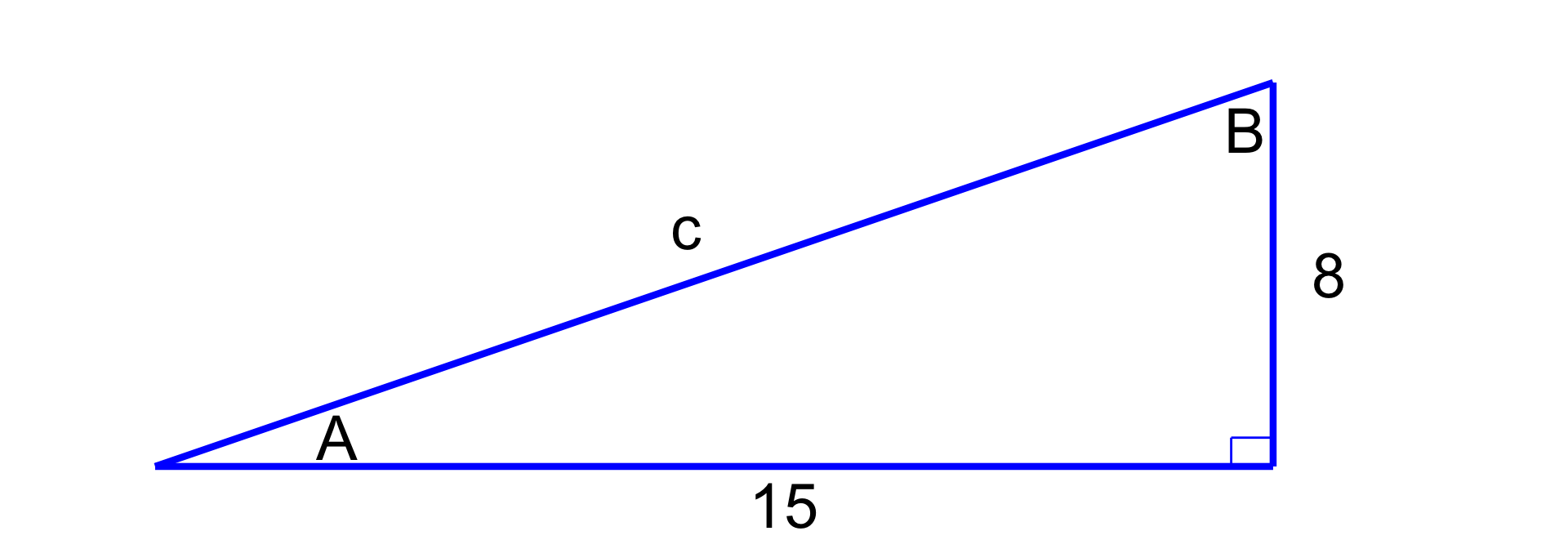
Step 1: Find \(c\) using the Pythagorean Theorem.
\[\begin{align} 8^2 + 15^2 &= c^2 \end{align}\]
Example 2: The right triangle below has \(a = 8\) and \(b = 15\). Find all missing sides and angles.
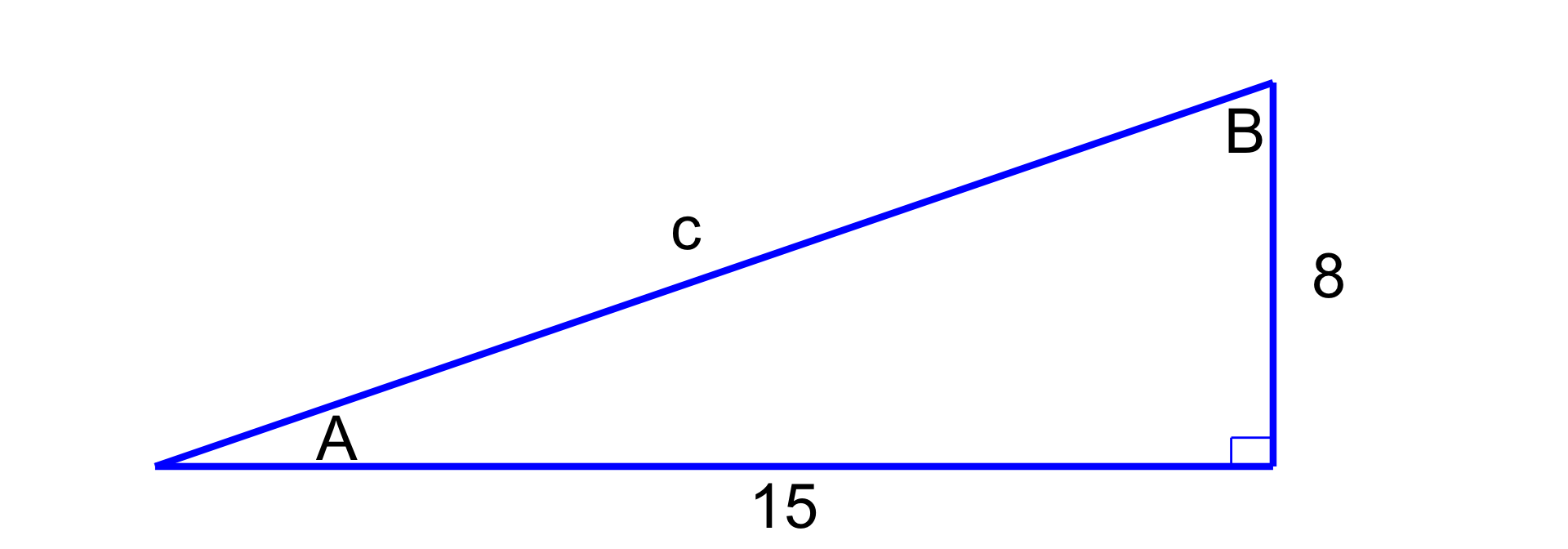
Step 1: Find \(c\) using the Pythagorean Theorem.
\[\begin{align} 8^2 + 15^2 &= c^2\\ \implies 64 + 225 &= c^2 \end{align}\]
Example 2: The right triangle below has \(a = 8\) and \(b = 15\). Find all missing sides and angles.
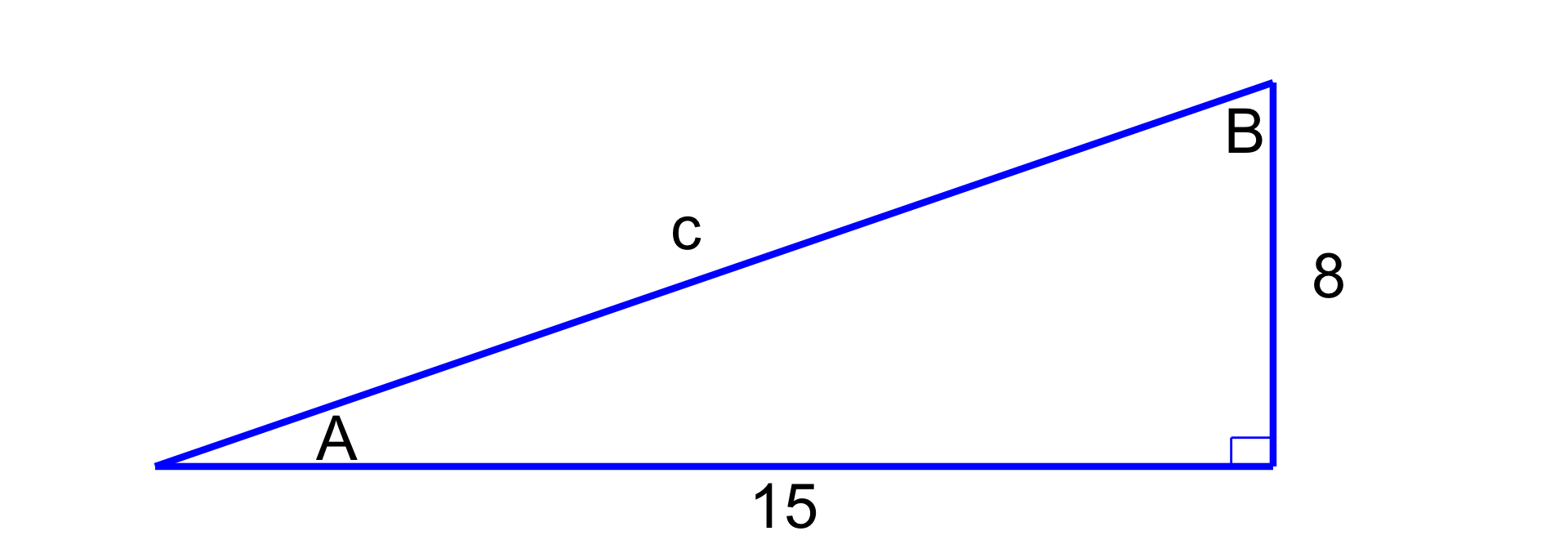
Step 1: Find \(c\) using the Pythagorean Theorem.
\[\begin{align} 8^2 + 15^2 &= c^2\\ \implies 64 + 225 &= c^2\\ \implies 289 &= c^2\\ \implies c &= 17 \end{align}\]
Example 2: The right triangle below has \(a = 8\) and \(b = 15\). Find all missing sides and angles.
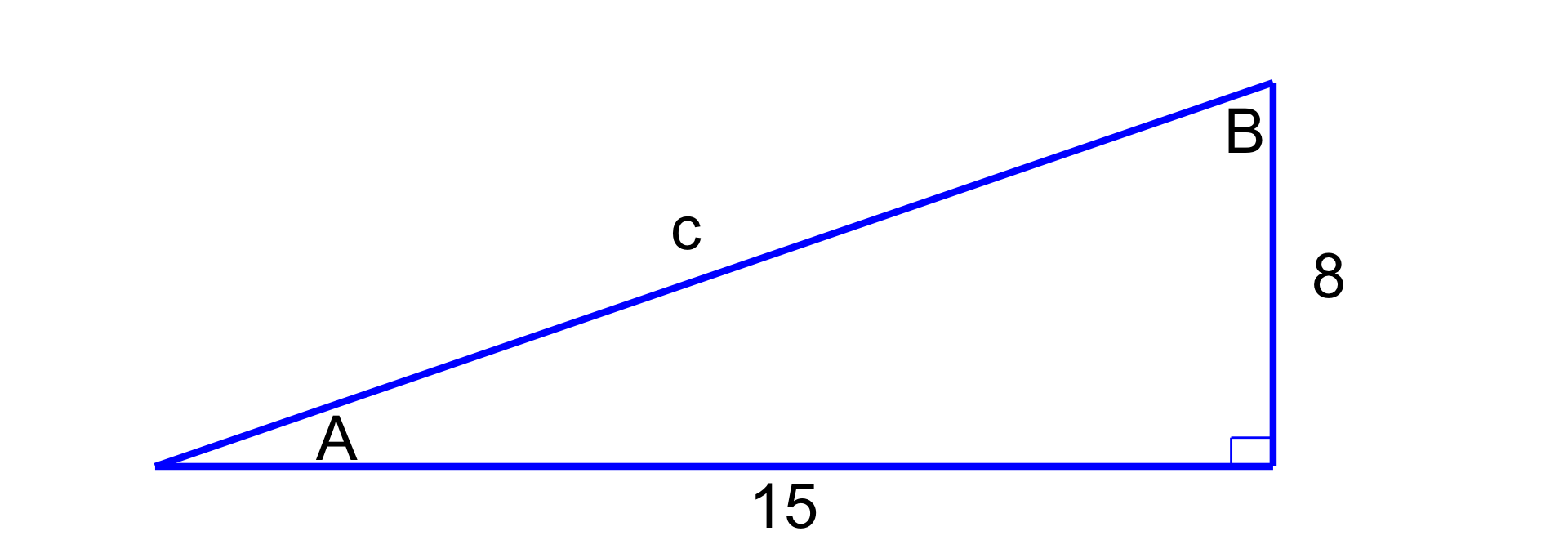
Step 2: Find angle \(A\) using \(\sin\!\left(A\right) = \dfrac{a}{c}\).
\[\begin{align} \sin\!\left(A\right) &= \frac{8}{17} \end{align}\]
Example 2: The right triangle below has \(a = 8\) and \(b = 15\). Find all missing sides and angles.
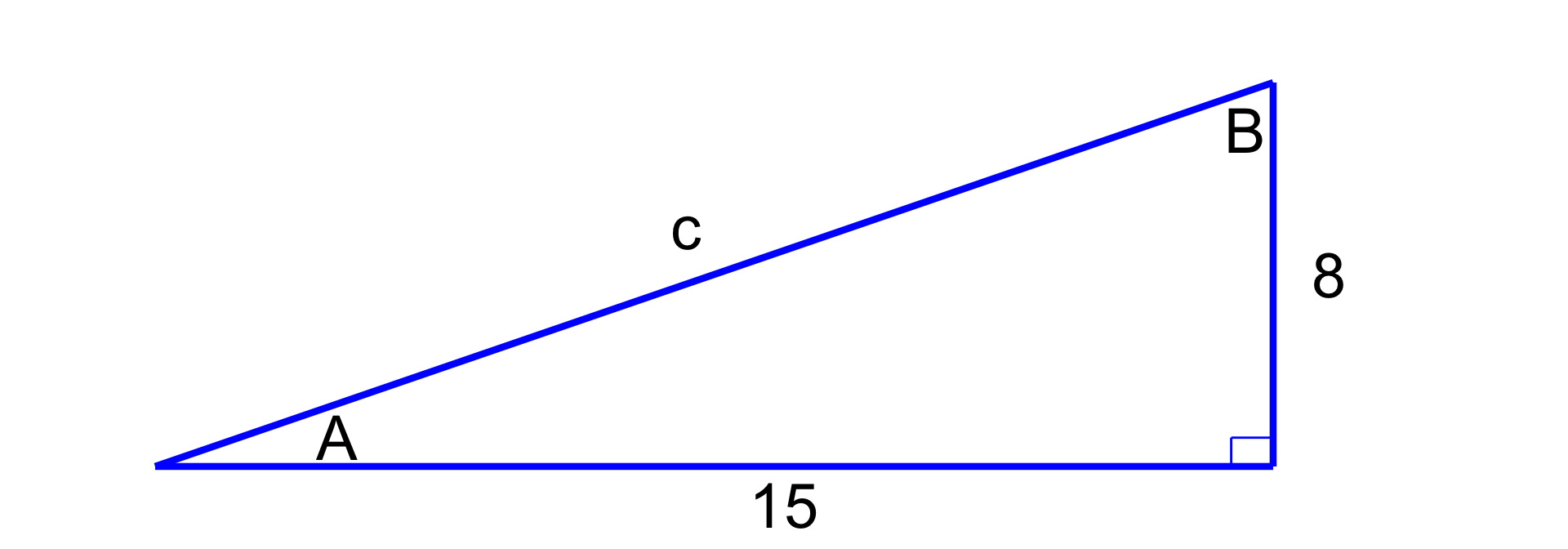
Step 2: Find angle \(A\) using \(\sin\!\left(A\right) = \dfrac{a}{c}\).
\[\begin{align} \sin\!\left(A\right) &= \frac{8}{17}\\ \implies A &= \arcsin\!\left(\frac{8}{17}\right)\\ \implies A &\approx 28.07° \end{align}\]
Example 2: The right triangle below has \(a = 8\) and \(b = 15\). Find all missing sides and angles.
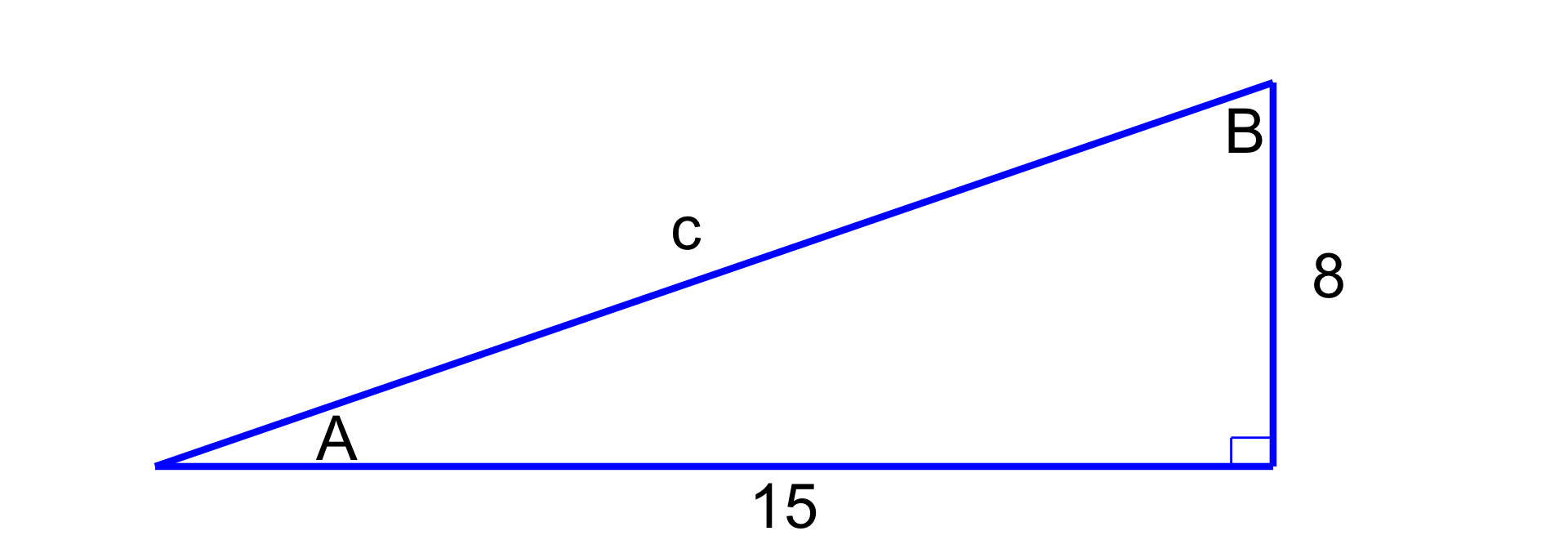
Step 3: Find angle \(B\) using the angle sum.
\[\begin{align} A + B + 90° &= 180° \end{align}\]
Example 2: The right triangle below has \(a = 8\) and \(b = 15\). Find all missing sides and angles.
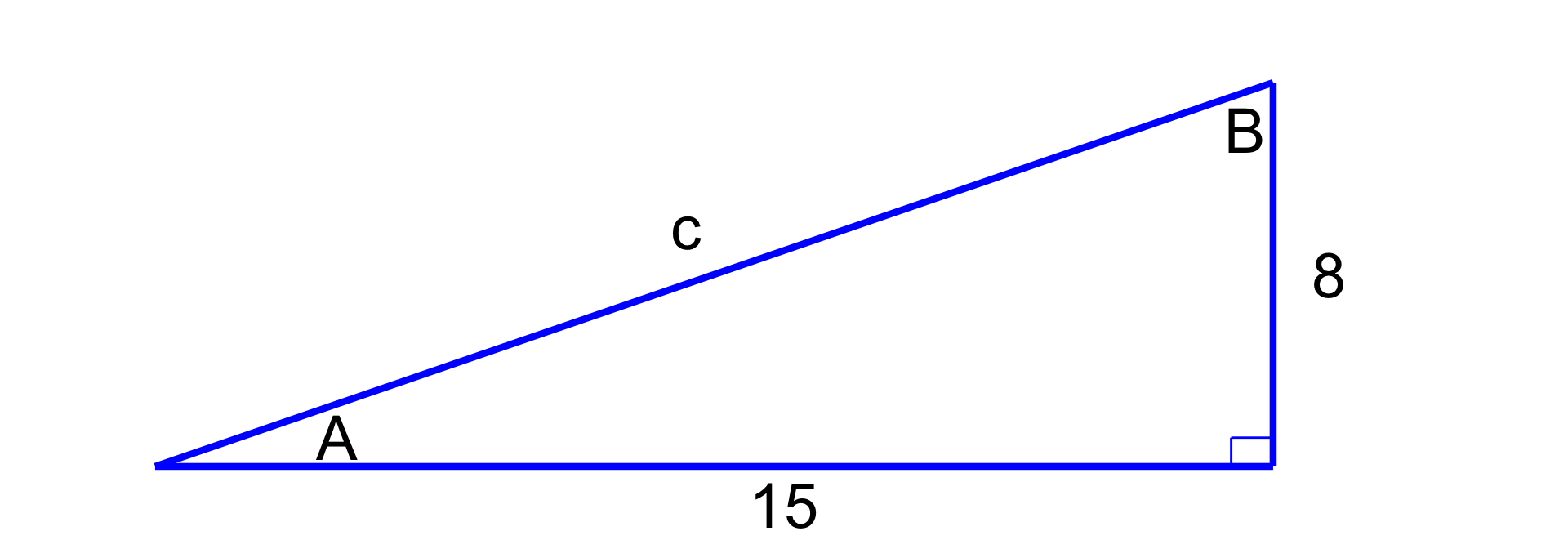
Step 3: Find angle \(B\) using the angle sum.
\[\begin{align} A + B + 90° &= 180°\\ \implies 28.07° + B + 90° &\approx 180°\\ \implies B &\approx 61.93° \end{align}\]
The triangle is fully solved: \(c = 17\), \(A \approx 28.07°\), \(B \approx 61.93°\).
Try It! 1: Find all missing sides and angles for a right triangle with \(A = 30°\) and \(a = 5\).
Try It! 2: Find all missing sides and angles for a right triangle with \(B = 50°\) and \(c = 7\).
Try It! 3: Find all missing sides and angles for a right triangle with \(A = 45°\) and \(c = 4\).
Try It! 4: Find all missing sides and angles for a right triangle with \(a = 5\) and \(b = 15\).
Problem: An arborist who is \(5'8''\) tall stands at the base of a tall tree and walks \(40\) feet away. Using an inclinometer, they measure an angle of \(57°\) from eye level to the treetop. Estimate the height of the tree.
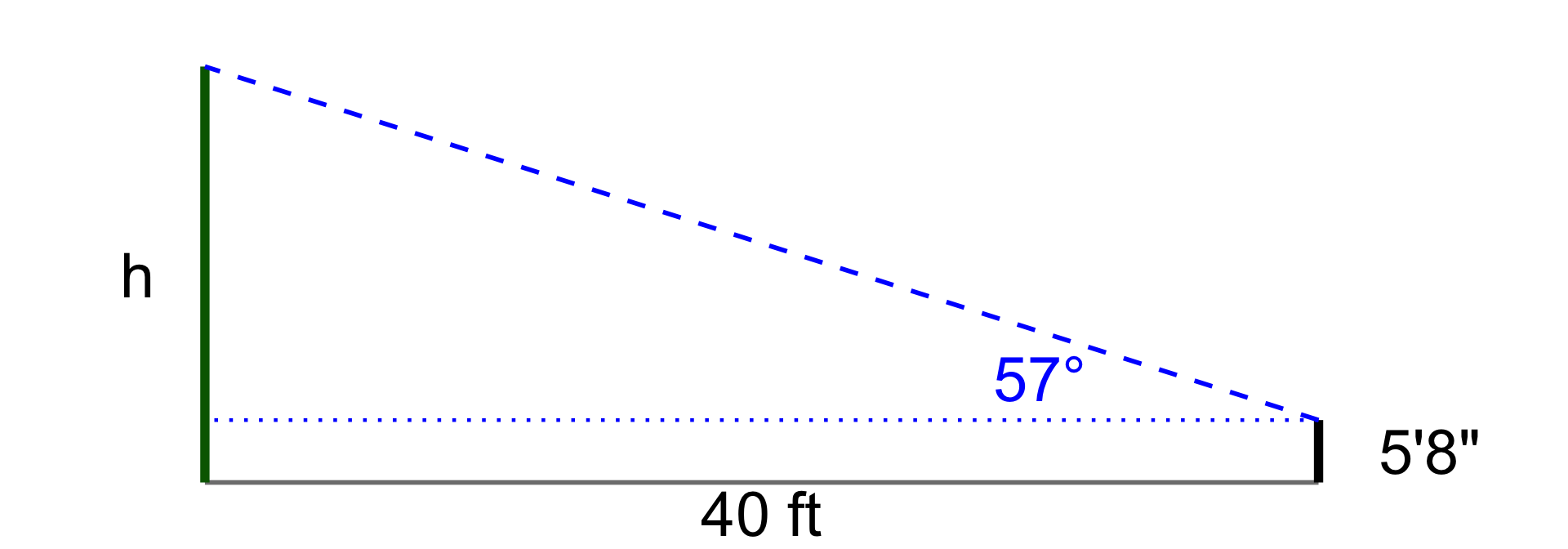
The height from eye level to the treetop uses \(\tan\):
\[\begin{align} \tan\!\left(57°\right) &= \frac{h_{\text{eye}}}{40} \end{align}\]
Problem: An arborist who is \(5'8''\) tall stands at the base of a tall tree and walks \(40\) feet away. Using an inclinometer, they measure an angle of \(57°\) from eye level to the treetop. Estimate the height of the tree.
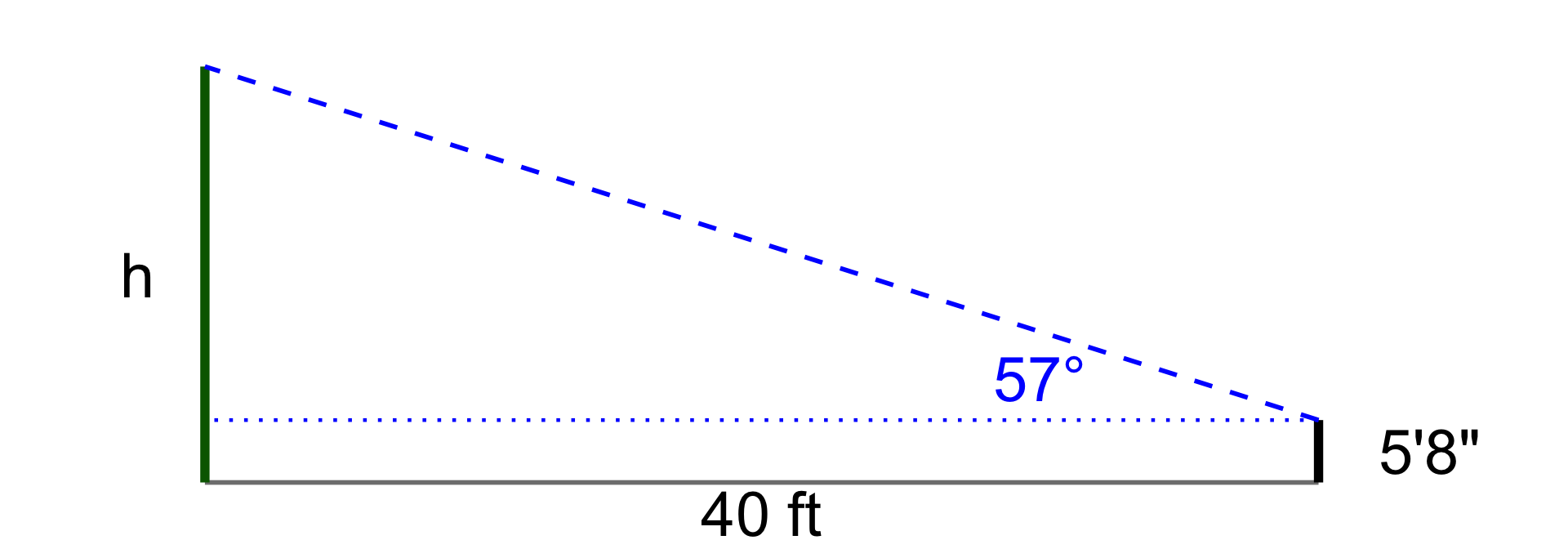
The height from eye level to the treetop uses \(\tan\):
\[\begin{align} \tan\!\left(57°\right) &= \frac{h_{\text{eye}}}{40}\\ \implies h_{\text{eye}} &= 40\tan\!\left(57°\right)\\ &\approx 61.59~\text{ft} \end{align}\]
Add the arborist’s eye height (\(5'8'' \approx 5.67\) ft):
\[\begin{align} h_{\text{tree}} &\approx 61.59 + 5.67 \approx \boxed{~67~\text{ft}~} \end{align}\]
Problem: From a point \(300\) ft from the base of a building, the angle of elevation to the top of the building is \(40°\) and to the top of a rooftop antenna is \(43°\). Find the height of the antenna.
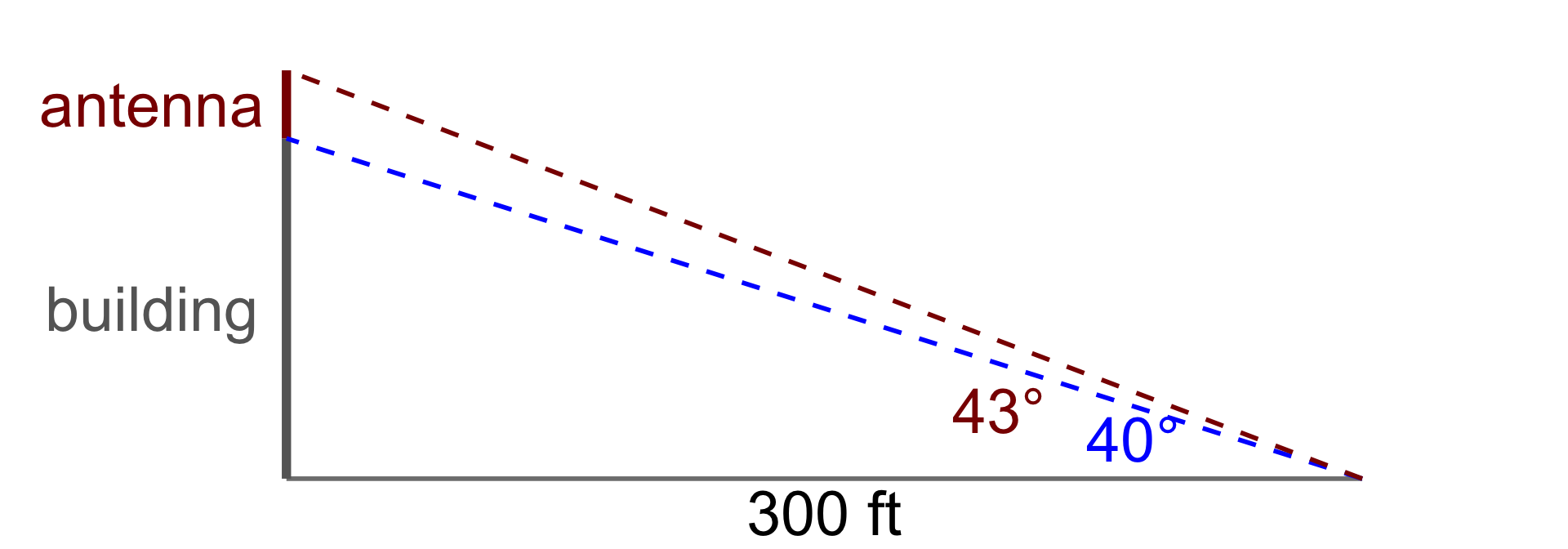
Height of building top:
\[\begin{align} h_{\text{bldg}} &= 300\tan\!\left(40°\right) \approx 251.73~\text{ft} \end{align}\]
Height of antenna top:
\[\begin{align} h_{\text{top}} &= 300\tan\!\left(43°\right) \approx 279.75~\text{ft} \end{align}\]
Antenna height:
\[\begin{align} h_{\text{antenna}} &= 279.75 - 251.73 \approx \boxed{~28~\text{ft}~} \end{align}\]
Problem: A radio tower is \(325\) ft from a building. From a window, the angle of elevation to the top of the tower is \(43°\) and the angle of depression to the base is \(31°\). How tall is the tower?
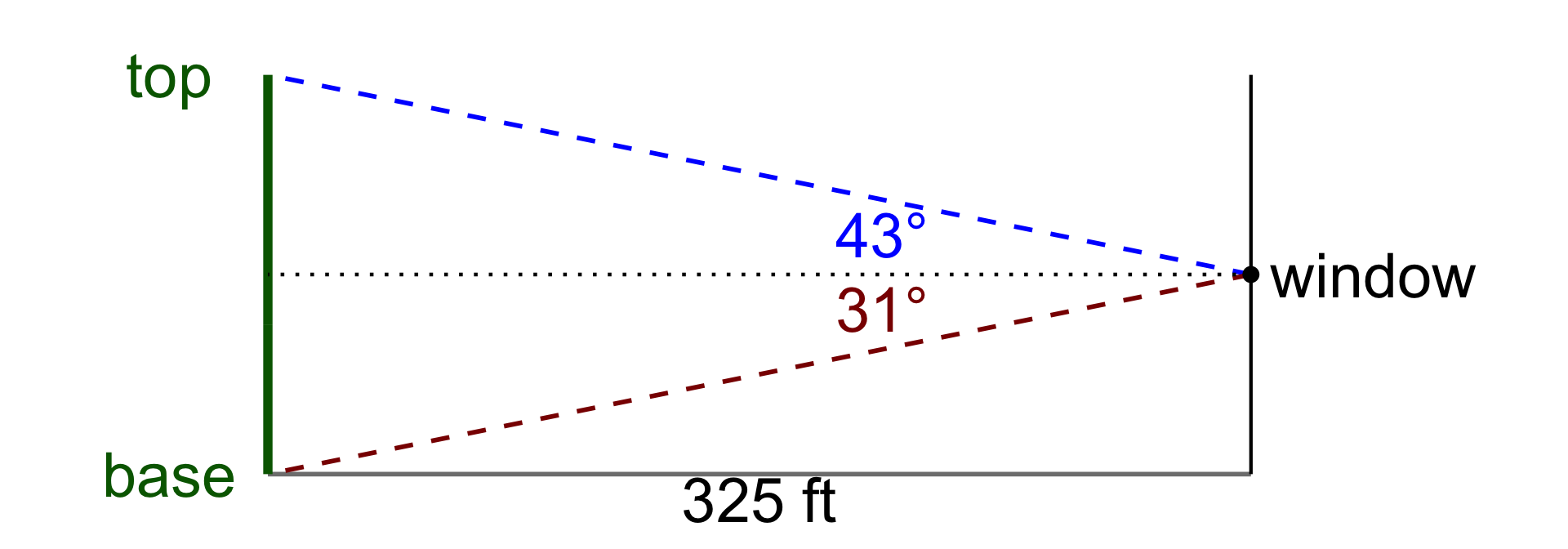
Height above the window:
\[\begin{align} h_{\text{above}} &= 325\tan\!\left(43°\right) \approx 303.07~\text{ft} \end{align}\]
Depth below the window:
\[\begin{align} h_{\text{below}} &= 325\tan\!\left(31°\right) \approx 195.28~\text{ft} \end{align}\]
Total tower height:
\[\begin{align} h_{\text{tower}} &= 303.07 + 195.28 \approx \boxed{~498~\text{ft}~} \end{align}\]
Navigate to our MAT142 Exit Ticket Form, answer the questions, and complete the task below.
Note. Today’s discussion is listed as 21. Right Triangle Trigonometry

Task: A surveyor standing at ground level measures the angle of elevation to the top of a cliff to be \(38°\). She then walks \(50\) feet closer to the cliff and measures the angle of elevation to be \(52°\). How tall is the cliff?