MAT 142: Trig Functions, Inverses, and Equations

Dr. Gilbert

June 12, 2026

Reminders and Warm-Up

Last class we introduced angles, radian measure, coterminal angles, and used the unit circle to evaluate \(\sin\left(\right)\), \(\cos\left(\right)\), and \(\tan\left(\right)\). Try the following warm-up problems.

Problem 1: Evaluate the following using the unit circle.

\[\left(a\right)~\sin\!\left(\frac{7\pi}{6}\right) \qquad \left(b\right)~\tan\!\left(120°\right) \qquad \left(c\right)~\cos\!\left(330°\right)\]

Problem 2: Evaluate the following. Use coterminal angles as needed.

\[\left(a\right)~\tan\!\left(-135°\right) \qquad \left(b\right)~\cos\!\left(\frac{27\pi}{6}\right) \qquad \left(c\right)~\cos\!\left(\frac{-15\pi}{3}\right)\]

Objectives

Today we study the graphs of the three primary trigonometric functions, their inverses, and how to solve trigonometric equations.

After today’s class meeting, you should be able to:

  • Identify key features (period, amplitude, phase shift, vertical shift) of transformed sine and cosine functions.
  • Evaluate inverse trigonometric functions \(\arcsin\), \(\arccos\), and \(\arctan\).
  • Solve trigonometric equations for all solutions using the unit circle.

The Book Trig Functions

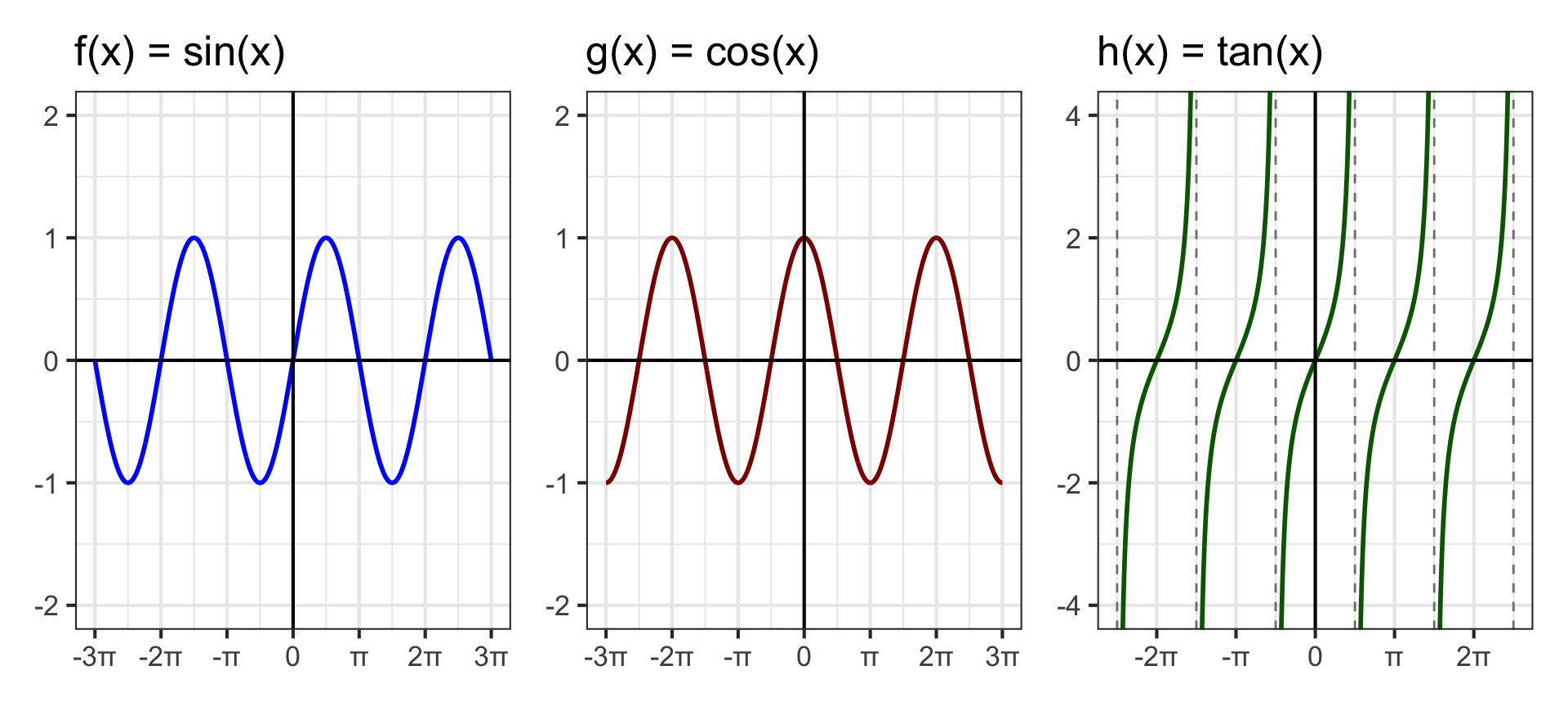
Geography of Sine and Cosine

Feature \(\sin\!\left(x\right)\) \(\cos\!\left(x\right)\)
Domain \(\left(-\infty, \infty\right)\) \(\left(-\infty, \infty\right)\)
Range \(\left[-1, 1\right]\) \(\left[-1, 1\right]\)
Period \(2\pi\) \(2\pi\)
\(y\)-intercept \(\left(0, 0\right)\) \(\left(0, 1\right)\)
Asymptotes None None

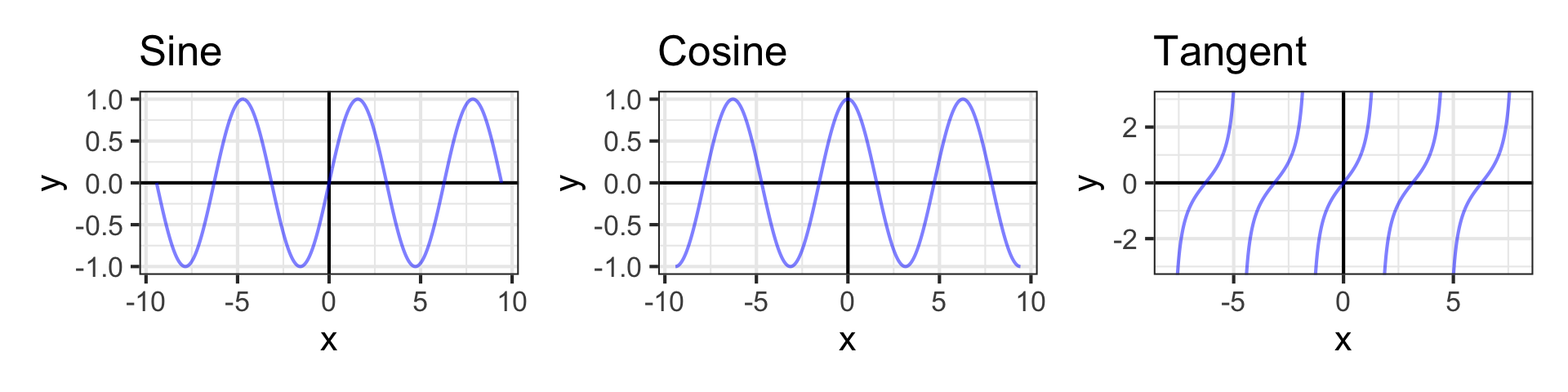
Tangent behaves differently: \(\tan\!\left(x\right) = \dfrac{\sin\!\left(x\right)}{\cos\!\left(x\right)}\), so it is undefined whenever \(\cos\!\left(x\right) = 0\).

  • Domain: all \(x \neq \frac{\pi}{2} + \pi k\) for any integer \(k\).
  • Period: \(\pi\) (half that of sine and cosine).
  • Vertical asymptotes at \(x = \frac{\pi}{2} + \pi k\).

Transformations of Trig Functions

The general transformed form is \(\displaystyle{f\left(x\right) = A\cdot\text{trig}\!\left(b\left(x - h\right)\right) + k}\), where:

Parameter Effect
\(\left\|A\right\|\) Amplitude — vertical stretch factor; range becomes \(\left[k - \left\|A\right\|,~ k + \left\|A\right\|\right]\)
\(A < 0\) Reflection over the midline
\(h\) Phase shift — horizontal shift (\(h > 0\) shifts right)
\(k\) Vertical shift — midline moves to \(y = k\)
\(b\) Period — for \(\sin\)/\(\cos\): period \(= \dfrac{2\pi}{\left|b\right|}\);
for \(\tan\): period \(= \dfrac{\pi}{\left|b\right|}\)

Always Factor First

If the argument isn’t already in the form \(b\left(x - h\right)\), factor out \(b\) before reading off the phase shift. For example, \(\sin\!\left(\frac{1}{2}x - 3\right) = \sin\!\left(\frac{1}{2}\left(x - 6\right)\right)\), so the phase shift is \(6\), not \(3\).

Transformations and Graphing

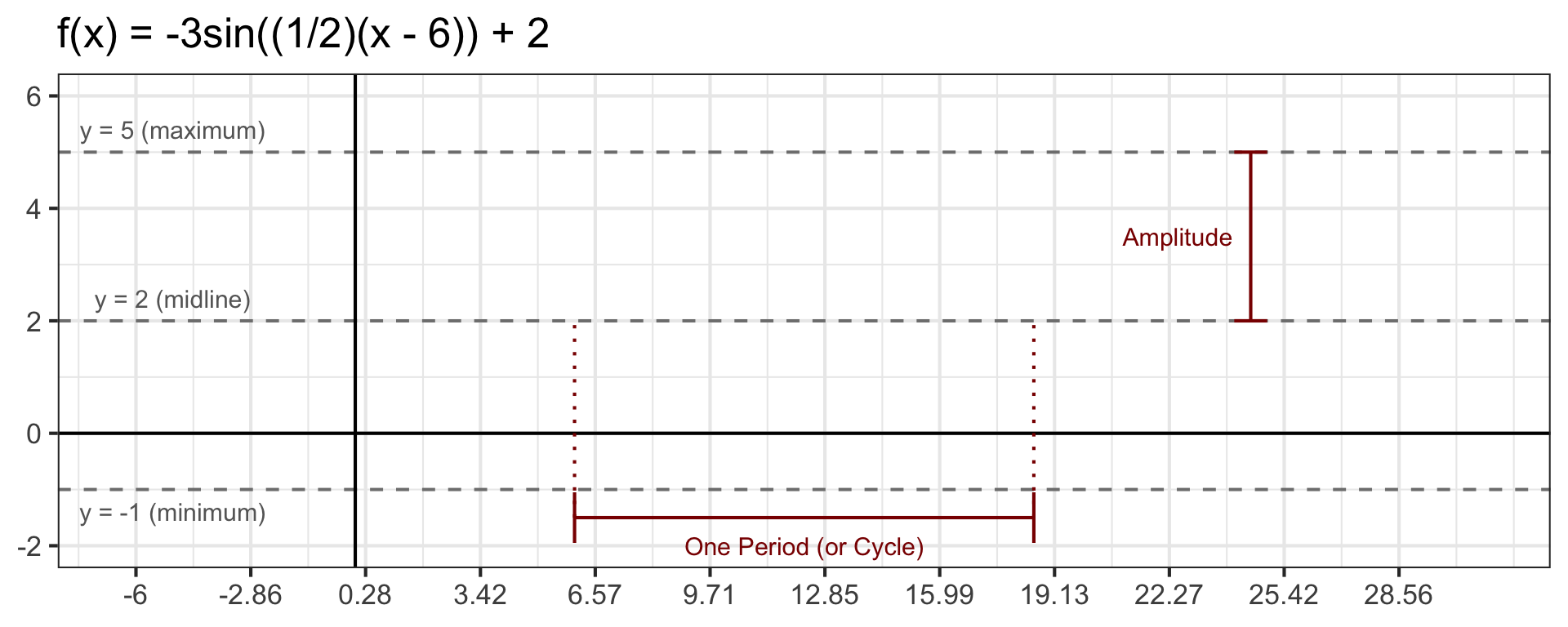
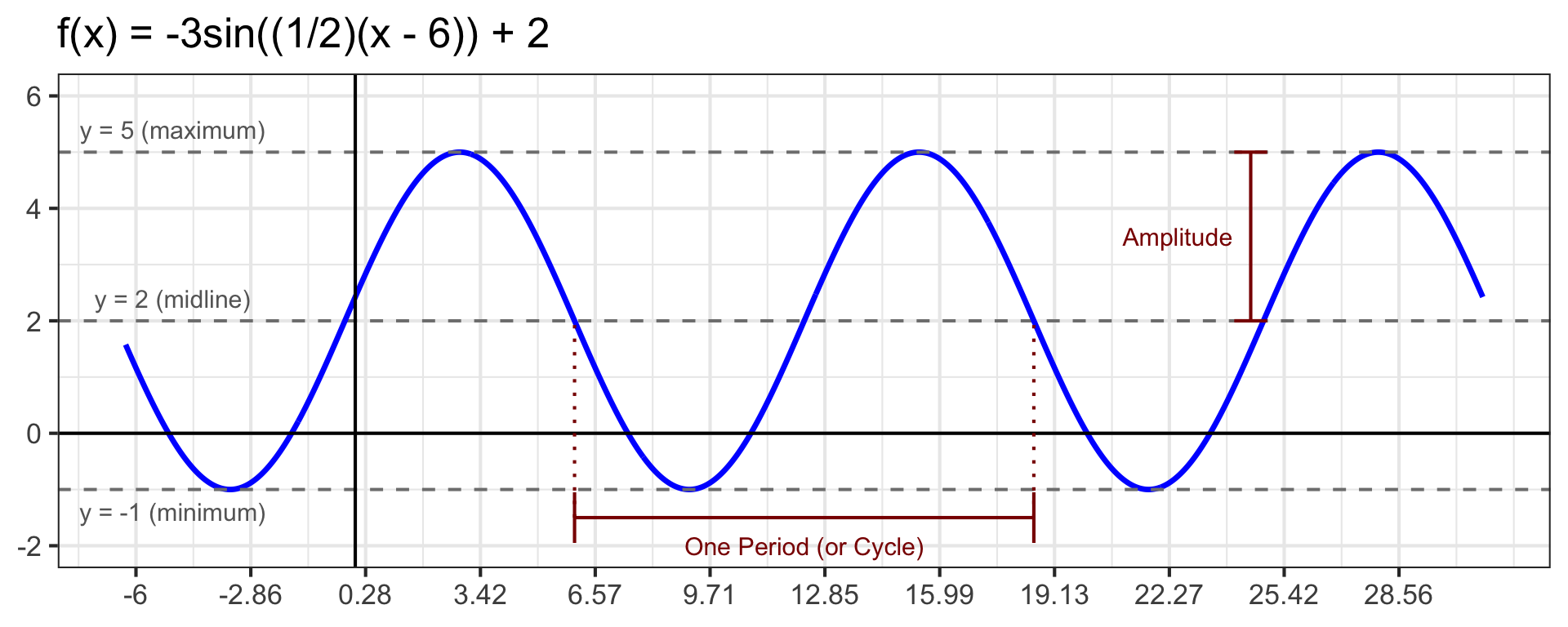
Example 1: For \(f\left(x\right) = -3\sin\!\left(\frac{1}{2}x - 3\right) + 2\), identify the amplitude, period, phase shift, and vertical shift. Sketch the graph.

Solution. Factor out \(b = \frac{1}{2}\) from the argument first.

\[\begin{align} f\left(x\right) &= -3\sin\!\left(\frac{1}{2}x - 3\right) + 2 \end{align}\]

Transformations and Graphing

Example 1: For \(f\left(x\right) = -3\sin\!\left(\frac{1}{2}x - 3\right) + 2\), identify the amplitude, period, phase shift, and vertical shift. Sketch the graph.

Solution. Factor out \(b = \frac{1}{2}\) from the argument first.

\[\begin{align} f\left(x\right) &= -3\sin\!\left(\frac{1}{2}x - 3\right) + 2\\ &= -3\sin\!\left(\frac{1}{2}\left(x - 6\right)\right) + 2 \end{align}\]

Transformations and Graphing

Example 1: For \(f\left(x\right) = -3\sin\!\left(\frac{1}{2}x - 3\right) + 2\), identify the amplitude, period, phase shift, and vertical shift. Sketch the graph.

Solution. Factor out \(b = \frac{1}{2}\) from the argument first.

\[\begin{align} f\left(x\right) &= -3\sin\!\left(\frac{1}{2}x - 3\right) + 2\\ &= -3\sin\!\left(\frac{1}{2}\left(x - 6\right)\right) + 2 \end{align}\]

Now we can read off the parameters directly.

  • Amplitude: \(\left|-3\right| = 3\) (the wave is also reflected over the midline, since \(A < 0\))
  • Phase shift: \(6\) units to the right
  • Period: \(\dfrac{2\pi}{1/2} = 4\pi\)
  • Vertical shift: \(+2\) (midline at \(y = 2\), range \(\left[-1, 5\right]\))

Transformations and Graphing

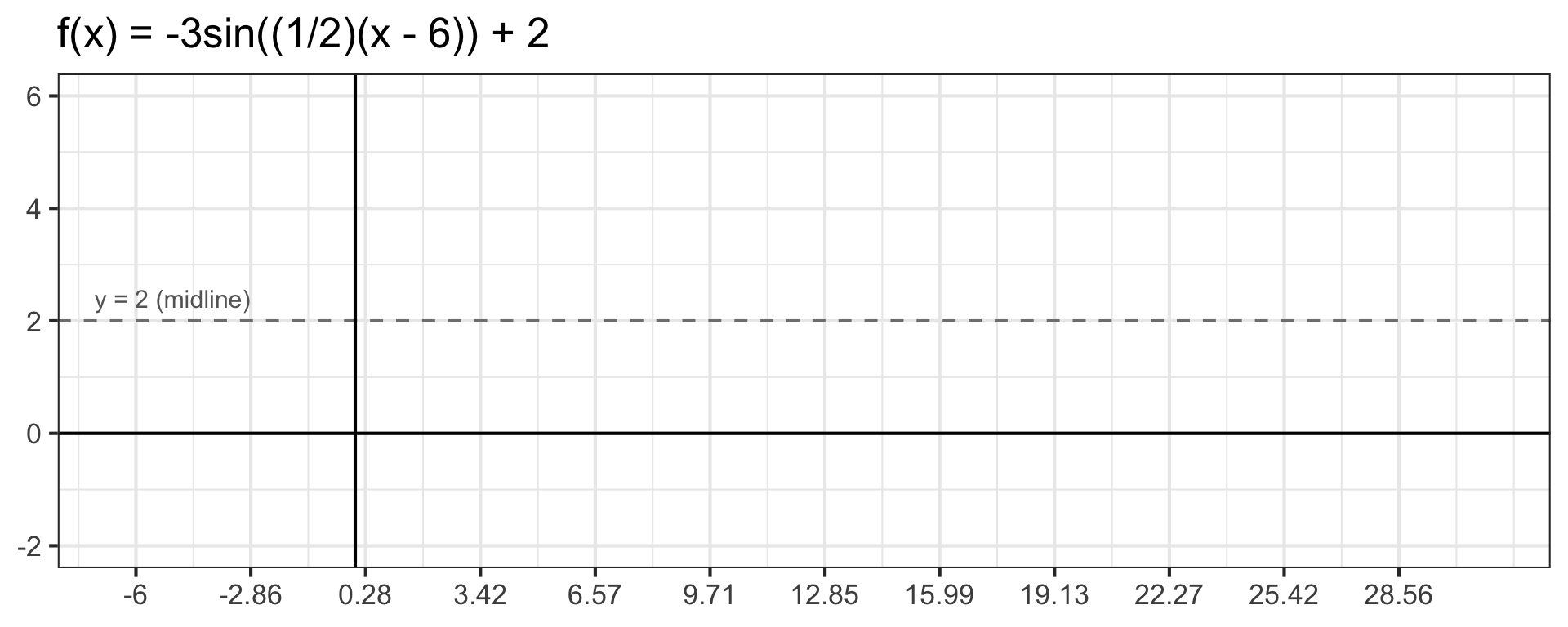
  • Vertical shift: \(+2\) (midline at \(y = 2\))
  • Amplitude: \(\left|-3\right| = 3\) (the wave is also reflected over the midline, since \(A < 0\))
  • Range: \(\left[-1, 5\right]\)
  • Phase shift: \(6\) units to the right
  • Period: \(\dfrac{2\pi}{1/2} = 4\pi\)

Transformations and Graphing
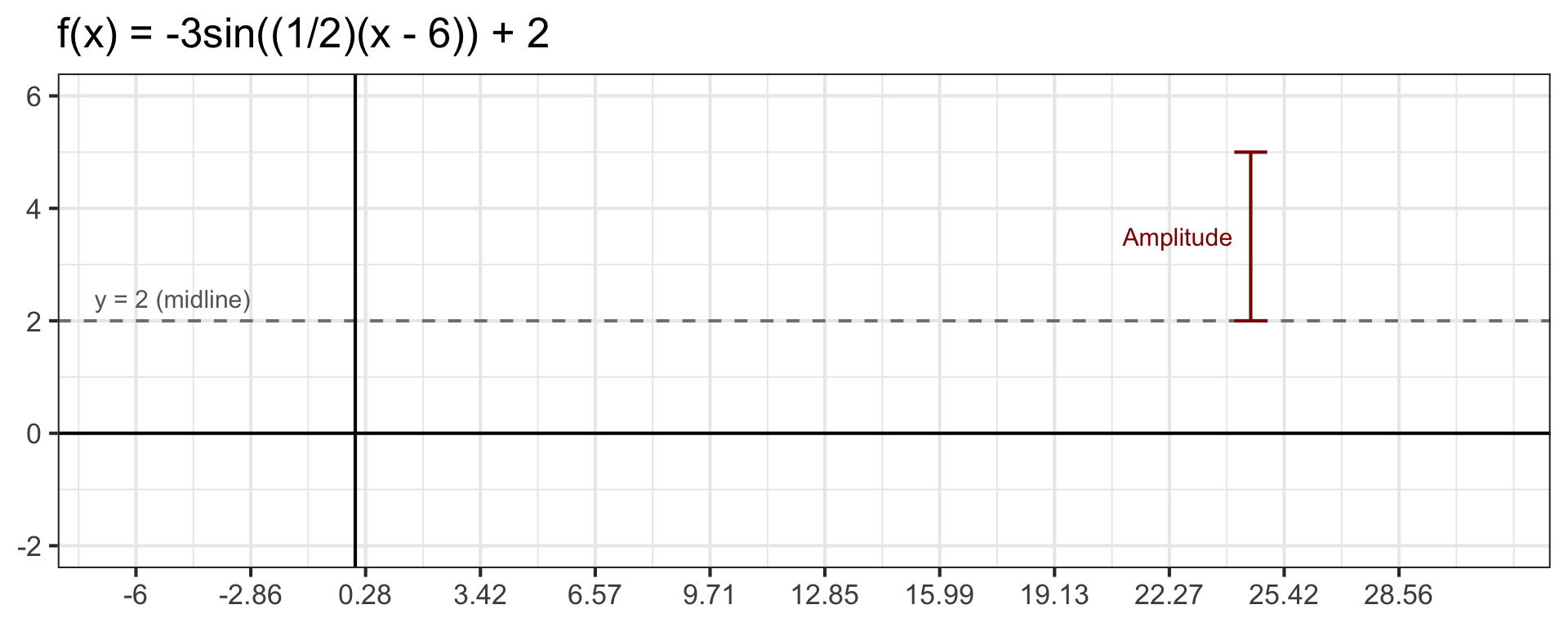
  • Vertical shift: \(+2\) (midline at \(y = 2\))
  • Amplitude: \(\left|-3\right| = 3\) (the wave is also reflected over the midline, since \(A < 0\))
  • Range: \(\left[-1, 5\right]\)
  • Phase shift: \(6\) units to the right
  • Period: \(\dfrac{2\pi}{1/2} = 4\pi\)

Transformations and Graphing
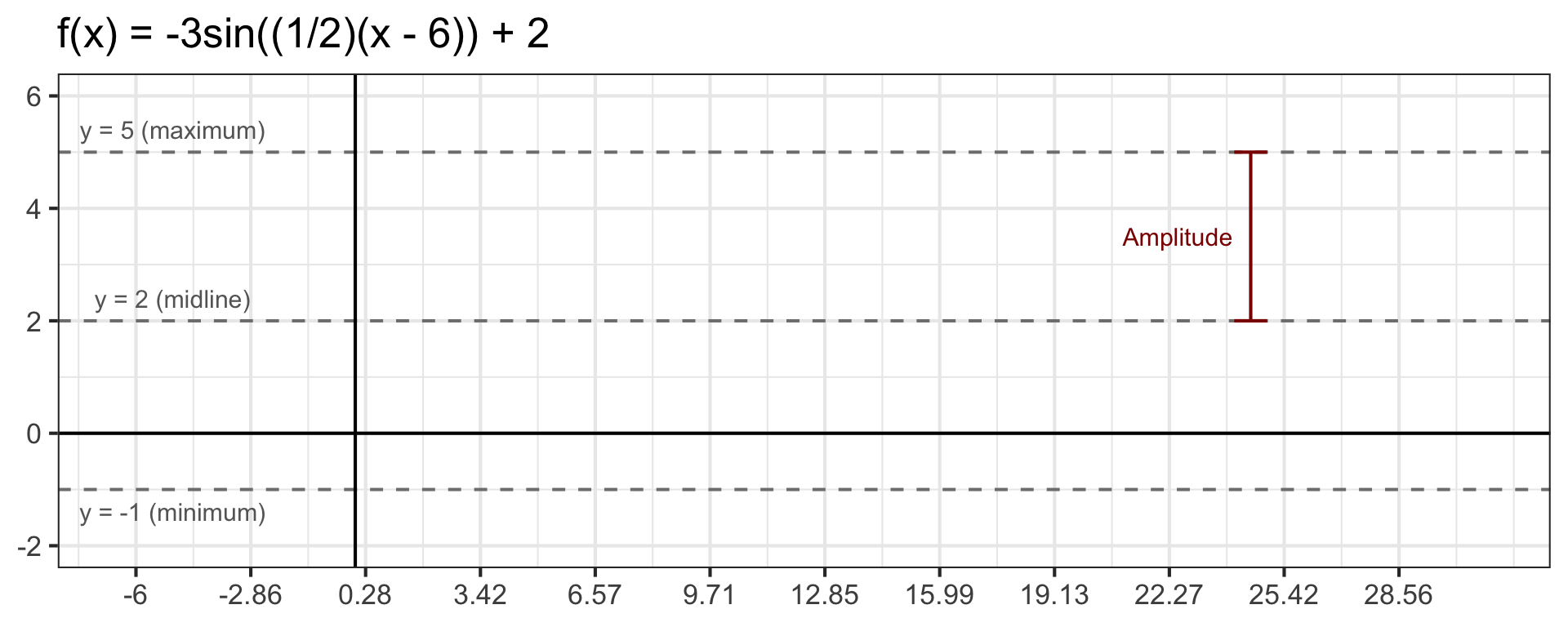
  • Vertical shift: \(+2\) (midline at \(y = 2\))
  • Amplitude: \(\left|-3\right| = 3\) (the wave is also reflected over the midline, since \(A < 0\))
  • Range: \(\left[-1, 5\right]\)
  • Phase shift: \(6\) units to the right
  • Period: \(\dfrac{2\pi}{1/2} = 4\pi\)

Transformations and Graphing
  • Vertical shift: \(+2\) (midline at \(y = 2\))
  • Amplitude: \(\left|-3\right| = 3\) (the wave is also reflected over the midline, since \(A < 0\))
  • Range: \(\left[-1, 5\right]\)
  • Phase shift: \(6\) units to the right
  • Period: \(\dfrac{2\pi}{1/2} = 4\pi\)

Transformations and Graphing
  • Vertical shift: \(+2\) (midline at \(y = 2\))
  • Amplitude: \(\left|-3\right| = 3\) (the wave is also reflected over the midline, since \(A < 0\))
  • Range: \(\left[-1, 5\right]\)
  • Phase shift: \(6\) units to the right
  • Period: \(\dfrac{2\pi}{1/2} = 4\pi\)

Wave Function Practice

Try It! 1: For \(\displaystyle{f\left(x\right) = 5\cos\!\left(2x + 4\right) - \frac{1}{2}}\), identify the amplitude, period, phase shift, and vertical shift.

Remember: Factor out \(b\) from the argument before reading off the phase shift.


Try It! 2: A wave function of the form \(f\left(x\right) = A\sin\!\left(b\left(x - h\right)\right) + k\) has:

  • Range \(\left[-2, 8\right]\)
  • Period \(\pi\)
  • Passes through the point \(\left(0, -2\right)\)

Sketch the graph and write down the algebraic definition of \(f\).

Inverse Trigonometric Functions

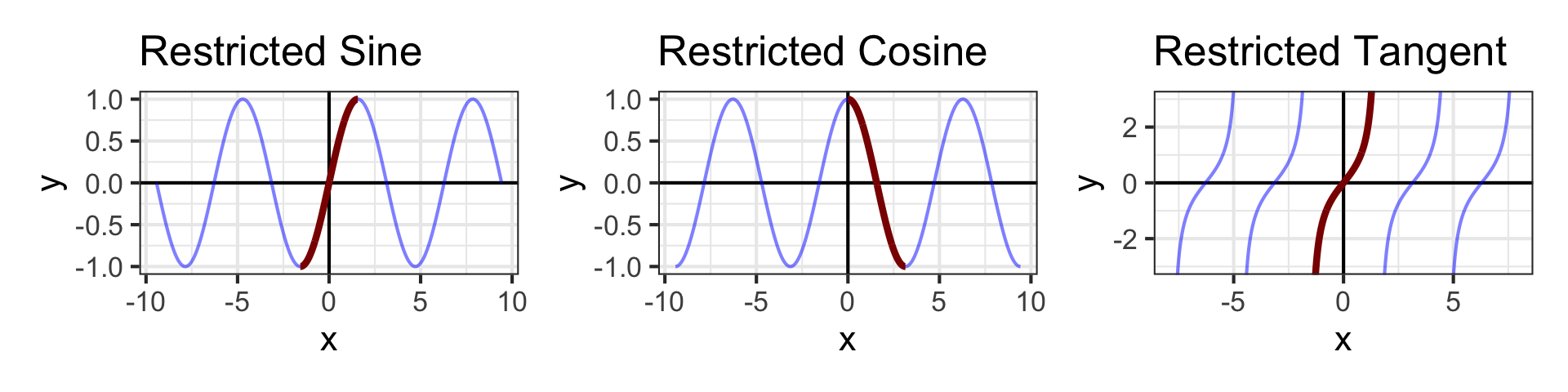
Since \(\sin\left(\right)\), \(\cos\left(\right)\), and \(\tan\left(\right)\) fail the horizontal line test, they are not invertible on their full domains. We restrict each to a domain where it is one-to-one, then define the inverse.
Inverse Trigonometric Functions

Since \(\sin\left(\right)\), \(\cos\left(\right)\), and \(\tan\left(\right)\) fail the horizontal line test, they are not invertible on their full domains. We restrict each to a domain where it is one-to-one, then define the inverse.
Function Restricted domain Inverse Permissible Inputs Output range
\(\sin\!\left(x\right)\) \(\left[-\frac{\pi}{2}, \frac{\pi}{2}\right]\) \(\arcsin\!\left(x\right)\) \(\left[-1, 1\right]\) \(\left[-\frac{\pi}{2}, \frac{\pi}{2}\right]\)
\(\cos\!\left(x\right)\) \(\left[0, \pi\right]\) \(\arccos\!\left(x\right)\) \(\left[-1, 1\right]\) \(\left[0, \pi\right]\)
\(\tan\!\left(x\right)\) \(\left(-\frac{\pi}{2}, \frac{\pi}{2}\right)\) \(\arctan\!\left(x\right)\) \(\left(-\infty, \infty\right)\) \(\left(-\frac{\pi}{2}, \frac{\pi}{2}\right)\)

Reading inverse trig: \(\arcsin\!\left(x\right)\) asks “what angle in \(\left[-\frac{\pi}{2}, \frac{\pi}{2}\right]\) has sine equal to \(x\)?” The other two functions work the same way within their respective output ranges.

Both notations \(\arcsin\!\left(x\right)\) and \(\sin^{-1}\!\left(x\right)\) mean the same thing.

Evaluating Inverse Trig Functions

Example 2: Evaluate each of the following.

\[\left(a\right)~\arccos\!\left(\frac{-1}{2}\right) \qquad \left(b\right)~\sin^{-1}\!\left(\frac{\sqrt{3}}{2}\right) \qquad \left(c\right)~\arctan\!\left(-1\right)\]

(a) \(\displaystyle{\arccos\left(\frac{-1}{2}\right)}\)

Ask: what angle \(\theta \in \left[0, \pi\right]\) satisfies \(\cos\!\left(\theta\right) = \dfrac{-1}{2}\)?

From the unit circle, \(\cos\!\left(\frac{2\pi}{3}\right) = -\frac{1}{2}\) and \(\frac{2\pi}{3} \in \left[0, \pi\right]\).

\[\arccos\!\left(\frac{-1}{2}\right) = \boxed{~\frac{2\pi}{3}~}\]

(b) \(\displaystyle{\sin^{-1}\left(\frac{\sqrt{3}}{2}\right)}\)

Ask: what angle \(\theta \in \left[-\frac{\pi}{2}, \frac{\pi}{2}\right]\) satisfies \(\sin\!\left(\theta\right) = \dfrac{\sqrt{3}}{2}\)?

From the unit circle, \(\sin\!\left(\frac{\pi}{3}\right) = \frac{\sqrt{3}}{2}\) and \(\frac{\pi}{3} \in \left[-\frac{\pi}{2}, \frac{\pi}{2}\right]\).

\[\sin^{-1}\!\left(\frac{\sqrt{3}}{2}\right) = \boxed{~\frac{\pi}{3}~}\]

(c) \(\displaystyle{\arctan\left(-1\right)}\)

Ask: what angle \(\theta \in \left(-\frac{\pi}{2}, \frac{\pi}{2}\right)\) satisfies \(\tan\!\left(\theta\right) = -1\)?

From the unit circle, \(\tan\!\left(\frac{-\pi}{4}\right) = -1\) and \(\frac{-\pi}{4} \in \left(-\frac{\pi}{2}, \frac{\pi}{2}\right)\).

\[\arctan\!\left(-1\right) = \boxed{~\frac{-\pi}{4}~}\]

Inverse Trig Practice

Try It! 3: Evaluate each of the following inverse trigonometric functions.


\[\left(a\right)~\arccos\!\left(\frac{\sqrt{2}}{2}\right) \qquad \left(b\right)~\arcsin\!\left(-1\right) \qquad \left(c\right)~\tan^{-1}\!\left(\frac{1}{\sqrt{3}}\right)\]


\[\left(d\right)~\cos^{-1}\!\left(0\right) \qquad \left(e\right)~\sin^{-1}\!\left(\frac{-\sqrt{3}}{2}\right) \qquad \left(f\right)~\tan^{-1}\!\left(-\sqrt{3}\right)\]

Solving Trigonometric Equations

Trigonometric equations typically have infinitely many solutions because \(\sin\), \(\cos\), and \(\tan\) are periodic. The general strategy is:

  1. Isolate the trigonometric function.
  2. Use \(\arcsin\), \(\arccos\), or \(\arctan\) to find the reference angle — this gives the principal solution.
  3. Use the unit circle to find all angles in \(\left[0, 2\pi\right)\) where the equation holds.
  4. Write the general solution by adding integer multiples of the period.

Always Give All Solutions

Unless the problem restricts the domain, trigonometric equations have infinitely many solutions. Always append \(+ 2\pi k\) (or \(+ \pi k\) for tangent) where \(k\) is an integer immediately after using the inverse trigonometric function to “unlock” the argument.

Solving Trigonometric Equations

Example 3: Solve \(2\sin\!\left(2x\right) + \sqrt{3} = 0\).

Solution. Isolate the trigonometric function first.

\[\begin{align} 2\sin\!\left(2x\right) + \sqrt{3} &= 0 \end{align}\]

Solving Trigonometric Equations

Example 3: Solve \(2\sin\!\left(2x\right) + \sqrt{3} = 0\).

Solution. Isolate the trigonometric function first.

\[\begin{align} 2\sin\!\left(2x\right) + \sqrt{3} &= 0\\ \implies 2\sin\!\left(2x\right) &= -\sqrt{3} \end{align}\]

Solving Trigonometric Equations

Example 3: Solve \(2\sin\!\left(2x\right) + \sqrt{3} = 0\).

Solution. Isolate the trigonometric function first.

\[\begin{align} 2\sin\!\left(2x\right) + \sqrt{3} &= 0\\ \implies 2\sin\!\left(2x\right) &= -\sqrt{3}\\ \implies \sin\!\left(2x\right) &= \frac{-\sqrt{3}}{2} \end{align}\]

Solving Trigonometric Equations

Example 3: Solve \(2\sin\!\left(2x\right) + \sqrt{3} = 0\).

Solution. Isolate the trigonometric function first. Then apply the appropriate inverse trigonometric function to “unlock” the variable expression.

\[\begin{align} 2\sin\!\left(2x\right) + \sqrt{3} &= 0\\ \implies 2\sin\!\left(2x\right) &= -\sqrt{3}\\ \implies \sin\!\left(2x\right) &= \frac{-\sqrt{3}}{2} \end{align}\]

Solving Trigonometric Equations

Example 3: Solve \(2\sin\!\left(2x\right) + \sqrt{3} = 0\).

Solution. Isolate the trigonometric function first. Then apply the appropriate inverse trigonometric function to “unlock” the variable expression.

\[\begin{align} 2\sin\!\left(2x\right) + \sqrt{3} &= 0\\ \implies 2\sin\!\left(2x\right) &= -\sqrt{3}\\ \implies \sin\!\left(2x\right) &= \frac{-\sqrt{3}}{2}\\ \implies \arcsin\left(\sin\left(2x\right)\right) &= \arcsin\left(\frac{-\sqrt{3}}{2}\right) \end{align}\]

Solving Trigonometric Equations

Example 3: Solve \(2\sin\!\left(2x\right) + \sqrt{3} = 0\).

Solution. Isolate the trigonometric function first. Then apply the appropriate inverse trigonometric function to “unlock” the variable expression.

\[\begin{align} 2\sin\!\left(2x\right) + \sqrt{3} &= 0\\ \implies 2\sin\!\left(2x\right) &= -\sqrt{3}\\ \implies \sin\!\left(2x\right) &= \frac{-\sqrt{3}}{2}\\ \implies \arcsin\left(\sin\left(2x\right)\right) &= \arcsin\left(\frac{-\sqrt{3}}{2}\right)\\ \implies 2x &= \arcsin\left(\frac{-\sqrt{3}}{2}\right) + 2\pi k \end{align}\]

Solving Trigonometric Equations

Example 3: Solve \(2\sin\!\left(2x\right) + \sqrt{3} = 0\).

Solution. Isolate the trigonometric function first. Then apply the appropriate inverse trigonometric function to “unlock” the variable expression.

\[\begin{align} 2\sin\!\left(2x\right) + \sqrt{3} &= 0\\ \implies 2\sin\!\left(2x\right) &= -\sqrt{3}\\ \implies \sin\!\left(2x\right) &= \frac{-\sqrt{3}}{2}\\ \implies \arcsin\left(\sin\left(2x\right)\right) &= \arcsin\left(\frac{-\sqrt{3}}{2}\right)\\ \implies 2x &= \arcsin\left(\frac{-\sqrt{3}}{2}\right) + 2\pi k \end{align}\]

Now evaluate \(\displaystyle{\arcsin\left(\frac{-\sqrt{3}}{2}\right)}\) by finding all angles \(\theta\) where \(\displaystyle{\sin\left(\theta\right) = \frac{-\sqrt{3}}{2}}\).

There are two possible solution angles – one in QIII and the other in QIV.

The angle in QIV is \(\displaystyle{\frac{-\pi}{3}}\) (since \(\displaystyle{\sin\left(\frac{-\pi}{3}\right) = \frac{\sqrt{3}}{2}}\)).

The angle in QIII is \(\displaystyle{\frac{-2\pi}{3}}\)

Solving Trigonometric Equations

Example 3: Solve \(2\sin\!\left(2x\right) + \sqrt{3} = 0\).

Solution. Isolate the trigonometric function first. Then apply the appropriate inverse trigonometric function to “unlock” the variable expression.

\[\begin{align} 2\sin\!\left(2x\right) + \sqrt{3} &= 0\\ \implies 2\sin\!\left(2x\right) &= -\sqrt{3}\\ \implies \sin\!\left(2x\right) &= \frac{-\sqrt{3}}{2}\\ \implies \arcsin\left(\sin\left(2x\right)\right) &= \arcsin\left(\frac{-\sqrt{3}}{2}\right)\\ \implies 2x &= \arcsin\left(\frac{-\sqrt{3}}{2}\right) + 2\pi k\\ \implies 2x = \frac{-2\pi}{3} + 2\pi k &\text{ or } 2x = \frac{-\pi}{3} + 2\pi k \end{align}\]

Solving Trigonometric Equations

Example 3: Solve \(2\sin\!\left(2x\right) + \sqrt{3} = 0\).

Solution. Isolate the trigonometric function first. Then apply the appropriate inverse trigonometric function to “unlock” the variable expression.

\[\begin{align} 2\sin\!\left(2x\right) + \sqrt{3} &= 0\\ \implies 2\sin\!\left(2x\right) &= -\sqrt{3}\\ \implies \sin\!\left(2x\right) &= \frac{-\sqrt{3}}{2}\\ \implies \arcsin\left(\sin\left(2x\right)\right) &= \arcsin\left(\frac{-\sqrt{3}}{2}\right)\\ \implies 2x &= \arcsin\left(\frac{-\sqrt{3}}{2}\right) + 2\pi k\\ \implies 2x = \frac{-2\pi}{3} + 2\pi k &\text{ or } 2x = \frac{-\pi}{3} + 2\pi k\\ \implies \boxed{~x = \frac{-\pi}{3} + \pi k~} &\text{ or } \boxed{~x = \frac{-\pi}{6} + \pi k~} \text{ for any integer $k$} \end{align}\]

Trigonometric Equation Practice

Try It! 4: Solve each of the following trigonometric equations. Give all solutions.


\(\left(a\right)~\displaystyle{2\cos\!\left(5x - 4\right) - \sqrt{3} = 0}\)


\(\left(b\right)~\displaystyle{\tan\!\left(x - 3\right) + \sqrt{3} = 0}\)

Exit Ticket Task

Navigate to our MAT142 Exit Ticket Form, answer the questions, and complete the task below.


Note. Today’s discussion is listed as 20. Trigonometric Functions and Equations

Task: Consider \(f\left(x\right) = 2\sin\!\left(3x + \pi\right) - 1\).

\(\left(a\right)\) Identify the amplitude, period, phase shift, and vertical shift.

\(\left(b\right)\) Solve \(f\left(x\right) = 0\) for all \(x\). (Hint: isolate \(\sin\left(\cdots\right)\), then find all solutions.)

Summary and Next Time…

Ideas From Today
  • \(\sin\left(\right)\) and \(\cos\left(\right)\) have period \(2\pi\), amplitude \(1\), domain all reals, range \(\left[-1, 1\right]\). \(\tan\left(\right)\) has period \(\pi\) and vertical asymptotes at \(x = \frac{\pi}{2} + \pi k\).
  • For \(A\cdot\text{trig}\!\left(b\left(x-h\right)\right)+k\): amplitude \(= \left|A\right|\), period \(= \frac{2\pi}{b}\) (or \(\frac{\pi}{b}\) for tangent), phase shift \(= h\), midline \(y = k\).
  • Always factor out \(b\) first before reading the phase shift.
  • \(\arcsin\left(\right)\), \(\arccos\left(\right)\), \(\arctan\left(\right)\) invert the trig functions on their restricted domains. Outputs are angles, not positional values.
  • Trig equations have infinitely many solutions. Obtain the general solution by adding \(+2\pi k\) (for sine and cosine) or \(+\pi k\) (for tangent) once you’ve applied the inverse trigonometric functions.
Looking Ahead
  • Next class is our final new content day — we apply trigonometry to right triangles and see how \(\sin\left(\right)\) and \(\cos\left(\right)\) connect to the ratios of sides that motivated the subject at the start of the unit.
  • This is also where we return to the projectile problem from Day 23 and finish what we started.
Next Time:
Right Triangle Trigonometry and Applications
Homework:
Continue Homework 12 on MyOpenMath