MAT 142: Angles and Measure
July 28, 2026
Reminders
Last class we completed our study of exponential and logarithmic functions. Today we begin trigonometry — the final major topic of the semester.
Try the following warm-up problems as review, challenge, and bridge.
Problem 1: A projectile is launched vertically from ground level, with initial velocity 64 feet per second. The height (in feet) of the projectile after \(t\) seconds is given by the function \(h\left(t\right) = -16t^2 + 64t\). Find the maximum height of the projectile and the time at which it reaches that height.
Problem 2: Solve \(\displaystyle{e^{2x} - 5e^x + 6 = 0}\).
Problem 3: Consider the projectile from the first problem. How does the scenario change if the projectile is launched at a \(60°\) angle instead of vertically? Are the answers the same? Why or why not? What do you need to know in order to solve this updated problem?
Objectives
Trigonometry connects angles to lengths and coordinates. It is the mathematical language of anything that rotates, oscillates, or repeats — from sound waves to planetary orbits to signal processing.
After today’s class meeting, you should be able to:
- Measure angles in both degrees and radians and convert between the two.
- Identify coterminal angles and find a coterminal angle in \(\left[0°, 360°\right)\) or \(\left[0, 2\pi\right)\).
- Use the unit circle to evaluate \(\sin\left(\right)\), \(\cos\left(\right)\), and \(\tan\left(\right)\) at common angles.
- Evaluate trigonometric functions at angles outside \(\left[0°, 360°\right)\) using coterminal angles.
The Unit Circle
The unit circle is a circle of radius \(1\), centered at the origin. It is the foundation of trigonometry.
Each point on the unit circle corresponds to an angle \(\theta\) measured from the positive \(x\)-axis, and is labeled with its coordinates \(\left(x, y\right)\).
The unit circle includes the angles that are multiples of \(30°\) \(\left(\text{or }\frac{\pi}{6}\text{ rad}\right)\) and multiples of \(45°\) \(\left(\text{or }\frac{\pi}{4}\text{ rad}\right)\) — the angle increments you will encounter most often.
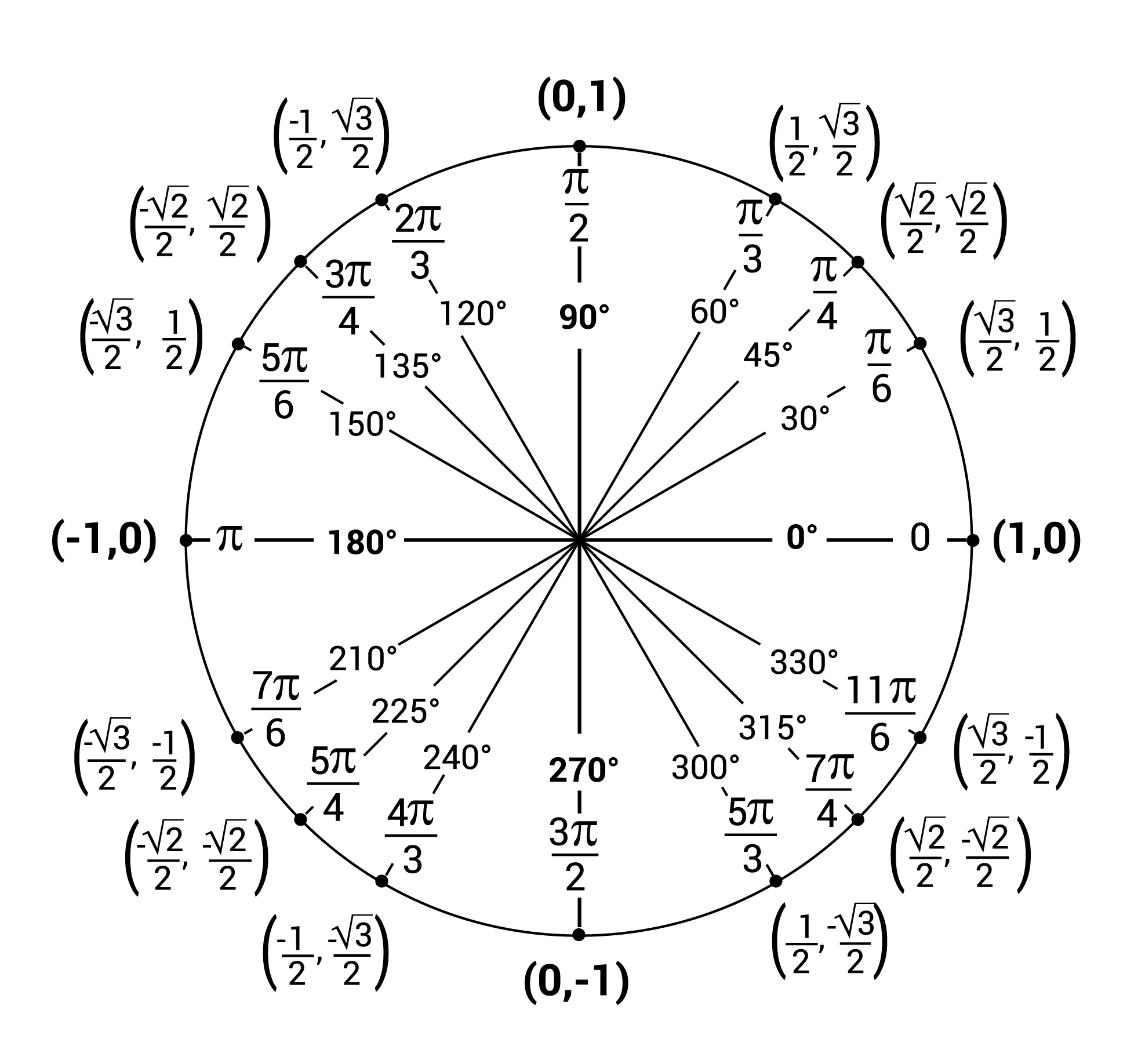
Degree and Radian Measure
There are two standard units for measuring angles.
Degrees: A full revolution around a circle measures \(360°\). This is the unit most familiar from everyday life.
Radians: A full revolution around a circle is \(2\pi\) rad. Radians are the natural unit for mathematics — many formulas in calculus and beyond require radian measure.
Converting between the two uses the fact that \(360° = 2\pi\) rad, so the ratio \(\dfrac{2\pi~\text{rad}}{360°} = 1\):
\[d° = d° \cdot \frac{2\pi~\text{rad}}{360°} \qquad \text{and} \qquad r~\text{rad} = r~\text{rad} \cdot \frac{360°}{2\pi~\text{rad}}\]
Sign and direction: Angles are measured from the positive \(x\)-axis. Counter-clockwise is the positive direction; clockwise is negative. Angles with measure exceeding \(360°\) (or less than \(-360°\)) represent more than one full revolution.
Converting Angles
Example 1: \(\left(1\right)\) Convert \(135°\) to radians. \(\quad\left(2\right)\) Convert \(\dfrac{11\pi}{6}\) rad to degrees.
(1) Multiply by the degree-to-radian conversion factor.
\[\begin{align} 135° \end{align}\]
Converting Angles
Example 1: \(\left(1\right)\) Convert \(135°\) to radians. \(\quad\left(2\right)\) Convert \(\dfrac{11\pi}{6}\) rad to degrees.
(1) Multiply by the degree-to-radian conversion factor.
\[\begin{align} 135° &= 135°\left(\frac{2\pi~\text{rad}}{360°}\right) \end{align}\]
Converting Angles
Example 1: \(\left(1\right)\) Convert \(135°\) to radians. \(\quad\left(2\right)\) Convert \(\dfrac{11\pi}{6}\) rad to degrees.
(1) Multiply by the degree-to-radian conversion factor.
\[\begin{align} 135° &= 135°\left(\frac{2\pi~\text{rad}}{360°}\right)\\ &= \frac{270\pi}{360} \end{align}\]
Converting Angles
Example 1: \(\left(1\right)\) Convert \(135°\) to radians. \(\quad\left(2\right)\) Convert \(\dfrac{11\pi}{6}\) rad to degrees.
(1) Multiply by the degree-to-radian conversion factor.
\[\begin{align} 135° &= 135°\left(\frac{2\pi~\text{rad}}{360°}\right)\\ &= \frac{270\pi}{360}\\ &= \frac{27\pi}{36} \end{align}\]
Converting Angles
Example 1: \(\left(1\right)\) Convert \(135°\) to radians. \(\quad\left(2\right)\) Convert \(\dfrac{11\pi}{6}\) rad to degrees.
(1) Multiply by the degree-to-radian conversion factor.
\[\begin{align} 135° &= 135°\left(\frac{2\pi~\text{rad}}{360°}\right)\\ &= \frac{270\pi}{360}\\ &= \frac{27\pi}{36}\\ &= \boxed{~\frac{3\pi}{4}~} \end{align}\]
(2) Multiply by the radian-to-degree conversion factor.
\[\begin{align} \frac{11\pi}{6}~\text{rad} \end{align}\]
Converting Angles
Example 1: \(\left(1\right)\) Convert \(135°\) to radians. \(\quad\left(2\right)\) Convert \(\dfrac{11\pi}{6}\) rad to degrees.
(1) Multiply by the degree-to-radian conversion factor.
\[\begin{align} 135° &= 135°\left(\frac{2\pi~\text{rad}}{360°}\right)\\ &= \frac{270\pi}{360}\\ &= \frac{27\pi}{36}\\ &= \boxed{~\frac{3\pi}{4}~} \end{align}\]
(2) Multiply by the radian-to-degree conversion factor.
\[\begin{align} \frac{11\pi}{6}~\text{rad} &= \left(\frac{11\pi}{6}~\text{rad}\right)\left(\frac{360°}{2\pi~\text{rad}}\right) \end{align}\]
Converting Angles
Example 1: \(\left(1\right)\) Convert \(135°\) to radians. \(\quad\left(2\right)\) Convert \(\dfrac{11\pi}{6}\) rad to degrees.
(1) Multiply by the degree-to-radian conversion factor.
\[\begin{align} 135° &= 135°\left(\frac{2\pi~\text{rad}}{360°}\right)\\ &= \frac{270\pi}{360}\\ &= \frac{27\pi}{36}\\ &= \boxed{~\frac{3\pi}{4}~} \end{align}\]
(2) Multiply by the radian-to-degree conversion factor.
\[\begin{align} \frac{11\pi}{6}~\text{rad} &= \left(\frac{11\pi}{6}~\text{rad}\right)\left(\frac{360°}{2\pi~\text{rad}}\right)\\ &= \frac{11\cdot 360°}{12} \end{align}\]
Converting Angles
Example 1: \(\left(1\right)\) Convert \(135°\) to radians. \(\quad\left(2\right)\) Convert \(\dfrac{11\pi}{6}\) rad to degrees.
(1) Multiply by the degree-to-radian conversion factor.
\[\begin{align} 135° &= 135°\left(\frac{2\pi~\text{rad}}{360°}\right)\\ &= \frac{270\pi}{360}\\ &= \frac{27\pi}{36}\\ &= \boxed{~\frac{3\pi}{4}~} \end{align}\]
(2) Multiply by the radian-to-degree conversion factor.
\[\begin{align} \frac{11\pi}{6}~\text{rad} &= \left(\frac{11\pi}{6}~\text{rad}\right)\left(\frac{360°}{2\pi~\text{rad}}\right)\\ &= \frac{11\cdot 360°}{12}\\ &= 11\cdot 30° \end{align}\]
Converting Angles
Example 1: \(\left(1\right)\) Convert \(135°\) to radians. \(\quad\left(2\right)\) Convert \(\dfrac{11\pi}{6}\) rad to degrees.
(1) Multiply by the degree-to-radian conversion factor.
\[\begin{align} 135° &= 135°\left(\frac{2\pi~\text{rad}}{360°}\right)\\ &= \frac{270\pi}{360}\\ &= \frac{27\pi}{36}\\ &= \boxed{~\frac{3\pi}{4}~} \end{align}\]
(2) Multiply by the radian-to-degree conversion factor.
\[\begin{align} \frac{11\pi}{6}~\text{rad} &= \left(\frac{11\pi}{6}~\text{rad}\right)\left(\frac{360°}{2\pi~\text{rad}}\right)\\ &= \frac{11\cdot 360°}{12}\\ &= 11\cdot 30°\\ &= \boxed{~330°~} \end{align}\]
Angle Conversion Practice
Try It! 1: Complete the following conversions.
\(\left(a\right)\) Convert \(780°\) to radians.
\(\left(b\right)\) Convert \(-50°\) to radians.
\(\left(c\right)\) Convert \(3\pi\) rad to degrees.
\(\left(d\right)\) Convert \(\displaystyle{-\frac{\pi}{5}}\) rad to degrees.
The Six Trigonometric Functions
For an angle \(\theta\) whose terminal side intersects the unit circle at the point \(\left(x, y\right)\), we define:
\[\begin{array}{lll} \sin\!\left(\theta\right) = y & \quad & \csc\!\left(\theta\right) = \dfrac{1}{y}\\[10pt] \cos\!\left(\theta\right) = x & \quad & \sec\!\left(\theta\right) = \dfrac{1}{x}\\[10pt] \tan\!\left(\theta\right) = \dfrac{y}{x} & \quad & \cot\!\left(\theta\right) = \dfrac{x}{y} \end{array}\]
Since \(x\) and \(y\) are coordinates on the unit circle, \(\sin\) and \(\cos\) always satisfy \(-1 \leq \sin\!\left(\theta\right) \leq 1\) and \(-1 \leq \cos\!\left(\theta\right) \leq 1\).
Note that \(\tan\), \(\sec\), \(\csc\), and \(\cot\) are undefined whenever their denominator is zero.
Evaluating Trig Functions
Example 2: Evaluate each of the following using the unit circle.
\[\left(a\right)~\sin\!\left(\frac{5\pi}{6}\right) \qquad \left(b\right)~\cos\!\left(\frac{4\pi}{3}\right) \qquad \left(c\right)~\tan\!\left(\frac{7\pi}{6}\right) \qquad \left(d\right)~\cos\!\left(135°\right) \qquad \left(e\right)~\tan\!\left(225°\right)\]
(a) \(\displaystyle{\frac{5\pi}{6}}\)
Evaluating Trig Functions
Example 2: Evaluate each of the following using the unit circle.
\[\left(a\right)~\sin\!\left(\frac{5\pi}{6}\right) \qquad \left(b\right)~\cos\!\left(\frac{4\pi}{3}\right) \qquad \left(c\right)~\tan\!\left(\frac{7\pi}{6}\right) \qquad \left(d\right)~\cos\!\left(135°\right) \qquad \left(e\right)~\tan\!\left(225°\right)\]
(a) \(\displaystyle{\frac{5\pi}{6}}\) is in QII.
Evaluating Trig Functions
Example 2: Evaluate each of the following using the unit circle.
\[\left(a\right)~\sin\!\left(\frac{5\pi}{6}\right) \qquad \left(b\right)~\cos\!\left(\frac{4\pi}{3}\right) \qquad \left(c\right)~\tan\!\left(\frac{7\pi}{6}\right) \qquad \left(d\right)~\cos\!\left(135°\right) \qquad \left(e\right)~\tan\!\left(225°\right)\]
(a) \(\displaystyle{\frac{5\pi}{6}}\) is in QII. The point on the unit circle is \(\displaystyle{\left(-\frac{\sqrt{3}}{2}, \frac{1}{2}\right)}\).
\[\sin\left(\frac{5\pi}{6}\right) = \boxed{~\frac{1}{2}~}\]
(b) \(\displaystyle{\frac{4\pi}{3}}\)
Evaluating Trig Functions
Example 2: Evaluate each of the following using the unit circle.
\[\left(a\right)~\sin\!\left(\frac{5\pi}{6}\right) \qquad \left(b\right)~\cos\!\left(\frac{4\pi}{3}\right) \qquad \left(c\right)~\tan\!\left(\frac{7\pi}{6}\right) \qquad \left(d\right)~\cos\!\left(135°\right) \qquad \left(e\right)~\tan\!\left(225°\right)\]
(a) \(\displaystyle{\frac{5\pi}{6}}\) is in QII. The point on the unit circle is \(\displaystyle{\left(-\frac{\sqrt{3}}{2}, \frac{1}{2}\right)}\).
\[\sin\left(\frac{5\pi}{6}\right) = \boxed{~\frac{1}{2}~}\]
(b) \(\displaystyle{\frac{4\pi}{3}}\) is in QIII.
Evaluating Trig Functions
Example 2: Evaluate each of the following using the unit circle.
\[\left(a\right)~\sin\!\left(\frac{5\pi}{6}\right) \qquad \left(b\right)~\cos\!\left(\frac{4\pi}{3}\right) \qquad \left(c\right)~\tan\!\left(\frac{7\pi}{6}\right) \qquad \left(d\right)~\cos\!\left(135°\right) \qquad \left(e\right)~\tan\!\left(225°\right)\]
(a) \(\displaystyle{\frac{5\pi}{6}}\) is in QII. The point on the unit circle is \(\displaystyle{\left(-\frac{\sqrt{3}}{2}, \frac{1}{2}\right)}\).
\[\sin\left(\frac{5\pi}{6}\right) = \boxed{~\frac{1}{2}~}\]
(b) \(\displaystyle{\frac{4\pi}{3}}\) is in QIII. The point is \(\displaystyle{\left(-\frac{1}{2}, -\frac{\sqrt{3}}{2}\right)}\).
\[\cos\left(\frac{4\pi}{3}\right) = \boxed{~\frac{-1}{2}~}\]
(c) \(\displaystyle{\frac{7\pi}{6}}\)
Evaluating Trig Functions
Example 2: Evaluate each of the following using the unit circle.
\[\left(a\right)~\sin\!\left(\frac{5\pi}{6}\right) \qquad \left(b\right)~\cos\!\left(\frac{4\pi}{3}\right) \qquad \left(c\right)~\tan\!\left(\frac{7\pi}{6}\right) \qquad \left(d\right)~\cos\!\left(135°\right) \qquad \left(e\right)~\tan\!\left(225°\right)\]
(a) \(\displaystyle{\frac{5\pi}{6}}\) is in QII. The point on the unit circle is \(\displaystyle{\left(-\frac{\sqrt{3}}{2}, \frac{1}{2}\right)}\).
\[\sin\left(\frac{5\pi}{6}\right) = \boxed{~\frac{1}{2}~}\]
(b) \(\displaystyle{\frac{4\pi}{3}}\) is in QIII. The point is \(\displaystyle{\left(-\frac{1}{2}, -\frac{\sqrt{3}}{2}\right)}\).
\[\cos\left(\frac{4\pi}{3}\right) = \boxed{~\frac{-1}{2}~}\]
(c) \(\displaystyle{\frac{7\pi}{6}}\) is in QIII.
Evaluating Trig Functions
Example 2: Evaluate each of the following using the unit circle.
\[\left(a\right)~\sin\!\left(\frac{5\pi}{6}\right) \qquad \left(b\right)~\cos\!\left(\frac{4\pi}{3}\right) \qquad \left(c\right)~\tan\!\left(\frac{7\pi}{6}\right) \qquad \left(d\right)~\cos\!\left(135°\right) \qquad \left(e\right)~\tan\!\left(225°\right)\]
(a) \(\displaystyle{\frac{5\pi}{6}}\) is in QII. The point on the unit circle is \(\displaystyle{\left(-\frac{\sqrt{3}}{2}, \frac{1}{2}\right)}\).
\[\sin\left(\frac{5\pi}{6}\right) = \boxed{~\frac{1}{2}~}\]
(b) \(\displaystyle{\frac{4\pi}{3}}\) is in QIII. The point is \(\displaystyle{\left(-\frac{1}{2}, -\frac{\sqrt{3}}{2}\right)}\).
\[\cos\left(\frac{4\pi}{3}\right) = \boxed{~\frac{-1}{2}~}\]
(c) \(\displaystyle{\frac{7\pi}{6}}\) is in QIII. The point is \(\displaystyle{\left(-\frac{\sqrt{3}}{2}, -\frac{1}{2}\right)}\).
\[\tan\left(\frac{7\pi}{6}\right) = \frac{-1/2}{-\sqrt{3}/2}\]
Evaluating Trig Functions
Example 2: Evaluate each of the following using the unit circle.
\[\left(a\right)~\sin\!\left(\frac{5\pi}{6}\right) \qquad \left(b\right)~\cos\!\left(\frac{4\pi}{3}\right) \qquad \left(c\right)~\tan\!\left(\frac{7\pi}{6}\right) \qquad \left(d\right)~\cos\!\left(135°\right) \qquad \left(e\right)~\tan\!\left(225°\right)\]
(a) \(\displaystyle{\frac{5\pi}{6}}\) is in QII. The point on the unit circle is \(\displaystyle{\left(-\frac{\sqrt{3}}{2}, \frac{1}{2}\right)}\).
\[\sin\left(\frac{5\pi}{6}\right) = \boxed{~\frac{1}{2}~}\]
(b) \(\displaystyle{\frac{4\pi}{3}}\) is in QIII. The point is \(\displaystyle{\left(-\frac{1}{2}, -\frac{\sqrt{3}}{2}\right)}\).
\[\cos\left(\frac{4\pi}{3}\right) = \boxed{~\frac{-1}{2}~}\]
(c) \(\displaystyle{\frac{7\pi}{6}}\) is in QIII. The point is \(\displaystyle{\left(-\frac{\sqrt{3}}{2}, -\frac{1}{2}\right)}\).
\[\tan\left(\frac{7\pi}{6}\right) = \frac{-1/2}{-\sqrt{3}/2} = \boxed{~\frac{1}{\sqrt{3}}~}\]
(d) \(\displaystyle{135°}\)
Evaluating Trig Functions
Example 2: Evaluate each of the following using the unit circle.
\[\left(a\right)~\sin\!\left(\frac{5\pi}{6}\right) \qquad \left(b\right)~\cos\!\left(\frac{4\pi}{3}\right) \qquad \left(c\right)~\tan\!\left(\frac{7\pi}{6}\right) \qquad \left(d\right)~\cos\!\left(135°\right) \qquad \left(e\right)~\tan\!\left(225°\right)\]
(a) \(\displaystyle{\frac{5\pi}{6}}\) is in QII. The point on the unit circle is \(\displaystyle{\left(-\frac{\sqrt{3}}{2}, \frac{1}{2}\right)}\).
\[\sin\left(\frac{5\pi}{6}\right) = \boxed{~\frac{1}{2}~}\]
(b) \(\displaystyle{\frac{4\pi}{3}}\) is in QIII. The point is \(\displaystyle{\left(-\frac{1}{2}, -\frac{\sqrt{3}}{2}\right)}\).
\[\cos\left(\frac{4\pi}{3}\right) = \boxed{~\frac{-1}{2}~}\]
(c) \(\displaystyle{\frac{7\pi}{6}}\) is in QIII. The point is \(\displaystyle{\left(-\frac{\sqrt{3}}{2}, -\frac{1}{2}\right)}\).
\[\tan\left(\frac{7\pi}{6}\right) = \frac{-1/2}{-\sqrt{3}/2} = \boxed{~\frac{1}{\sqrt{3}}~}\]
(d) \(\displaystyle{135°}\) is in QII.
Evaluating Trig Functions
Example 2: Evaluate each of the following using the unit circle.
\[\left(a\right)~\sin\!\left(\frac{5\pi}{6}\right) \qquad \left(b\right)~\cos\!\left(\frac{4\pi}{3}\right) \qquad \left(c\right)~\tan\!\left(\frac{7\pi}{6}\right) \qquad \left(d\right)~\cos\!\left(135°\right) \qquad \left(e\right)~\tan\!\left(225°\right)\]
(a) \(\displaystyle{\frac{5\pi}{6}}\) is in QII. The point on the unit circle is \(\displaystyle{\left(-\frac{\sqrt{3}}{2}, \frac{1}{2}\right)}\).
\[\sin\left(\frac{5\pi}{6}\right) = \boxed{~\frac{1}{2}~}\]
(b) \(\displaystyle{\frac{4\pi}{3}}\) is in QIII. The point is \(\displaystyle{\left(-\frac{1}{2}, -\frac{\sqrt{3}}{2}\right)}\).
\[\cos\left(\frac{4\pi}{3}\right) = \boxed{~\frac{-1}{2}~}\]
(c) \(\displaystyle{\frac{7\pi}{6}}\) is in QIII. The point is \(\displaystyle{\left(-\frac{\sqrt{3}}{2}, -\frac{1}{2}\right)}\).
\[\tan\left(\frac{7\pi}{6}\right) = \frac{-1/2}{-\sqrt{3}/2} = \boxed{~\frac{1}{\sqrt{3}}~}\]
(d) \(\displaystyle{135°}\) is in QII. The point is \(\displaystyle{\left(-\frac{\sqrt{2}}{2}, \frac{\sqrt{2}}{2}\right)}\).
\[\cos\left(135°\right) = \boxed{~-\frac{\sqrt{2}}{2}~}\]
(e) \(\displaystyle{225°}\)
Evaluating Trig Functions
Example 2: Evaluate each of the following using the unit circle.
\[\left(a\right)~\sin\!\left(\frac{5\pi}{6}\right) \qquad \left(b\right)~\cos\!\left(\frac{4\pi}{3}\right) \qquad \left(c\right)~\tan\!\left(\frac{7\pi}{6}\right) \qquad \left(d\right)~\cos\!\left(135°\right) \qquad \left(e\right)~\tan\!\left(225°\right)\]
(a) \(\displaystyle{\frac{5\pi}{6}}\) is in QII. The point on the unit circle is \(\displaystyle{\left(-\frac{\sqrt{3}}{2}, \frac{1}{2}\right)}\).
\[\sin\left(\frac{5\pi}{6}\right) = \boxed{~\frac{1}{2}~}\]
(b) \(\displaystyle{\frac{4\pi}{3}}\) is in QIII. The point is \(\displaystyle{\left(-\frac{1}{2}, -\frac{\sqrt{3}}{2}\right)}\).
\[\cos\left(\frac{4\pi}{3}\right) = \boxed{~\frac{-1}{2}~}\]
(c) \(\displaystyle{\frac{7\pi}{6}}\) is in QIII. The point is \(\displaystyle{\left(-\frac{\sqrt{3}}{2}, -\frac{1}{2}\right)}\).
\[\tan\left(\frac{7\pi}{6}\right) = \frac{-1/2}{-\sqrt{3}/2} = \boxed{~\frac{1}{\sqrt{3}}~}\]
(d) \(\displaystyle{135°}\) is in QII. The point is \(\displaystyle{\left(-\frac{\sqrt{2}}{2}, \frac{\sqrt{2}}{2}\right)}\).
\[\cos\left(135°\right) = \boxed{~-\frac{\sqrt{2}}{2}~}\]
(e) \(\displaystyle{225°}\) is in QIII.
Evaluating Trig Functions
Example 2: Evaluate each of the following using the unit circle.
\[\left(a\right)~\sin\!\left(\frac{5\pi}{6}\right) \qquad \left(b\right)~\cos\!\left(\frac{4\pi}{3}\right) \qquad \left(c\right)~\tan\!\left(\frac{7\pi}{6}\right) \qquad \left(d\right)~\cos\!\left(135°\right) \qquad \left(e\right)~\tan\!\left(225°\right)\]
(a) \(\displaystyle{\frac{5\pi}{6}}\) is in QII. The point on the unit circle is \(\displaystyle{\left(-\frac{\sqrt{3}}{2}, \frac{1}{2}\right)}\).
\[\sin\left(\frac{5\pi}{6}\right) = \boxed{~\frac{1}{2}~}\]
(b) \(\displaystyle{\frac{4\pi}{3}}\) is in QIII. The point is \(\displaystyle{\left(-\frac{1}{2}, -\frac{\sqrt{3}}{2}\right)}\).
\[\cos\left(\frac{4\pi}{3}\right) = \boxed{~\frac{-1}{2}~}\]
(c) \(\displaystyle{\frac{7\pi}{6}}\) is in QIII. The point is \(\displaystyle{\left(-\frac{\sqrt{3}}{2}, -\frac{1}{2}\right)}\).
\[\tan\left(\frac{7\pi}{6}\right) = \frac{-1/2}{-\sqrt{3}/2} = \boxed{~\frac{1}{\sqrt{3}}~}\]
(d) \(\displaystyle{135°}\) is in QII. The point is \(\displaystyle{\left(-\frac{\sqrt{2}}{2}, \frac{\sqrt{2}}{2}\right)}\).
\[\cos\left(135°\right) = \boxed{~-\frac{\sqrt{2}}{2}~}\]
(e) \(\displaystyle{225°}\) is in QIII. The point is \(\displaystyle{\left(-\frac{\sqrt{2}}{2}, -\frac{\sqrt{2}}{2}\right)}\).
\[\tan\left(225°\right) = \frac{-\sqrt{2}/2}{-\sqrt{2}/2}\]
Evaluating Trig Functions
Example 2: Evaluate each of the following using the unit circle.
\[\left(a\right)~\sin\!\left(\frac{5\pi}{6}\right) \qquad \left(b\right)~\cos\!\left(\frac{4\pi}{3}\right) \qquad \left(c\right)~\tan\!\left(\frac{7\pi}{6}\right) \qquad \left(d\right)~\cos\!\left(135°\right) \qquad \left(e\right)~\tan\!\left(225°\right)\]
(a) \(\displaystyle{\frac{5\pi}{6}}\) is in QII. The point on the unit circle is \(\displaystyle{\left(-\frac{\sqrt{3}}{2}, \frac{1}{2}\right)}\).
\[\sin\left(\frac{5\pi}{6}\right) = \boxed{~\frac{1}{2}~}\]
(b) \(\displaystyle{\frac{4\pi}{3}}\) is in QIII. The point is \(\displaystyle{\left(-\frac{1}{2}, -\frac{\sqrt{3}}{2}\right)}\).
\[\cos\left(\frac{4\pi}{3}\right) = \boxed{~\frac{-1}{2}~}\]
(c) \(\displaystyle{\frac{7\pi}{6}}\) is in QIII. The point is \(\displaystyle{\left(-\frac{\sqrt{3}}{2}, -\frac{1}{2}\right)}\).
\[\tan\left(\frac{7\pi}{6}\right) = \frac{-1/2}{-\sqrt{3}/2} = \boxed{~\frac{1}{\sqrt{3}}~}\]
(d) \(\displaystyle{135°}\) is in QII. The point is \(\displaystyle{\left(-\frac{\sqrt{2}}{2}, \frac{\sqrt{2}}{2}\right)}\).
\[\cos\left(135°\right) = \boxed{~-\frac{\sqrt{2}}{2}~}\]
(e) \(\displaystyle{225°}\) is in QIII. The point is \(\displaystyle{\left(-\frac{\sqrt{2}}{2}, -\frac{\sqrt{2}}{2}\right)}\).
\[\tan\left(225°\right) = \frac{-\sqrt{2}/2}{-\sqrt{2}/2} = \boxed{~1~}\]
Coterminal Angles
Angles outside \(\left[0°, 360°\right)\) or \(\left[0, 2\pi\right)\) are common, especially in applications. We can still evaluate trigonometric functions at these angles by finding a coterminal reference angle.
Definition: Two angles are coterminal if their terminal sides intersect the unit circle at the same point. This happens when the angles differ by a whole number of full revolutions:
\[\theta~\text{and}~\gamma~\text{are coterminal} \iff \theta = \gamma + 360° \cdot k \quad \text{or} \quad \theta = \gamma + 2\pi \cdot k \quad \text{for some integer}~k\]
Strategy: To find a coterminal angle in \(\left[0°, 360°\right)\) or \(\left[0, 2\pi\right)\):
- If the angle is too large, subtract \(360°\) (or \(2\pi\)) repeatedly until in range.
- If the angle is negative, add \(360°\) (or \(2\pi\)) repeatedly until in range.
Finding Coterminal Angles
Example 3: Find a coterminal angle in \(\left[0°, 360°\right)\) or \(\left[0, 2\pi\right)\) for each of the following.
\[\left(a\right)~780° \qquad \left(b\right)~-50° \qquad \left(c\right)~-3\pi~\text{rad} \qquad \left(d\right)~\frac{-\pi}{5}~\text{rad}\]
(a) \(780°\)
Finding Coterminal Angles
Example 3: Find a coterminal angle in \(\left[0°, 360°\right)\) or \(\left[0, 2\pi\right)\) for each of the following.
\[\left(a\right)~780° \qquad \left(b\right)~-50° \qquad \left(c\right)~-3\pi~\text{rad} \qquad \left(d\right)~\frac{-\pi}{5}~\text{rad}\]
(a) \(780°\) is too large.
Finding Coterminal Angles
Example 3: Find a coterminal angle in \(\left[0°, 360°\right)\) or \(\left[0, 2\pi\right)\) for each of the following.
\[\left(a\right)~780° \qquad \left(b\right)~-50° \qquad \left(c\right)~-3\pi~\text{rad} \qquad \left(d\right)~\frac{-\pi}{5}~\text{rad}\]
(a) \(780°\) is too large. Subtract \(360°\) twice (that’s two full revolutions).
\[\begin{align} 780° - 360° &= 420° \end{align}\]
Finding Coterminal Angles
Example 3: Find a coterminal angle in \(\left[0°, 360°\right)\) or \(\left[0, 2\pi\right)\) for each of the following.
\[\left(a\right)~780° \qquad \left(b\right)~-50° \qquad \left(c\right)~-3\pi~\text{rad} \qquad \left(d\right)~\frac{-\pi}{5}~\text{rad}\]
(a) \(780°\) is too large. Subtract \(360°\) twice (that’s two full revolutions).
\[\begin{align} 780° - 360° &= 420°\\ 420° - 360° &= \boxed{~60°~} \end{align}\]
(b) \(-50°\)
Finding Coterminal Angles
Example 3: Find a coterminal angle in \(\left[0°, 360°\right)\) or \(\left[0, 2\pi\right)\) for each of the following.
\[\left(a\right)~780° \qquad \left(b\right)~-50° \qquad \left(c\right)~-3\pi~\text{rad} \qquad \left(d\right)~\frac{-\pi}{5}~\text{rad}\]
(a) \(780°\) is too large. Subtract \(360°\) twice (that’s two full revolutions).
\[\begin{align} 780° - 360° &= 420°\\ 420° - 360° &= \boxed{~60°~} \end{align}\]
(b) \(-50°\) is negative, so add \(360°\).
\[\begin{align} -50° + 360° &= \boxed{~310°~}\end{align}\]
(c) \(-3\pi\)
Finding Coterminal Angles
Example 3: Find a coterminal angle in \(\left[0°, 360°\right)\) or \(\left[0, 2\pi\right)\) for each of the following.
\[\left(a\right)~780° \qquad \left(b\right)~-50° \qquad \left(c\right)~-3\pi~\text{rad} \qquad \left(d\right)~\frac{-\pi}{5}~\text{rad}\]
(a) \(780°\) is too large. Subtract \(360°\) twice (that’s two full revolutions).
\[\begin{align} 780° - 360° &= 420°\\ 420° - 360° &= \boxed{~60°~} \end{align}\]
(b) \(-50°\) is negative, so add \(360°\).
\[\begin{align} -50° + 360° &= \boxed{~310°~}\end{align}\]
(c) \(-3\pi\) is negative, so we’ll add two full revolutions (add \(2\pi\) twice).
\[\begin{align} -3\pi + 2\pi &= -\pi \end{align}\]
Finding Coterminal Angles
Example 3: Find a coterminal angle in \(\left[0°, 360°\right)\) or \(\left[0, 2\pi\right)\) for each of the following.
\[\left(a\right)~780° \qquad \left(b\right)~-50° \qquad \left(c\right)~-3\pi~\text{rad} \qquad \left(d\right)~\frac{-\pi}{5}~\text{rad}\]
(a) \(780°\) is too large. Subtract \(360°\) twice (that’s two full revolutions).
\[\begin{align} 780° - 360° &= 420°\\ 420° - 360° &= \boxed{~60°~} \end{align}\]
(b) \(-50°\) is negative, so add \(360°\).
\[\begin{align} -50° + 360° &= \boxed{~310°~}\end{align}\]
(c) \(-3\pi\) is negative, so we’ll add two full revolutions (add \(2\pi\) twice).
\[\begin{align} -3\pi + 2\pi &= -\pi\\ -\pi + 2\pi &= \boxed{~\pi~\text{rad}~} \end{align}\]
(d) \(\displaystyle{\frac{-\pi}{5}}\)
Finding Coterminal Angles
Example 3: Find a coterminal angle in \(\left[0°, 360°\right)\) or \(\left[0, 2\pi\right)\) for each of the following.
\[\left(a\right)~780° \qquad \left(b\right)~-50° \qquad \left(c\right)~-3\pi~\text{rad} \qquad \left(d\right)~\frac{-\pi}{5}~\text{rad}\]
(a) \(780°\) is too large. Subtract \(360°\) twice (that’s two full revolutions).
\[\begin{align} 780° - 360° &= 420°\\ 420° - 360° &= \boxed{~60°~} \end{align}\]
(b) \(-50°\) is negative, so add \(360°\).
\[\begin{align} -50° + 360° &= \boxed{~310°~}\end{align}\]
(c) \(-3\pi\) is negative, so we’ll add two full revolutions (add \(2\pi\) twice).
\[\begin{align} -3\pi + 2\pi &= -\pi\\ -\pi + 2\pi &= \boxed{~\pi~\text{rad}~} \end{align}\]
(d) \(\displaystyle{\frac{-\pi}{5}}\) is negative, so we’ll add \(2\pi\).
\[\begin{align} \frac{-\pi}{5} + 2\pi &= \frac{-\pi}{5} + \frac{10\pi}{5} \end{align}\]
Finding Coterminal Angles
Example 3: Find a coterminal angle in \(\left[0°, 360°\right)\) or \(\left[0, 2\pi\right)\) for each of the following.
\[\left(a\right)~780° \qquad \left(b\right)~-50° \qquad \left(c\right)~-3\pi~\text{rad} \qquad \left(d\right)~\frac{-\pi}{5}~\text{rad}\]
(a) \(780°\) is too large. Subtract \(360°\) twice (that’s two full revolutions).
\[\begin{align} 780° - 360° &= 420°\\ 420° - 360° &= \boxed{~60°~} \end{align}\]
(b) \(-50°\) is negative, so add \(360°\).
\[\begin{align} -50° + 360° &= \boxed{~310°~}\end{align}\]
(c) \(-3\pi\) is negative, so we’ll add two full revolutions (add \(2\pi\) twice).
\[\begin{align} -3\pi + 2\pi &= -\pi\\ -\pi + 2\pi &= \boxed{~\pi~\text{rad}~} \end{align}\]
(d) \(\displaystyle{\frac{-\pi}{5}}\) is negative, so we’ll add \(2\pi\).
\[\begin{align} \frac{-\pi}{5} + 2\pi &= \frac{-\pi}{5} + \frac{10\pi}{5}\\ &= \boxed{~\frac{9\pi}{5}~\text{rad}~} \end{align}\]
Coterminal Angle Practice
Try It! 2: Find a coterminal angle in \(\left[0°, 360°\right)\) or \(\left[0, 2\pi\right)\) for each of the following.
\(\left(a\right)~\displaystyle{\frac{-14\pi}{3}}\) rad
\(\left(b\right)~1030°\)
\(\left(c\right)~\displaystyle{\frac{24\pi}{11}}\) rad
Trig via Coterminal Angles
Example 4: Use coterminal angles to evaluate each of the following.
\[\left(a\right)~\sin\!\left(\frac{-11\pi}{4}\right) \qquad \left(b\right)~\cos\!\left(510°\right) \qquad \left(c\right)~\tan\!\left(\frac{7\pi}{3}\right)\]
(a) \(\displaystyle{\sin\left(\frac{-11\pi}{4}\right)}\)
Trig via Coterminal Angles
Example 4: Use coterminal angles to evaluate each of the following.
\[\left(a\right)~\sin\!\left(\frac{-11\pi}{4}\right) \qquad \left(b\right)~\cos\!\left(510°\right) \qquad \left(c\right)~\tan\!\left(\frac{7\pi}{3}\right)\]
(a) \(\displaystyle{\sin\left(\frac{-11\pi}{4}\right)}\) – add two full revolutions to find a coterminal angle in \(\left[0, 2\pi\right)\)
\[\begin{align} \sin\left(\frac{-11\pi}{4}\right) &= \sin\left(\frac{-11\pi}{4} + 2\pi\right) \end{align}\]
Trig via Coterminal Angles
Example 4: Use coterminal angles to evaluate each of the following.
\[\left(a\right)~\sin\!\left(\frac{-11\pi}{4}\right) \qquad \left(b\right)~\cos\!\left(510°\right) \qquad \left(c\right)~\tan\!\left(\frac{7\pi}{3}\right)\]
(a) \(\displaystyle{\sin\left(\frac{-11\pi}{4}\right)}\) – add two full revolutions to find a coterminal angle in \(\left[0, 2\pi\right)\)
\[\begin{align} \sin\left(\frac{-11\pi}{4}\right) &= \sin\left(\frac{-11\pi}{4} + 2\pi\right)\\ &= \sin\left(\frac{-11\pi}{4} + \frac{8\pi}{4}\right) \end{align}\]
Trig via Coterminal Angles
Example 4: Use coterminal angles to evaluate each of the following.
\[\left(a\right)~\sin\!\left(\frac{-11\pi}{4}\right) \qquad \left(b\right)~\cos\!\left(510°\right) \qquad \left(c\right)~\tan\!\left(\frac{7\pi}{3}\right)\]
(a) \(\displaystyle{\sin\left(\frac{-11\pi}{4}\right)}\) – add two full revolutions to find a coterminal angle in \(\left[0, 2\pi\right)\)
\[\begin{align} \sin\left(\frac{-11\pi}{4}\right) &= \sin\left(\frac{-11\pi}{4} + 2\pi\right)\\ &= \sin\left(\frac{-11\pi}{4} + \frac{8\pi}{4}\right)\\ &= \sin\left(\frac{-3\pi}{4}\right) \end{align}\]
Trig via Coterminal Angles
Example 4: Use coterminal angles to evaluate each of the following.
\[\left(a\right)~\sin\!\left(\frac{-11\pi}{4}\right) \qquad \left(b\right)~\cos\!\left(510°\right) \qquad \left(c\right)~\tan\!\left(\frac{7\pi}{3}\right)\]
(a) \(\displaystyle{\sin\left(\frac{-11\pi}{4}\right)}\) – add two full revolutions to find a coterminal angle in \(\left[0, 2\pi\right)\)
\[\begin{align} \sin\left(\frac{-11\pi}{4}\right) &= \sin\left(\frac{-11\pi}{4} + 2\pi\right)\\ &= \sin\left(\frac{-11\pi}{4} + \frac{8\pi}{4}\right)\\ &= \sin\left(\frac{-3\pi}{4}\right)\\ &= \sin\left(\frac{-3\pi}{4} + 2\pi\right) \end{align}\]
Trig via Coterminal Angles
Example 4: Use coterminal angles to evaluate each of the following.
\[\left(a\right)~\sin\!\left(\frac{-11\pi}{4}\right) \qquad \left(b\right)~\cos\!\left(510°\right) \qquad \left(c\right)~\tan\!\left(\frac{7\pi}{3}\right)\]
(a) \(\displaystyle{\sin\left(\frac{-11\pi}{4}\right)}\) – add two full revolutions to find a coterminal angle in \(\left[0, 2\pi\right)\)
\[\begin{align} \sin\left(\frac{-11\pi}{4}\right) &= \sin\left(\frac{-11\pi}{4} + 2\pi\right)\\ &= \sin\left(\frac{-11\pi}{4} + \frac{8\pi}{4}\right)\\ &= \sin\left(\frac{-3\pi}{4}\right)\\ &= \sin\left(\frac{-3\pi}{4} + 2\pi\right)\\ &= \sin\left(\frac{-3\pi}{4} + \frac{8\pi}{4}\right) \end{align}\]
Trig via Coterminal Angles
Example 4: Use coterminal angles to evaluate each of the following.
\[\left(a\right)~\sin\!\left(\frac{-11\pi}{4}\right) \qquad \left(b\right)~\cos\!\left(510°\right) \qquad \left(c\right)~\tan\!\left(\frac{7\pi}{3}\right)\]
(a) \(\displaystyle{\sin\left(\frac{-11\pi}{4}\right)}\) – add two full revolutions to find a coterminal angle in \(\left[0, 2\pi\right)\)
\[\begin{align} \sin\left(\frac{-11\pi}{4}\right) &= \sin\left(\frac{-11\pi}{4} + 2\pi\right)\\ &= \sin\left(\frac{-11\pi}{4} + \frac{8\pi}{4}\right)\\ &= \sin\left(\frac{-3\pi}{4}\right)\\ &= \sin\left(\frac{-3\pi}{4} + 2\pi\right)\\ &= \sin\left(\frac{-3\pi}{4} + \frac{8\pi}{4}\right)\\ &= \sin\left(\frac{5\pi}{4}\right) \end{align}\]
Trig via Coterminal Angles
Example 4: Use coterminal angles to evaluate each of the following.
\[\left(a\right)~\sin\!\left(\frac{-11\pi}{4}\right) \qquad \left(b\right)~\cos\!\left(510°\right) \qquad \left(c\right)~\tan\!\left(\frac{7\pi}{3}\right)\]
(a) \(\displaystyle{\sin\left(\frac{-11\pi}{4}\right)}\) – add two full revolutions to find a coterminal angle in \(\left[0, 2\pi\right)\)
\[\begin{align} \sin\left(\frac{-11\pi}{4}\right) &= \sin\left(\frac{-11\pi}{4} + 2\pi\right)\\ &= \sin\left(\frac{-11\pi}{4} + \frac{8\pi}{4}\right)\\ &= \sin\left(\frac{-3\pi}{4}\right)\\ &= \sin\left(\frac{-3\pi}{4} + 2\pi\right)\\ &= \sin\left(\frac{-3\pi}{4} + \frac{8\pi}{4}\right)\\ &= \sin\left(\frac{5\pi}{4}\right)\\ &= \boxed{~\frac{-\sqrt{2}}{2}~} \end{align}\]
(b) \(\displaystyle{\cos\left(510°\right)}\)
Trig via Coterminal Angles
Example 4: Use coterminal angles to evaluate each of the following.
\[\left(a\right)~\sin\!\left(\frac{-11\pi}{4}\right) \qquad \left(b\right)~\cos\!\left(510°\right) \qquad \left(c\right)~\tan\!\left(\frac{7\pi}{3}\right)\]
(a) \(\displaystyle{\sin\left(\frac{-11\pi}{4}\right)}\) – add two full revolutions to find a coterminal angle in \(\left[0, 2\pi\right)\)
\[\begin{align} \sin\left(\frac{-11\pi}{4}\right) &= \sin\left(\frac{-11\pi}{4} + 2\pi\right)\\ &= \sin\left(\frac{-11\pi}{4} + \frac{8\pi}{4}\right)\\ &= \sin\left(\frac{-3\pi}{4}\right)\\ &= \sin\left(\frac{-3\pi}{4} + 2\pi\right)\\ &= \sin\left(\frac{-3\pi}{4} + \frac{8\pi}{4}\right)\\ &= \sin\left(\frac{5\pi}{4}\right)\\ &= \boxed{~\frac{-\sqrt{2}}{2}~} \end{align}\]
(b) \(\displaystyle{\cos\left(510°\right)}\) – subtract a full revolution.
\[\begin{align} \cos\left(510°\right) &= \cos\left(510° - 360°\right) \end{align}\]
Trig via Coterminal Angles
Example 4: Use coterminal angles to evaluate each of the following.
\[\left(a\right)~\sin\!\left(\frac{-11\pi}{4}\right) \qquad \left(b\right)~\cos\!\left(510°\right) \qquad \left(c\right)~\tan\!\left(\frac{7\pi}{3}\right)\]
(a) \(\displaystyle{\sin\left(\frac{-11\pi}{4}\right)}\) – add two full revolutions to find a coterminal angle in \(\left[0, 2\pi\right)\)
\[\begin{align} \sin\left(\frac{-11\pi}{4}\right) &= \sin\left(\frac{-11\pi}{4} + 2\pi\right)\\ &= \sin\left(\frac{-11\pi}{4} + \frac{8\pi}{4}\right)\\ &= \sin\left(\frac{-3\pi}{4}\right)\\ &= \sin\left(\frac{-3\pi}{4} + 2\pi\right)\\ &= \sin\left(\frac{-3\pi}{4} + \frac{8\pi}{4}\right)\\ &= \sin\left(\frac{5\pi}{4}\right)\\ &= \boxed{~\frac{-\sqrt{2}}{2}~} \end{align}\]
(b) \(\displaystyle{\cos\left(510°\right)}\) – subtract a full revolution.
\[\begin{align} \cos\left(510°\right) &= \cos\left(510° - 360°\right)\\ &= \cos\left(150°\right) \end{align}\]
Trig via Coterminal Angles
Example 4: Use coterminal angles to evaluate each of the following.
\[\left(a\right)~\sin\!\left(\frac{-11\pi}{4}\right) \qquad \left(b\right)~\cos\!\left(510°\right) \qquad \left(c\right)~\tan\!\left(\frac{7\pi}{3}\right)\]
(a) \(\displaystyle{\sin\left(\frac{-11\pi}{4}\right)}\) – add two full revolutions to find a coterminal angle in \(\left[0, 2\pi\right)\)
\[\begin{align} \sin\left(\frac{-11\pi}{4}\right) &= \sin\left(\frac{-11\pi}{4} + 2\pi\right)\\ &= \sin\left(\frac{-11\pi}{4} + \frac{8\pi}{4}\right)\\ &= \sin\left(\frac{-3\pi}{4}\right)\\ &= \sin\left(\frac{-3\pi}{4} + 2\pi\right)\\ &= \sin\left(\frac{-3\pi}{4} + \frac{8\pi}{4}\right)\\ &= \sin\left(\frac{5\pi}{4}\right)\\ &= \boxed{~\frac{-\sqrt{2}}{2}~} \end{align}\]
(b) \(\displaystyle{\cos\left(510°\right)}\) – subtract a full revolution.
\[\begin{align} \cos\left(510°\right) &= \cos\left(510° - 360°\right)\\ &= \cos\left(150°\right)\\ &= \boxed{~\frac{-\sqrt{3}}{2}~} \end{align}\]
(c) \(\displaystyle{\tan\left(\frac{7\pi}{3}\right)}\)
Trig via Coterminal Angles
Example 4: Use coterminal angles to evaluate each of the following.
\[\left(a\right)~\sin\!\left(\frac{-11\pi}{4}\right) \qquad \left(b\right)~\cos\!\left(510°\right) \qquad \left(c\right)~\tan\!\left(\frac{7\pi}{3}\right)\]
(a) \(\displaystyle{\sin\left(\frac{-11\pi}{4}\right)}\) – add two full revolutions to find a coterminal angle in \(\left[0, 2\pi\right)\)
\[\begin{align} \sin\left(\frac{-11\pi}{4}\right) &= \sin\left(\frac{-11\pi}{4} + 2\pi\right)\\ &= \sin\left(\frac{-11\pi}{4} + \frac{8\pi}{4}\right)\\ &= \sin\left(\frac{-3\pi}{4}\right)\\ &= \sin\left(\frac{-3\pi}{4} + 2\pi\right)\\ &= \sin\left(\frac{-3\pi}{4} + \frac{8\pi}{4}\right)\\ &= \sin\left(\frac{5\pi}{4}\right)\\ &= \boxed{~\frac{-\sqrt{2}}{2}~} \end{align}\]
(b) \(\displaystyle{\cos\left(510°\right)}\) – subtract a full revolution.
\[\begin{align} \cos\left(510°\right) &= \cos\left(510° - 360°\right)\\ &= \cos\left(150°\right)\\ &= \boxed{~\frac{-\sqrt{3}}{2}~} \end{align}\]
(c) \(\displaystyle{\tan\left(\frac{7\pi}{3}\right)}\) – subtract a full revolution.
\[\begin{align} \tan\left(\frac{7\pi}{3}\right) &= \tan\left(\frac{7\pi}{3} - 2\pi\right) \end{align}\]
Trig via Coterminal Angles
Example 4: Use coterminal angles to evaluate each of the following.
\[\left(a\right)~\sin\!\left(\frac{-11\pi}{4}\right) \qquad \left(b\right)~\cos\!\left(510°\right) \qquad \left(c\right)~\tan\!\left(\frac{7\pi}{3}\right)\]
(a) \(\displaystyle{\sin\left(\frac{-11\pi}{4}\right)}\) – add two full revolutions to find a coterminal angle in \(\left[0, 2\pi\right)\)
\[\begin{align} \sin\left(\frac{-11\pi}{4}\right) &= \sin\left(\frac{-11\pi}{4} + 2\pi\right)\\ &= \sin\left(\frac{-11\pi}{4} + \frac{8\pi}{4}\right)\\ &= \sin\left(\frac{-3\pi}{4}\right)\\ &= \sin\left(\frac{-3\pi}{4} + 2\pi\right)\\ &= \sin\left(\frac{-3\pi}{4} + \frac{8\pi}{4}\right)\\ &= \sin\left(\frac{5\pi}{4}\right)\\ &= \boxed{~\frac{-\sqrt{2}}{2}~} \end{align}\]
(b) \(\displaystyle{\cos\left(510°\right)}\) – subtract a full revolution.
\[\begin{align} \cos\left(510°\right) &= \cos\left(510° - 360°\right)\\ &= \cos\left(150°\right)\\ &= \boxed{~\frac{-\sqrt{3}}{2}~} \end{align}\]
(c) \(\displaystyle{\tan\left(\frac{7\pi}{3}\right)}\) – subtract a full revolution.
\[\begin{align} \tan\left(\frac{7\pi}{3}\right) &= \tan\left(\frac{7\pi}{3} - 2\pi\right)\\ &= \tan\left(\frac{7\pi}{3} - \frac{6\pi}{3}\right) \end{align}\]
Trig via Coterminal Angles
Example 4: Use coterminal angles to evaluate each of the following.
\[\left(a\right)~\sin\!\left(\frac{-11\pi}{4}\right) \qquad \left(b\right)~\cos\!\left(510°\right) \qquad \left(c\right)~\tan\!\left(\frac{7\pi}{3}\right)\]
(a) \(\displaystyle{\sin\left(\frac{-11\pi}{4}\right)}\) – add two full revolutions to find a coterminal angle in \(\left[0, 2\pi\right)\)
\[\begin{align} \sin\left(\frac{-11\pi}{4}\right) &= \sin\left(\frac{-11\pi}{4} + 2\pi\right)\\ &= \sin\left(\frac{-11\pi}{4} + \frac{8\pi}{4}\right)\\ &= \sin\left(\frac{-3\pi}{4}\right)\\ &= \sin\left(\frac{-3\pi}{4} + 2\pi\right)\\ &= \sin\left(\frac{-3\pi}{4} + \frac{8\pi}{4}\right)\\ &= \sin\left(\frac{5\pi}{4}\right)\\ &= \boxed{~\frac{-\sqrt{2}}{2}~} \end{align}\]
(b) \(\displaystyle{\cos\left(510°\right)}\) – subtract a full revolution.
\[\begin{align} \cos\left(510°\right) &= \cos\left(510° - 360°\right)\\ &= \cos\left(150°\right)\\ &= \boxed{~\frac{-\sqrt{3}}{2}~} \end{align}\]
(c) \(\displaystyle{\tan\left(\frac{7\pi}{3}\right)}\) – subtract a full revolution.
\[\begin{align} \tan\left(\frac{7\pi}{3}\right) &= \tan\left(\frac{7\pi}{3} - 2\pi\right)\\ &= \tan\left(\frac{7\pi}{3} - \frac{6\pi}{3}\right)\\ &= \tan\left(\frac{\pi}{3}\right) \end{align}\]
Trig via Coterminal Angles
Example 4: Use coterminal angles to evaluate each of the following.
\[\left(a\right)~\sin\!\left(\frac{-11\pi}{4}\right) \qquad \left(b\right)~\cos\!\left(510°\right) \qquad \left(c\right)~\tan\!\left(\frac{7\pi}{3}\right)\]
(a) \(\displaystyle{\sin\left(\frac{-11\pi}{4}\right)}\) – add two full revolutions to find a coterminal angle in \(\left[0, 2\pi\right)\)
\[\begin{align} \sin\left(\frac{-11\pi}{4}\right) &= \sin\left(\frac{-11\pi}{4} + 2\pi\right)\\ &= \sin\left(\frac{-11\pi}{4} + \frac{8\pi}{4}\right)\\ &= \sin\left(\frac{-3\pi}{4}\right)\\ &= \sin\left(\frac{-3\pi}{4} + 2\pi\right)\\ &= \sin\left(\frac{-3\pi}{4} + \frac{8\pi}{4}\right)\\ &= \sin\left(\frac{5\pi}{4}\right)\\ &= \boxed{~\frac{-\sqrt{2}}{2}~} \end{align}\]
(b) \(\displaystyle{\cos\left(510°\right)}\) – subtract a full revolution.
\[\begin{align} \cos\left(510°\right) &= \cos\left(510° - 360°\right)\\ &= \cos\left(150°\right)\\ &= \boxed{~\frac{-\sqrt{3}}{2}~} \end{align}\]
(c) \(\displaystyle{\tan\left(\frac{7\pi}{3}\right)}\) – subtract a full revolution.
\[\begin{align} \tan\left(\frac{7\pi}{3}\right) &= \tan\left(\frac{7\pi}{3} - 2\pi\right)\\ &= \tan\left(\frac{7\pi}{3} - \frac{6\pi}{3}\right)\\ &= \tan\left(\frac{\pi}{3}\right)\\ &= \frac{\sqrt{3}/2}{1/2} \end{align}\]
Trig via Coterminal Angles
Example 4: Use coterminal angles to evaluate each of the following.
\[\left(a\right)~\sin\!\left(\frac{-11\pi}{4}\right) \qquad \left(b\right)~\cos\!\left(510°\right) \qquad \left(c\right)~\tan\!\left(\frac{7\pi}{3}\right)\]
(a) \(\displaystyle{\sin\left(\frac{-11\pi}{4}\right)}\) – add two full revolutions to find a coterminal angle in \(\left[0, 2\pi\right)\)
\[\begin{align} \sin\left(\frac{-11\pi}{4}\right) &= \sin\left(\frac{-11\pi}{4} + 2\pi\right)\\ &= \sin\left(\frac{-11\pi}{4} + \frac{8\pi}{4}\right)\\ &= \sin\left(\frac{-3\pi}{4}\right)\\ &= \sin\left(\frac{-3\pi}{4} + 2\pi\right)\\ &= \sin\left(\frac{-3\pi}{4} + \frac{8\pi}{4}\right)\\ &= \sin\left(\frac{5\pi}{4}\right)\\ &= \boxed{~\frac{-\sqrt{2}}{2}~} \end{align}\]
(b) \(\displaystyle{\cos\left(510°\right)}\) – subtract a full revolution.
\[\begin{align} \cos\left(510°\right) &= \cos\left(510° - 360°\right)\\ &= \cos\left(150°\right)\\ &= \boxed{~\frac{-\sqrt{3}}{2}~} \end{align}\]
(c) \(\displaystyle{\tan\left(\frac{7\pi}{3}\right)}\) – subtract a full revolution.
\[\begin{align} \tan\left(\frac{7\pi}{3}\right) &= \tan\left(\frac{7\pi}{3} - 2\pi\right)\\ &= \tan\left(\frac{7\pi}{3} - \frac{6\pi}{3}\right)\\ &= \tan\left(\frac{\pi}{3}\right)\\ &= \frac{\sqrt{3}/2}{1/2}\\ &= \boxed{~\sqrt{3}~} \end{align}\]
Trig Evaluation Practice
Try It! 3: Use coterminal angles and the unit circle to evaluate each of the following.
\(\left(a\right)~\tan\!\left(-450°\right)\)
\(\left(b\right)~\sin\!\left(\dfrac{21\pi}{6}\right)\)
\(\left(c\right)~\cos\!\left(\dfrac{-5\pi}{3}\right)\)
Exit Ticket Task
Navigate to our MAT142 Exit Ticket Form, answer the questions, and complete the task below.
Note. Today’s discussion is listed as 19. Angles and Measure

Task: Consider the angle \(\displaystyle{\theta = \frac{-17\pi}{6}}\).
\(\left(a\right)\) Find a coterminal angle in \(\left[0, 2\pi\right)\).
\(\left(b\right)\) Use the unit circle to evaluate \(\sin\!\left(\theta\right)\) and \(\cos\!\left(\theta\right)\).
Summary and Next Time…
- Angles are measured in degrees (one full revolution is \(360°\)) or radians (one full revolution is \(2\pi~\text{rad}\)). Convert by multiplying by \(\displaystyle{\frac{2\pi~\text{rad}}{360°}}\) or \(\displaystyle{\frac{360°}{2\pi~\text{rad}}}\).
- Counter-clockwise angles are positive; clockwise are negative. Angles outside \(\left[0°, 360°\right)\) represent multiple revolutions.
- For an angle \(\theta\) with terminal point \(\left(x, y\right)\) on the unit circle: \(\sin\theta = y\), \(\cos\theta = x\), \(\tan\theta = y/x\).
- Coterminal angles share the same terminal point on the unit circle. Find one in \(\left[0°, 360°\right)\) or \(\left[0, 2\pi\right)\) by adding or subtracting full revolutions.
- Next class we study the graphs of trigonometric functions — their shape, period, amplitude, and how transformations apply.
- We also define inverse trigonometric functions and use them to
- find inverses of general trignometric functions.
- solve trigonomeric equations.
- Understanding the unit circle values from today is essential preparation for that work.
Graphs of Trigonometric Functions, Inverses, and Solving Equations
Begin Homework 12 on MyOpenMath