MAT 142: Logarithmic Functions
July 28, 2026
Reminders
Last class we investigated exponential functions — their geography, transformations, inverses, and applications to compound interest and decay. Try the following warm-up problems.
Problem 1: Solve \(\displaystyle{\log_5\!\left(x + 10\right) = 30}\).
Problem 2: Solve \(\displaystyle{\ln\!\left(x + 5\right) = 8 - \ln\!\left(x + 1\right)}\). Check your solution carefully.
Note: Problem 2 requires combining logarithms before exponentiating. The resulting equation is quadratic — and one solution will be extraneous.
Objectives
Since logarithmic and exponential functions are inverses of each other, much of today’s analysis mirrors last class — but with the roles of domain/range, asymptotes, and intercepts swapped.
After today’s class meeting, you should be able to:
- Identify and sketch the graph of the logarithmic book function \(f\left(x\right) = \log_a\!\left(x\right)\).
- Describe the domain, range, asymptote, and end behavior of a logarithmic function.
- Apply transformations to sketch graphs of logarithmic functions.
- Find the inverse of a logarithmic function.
- Apply exponential and logarithmic models to real-world problems.
The Logarithmic Book Function
Definition: The logarithmic book function is \(f\left(x\right) = \log_a\!\left(x\right)\), where \(a > 0\) and \(a \neq 1\).
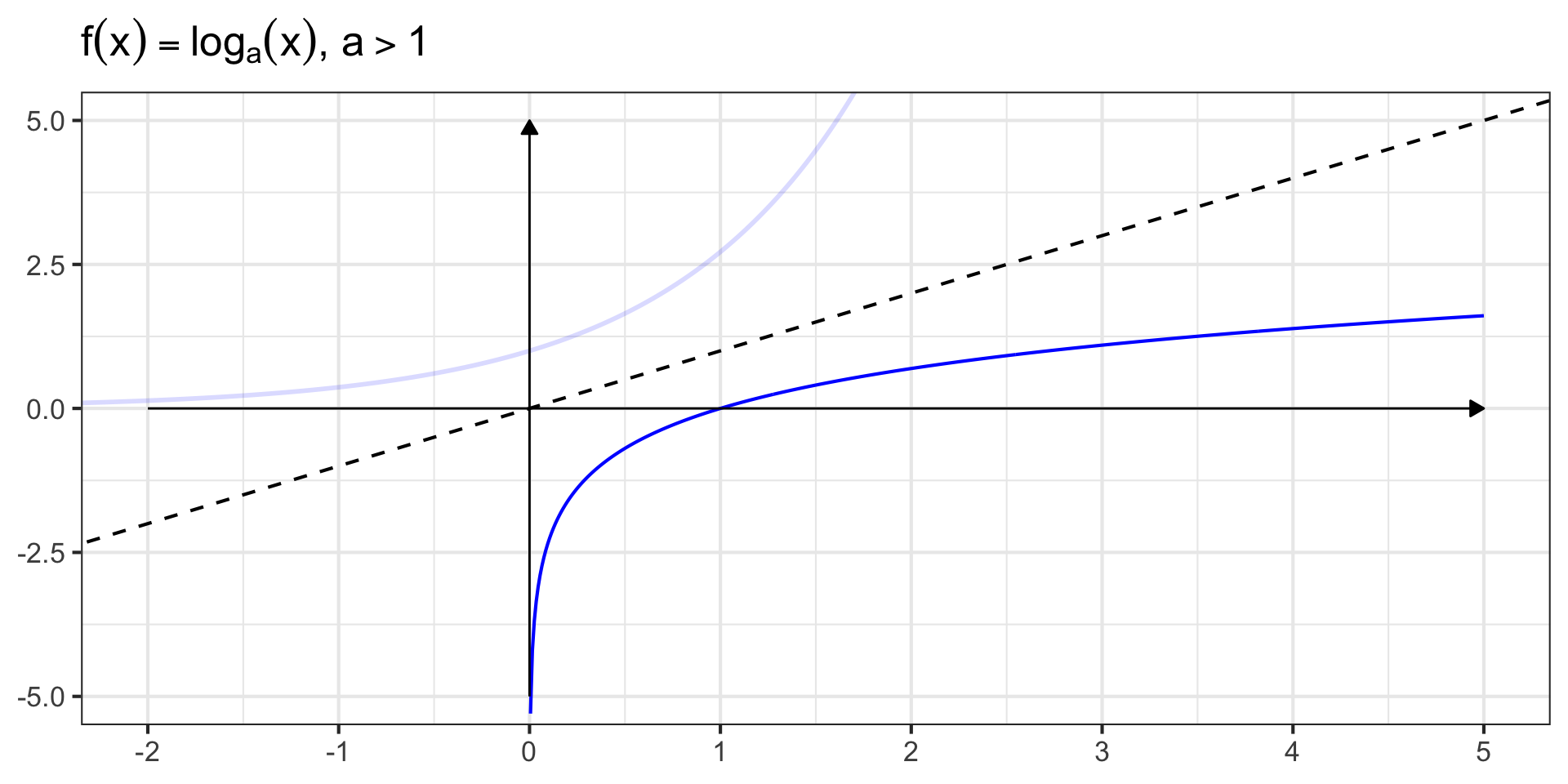
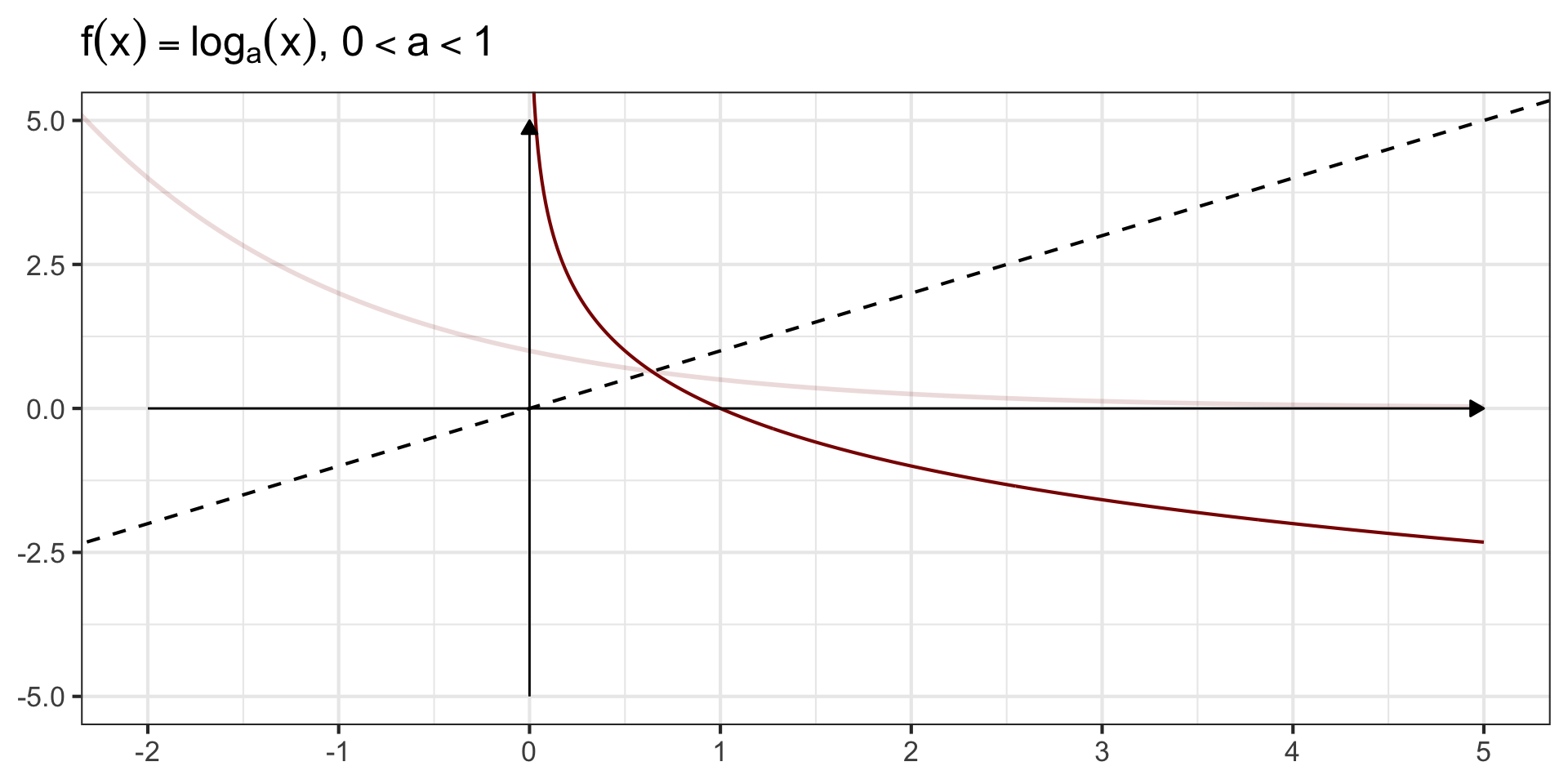
Since \(f\left(x\right) = \log_a\!\left(x\right)\) is the inverse of \(g\left(x\right) = a^x\), its graph is the reflection of the exponential graph across the line \(y = x\). Every feature swaps:
| Exponential \(a^x\) | Logarithmic \(\log_a\!\left(x\right)\) |
|---|---|
| Domain: \(\left(-\infty, \infty\right)\) | Domain: \(\left(0, \infty\right)\) |
| Range: \(\left(0, \infty\right)\) | Range: \(\left(-\infty, \infty\right)\) |
| \(y\)-intercept: \(\left(0, 1\right)\) | \(x\)-intercept: \(\left(1, 0\right)\) |
| Horizontal asymptote: \(y = 0\) | Vertical asymptote: \(x = 0\) |
The behavior again depends on the base:
- \(a > 1\): increasing — the logarithm grows without bound, but slowly.
- \(0 < a < 1\): decreasing.
The Logarithmic Book Function
Definition: The logarithmic book function is \(f\left(x\right) = \log_a\!\left(x\right)\), where \(a > 0\) and \(a \neq 1\).
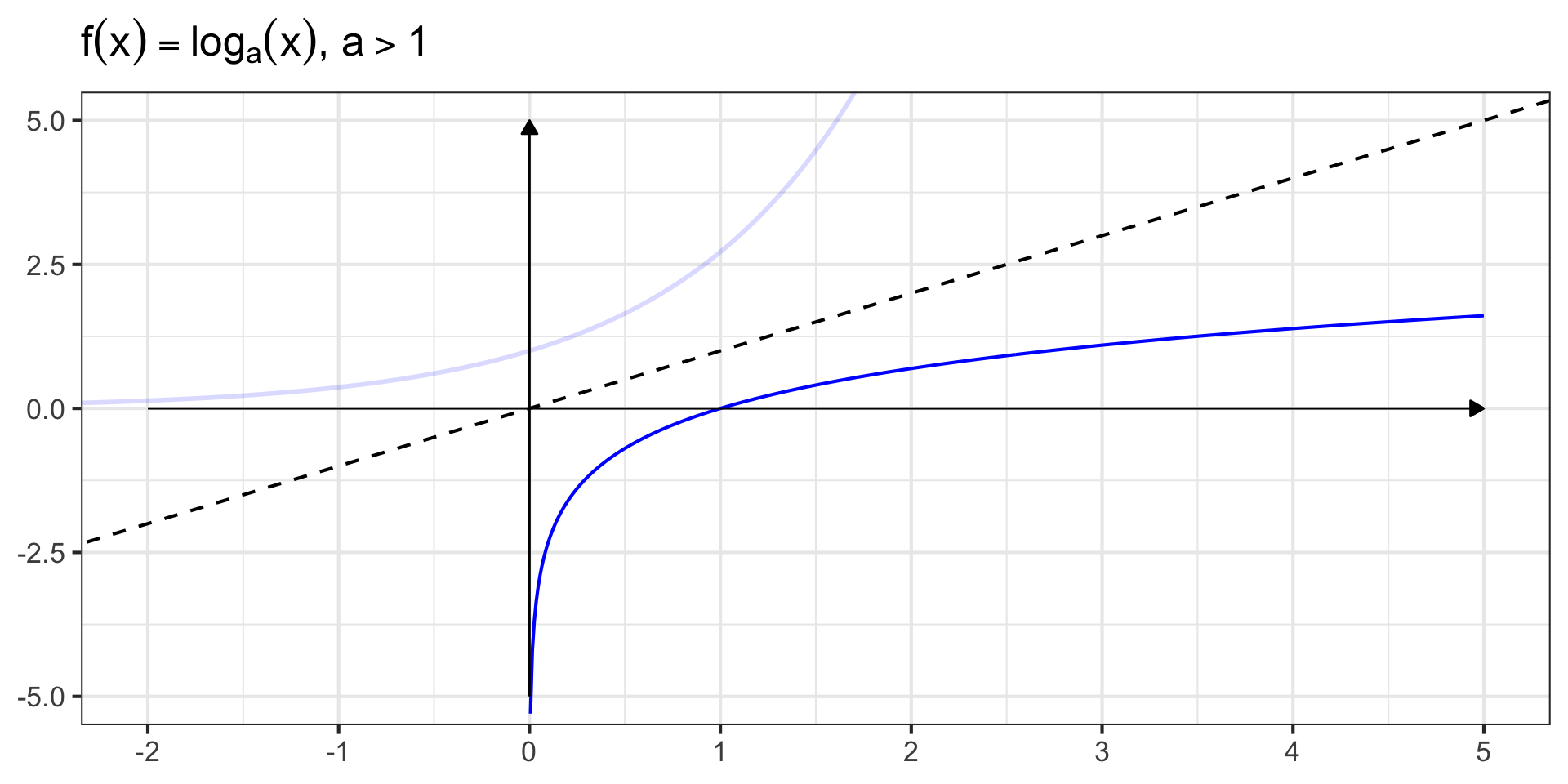
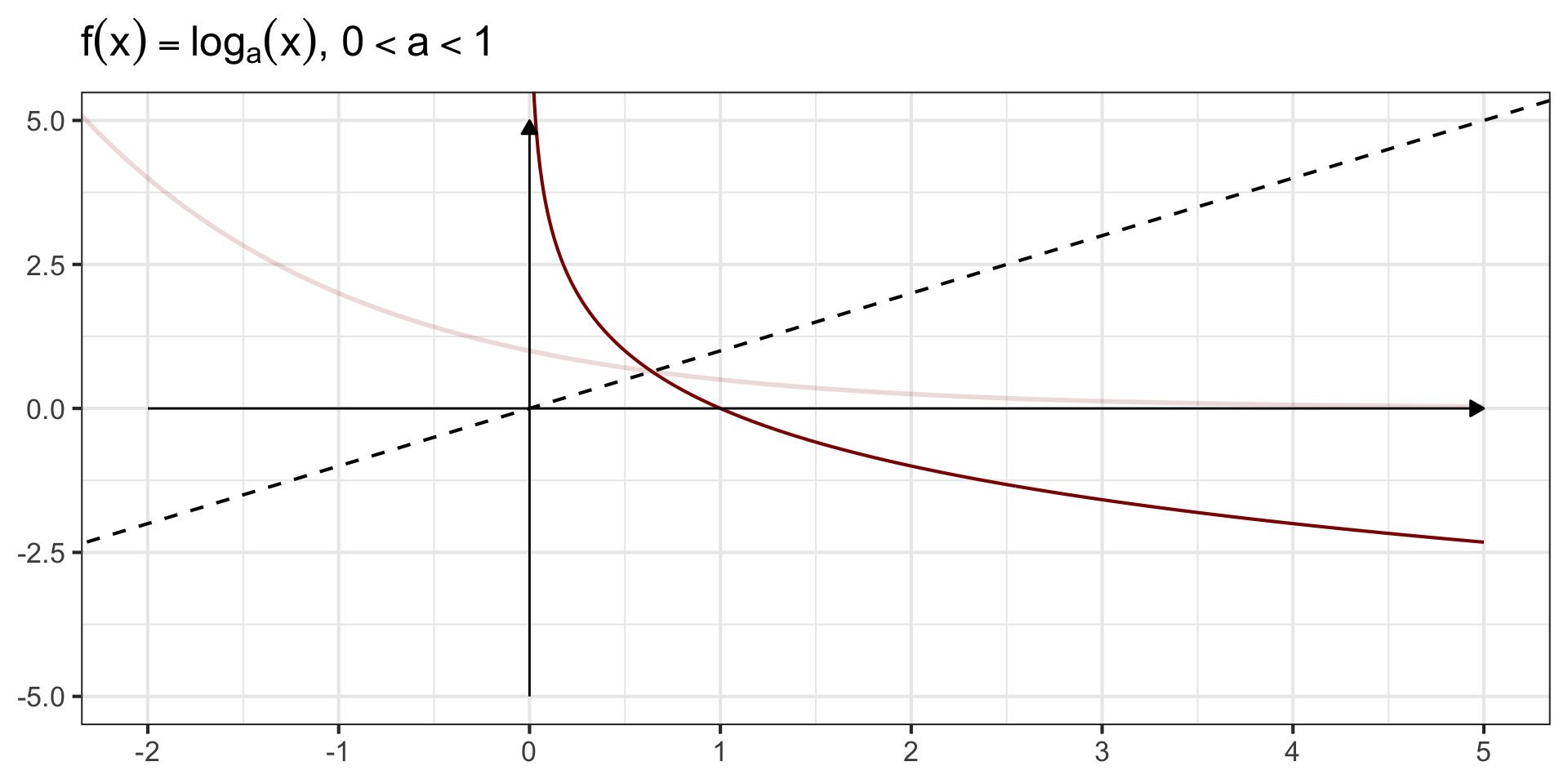
Since \(f\left(x\right) = \log_a\!\left(x\right)\) is the inverse of \(g\left(x\right) = a^x\), its graph is the reflection of the exponential graph across the line \(y = x\). Every feature swaps:
| Exponential \(a^x\) | Logarithmic \(\log_a\!\left(x\right)\) |
|---|---|
| Domain: \(\left(-\infty, \infty\right)\) | Domain: \(\left(0, \infty\right)\) |
| Range: \(\left(0, \infty\right)\) | Range: \(\left(-\infty, \infty\right)\) |
| \(y\)-intercept: \(\left(0, 1\right)\) | \(x\)-intercept: \(\left(1, 0\right)\) |
| Horizontal asymptote: \(y = 0\) | Vertical asymptote: \(x = 0\) |
The behavior again depends on the base:
- \(a > 1\): increasing — the logarithm grows without bound, but slowly.
- \(0 < a < 1\): decreasing.
The faded curves in the plots on the right are the corresponding exponentials.
The dashed line is the \(y = x\) line, allowing us to see that the graph of the logarithmic functions are reflections of the graphs of the exponentials.
Transformations of Logarithmic Functions
For \(f\left(x\right) = A\cdot\log_a\!\left(B\left(x - H\right)\right) + K\), the key effects are:
- The vertical asymptote shifts from \(x = 0\) to \(x = H\).
- The domain shifts from \(\left(0, \infty\right)\) to \(\left(H, \infty\right)\) if \(B > 0\) or to \(\left(-\infty, H\right)\) if \(B < 0\).
- The \(x\)-intercept changes. Solve \(f\left(x\right) = 0\) to find it.
- The \(y\)-intercept may or may not exist. If \(x = 0\) is in the domain of the function, evaluate \(f\left(0\right)\) to find the \(y\)-intercept.
- End behavior adjusts accordingly.
The Mirror Image
Since \(\log_a\) and \(a^x\) are inverses, the logarithm’s vertical asymptote plays the same role as the exponential’s horizontal asymptote — it’s the boundary the function approaches but never crosses. The logarithm approaches it as \(x\) approaches the asymptote from the side on which the function values are defined; the exponential approaches its asymptote as \(x \to \pm\infty\).
Analysis of Logarithmic Functions I
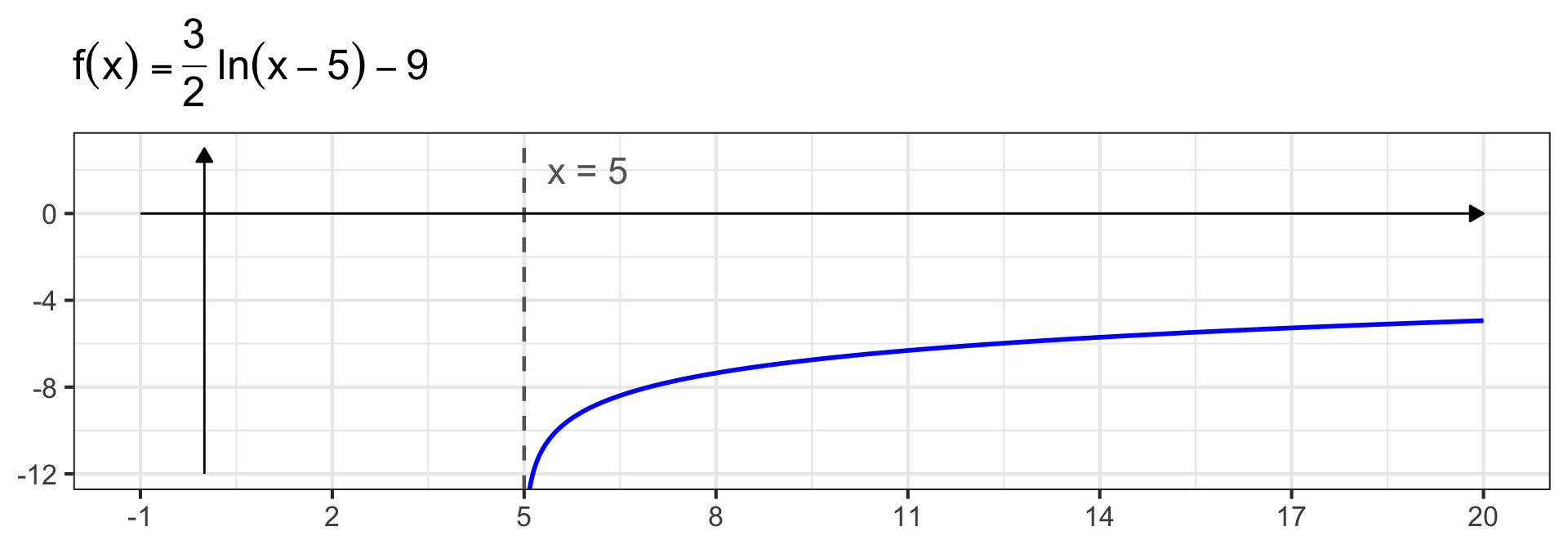
Example 1: For \(\displaystyle{f\left(x\right) = \frac{3}{2}\ln\!\left(x - 5\right) - 9}\), identify the domain, vertical asymptote, \(y\)-intercept, \(x\)-intercept, and end behavior. Sketch a graph.
Solution. Base function is \(\ln\!\left(x\right)\), but it has been…
- shifted right by \(5\)
- stretched vertically by a factor of \(\frac{3}{2}\)
- shifted downward by \(9\).
Domain:
Analysis of Logarithmic Functions I
Example 1: For \(\displaystyle{f\left(x\right) = \frac{3}{2}\ln\!\left(x - 5\right) - 9}\), identify the domain, vertical asymptote, \(y\)-intercept, \(x\)-intercept, and end behavior. Sketch a graph.
Solution. Base function is \(\ln\!\left(x\right)\), but it has been…
- shifted right by \(5\)
- stretched vertically by a factor of \(\frac{3}{2}\)
- shifted downward by \(9\).
Domain: The argument of the logarithm (\(x - 5\)) must be positive.
\[\begin{align} x - 5 > 0 \end{align}\]
Analysis of Logarithmic Functions I
Example 1: For \(\displaystyle{f\left(x\right) = \frac{3}{2}\ln\!\left(x - 5\right) - 9}\), identify the domain, vertical asymptote, \(y\)-intercept, \(x\)-intercept, and end behavior. Sketch a graph.
Solution. Base function is \(\ln\!\left(x\right)\), but it has been…
- shifted right by \(5\)
- stretched vertically by a factor of \(\frac{3}{2}\)
- shifted downward by \(9\).
Domain: The argument of the logarithm (\(x - 5\)) must be positive.
\[\begin{align} x - 5 > 0\\ x > 5 \end{align}\]
Analysis of Logarithmic Functions I
Example 1: For \(\displaystyle{f\left(x\right) = \frac{3}{2}\ln\!\left(x - 5\right) - 9}\), identify the domain, vertical asymptote, \(y\)-intercept, \(x\)-intercept, and end behavior. Sketch a graph.
Solution. Base function is \(\ln\!\left(x\right)\), but it has been…
- shifted right by \(5\)
- stretched vertically by a factor of \(\frac{3}{2}\)
- shifted downward by \(9\).
Domain: \(x > 5\) or \(\left(5, \infty\right)\)
Vertical Asymptote:
Analysis of Logarithmic Functions I
Example 1: For \(\displaystyle{f\left(x\right) = \frac{3}{2}\ln\!\left(x - 5\right) - 9}\), identify the domain, vertical asymptote, \(y\)-intercept, \(x\)-intercept, and end behavior. Sketch a graph.
Solution. Base function is \(\ln\!\left(x\right)\), but it has been…
- shifted right by \(5\)
- stretched vertically by a factor of \(\frac{3}{2}\)
- shifted downward by \(9\).
Domain: \(x > 5\) or \(\left(5, \infty\right)\)
Vertical Asymptote: Since the graph was shifted \(5\) to the right, the asymptote is shifted that same way.
The asymptote for the comparison/base function was at \(x = 0\)
The asymptote for the translated function is at \(x = 5\)
Analysis of Logarithmic Functions I
Example 1: For \(\displaystyle{f\left(x\right) = \frac{3}{2}\ln\!\left(x - 5\right) - 9}\), identify the domain, vertical asymptote, \(y\)-intercept, \(x\)-intercept, and end behavior. Sketch a graph.
Solution. Base function is \(\ln\!\left(x\right)\), but it has been…
- shifted right by \(5\)
- stretched vertically by a factor of \(\frac{3}{2}\)
- shifted downward by \(9\).
Domain: \(x > 5\) or \(\left(5, \infty\right)\)
Vertical Asymptote: \(x = 5\)
\(y\)-intercept:
Analysis of Logarithmic Functions I
Example 1: For \(\displaystyle{f\left(x\right) = \frac{3}{2}\ln\!\left(x - 5\right) - 9}\), identify the domain, vertical asymptote, \(y\)-intercept, \(x\)-intercept, and end behavior. Sketch a graph.
Solution. Base function is \(\ln\!\left(x\right)\), but it has been…
- shifted right by \(5\)
- stretched vertically by a factor of \(\frac{3}{2}\)
- shifted downward by \(9\).
Domain: \(x > 5\) or \(\left(5, \infty\right)\)
Vertical Asymptote: \(x = 5\)
\(y\)-intercept: \(x = 0\) is not in the domain of \(f\left(x\right)\), so there is no \(y\) intercept.
Analysis of Logarithmic Functions I
Example 1: For \(\displaystyle{f\left(x\right) = \frac{3}{2}\ln\!\left(x - 5\right) - 9}\), identify the domain, vertical asymptote, \(y\)-intercept, \(x\)-intercept, and end behavior. Sketch a graph.
Solution. Base function is \(\ln\!\left(x\right)\), but it has been…
- shifted right by \(5\)
- stretched vertically by a factor of \(\frac{3}{2}\)
- shifted downward by \(9\).
Domain: \(x > 5\) or \(\left(5, \infty\right)\)
Vertical Asymptote: \(x = 5\)
\(y\)-intercept: None
\(x\)-intercept:
\[\begin{align} \frac{3}{2}\ln\left(x - 5\right) - 9 = 0 \end{align}\]
Analysis of Logarithmic Functions I
Example 1: For \(\displaystyle{f\left(x\right) = \frac{3}{2}\ln\!\left(x - 5\right) - 9}\), identify the domain, vertical asymptote, \(y\)-intercept, \(x\)-intercept, and end behavior. Sketch a graph.
Solution. Base function is \(\ln\!\left(x\right)\), but it has been…
- shifted right by \(5\)
- stretched vertically by a factor of \(\frac{3}{2}\)
- shifted downward by \(9\).
Domain: \(x > 5\) or \(\left(5, \infty\right)\)
Vertical Asymptote: \(x = 5\)
\(y\)-intercept: None
\(x\)-intercept:
\[\begin{align} \frac{3}{2}\ln\left(x - 5\right) - 9 = 0\\ \implies \frac{3}{2}\ln\left(x - 5\right) &= 9 \end{align}\]
Analysis of Logarithmic Functions I
Example 1: For \(\displaystyle{f\left(x\right) = \frac{3}{2}\ln\!\left(x - 5\right) - 9}\), identify the domain, vertical asymptote, \(y\)-intercept, \(x\)-intercept, and end behavior. Sketch a graph.
Solution. Base function is \(\ln\!\left(x\right)\), but it has been…
- shifted right by \(5\)
- stretched vertically by a factor of \(\frac{3}{2}\)
- shifted downward by \(9\).
Domain: \(x > 5\) or \(\left(5, \infty\right)\)
Vertical Asymptote: \(x = 5\)
\(y\)-intercept: None
\(x\)-intercept:
\[\begin{align} \frac{3}{2}\ln\left(x - 5\right) - 9 = 0\\ \implies \frac{3}{2}\ln\left(x - 5\right) &= 9\\ \implies \ln\left(x - 5\right) &= 6 \end{align}\]
Analysis of Logarithmic Functions I
Example 1: For \(\displaystyle{f\left(x\right) = \frac{3}{2}\ln\!\left(x - 5\right) - 9}\), identify the domain, vertical asymptote, \(y\)-intercept, \(x\)-intercept, and end behavior. Sketch a graph.
Solution. Base function is \(\ln\!\left(x\right)\), but it has been…
- shifted right by \(5\)
- stretched vertically by a factor of \(\frac{3}{2}\)
- shifted downward by \(9\).
Domain: \(x > 5\) or \(\left(5, \infty\right)\)
Vertical Asymptote: \(x = 5\)
\(y\)-intercept: None
\(x\)-intercept:
\[\begin{align} \frac{3}{2}\ln\left(x - 5\right) - 9 = 0\\ \implies \frac{3}{2}\ln\left(x - 5\right) &= 9\\ \implies \ln\left(x - 5\right) &= 6\\ \implies x - 5 &= e^6 \end{align}\]
Analysis of Logarithmic Functions I
Example 1: For \(\displaystyle{f\left(x\right) = \frac{3}{2}\ln\!\left(x - 5\right) - 9}\), identify the domain, vertical asymptote, \(y\)-intercept, \(x\)-intercept, and end behavior. Sketch a graph.
Solution. Base function is \(\ln\!\left(x\right)\), but it has been…
- shifted right by \(5\)
- stretched vertically by a factor of \(\frac{3}{2}\)
- shifted downward by \(9\).
Domain: \(x > 5\) or \(\left(5, \infty\right)\)
Vertical Asymptote: \(x = 5\)
\(y\)-intercept: None
\(x\)-intercept: \(\displaystyle{\left(5 + e^6, 0\right)}\)
\[\begin{align} \frac{3}{2}\ln\left(x - 5\right) - 9 = 0\\ \implies \frac{3}{2}\ln\left(x - 5\right) &= 9\\ \implies \ln\left(x - 5\right) &= 6\\ \implies x - 5 &= e^6 \end{align}\]
End behavior:
\(\displaystyle{\lim_{x\to -\infty}{\frac{3}{2}\ln\left(x - 5\right) - 9}}\)
\(\displaystyle{\lim_{x\to \infty}{\frac{3}{2}\ln\left(x - 5\right) - 9}}\)
Analysis of Logarithmic Functions I
Example 1: For \(\displaystyle{f\left(x\right) = \frac{3}{2}\ln\!\left(x - 5\right) - 9}\), identify the domain, vertical asymptote, \(y\)-intercept, \(x\)-intercept, and end behavior. Sketch a graph.
Solution. Base function is \(\ln\!\left(x\right)\), but it has been…
- shifted right by \(5\)
- stretched vertically by a factor of \(\frac{3}{2}\)
- shifted downward by \(9\).
Domain: \(x > 5\) or \(\left(5, \infty\right)\)
Vertical Asymptote: \(x = 5\)
\(y\)-intercept: None
\(x\)-intercept: \(\displaystyle{\left(5 + e^6, 0\right)}\)
\[\begin{align} \frac{3}{2}\ln\left(x - 5\right) - 9 = 0\\ \implies \frac{3}{2}\ln\left(x - 5\right) &= 9\\ \implies \ln\left(x - 5\right) &= 6\\ \implies x - 5 &= e^6 \end{align}\]
End behavior:
\(\displaystyle{\lim_{x\to 5^+}{\frac{3}{2}\ln\left(x - 5\right) - 9}} = -\infty\)
\(\displaystyle{\lim_{x\to \infty}{\frac{3}{2}\ln\left(x - 5\right) - 9}}\)
Analysis of Logarithmic Functions I
Example 1: For \(\displaystyle{f\left(x\right) = \frac{3}{2}\ln\!\left(x - 5\right) - 9}\), identify the domain, vertical asymptote, \(y\)-intercept, \(x\)-intercept, and end behavior. Sketch a graph.
Solution. Base function is \(\ln\!\left(x\right)\), but it has been…
- shifted right by \(5\)
- stretched vertically by a factor of \(\frac{3}{2}\)
- shifted downward by \(9\).
Domain: \(x > 5\) or \(\left(5, \infty\right)\)
Vertical Asymptote: \(x = 5\)
\(y\)-intercept: None
\(x\)-intercept: \(\displaystyle{\left(5 + e^6, 0\right)}\)
\[\begin{align} \frac{3}{2}\ln\left(x - 5\right) - 9 = 0\\ \implies \frac{3}{2}\ln\left(x - 5\right) &= 9\\ \implies \ln\left(x - 5\right) &= 6\\ \implies x - 5 &= e^6 \end{align}\]
End behavior:
\(\displaystyle{\lim_{x\to 5^+}{\frac{3}{2}\ln\left(x - 5\right) - 9} = -\infty}\)
\(\displaystyle{\lim_{x\to \infty}{\frac{3}{2}\ln\left(x - 5\right) - 9} = \infty}\)
Analysis of Logarithmic Functions II
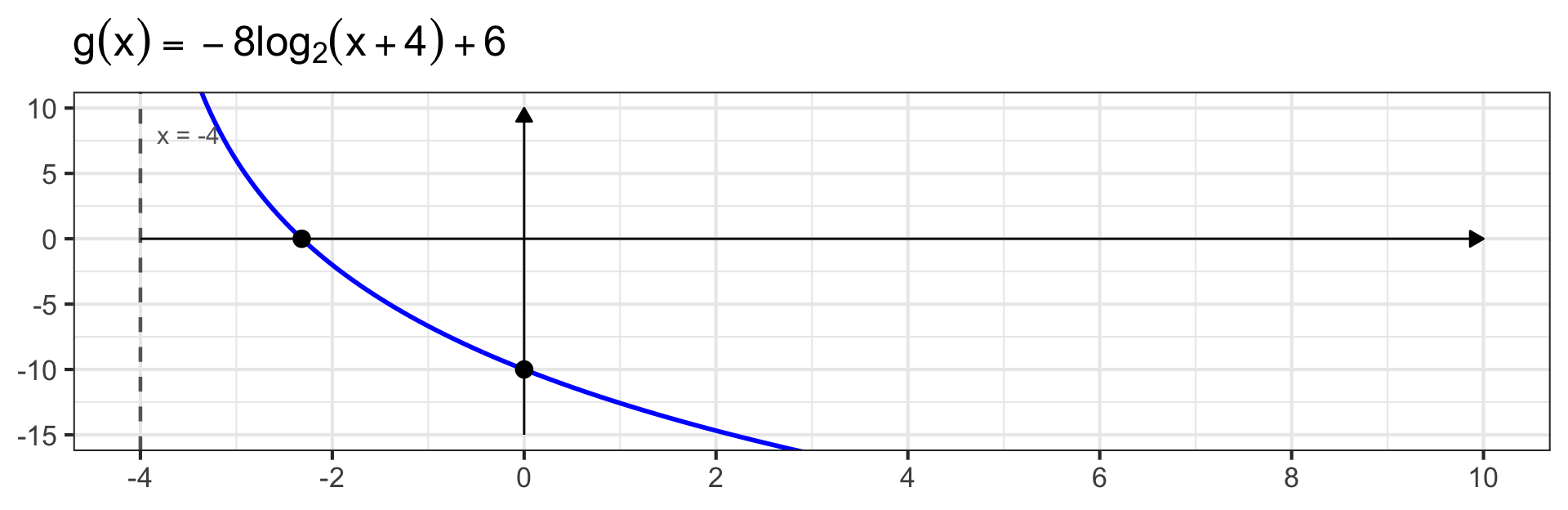
Example 2: For \(g\left(x\right) = -8\log_2\!\left(x + 4\right) + 6\), identify the domain, vertical asymptote, \(y\)-intercept, \(x\)-intercept, and end behavior. Sketch a graph.
Solution. The base/comparison function is \(\log_2\left(x\right)\), but…
- shifted left by \(4\)
- reflected across the \(x\)-axis
- stretched vertically by a factor of \(8\)
- shifted upwards by \(6\).
Domain:
Analysis of Logarithmic Functions II
Example 2: For \(g\left(x\right) = -8\log_2\!\left(x + 4\right) + 6\), identify the domain, vertical asymptote, \(y\)-intercept, \(x\)-intercept, and end behavior. Sketch a graph.
Solution. The base/comparison function is \(\log_2\left(x\right)\), but…
- shifted left by \(4\)
- reflected across the \(x\)-axis
- stretched vertically by a factor of \(8\)
- shifted upwards by \(6\).
Domain: The argument to the logarithm must be positive.
\[\begin{align} x + 4 &> 0 \end{align}\]
Analysis of Logarithmic Functions II
Example 2: For \(g\left(x\right) = -8\log_2\!\left(x + 4\right) + 6\), identify the domain, vertical asymptote, \(y\)-intercept, \(x\)-intercept, and end behavior. Sketch a graph.
Solution. The base/comparison function is \(\log_2\left(x\right)\), but…
- shifted left by \(4\)
- reflected across the \(x\)-axis
- stretched vertically by a factor of \(8\)
- shifted upwards by \(6\).
Domain: The argument to the logarithm must be positive.
\[\begin{align} x + 4 &> 0\\ x &> -4 \end{align}\]
Analysis of Logarithmic Functions II
Example 2: For \(g\left(x\right) = -8\log_2\!\left(x + 4\right) + 6\), identify the domain, vertical asymptote, \(y\)-intercept, \(x\)-intercept, and end behavior. Sketch a graph.
Solution. The base/comparison function is \(\log_2\left(x\right)\), but…
- shifted left by \(4\)
- reflected across the \(x\)-axis
- stretched vertically by a factor of \(8\)
- shifted upwards by \(6\).
Domain: \(x > -4\) or \(\left(-4, \infty\right)\)
\[\begin{align} x + 4 &> 0\\ x &> -4 \end{align}\]
Analysis of Logarithmic Functions II
Example 2: For \(g\left(x\right) = -8\log_2\!\left(x + 4\right) + 6\), identify the domain, vertical asymptote, \(y\)-intercept, \(x\)-intercept, and end behavior. Sketch a graph.
Solution. The base/comparison function is \(\log_2\left(x\right)\), but…
- shifted left by \(4\)
- reflected across the \(x\)-axis
- stretched vertically by a factor of \(8\)
- shifted upwards by \(6\).
Domain: \(x > -4\) or \(\left(-4, \infty\right)\)
Vertical asymptote:
Analysis of Logarithmic Functions II
Example 2: For \(g\left(x\right) = -8\log_2\!\left(x + 4\right) + 6\), identify the domain, vertical asymptote, \(y\)-intercept, \(x\)-intercept, and end behavior. Sketch a graph.
Solution. The base/comparison function is \(\log_2\left(x\right)\), but…
- shifted left by \(4\)
- reflected across the \(x\)-axis
- stretched vertically by a factor of \(8\)
- shifted upwards by \(6\).
Domain: \(x > -4\) or \(\left(-4, \infty\right)\)
Vertical asymptote: Since the graph is shifted left by \(4\), so is the vertical asymptote.
Analysis of Logarithmic Functions II
Example 2: For \(g\left(x\right) = -8\log_2\!\left(x + 4\right) + 6\), identify the domain, vertical asymptote, \(y\)-intercept, \(x\)-intercept, and end behavior. Sketch a graph.
Solution. The base/comparison function is \(\log_2\left(x\right)\), but…
- shifted left by \(4\)
- reflected across the \(x\)-axis
- stretched vertically by a factor of \(8\)
- shifted upwards by \(6\).
Domain: \(x > -4\) or \(\left(-4, \infty\right)\)
Vertical asymptote: \(x = -4\)
\(y\)-intercept:
\[\begin{align} g\left(0\right) &= -8\log_{2}\left(0 + 4\right) + 6 \end{align}\]
Analysis of Logarithmic Functions II
Example 2: For \(g\left(x\right) = -8\log_2\!\left(x + 4\right) + 6\), identify the domain, vertical asymptote, \(y\)-intercept, \(x\)-intercept, and end behavior. Sketch a graph.
Solution. The base/comparison function is \(\log_2\left(x\right)\), but…
- shifted left by \(4\)
- reflected across the \(x\)-axis
- stretched vertically by a factor of \(8\)
- shifted upwards by \(6\).
Domain: \(x > -4\) or \(\left(-4, \infty\right)\)
Vertical asymptote: \(x = -4\)
\(y\)-intercept:
\[\begin{align} g\left(0\right) &= -8\log_{2}\left(0 + 4\right) + 6\\ &= -8\log_{2}\left(4\right) + 6 \end{align}\]
Analysis of Logarithmic Functions II
Example 2: For \(g\left(x\right) = -8\log_2\!\left(x + 4\right) + 6\), identify the domain, vertical asymptote, \(y\)-intercept, \(x\)-intercept, and end behavior. Sketch a graph.
Solution. The base/comparison function is \(\log_2\left(x\right)\), but…
- shifted left by \(4\)
- reflected across the \(x\)-axis
- stretched vertically by a factor of \(8\)
- shifted upwards by \(6\).
Domain: \(x > -4\) or \(\left(-4, \infty\right)\)
Vertical asymptote: \(x = -4\)
\(y\)-intercept:
\[\begin{align} g\left(0\right) &= -8\log_{2}\left(0 + 4\right) + 6\\ &= -8\log_{2}\left(4\right) + 6\\ &= -8\left(2\right) + 6 \end{align}\]
Analysis of Logarithmic Functions II
Example 2: For \(g\left(x\right) = -8\log_2\!\left(x + 4\right) + 6\), identify the domain, vertical asymptote, \(y\)-intercept, \(x\)-intercept, and end behavior. Sketch a graph.
Solution. The base/comparison function is \(\log_2\left(x\right)\), but…
- shifted left by \(4\)
- reflected across the \(x\)-axis
- stretched vertically by a factor of \(8\)
- shifted upwards by \(6\).
Domain: \(x > -4\) or \(\left(-4, \infty\right)\)
Vertical asymptote: \(x = -4\)
\(y\)-intercept:
\[\begin{align} g\left(0\right) &= -8\log_{2}\left(0 + 4\right) + 6\\ &= -8\log_{2}\left(4\right) + 6\\ &= -8\left(2\right) + 6\\ &= -10 \end{align}\]
Analysis of Logarithmic Functions II
Example 2: For \(g\left(x\right) = -8\log_2\!\left(x + 4\right) + 6\), identify the domain, vertical asymptote, \(y\)-intercept, \(x\)-intercept, and end behavior. Sketch a graph.
Solution. The base/comparison function is \(\log_2\left(x\right)\), but…
- shifted left by \(4\)
- reflected across the \(x\)-axis
- stretched vertically by a factor of \(8\)
- shifted upwards by \(6\).
Domain: \(x > -4\) or \(\left(-4, \infty\right)\)
Vertical asymptote: \(x = -4\)
\(y\)-intercept: \(\left(0, -10\right)\)
\[\begin{align} g\left(0\right) &= -8\log_{2}\left(0 + 4\right) + 6\\ &= -8\log_{2}\left(4\right) + 6\\ &= -8\left(2\right) + 6\\ &= -10 \end{align}\]
Analysis of Logarithmic Functions II
Example 2: For \(g\left(x\right) = -8\log_2\!\left(x + 4\right) + 6\), identify the domain, vertical asymptote, \(y\)-intercept, \(x\)-intercept, and end behavior. Sketch a graph.
Solution. The base/comparison function is \(\log_2\left(x\right)\), but…
- shifted left by \(4\)
- reflected across the \(x\)-axis
- stretched vertically by a factor of \(8\)
- shifted upwards by \(6\).
Domain: \(x > -4\) or \(\left(-4, \infty\right)\)
Vertical asymptote: \(x = -4\)
\(y\)-intercept: \(\left(0, -10\right)\)
\(x\)-intercept:
\[\begin{align} -8\log_{2}\left(x + 4\right) + 6 &= 0 \end{align}\]
Analysis of Logarithmic Functions II
Example 2: For \(g\left(x\right) = -8\log_2\!\left(x + 4\right) + 6\), identify the domain, vertical asymptote, \(y\)-intercept, \(x\)-intercept, and end behavior. Sketch a graph.
Solution. The base/comparison function is \(\log_2\left(x\right)\), but…
- shifted left by \(4\)
- reflected across the \(x\)-axis
- stretched vertically by a factor of \(8\)
- shifted upwards by \(6\).
Domain: \(x > -4\) or \(\left(-4, \infty\right)\)
Vertical asymptote: \(x = -4\)
\(y\)-intercept: \(\left(0, -10\right)\)
\(x\)-intercept:
\[\begin{align} -8\log_{2}\left(x + 4\right) + 6 &= 0\\ \implies -8\log_{2}\left(x + 4\right) &= -6 \end{align}\]
Analysis of Logarithmic Functions II
Example 2: For \(g\left(x\right) = -8\log_2\!\left(x + 4\right) + 6\), identify the domain, vertical asymptote, \(y\)-intercept, \(x\)-intercept, and end behavior. Sketch a graph.
Solution. The base/comparison function is \(\log_2\left(x\right)\), but…
- shifted left by \(4\)
- reflected across the \(x\)-axis
- stretched vertically by a factor of \(8\)
- shifted upwards by \(6\).
Domain: \(x > -4\) or \(\left(-4, \infty\right)\)
Vertical asymptote: \(x = -4\)
\(y\)-intercept: \(\left(0, -10\right)\)
\(x\)-intercept:
\[\begin{align} -8\log_{2}\left(x + 4\right) + 6 &= 0\\ \implies -8\log_{2}\left(x + 4\right) &= -6\\ \implies \log_{2}\left(x + 4\right) &= \frac{-6}{-8} \end{align}\]
Analysis of Logarithmic Functions II
Example 2: For \(g\left(x\right) = -8\log_2\!\left(x + 4\right) + 6\), identify the domain, vertical asymptote, \(y\)-intercept, \(x\)-intercept, and end behavior. Sketch a graph.
Solution. The base/comparison function is \(\log_2\left(x\right)\), but…
- shifted left by \(4\)
- reflected across the \(x\)-axis
- stretched vertically by a factor of \(8\)
- shifted upwards by \(6\).
Domain: \(x > -4\) or \(\left(-4, \infty\right)\)
Vertical asymptote: \(x = -4\)
\(y\)-intercept: \(\left(0, -10\right)\)
\(x\)-intercept:
\[\begin{align} -8\log_{2}\left(x + 4\right) + 6 &= 0\\ \implies -8\log_{2}\left(x + 4\right) &= -6\\ \implies \log_{2}\left(x + 4\right) &= \frac{3}{4} \end{align}\]
Analysis of Logarithmic Functions II
Example 2: For \(g\left(x\right) = -8\log_2\!\left(x + 4\right) + 6\), identify the domain, vertical asymptote, \(y\)-intercept, \(x\)-intercept, and end behavior. Sketch a graph.
Solution. The base/comparison function is \(\log_2\left(x\right)\), but…
- shifted left by \(4\)
- reflected across the \(x\)-axis
- stretched vertically by a factor of \(8\)
- shifted upwards by \(6\).
Domain: \(x > -4\) or \(\left(-4, \infty\right)\)
Vertical asymptote: \(x = -4\)
\(y\)-intercept: \(\left(0, -10\right)\)
\(x\)-intercept:
\[\begin{align} -8\log_{2}\left(x + 4\right) + 6 &= 0\\ \implies -8\log_{2}\left(x + 4\right) &= -6\\ \implies \log_{2}\left(x + 4\right) &= \frac{3}{4}\\ \implies 2^{\log_{2}\left(x + 4\right)} &= 2^{3/4} \end{align}\]
Analysis of Logarithmic Functions II
Example 2: For \(g\left(x\right) = -8\log_2\!\left(x + 4\right) + 6\), identify the domain, vertical asymptote, \(y\)-intercept, \(x\)-intercept, and end behavior. Sketch a graph.
Solution. The base/comparison function is \(\log_2\left(x\right)\), but…
- shifted left by \(4\)
- reflected across the \(x\)-axis
- stretched vertically by a factor of \(8\)
- shifted upwards by \(6\).
Domain: \(x > -4\) or \(\left(-4, \infty\right)\)
Vertical asymptote: \(x = -4\)
\(y\)-intercept: \(\left(0, -10\right)\)
\(x\)-intercept:
\[\begin{align} -8\log_{2}\left(x + 4\right) + 6 &= 0\\ \implies -8\log_{2}\left(x + 4\right) &= -6\\ \implies \log_{2}\left(x + 4\right) &= \frac{3}{4}\\ \implies 2^{\log_{2}\left(x + 4\right)} &= 2^{3/4}\\ \implies x + 4 &= 8^{1/4} \end{align}\]
Analysis of Logarithmic Functions II
Example 2: For \(g\left(x\right) = -8\log_2\!\left(x + 4\right) + 6\), identify the domain, vertical asymptote, \(y\)-intercept, \(x\)-intercept, and end behavior. Sketch a graph.
Solution. The base/comparison function is \(\log_2\left(x\right)\), but…
- shifted left by \(4\)
- reflected across the \(x\)-axis
- stretched vertically by a factor of \(8\)
- shifted upwards by \(6\).
Domain: \(x > -4\) or \(\left(-4, \infty\right)\)
Vertical asymptote: \(x = -4\)
\(y\)-intercept: \(\left(0, -10\right)\)
\(x\)-intercept:
\[\begin{align} -8\log_{2}\left(x + 4\right) + 6 &= 0\\ \implies -8\log_{2}\left(x + 4\right) &= -6\\ \implies \log_{2}\left(x + 4\right) &= \frac{3}{4}\\ \implies 2^{\log_{2}\left(x + 4\right)} &= 2^{3/4}\\ \implies x + 4 &= 8^{1/4}\\ \implies x &= 8^{1/4} - 4 \end{align}\]
Analysis of Logarithmic Functions II
Example 2: For \(g\left(x\right) = -8\log_2\!\left(x + 4\right) + 6\), identify the domain, vertical asymptote, \(y\)-intercept, \(x\)-intercept, and end behavior. Sketch a graph.
Solution. The base/comparison function is \(\log_2\left(x\right)\), but…
- shifted left by \(4\)
- reflected across the \(x\)-axis
- stretched vertically by a factor of \(8\)
- shifted upwards by \(6\).
Domain: \(x > -4\) or \(\left(-4, \infty\right)\)
Vertical asymptote: \(x = -4\)
\(y\)-intercept: \(\left(0, -10\right)\)
\(x\)-intercept: \(\displaystyle{\left(8^{1/4} - 4, 0\right)}\)
\[\begin{align} -8\log_{2}\left(x + 4\right) + 6 &= 0\\ \implies -8\log_{2}\left(x + 4\right) &= -6\\ \implies \log_{2}\left(x + 4\right) &= \frac{3}{4}\\ \implies 2^{\log_{2}\left(x + 4\right)} &= 2^{3/4}\\ \implies x + 4 &= 8^{1/4}\\ \implies x &= 8^{1/4} - 4 \end{align}\]
Analysis of Logarithmic Functions II
Example 2: For \(g\left(x\right) = -8\log_2\!\left(x + 4\right) + 6\), identify the domain, vertical asymptote, \(y\)-intercept, \(x\)-intercept, and end behavior. Sketch a graph.
Solution. The base/comparison function is \(\log_2\left(x\right)\), but…
- shifted left by \(4\)
- reflected across the \(x\)-axis
- stretched vertically by a factor of \(8\)
- shifted upwards by \(6\).
Domain: \(x > -4\) or \(\left(-4, \infty\right)\)
Vertical asymptote: \(x = -4\)
\(y\)-intercept: \(\left(0, -10\right)\)
\(x\)-intercept: \(\displaystyle{\left(8^{1/4} - 4, 0\right)}\)
End behavior:
\(\displaystyle{\lim_{x \to -4^+}{-8\log_{2}\left(x + 4\right) + 6}}\)
\(\displaystyle{\lim_{x \to \infty}{-8\log_{2}\left(x + 4\right) + 6}}\)
Analysis of Logarithmic Functions II
Example 2: For \(g\left(x\right) = -8\log_2\!\left(x + 4\right) + 6\), identify the domain, vertical asymptote, \(y\)-intercept, \(x\)-intercept, and end behavior. Sketch a graph.
Solution. The base/comparison function is \(\log_2\left(x\right)\), but…
- shifted left by \(4\)
- reflected across the \(x\)-axis
- stretched vertically by a factor of \(8\)
- shifted upwards by \(6\).
Domain: \(x > -4\) or \(\left(-4, \infty\right)\)
Vertical asymptote: \(x = -4\)
\(y\)-intercept: \(\left(0, -10\right)\)
\(x\)-intercept: \(\displaystyle{\left(8^{1/4} - 4, 0\right)}\)
End behavior:
\(\displaystyle{\lim_{x \to -4^+}{-8\log_{2}\left(x + 4\right) + 6} = \infty}\)
\(\displaystyle{\lim_{x \to \infty}{-8\log_{2}\left(x + 4\right) + 6}}\)
Analysis of Logarithmic Functions II
Example 2: For \(g\left(x\right) = -8\log_2\!\left(x + 4\right) + 6\), identify the domain, vertical asymptote, \(y\)-intercept, \(x\)-intercept, and end behavior. Sketch a graph.
Solution. The base/comparison function is \(\log_2\left(x\right)\), but…
- shifted left by \(4\)
- reflected across the \(x\)-axis
- stretched vertically by a factor of \(8\)
- shifted upwards by \(6\).
Domain: \(x > -4\) or \(\left(-4, \infty\right)\)
Vertical asymptote: \(x = -4\)
\(y\)-intercept: \(\left(0, -10\right)\)
\(x\)-intercept: \(\displaystyle{\left(8^{1/4} - 4, 0\right)}\)
End behavior:
\(\displaystyle{\lim_{x \to -4^+}{-8\log_{2}\left(x + 4\right) + 6} = \infty}\)
\(\displaystyle{\lim_{x \to \infty}{-8\log_{2}\left(x + 4\right) + 6} = -\infty}\)
Analysis of Logarithmic Functions II
Example 2: For \(g\left(x\right) = -8\log_2\!\left(x + 4\right) + 6\), identify the domain, vertical asymptote, \(y\)-intercept, \(x\)-intercept, and end behavior. Sketch a graph.
Solution. The base/comparison function is \(\log_2\left(x\right)\), but…
- shifted left by \(4\)
- reflected across the \(x\)-axis
- stretched vertically by a factor of \(8\)
- shifted upwards by \(6\).
Domain: \(x > -4\) or \(\left(-4, \infty\right)\)
Vertical asymptote: \(x = -4\)
\(y\)-intercept: \(\left(0, -10\right)\)
\(x\)-intercept: \(\displaystyle{\left(8^{1/4} - 4, 0\right)}\)
End behavior: \(\displaystyle{\lim_{x \to -4^+}{g\left(x\right)} = \infty}\) and \(\displaystyle{\lim_{x \to \infty}{g\left(x\right)} = -\infty}\)
\(\displaystyle{\lim_{x \to -4^+}{-8\log_{2}\left(x + 4\right) + 6} = \infty}\)
\(\displaystyle{\lim_{x \to \infty}{-8\log_{2}\left(x + 4\right) + 6} = -\infty}\)
Analysis of Logarithmic Functions II
Example 2: For \(g\left(x\right) = -8\log_2\!\left(x + 4\right) + 6\), identify the domain, vertical asymptote, \(y\)-intercept, \(x\)-intercept, and end behavior. Sketch a graph.
Solution. The base/comparison function is \(\log_2\left(x\right)\), but…
- shifted left by \(4\)
- reflected across the \(x\)-axis
- stretched vertically by a factor of \(8\)
- shifted upwards by \(6\).
Domain: \(x > -4\) or \(\left(-4, \infty\right)\)
Vertical asymptote: \(x = -4\)
\(y\)-intercept: \(\left(0, -10\right)\)
\(x\)-intercept: \(\displaystyle{\left(8^{1/4} - 4, 0\right)}\)
End behavior: \(\displaystyle{\lim_{x \to -4^+}{g\left(x\right)} = \infty}\) and \(\displaystyle{\lim_{x \to \infty}{g\left(x\right)} = -\infty}\)
Logarithmic Function Practice
Try It! 1: For \(f\left(x\right) = \log_3\!\left(x + 2\right) - 4\), identify the domain, vertical asymptote, \(y\)-intercept (if it exists), \(x\)-intercept, and end behavior. Sketch an approximate graph.
Try It! 2: For \(g\left(x\right) = -2\ln\!\left(x - 1\right) + 3\), identify the same features and sketch a graph.
Before sketching: The negative leading coefficient flips the graph. How does that affect the end behavior and range compared to the basic \(\ln\!\left(x\right)\) function?
Inverses of Logarithmic Functions I
Since logarithmic functions are one-to-one, they are invertible. Their inverses are exponential functions.
Strategy: Swap-and-solve, using exponentiation to undo the logarithm once it has been isolated.
Example 3: Find the inverse of \(f\left(x\right) = \log\!\left(4x - 5\right) + 8\).
Solution. Recall \(\log\) without a base denotes \(\log_{10}\).
\[\begin{align} y &= \log_{10}\!\left(4x - 5\right) + 8 \end{align}\]
Inverses of Logarithmic Functions I
Since logarithmic functions are one-to-one, they are invertible. Their inverses are exponential functions.
Strategy: Swap-and-solve, using exponentiation to undo the logarithm once it has been isolated.
Example 3: Find the inverse of \(f\left(x\right) = \log\left(4x - 5\right) + 8\).
Solution. Recall \(\log\) without a base denotes \(\log_{10}\).
\[\begin{align} y &= \log_{10}\!\left(4x - 5\right) + 8\\ \stackrel{\text{Swap}}{} x &= \log_{10}\left(4y - 5\right) + 8 \end{align}\]
Inverses of Logarithmic Functions I
Since logarithmic functions are one-to-one, they are invertible. Their inverses are exponential functions.
Strategy: Swap-and-solve, using exponentiation to undo the logarithm once it has been isolated.
Example 3: Find the inverse of \(f\left(x\right) = \log\left(4x - 5\right) + 8\).
Solution. Recall \(\log\) without a base denotes \(\log_{10}\).
\[\begin{align} y &= \log_{10}\!\left(4x - 5\right) + 8\\ \stackrel{\text{Swap}}{} x &= \log_{10}\left(4y - 5\right) + 8\\ \implies \log_{10}\left(4y - 5\right) + 8 &= x \end{align}\]
Inverses of Logarithmic Functions I
Since logarithmic functions are one-to-one, they are invertible. Their inverses are exponential functions.
Strategy: Swap-and-solve, using exponentiation to undo the logarithm once it has been isolated.
Example 3: Find the inverse of \(f\left(x\right) = \log\left(4x - 5\right) + 8\).
Solution. Recall \(\log\) without a base denotes \(\log_{10}\).
\[\begin{align} y &= \log_{10}\!\left(4x - 5\right) + 8\\ \stackrel{\text{Swap}}{} x &= \log_{10}\left(4y - 5\right) + 8\\ \implies \log_{10}\left(4y - 5\right) + 8 &= x\\ \implies \log_{10}\left(4y - 5\right) &= x - 8 \end{align}\]
Inverses of Logarithmic Functions I
Since logarithmic functions are one-to-one, they are invertible. Their inverses are exponential functions.
Strategy: Swap-and-solve, using exponentiation to undo the logarithm once it has been isolated.
Example 3: Find the inverse of \(f\left(x\right) = \log\left(4x - 5\right) + 8\).
Solution. Recall \(\log\) without a base denotes \(\log_{10}\).
\[\begin{align} y &= \log_{10}\!\left(4x - 5\right) + 8\\ \stackrel{\text{Swap}}{} x &= \log_{10}\left(4y - 5\right) + 8\\ \implies \log_{10}\left(4y - 5\right) + 8 &= x\\ \implies \log_{10}\left(4y - 5\right) &= x - 8\\ \implies 10^{\log_{10}\left(4y - 5\right)} &= 10^{x - 8} \end{align}\]
Inverses of Logarithmic Functions I
Since logarithmic functions are one-to-one, they are invertible. Their inverses are exponential functions.
Strategy: Swap-and-solve, using exponentiation to undo the logarithm once it has been isolated.
Example 3: Find the inverse of \(f\left(x\right) = \log\left(4x - 5\right) + 8\).
Solution. Recall \(\log\) without a base denotes \(\log_{10}\).
\[\begin{align} y &= \log_{10}\!\left(4x - 5\right) + 8\\ \stackrel{\text{Swap}}{} x &= \log_{10}\left(4y - 5\right) + 8\\ \implies \log_{10}\left(4y - 5\right) + 8 &= x\\ \implies \log_{10}\left(4y - 5\right) &= x - 8\\ \implies 10^{\log_{10}\left(4y - 5\right)} &= 10^{x - 8}\\ \implies 4y - 5 &= 10^{x - 8} \end{align}\]
Inverses of Logarithmic Functions I
Since logarithmic functions are one-to-one, they are invertible. Their inverses are exponential functions.
Strategy: Swap-and-solve, using exponentiation to undo the logarithm once it has been isolated.
Example 3: Find the inverse of \(f\left(x\right) = \log\left(4x - 5\right) + 8\).
Solution. Recall \(\log\) without a base denotes \(\log_{10}\).
\[\begin{align} y &= \log_{10}\!\left(4x - 5\right) + 8\\ \stackrel{\text{Swap}}{} x &= \log_{10}\left(4y - 5\right) + 8\\ \implies \log_{10}\left(4y - 5\right) + 8 &= x\\ \implies \log_{10}\left(4y - 5\right) &= x - 8\\ \implies 10^{\log_{10}\left(4y - 5\right)} &= 10^{x - 8}\\ \implies 4y - 5 &= 10^{x - 8}\\ \implies 4y &= 10^{x - 8} + 5 \end{align}\]
Inverses of Logarithmic Functions I
Since logarithmic functions are one-to-one, they are invertible. Their inverses are exponential functions.
Strategy: Swap-and-solve, using exponentiation to undo the logarithm once it has been isolated.
Example 3: Find the inverse of \(f\left(x\right) = \log\left(4x - 5\right) + 8\).
Solution. Recall \(\log\) without a base denotes \(\log_{10}\).
\[\begin{align} y &= \log_{10}\!\left(4x - 5\right) + 8\\ \stackrel{\text{Swap}}{} x &= \log_{10}\left(4y - 5\right) + 8\\ \implies \log_{10}\left(4y - 5\right) + 8 &= x\\ \implies \log_{10}\left(4y - 5\right) &= x - 8\\ \implies 10^{\log_{10}\left(4y - 5\right)} &= 10^{x - 8}\\ \implies 4y - 5 &= 10^{x - 8}\\ \implies 4y &= 10^{x - 8} + 5\\ \implies y &= \frac{10^{x - 8} + 5}{4} \end{align}\]
So \(\boxed{~\displaystyle{f^{-1}\left(x\right) = \frac{10^{x - 8} + 5}{4}}~}\).
Inverses of Logarithmic Functions II
Example 4: Find the inverse of \(\displaystyle{g\left(x\right) = \frac{5 - \ln\!\left(x - 2\right)}{2} + 1}\).
Solution. Simplify first: \(g\left(x\right) = \dfrac{7}{2} - \dfrac{\ln\!\left(x-2\right)}{2}\).
\[\begin{align} y &= \frac{7}{2} - \frac{\ln\!\left(x - 2\right)}{2} \end{align}\]
Inverses of Logarithmic Functions II
Example 4: Find the inverse of \(\displaystyle{g\left(x\right) = \frac{5 - \ln\!\left(x - 2\right)}{2} + 1}\).
Solution. Simplify first: \(g\left(x\right) = \dfrac{7}{2} - \dfrac{\ln\!\left(x-2\right)}{2}\). \[\begin{align} y &= \frac{7}{2} - \frac{\ln\!\left(x - 2\right)}{2}\\ \stackrel{\text{Swap}}{} x &= \frac{7}{2} - \frac{\ln\left(y - 2\right)}{2} \end{align}\]
Inverses of Logarithmic Functions II
Example 4: Find the inverse of \(\displaystyle{g\left(x\right) = \frac{5 - \ln\!\left(x - 2\right)}{2} + 1}\).
Solution. Simplify first: \(g\left(x\right) = \dfrac{7}{2} - \dfrac{\ln\!\left(x-2\right)}{2}\). \[\begin{align} y &= \frac{7}{2} - \frac{\ln\!\left(x - 2\right)}{2}\\ \stackrel{\text{Swap}}{} x &= \frac{7}{2} - \frac{\ln\left(y - 2\right)}{2}\\ \implies \frac{7}{2} - \frac{\ln\left(y - 2\right)}{2} &= x \end{align}\]
Inverses of Logarithmic Functions II
Example 4: Find the inverse of \(\displaystyle{g\left(x\right) = \frac{5 - \ln\!\left(x - 2\right)}{2} + 1}\).
Solution. Simplify first: \(g\left(x\right) = \dfrac{7}{2} - \dfrac{\ln\!\left(x-2\right)}{2}\). \[\begin{align} y &= \frac{7}{2} - \frac{\ln\!\left(x - 2\right)}{2}\\ \stackrel{\text{Swap}}{} x &= \frac{7}{2} - \frac{\ln\left(y - 2\right)}{2}\\ \implies \frac{7}{2} - \frac{\ln\left(y - 2\right)}{2} &= x\\ \implies 7 - \ln\left(y - 2\right) &= 2x \end{align}\]
Inverses of Logarithmic Functions II
Example 4: Find the inverse of \(\displaystyle{g\left(x\right) = \frac{5 - \ln\!\left(x - 2\right)}{2} + 1}\).
Solution. Simplify first: \(g\left(x\right) = \dfrac{7}{2} - \dfrac{\ln\!\left(x-2\right)}{2}\). \[\begin{align} y &= \frac{7}{2} - \frac{\ln\!\left(x - 2\right)}{2}\\ \stackrel{\text{Swap}}{} x &= \frac{7}{2} - \frac{\ln\left(y - 2\right)}{2}\\ \implies \frac{7}{2} - \frac{\ln\left(y - 2\right)}{2} &= x\\ \implies 7 - \ln\left(y - 2\right) &= 2x\\ \implies -\ln\left(y - 2\right) &= 2x -7 \end{align}\]
Inverses of Logarithmic Functions II
Example 4: Find the inverse of \(\displaystyle{g\left(x\right) = \frac{5 - \ln\!\left(x - 2\right)}{2} + 1}\).
Solution. Simplify first: \(g\left(x\right) = \dfrac{7}{2} - \dfrac{\ln\!\left(x-2\right)}{2}\). \[\begin{align} y &= \frac{7}{2} - \frac{\ln\!\left(x - 2\right)}{2}\\ \stackrel{\text{Swap}}{} x &= \frac{7}{2} - \frac{\ln\left(y - 2\right)}{2}\\ \implies \frac{7}{2} - \frac{\ln\left(y - 2\right)}{2} &= x\\ \implies 7 - \ln\left(y - 2\right) &= 2x\\ \implies -\ln\left(y - 2\right) &= 2x -7\\ \implies \ln\left(y - 2\right) &= 7 - 2x \end{align}\]
Inverses of Logarithmic Functions II
Example 4: Find the inverse of \(\displaystyle{g\left(x\right) = \frac{5 - \ln\!\left(x - 2\right)}{2} + 1}\).
Solution. Simplify first: \(g\left(x\right) = \dfrac{7}{2} - \dfrac{\ln\!\left(x-2\right)}{2}\). \[\begin{align} y &= \frac{7}{2} - \frac{\ln\!\left(x - 2\right)}{2}\\ \stackrel{\text{Swap}}{} x &= \frac{7}{2} - \frac{\ln\left(y - 2\right)}{2}\\ \implies \frac{7}{2} - \frac{\ln\left(y - 2\right)}{2} &= x\\ \implies 7 - \ln\left(y - 2\right) &= 2x\\ \implies -\ln\left(y - 2\right) &= 2x -7\\ \implies \ln\left(y - 2\right) &= 7 - 2x\\ \implies e^{\ln\left(y - 2\right)} &= e^{7 - 2x} \end{align}\]
Inverses of Logarithmic Functions II
Example 4: Find the inverse of \(\displaystyle{g\left(x\right) = \frac{5 - \ln\!\left(x - 2\right)}{2} + 1}\).
Solution. Simplify first: \(g\left(x\right) = \dfrac{7}{2} - \dfrac{\ln\!\left(x-2\right)}{2}\). \[\begin{align} y &= \frac{7}{2} - \frac{\ln\!\left(x - 2\right)}{2}\\ \stackrel{\text{Swap}}{} x &= \frac{7}{2} - \frac{\ln\left(y - 2\right)}{2}\\ \implies \frac{7}{2} - \frac{\ln\left(y - 2\right)}{2} &= x\\ \implies 7 - \ln\left(y - 2\right) &= 2x\\ \implies -\ln\left(y - 2\right) &= 2x -7\\ \implies \ln\left(y - 2\right) &= 7 - 2x\\ \implies e^{\ln\left(y - 2\right)} &= e^{7 - 2x}\\ \implies y - 2 &= e^{7 - 2x} \end{align}\]
Inverses of Logarithmic Functions II
Example 4: Find the inverse of \(\displaystyle{g\left(x\right) = \frac{5 - \ln\!\left(x - 2\right)}{2} + 1}\).
Solution. Simplify first: \(g\left(x\right) = \dfrac{7}{2} - \dfrac{\ln\!\left(x-2\right)}{2}\). \[\begin{align} y &= \frac{7}{2} - \frac{\ln\!\left(x - 2\right)}{2}\\ \stackrel{\text{Swap}}{} x &= \frac{7}{2} - \frac{\ln\left(y - 2\right)}{2}\\ \implies \frac{7}{2} - \frac{\ln\left(y - 2\right)}{2} &= x\\ \implies 7 - \ln\left(y - 2\right) &= 2x\\ \implies -\ln\left(y - 2\right) &= 2x -7\\ \implies \ln\left(y - 2\right) &= 7 - 2x\\ \implies e^{\ln\left(y - 2\right)} &= e^{7 - 2x}\\ \implies y - 2 &= e^{7 - 2x}\\ \implies y &= e^{7 - 2x} + 2 \end{align}\]
So, \(\boxed{~\displaystyle{g^{-1}\left(x\right) = e^{7 - 2x} + 2}~}\).
Inverses of Logarithmic Functions Practice
Try It! 3: Find the inverse of \(f\left(x\right) = \log_3\!\left(x + 2\right) - 4\) from Try It! 1. State the domain of \(f^{-1}\).
Try It! 4: Find the inverse of \(g\left(x\right) = -2\ln\!\left(x - 1\right) + 3\) from Try It! 2. State the domain of \(g^{-1}\).
Exponential Growth and Decay
Many real-world quantities change at a rate proportional to their current size. This produces the model:
\[A = Pe^{rt}\]
where \(P\) is the initial quantity, \(r\) is the continuous rate of growth (\(r > 0\)) or decay (\(r < 0\)), \(t\) is time, and \(A\) is the quantity at time \(t\).
This is the same continuous compounding formula from last class — extended now as a general model for any exponential process.
Key insight: Solving for \(t\) always requires a logarithm, since \(t\) is in the exponent. This is one reason why logarithms are almost always introduced immediately following exponential functions.
Application to Carbon Dating
Example 5: The half-life of Carbon-14 is 5730 years. A fossil contains 12 grams of C-14. If we know it originally contained 32 grams, how old is the fossil?
Solution. Using the decay model \(A = Pe^{rt}\), first find \(r\) from the half-life condition that after 5730 years, half remains.
\[\begin{align} \frac{P}{2} &= Pe^{r \cdot 5730} \end{align}\]
Application to Carbon Dating
Example 5: The half-life of Carbon-14 is 5730 years. A fossil contains 12 grams of C-14. If we know it originally contained 32 grams, how old is the fossil?
Solution. Using the decay model \(A = Pe^{rt}\), first find \(r\) from the half-life condition that after 5730 years, half remains.
\[\begin{align} \frac{P}{2} &= Pe^{r \cdot 5730}\\ \implies \frac{1}{2} &= e^{r\cdot 5730} \end{align}\]
Application to Carbon Dating
Example 5: The half-life of Carbon-14 is 5730 years. A fossil contains 12 grams of C-14. If we know it originally contained 32 grams, how old is the fossil?
Solution. Using the decay model \(A = Pe^{rt}\), first find \(r\) from the half-life condition that after 5730 years, half remains.
\[\begin{align} \frac{P}{2} &= Pe^{r \cdot 5730}\\ \implies \frac{1}{2} &= e^{r\cdot 5730}\\ \implies \ln\left(\frac{1}{2}\right) &= r\cdot 5730 \end{align}\]
Application to Carbon Dating
Example 5: The half-life of Carbon-14 is 5730 years. A fossil contains 12 grams of C-14. If we know it originally contained 32 grams, how old is the fossil?
Solution. Using the decay model \(A = Pe^{rt}\), first find \(r\) from the half-life condition that after 5730 years, half remains.
\[\begin{align} \frac{P}{2} &= Pe^{r \cdot 5730}\\ \implies \frac{1}{2} &= e^{r\cdot 5730}\\ \implies \ln\left(\frac{1}{2}\right) &= r\cdot 5730\\ \implies r &= \frac{\ln\left(\frac{1}{2}\right)}{5730} \end{align}\]
Application to Carbon Dating
Example 5: The half-life of Carbon-14 is 5730 years. A fossil contains 12 grams of C-14. If we know it originally contained 32 grams, how old is the fossil?
Solution. Using the decay model \(A = Pe^{rt}\), first find \(r\) from the half-life condition that after 5730 years, half remains.
\[\begin{align} \frac{P}{2} &= Pe^{r \cdot 5730}\\ \implies \frac{1}{2} &= e^{r\cdot 5730}\\ \implies \ln\left(\frac{1}{2}\right) &= r\cdot 5730\\ \implies r &= \frac{\ln\left(\frac{1}{2}\right)}{5730}\\ \implies r &= \frac{-\ln\left(2\right)}{5730} \end{align}\]
Now, solve for \(t\) using the discovered decay rate, the initial amount of Carbon-14 and the current amount of Carbon-14.
\[\begin{align} 12 &= 32e^{-\frac{\ln\left(2\right)}{5730}t} \end{align}\]
Application to Carbon Dating
Example 5: The half-life of Carbon-14 is 5730 years. A fossil contains 12 grams of C-14. If we know it originally contained 32 grams, how old is the fossil?
Solution. Using the decay model \(A = Pe^{rt}\), first find \(r\) from the half-life condition that after 5730 years, half remains.
\[\begin{align} \frac{P}{2} &= Pe^{r \cdot 5730}\\ \implies \frac{1}{2} &= e^{r\cdot 5730}\\ \implies \ln\left(\frac{1}{2}\right) &= r\cdot 5730\\ \implies r &= \frac{\ln\left(\frac{1}{2}\right)}{5730}\\ \implies r &= \frac{-\ln\left(2\right)}{5730} \end{align}\]
Now, solve for \(t\) using the discovered decay rate, the initial amount of Carbon-14 and the current amount of Carbon-14.
\[\begin{align} 12 &= 32e^{-\frac{\ln\left(2\right)}{5730}t}\\ \implies \frac{12}{32} &= e^{-\frac{\ln\left(2\right)}{5730}t} \end{align}\]
Application to Carbon Dating
Example 5: The half-life of Carbon-14 is 5730 years. A fossil contains 12 grams of C-14. If we know it originally contained 32 grams, how old is the fossil?
Solution. Using the decay model \(A = Pe^{rt}\), first find \(r\) from the half-life condition that after 5730 years, half remains.
\[\begin{align} \frac{P}{2} &= Pe^{r \cdot 5730}\\ \implies \frac{1}{2} &= e^{r\cdot 5730}\\ \implies \ln\left(\frac{1}{2}\right) &= r\cdot 5730\\ \implies r &= \frac{\ln\left(\frac{1}{2}\right)}{5730}\\ \implies r &= \frac{-\ln\left(2\right)}{5730} \end{align}\]
Now, solve for \(t\) using the discovered decay rate, the initial amount of Carbon-14 and the current amount of Carbon-14.
\[\begin{align} 12 &= 32e^{-\frac{\ln\left(2\right)}{5730}t}\\ \implies \frac{3}{8} &= e^{-\frac{\ln\left(2\right)}{5730}t} \end{align}\]
Application to Carbon Dating
Example 5: The half-life of Carbon-14 is 5730 years. A fossil contains 12 grams of C-14. If we know it originally contained 32 grams, how old is the fossil?
Solution. Using the decay model \(A = Pe^{rt}\), first find \(r\) from the half-life condition that after 5730 years, half remains.
\[\begin{align} \frac{P}{2} &= Pe^{r \cdot 5730}\\ \implies \frac{1}{2} &= e^{r\cdot 5730}\\ \implies \ln\left(\frac{1}{2}\right) &= r\cdot 5730\\ \implies r &= \frac{\ln\left(\frac{1}{2}\right)}{5730}\\ \implies r &= \frac{-\ln\left(2\right)}{5730} \end{align}\]
Now, solve for \(t\) using the discovered decay rate, the initial amount of Carbon-14 and the current amount of Carbon-14.
\[\begin{align} 12 &= 32e^{-\frac{\ln\left(2\right)}{5730}t}\\ \implies \frac{3}{8} &= e^{-\frac{\ln\left(2\right)}{5730}t}\\ \implies \ln\left(\frac{3}{8}\right) &= -\frac{\ln\left(2\right)}{5730}t \end{align}\]
Application to Carbon Dating
Example 5: The half-life of Carbon-14 is 5730 years. A fossil contains 12 grams of C-14. If we know it originally contained 32 grams, how old is the fossil?
Solution. Using the decay model \(A = Pe^{rt}\), first find \(r\) from the half-life condition that after 5730 years, half remains.
\[\begin{align} \frac{P}{2} &= Pe^{r \cdot 5730}\\ \implies \frac{1}{2} &= e^{r\cdot 5730}\\ \implies \ln\left(\frac{1}{2}\right) &= r\cdot 5730\\ \implies r &= \frac{\ln\left(\frac{1}{2}\right)}{5730}\\ \implies r &= \frac{-\ln\left(2\right)}{5730} \end{align}\]
Now, solve for \(t\) using the discovered decay rate, the initial amount of Carbon-14 and the current amount of Carbon-14.
\[\begin{align} 12 &= 32e^{-\frac{\ln\left(2\right)}{5730}t}\\ \implies \frac{3}{8} &= e^{-\frac{\ln\left(2\right)}{5730}t}\\ \implies \ln\left(\frac{3}{8}\right) &= -\frac{\ln\left(2\right)}{5730}t\\ \implies -\ln\left(2\right)t &= 5730\ln\left(\frac{3}{8}\right) \end{align}\]
Application to Carbon Dating
Example 5: The half-life of Carbon-14 is 5730 years. A fossil contains 12 grams of C-14. If we know it originally contained 32 grams, how old is the fossil?
Solution. Using the decay model \(A = Pe^{rt}\), first find \(r\) from the half-life condition that after 5730 years, half remains.
\[\begin{align} \frac{P}{2} &= Pe^{r \cdot 5730}\\ \implies \frac{1}{2} &= e^{r\cdot 5730}\\ \implies \ln\left(\frac{1}{2}\right) &= r\cdot 5730\\ \implies r &= \frac{\ln\left(\frac{1}{2}\right)}{5730}\\ \implies r &= \frac{-\ln\left(2\right)}{5730} \end{align}\]
Now, solve for \(t\) using the discovered decay rate, the initial amount of Carbon-14 and the current amount of Carbon-14.
\[\begin{align} 12 &= 32e^{-\frac{\ln\left(2\right)}{5730}t}\\ \implies \frac{3}{8} &= e^{-\frac{\ln\left(2\right)}{5730}t}\\ \implies \ln\left(\frac{3}{8}\right) &= -\frac{\ln\left(2\right)}{5730}t\\ \implies -\ln\left(2\right)t &= 5730\ln\left(\frac{3}{8}\right)\\ \implies t &= -\frac{5730\ln\left(3/8\right)}{\ln\left(2\right)} \end{align}\]
Application to Carbon Dating
Example 5: The half-life of Carbon-14 is 5730 years. A fossil contains 12 grams of C-14. If we know it originally contained 32 grams, how old is the fossil?
Solution. Using the decay model \(A = Pe^{rt}\), first find \(r\) from the half-life condition that after 5730 years, half remains.
\[\begin{align} \frac{P}{2} &= Pe^{r \cdot 5730}\\ \implies \frac{1}{2} &= e^{r\cdot 5730}\\ \implies \ln\left(\frac{1}{2}\right) &= r\cdot 5730\\ \implies r &= \frac{\ln\left(\frac{1}{2}\right)}{5730}\\ \implies r &= \frac{-\ln\left(2\right)}{5730} \end{align}\]
Now, solve for \(t\) using the discovered decay rate, the initial amount of Carbon-14 and the current amount of Carbon-14.
\[\begin{align} 12 &= 32e^{-\frac{\ln\left(2\right)}{5730}t}\\ \implies \frac{3}{8} &= e^{-\frac{\ln\left(2\right)}{5730}t}\\ \implies \ln\left(\frac{3}{8}\right) &= -\frac{\ln\left(2\right)}{5730}t\\ \implies -\ln\left(2\right)t &= 5730\ln\left(\frac{3}{8}\right)\\ \implies t &= -\frac{5730\ln\left(3/8\right)}{\ln\left(2\right)}\\ \implies t &\approx 8108 \end{align}\]
The fossil is approximately 8,108 years old.
Application to Drug Dosages
Example 6: A doctor prescribes 125 mg of a drug that decays by about 30% each hour.
\(\left(a\right)\) To the nearest hour, what is the half-life of the drug?
\(\left(b\right)\) Write an exponential model and find the amount remaining after 3 hours.
\(\left(c\right)\) Find and interpret \(f\left(10\right)\).
(a) The model is \(A = 125\left(0.7\right)^t\) since the concentration decays hourly.
At the time of one half-life, there will be 62.5mg of the drug remaining.
\[\begin{align} 62.5 &= 125\left(0.7\right)^t \end{align}\]
Application to Drug Dosages
Example 6: A doctor prescribes 125 mg of a drug that decays by about 30% each hour.
\(\left(a\right)\) To the nearest hour, what is the half-life of the drug?
\(\left(b\right)\) Write an exponential model and find the amount remaining after 3 hours.
\(\left(c\right)\) Find and interpret \(f\left(10\right)\).
(a) The model is \(A = 125\left(0.7\right)^t\) since the concentration decays hourly.
At the time of one half-life, there will be 62.5mg of the drug remaining.
\[\begin{align} 62.5 &= 125\left(0.7\right)^t\\ \implies \frac{1}{2} &= 0.7^t \end{align}\]
Application to Drug Dosages
Example 6: A doctor prescribes 125 mg of a drug that decays by about 30% each hour.
\(\left(a\right)\) To the nearest hour, what is the half-life of the drug?
\(\left(b\right)\) Write an exponential model and find the amount remaining after 3 hours.
\(\left(c\right)\) Find and interpret \(f\left(10\right)\).
(a) The model is \(A = 125\left(0.7\right)^t\) since the concentration decays hourly.
At the time of one half-life, there will be 62.5mg of the drug remaining.
\[\begin{align} 62.5 &= 125\left(0.7\right)^t\\ \implies \frac{1}{2} &= 0.7^t\\ \implies t\ln\left(0.7\right) &= \ln\left(0.5\right) \end{align}\]
Application to Drug Dosages
Example 6: A doctor prescribes 125 mg of a drug that decays by about 30% each hour.
\(\left(a\right)\) To the nearest hour, what is the half-life of the drug?
\(\left(b\right)\) Write an exponential model and find the amount remaining after 3 hours.
\(\left(c\right)\) Find and interpret \(f\left(10\right)\).
(a) The model is \(A = 125\left(0.7\right)^t\) since the concentration decays hourly.
At the time of one half-life, there will be 62.5mg of the drug remaining.
\[\begin{align} 62.5 &= 125\left(0.7\right)^t\\ \implies \frac{1}{2} &= 0.7^t\\ \implies t\ln\left(0.7\right) &= \ln\left(0.5\right)\\ \implies t &= \frac{\ln\left(0.5\right)}{\ln\left(0.7\right)} \end{align}\]
Application to Drug Dosages
Example 6: A doctor prescribes 125 mg of a drug that decays by about 30% each hour.
\(\left(a\right)\) To the nearest hour, what is the half-life of the drug?
\(\left(b\right)\) Write an exponential model and find the amount remaining after 3 hours.
\(\left(c\right)\) Find and interpret \(f\left(10\right)\).
(a) The model is \(A = 125\left(0.7\right)^t\) since the concentration decays hourly.
At the time of one half-life, there will be 62.5mg of the drug remaining.
\[\begin{align} 62.5 &= 125\left(0.7\right)^t\\ \implies \frac{1}{2} &= 0.7^t\\ \implies t\ln\left(0.7\right) &= \ln\left(0.5\right)\\ \implies t &= \frac{\ln\left(0.5\right)}{\ln\left(0.7\right)}\\ \implies t &\approx 1.94 \approx 2~\text{hours} \end{align}\]
Application to Drug Dosages
Example 6: A doctor prescribes 125 mg of a drug that decays by about 30% each hour.
\(\left(a\right)\) To the nearest hour, what is the half-life of the drug?
\(\left(b\right)\) Write an exponential model and find the amount remaining after 3 hours.
\(\left(c\right)\) Find and interpret \(f\left(10\right)\).
(a) The model is \(A = 125\left(0.7\right)^t\) since the concentration decays hourly.
At the time of one half-life, there will be 62.5mg of the drug remaining.
\[\begin{align} 62.5 &= 125\left(0.7\right)^t\\ \implies \frac{1}{2} &= 0.7^t\\ \implies t\ln\left(0.7\right) &= \ln\left(0.5\right)\\ \implies t &= \frac{\ln\left(0.5\right)}{\ln\left(0.7\right)}\\ \implies t &\approx 1.94 \approx 2~\text{hours} \end{align}\]
(b) \(f\left(t\right) = 125\left(0.7\right)^t\).
After 3 hours:
\[\begin{align} f\left(3\right) &= 125\left(0.7\right)^3 = 125\left(0.343\right) \approx 43 \text{ mg} \end{align}\]
(c)
\(\displaystyle{f\left(10\right) = 125\left(0.7\right)^{10} \approx 3.53~\text{mg}}\)
Application to Earthquake Magnitude
Example 7: The Moment-Magnitude Scale (MMS) gives earthquake magnitude as \(\displaystyle{M = \frac{2}{3}\log\!\left(\frac{E}{E_0}\right)}\), where \(E\) is energy released (joules) and \(E_0 = 10^{4.4}\) J.
\(\left(a\right)\) Find the magnitude of a quake releasing \(1.4 \times 10^{13}\) J.
\(\left(b\right)\) A second earthquake has 750 times the energy of a magnitude-3.9 quake. Find its magnitude.
(a)
\[\begin{align} M &= \frac{2}{3}\log\left(\frac{1.4 \times 10^{13}}{10^{4.4}}\right) \end{align}\]
Application to Earthquake Magnitude
Example 7: The Moment-Magnitude Scale (MMS) gives earthquake magnitude as \(\displaystyle{M = \frac{2}{3}\log\!\left(\frac{E}{E_0}\right)}\), where \(E\) is energy released (joules) and \(E_0 = 10^{4.4}\) J.
\(\left(a\right)\) Find the magnitude of a quake releasing \(1.4 \times 10^{13}\) J.
\(\left(b\right)\) A second earthquake has 750 times the energy of a magnitude-3.9 quake. Find its magnitude.
(a)
\[\begin{align} M &= \frac{2}{3}\log\left(\frac{1.4 \times 10^{13}}{10^{4.4}}\right)\\ &= \frac{2}{3}\log\left(1.4\times 10^{8.6}\right) \end{align}\]
Application to Earthquake Magnitude
Example 7: The Moment-Magnitude Scale (MMS) gives earthquake magnitude as \(\displaystyle{M = \frac{2}{3}\log\!\left(\frac{E}{E_0}\right)}\), where \(E\) is energy released (joules) and \(E_0 = 10^{4.4}\) J.
\(\left(a\right)\) Find the magnitude of a quake releasing \(1.4 \times 10^{13}\) J.
\(\left(b\right)\) A second earthquake has 750 times the energy of a magnitude-3.9 quake. Find its magnitude.
(a)
\[\begin{align} M &= \frac{2}{3}\log\left(\frac{1.4 \times 10^{13}}{10^{4.4}}\right)\\ &= \frac{2}{3}\log\left(1.4\times 10^{8.6}\right)\\ &\approx 5.83 \end{align}\]
(b) Let \(E_1\) be the energy released by the \(3.9\) magnitude earthquake.
\[\begin{align} M_2 &= \frac{2}{3}\log\left(\frac{750E_1}{10^{4.4}}\right) \end{align}\]
Application to Earthquake Magnitude
Example 7: The Moment-Magnitude Scale (MMS) gives earthquake magnitude as \(\displaystyle{M = \frac{2}{3}\log\!\left(\frac{E}{E_0}\right)}\), where \(E\) is energy released (joules) and \(E_0 = 10^{4.4}\) J.
\(\left(a\right)\) Find the magnitude of a quake releasing \(1.4 \times 10^{13}\) J.
\(\left(b\right)\) A second earthquake has 750 times the energy of a magnitude-3.9 quake. Find its magnitude.
(a)
\[\begin{align} M &= \frac{2}{3}\log\left(\frac{1.4 \times 10^{13}}{10^{4.4}}\right)\\ &= \frac{2}{3}\log\left(1.4\times 10^{8.6}\right)\\ &\approx 5.83 \end{align}\]
(b) Let \(E_1\) be the energy released by the \(3.9\) magnitude earthquake.
\[\begin{align} M_2 &= \frac{2}{3}\log\left(\frac{750E_1}{10^{4.4}}\right)\\ \implies M_2 &= \frac{2}{3}\left(\log\left(750\right) + \log\left(\frac{E_1}{10^{4.4}}\right)\right) \end{align}\]
Application to Earthquake Magnitude
Example 7: The Moment-Magnitude Scale (MMS) gives earthquake magnitude as \(\displaystyle{M = \frac{2}{3}\log\!\left(\frac{E}{E_0}\right)}\), where \(E\) is energy released (joules) and \(E_0 = 10^{4.4}\) J.
\(\left(a\right)\) Find the magnitude of a quake releasing \(1.4 \times 10^{13}\) J.
\(\left(b\right)\) A second earthquake has 750 times the energy of a magnitude-3.9 quake. Find its magnitude.
(a)
\[\begin{align} M &= \frac{2}{3}\log\left(\frac{1.4 \times 10^{13}}{10^{4.4}}\right)\\ &= \frac{2}{3}\log\left(1.4\times 10^{8.6}\right)\\ &\approx 5.83 \end{align}\]
(b) Let \(E_1\) be the energy released by the \(3.9\) magnitude earthquake.
\[\begin{align} M_2 &= \frac{2}{3}\log\left(\frac{750E_1}{10^{4.4}}\right)\\ \implies M_2 &= \frac{2}{3}\left(\log\left(750\right) + \log\left(\frac{E_1}{10^{4.4}}\right)\right)\\ \implies M_2 &= \frac{2}{3}\log\left(750\right) + \frac{2}{3}\log\left(\frac{E_1}{10^{4.4}}\right) \end{align}\]
Application to Earthquake Magnitude
Example 7: The Moment-Magnitude Scale (MMS) gives earthquake magnitude as \(\displaystyle{M = \frac{2}{3}\log\!\left(\frac{E}{E_0}\right)}\), where \(E\) is energy released (joules) and \(E_0 = 10^{4.4}\) J.
\(\left(a\right)\) Find the magnitude of a quake releasing \(1.4 \times 10^{13}\) J.
\(\left(b\right)\) A second earthquake has 750 times the energy of a magnitude-3.9 quake. Find its magnitude.
(a)
\[\begin{align} M &= \frac{2}{3}\log\left(\frac{1.4 \times 10^{13}}{10^{4.4}}\right)\\ &= \frac{2}{3}\log\left(1.4\times 10^{8.6}\right)\\ &\approx 5.83 \end{align}\]
(b) Let \(E_1\) be the energy released by the \(3.9\) magnitude earthquake.
\[\begin{align} M_2 &= \frac{2}{3}\log\left(\frac{750E_1}{10^{4.4}}\right)\\ &= \frac{2}{3}\left(\log\left(750\right) + \log\left(\frac{E_1}{10^{4.4}}\right)\right)\\ &= \frac{2}{3}\log\left(750\right) + \frac{2}{3}\log\left(\frac{E_1}{10^{4.4}}\right)\\ &\approx 1.917 + \frac{2}{3}\log\left(\frac{E_1}{10^{4.4}}\right) \end{align}\]
Application to Earthquake Magnitude
Example 7: The Moment-Magnitude Scale (MMS) gives earthquake magnitude as \(\displaystyle{M = \frac{2}{3}\log\!\left(\frac{E}{E_0}\right)}\), where \(E\) is energy released (joules) and \(E_0 = 10^{4.4}\) J.
\(\left(a\right)\) Find the magnitude of a quake releasing \(1.4 \times 10^{13}\) J.
\(\left(b\right)\) A second earthquake has 750 times the energy of a magnitude-3.9 quake. Find its magnitude.
(a)
\[\begin{align} M &= \frac{2}{3}\log\left(\frac{1.4 \times 10^{13}}{10^{4.4}}\right)\\ &= \frac{2}{3}\log\left(1.4\times 10^{8.6}\right)\\ &\approx 5.83 \end{align}\]
(b) Let \(E_1\) be the energy released by the \(3.9\) magnitude earthquake.
\[\begin{align} M_2 &= \frac{2}{3}\log\left(\frac{750E_1}{10^{4.4}}\right)\\ &= \frac{2}{3}\left(\log\left(750\right) + \log\left(\frac{E_1}{10^{4.4}}\right)\right)\\ &= \frac{2}{3}\log\left(750\right) + \frac{2}{3}\log\left(\frac{E_1}{10^{4.4}}\right)\\ &\approx 1.917 + \frac{2}{3}\log\left(\frac{E_1}{10^{4.4}}\right)\\ &= 1.917 + 3.9 \end{align}\]
Application to Earthquake Magnitude
Example 7: The Moment-Magnitude Scale (MMS) gives earthquake magnitude as \(\displaystyle{M = \frac{2}{3}\log\!\left(\frac{E}{E_0}\right)}\), where \(E\) is energy released (joules) and \(E_0 = 10^{4.4}\) J.
\(\left(a\right)\) Find the magnitude of a quake releasing \(1.4 \times 10^{13}\) J.
\(\left(b\right)\) A second earthquake has 750 times the energy of a magnitude-3.9 quake. Find its magnitude.
(a)
\[\begin{align} M &= \frac{2}{3}\log\left(\frac{1.4 \times 10^{13}}{10^{4.4}}\right)\\ &= \frac{2}{3}\log\left(1.4\times 10^{8.6}\right)\\ &\approx 5.83 \end{align}\]
(b) Let \(E_1\) be the energy released by the \(3.9\) magnitude earthquake.
\[\begin{align} M_2 &= \frac{2}{3}\log\left(\frac{750E_1}{10^{4.4}}\right)\\ &= \frac{2}{3}\left(\log\left(750\right) + \log\left(\frac{E_1}{10^{4.4}}\right)\right)\\ &= \frac{2}{3}\log\left(750\right) + \frac{2}{3}\log\left(\frac{E_1}{10^{4.4}}\right)\\ &\approx 1.917 + \frac{2}{3}\log\left(\frac{E_1}{10^{4.4}}\right)\\ &= 1.917 + 3.9\\ &\approx 5.82 \end{align}\]
Applications Practice
Try It! 5: A bacterial culture starts with 500 cells and grows continuously at a rate of 8% per hour. How many hours does it take for the culture to reach 2{,}000 cells? Leave your answer in exact form, then approximate to the nearest tenth of an hour.
Try It! 6: Two earthquakes occur on the same day. The first has magnitude 4.5 on the MMS scale. The second releases \(\frac{1}{200}\) of the energy of the first. Find the magnitude of the second earthquake. Round to the nearest hundredth.
Exit Ticket Task
Navigate to our MAT142 Exit Ticket Form, answer the questions, and complete the task below.
Note. Today’s discussion is listed as 18. Logarithmic Functions and Equations

Task: Consider \(h\left(x\right) = \ln\!\left(x + 3\right) - 2\).
\(\left(a\right)\) State the domain and vertical asymptote.
\(\left(b\right)\) Find the \(x\)-intercept.
\(\left(c\right)\) Find \(h^{-1}\!\left(x\right)\) and state its domain.
Summary and Next Time…
- \(f\left(x\right) = \log_a\!\left(x\right)\) is the inverse of \(a^x\). Every feature swaps: domain becomes range, \(y\)-intercept becomes \(x\)-intercept, horizontal asymptote becomes vertical.
- Transformations shift the vertical asymptote and domain, change intercepts, and alter end behavior.
- The general exponential growth/decay model is \(A = Pe^{rt}\). Solving for \(t\) always requires a logarithm.
- Logarithmic scales (like MMS) compress enormous ranges of values into manageable numbers — a difference of 1 on the scale corresponds to a factor of \(10^{3/2} \approx 31.6\) in energy.
- Our next stop is trigonometry — a genuinely new area of mathematics covering angles, circular functions, and periodic behavior.
- If you deal with angles, objects in motion, items rotating, etc. then you need trigonometry.
- This is the last major topic of the course, but we’ll spend several class meetings on it.
Introduction to Trigonometry
Complete Homework 11 on MyOpenMath