MAT 142: Exponential Functions
July 28, 2026
Reminders
Last class we reviewed laws of exponents and logarithms, and practiced solving exponential and logarithmic equations. Try the following warm-up problems.
Problem 1: Solve \(\displaystyle{2^{2x+3} = 2^{x+9}}\).
Hint: Since the bases are equal, the exponents must be equal.
Problem 2: Solve \(\displaystyle{\frac{1}{5}\left(8^{5-6x}\right) + 9 = 20}\).
Hint: Isolate the exponential first, then take the natural logarithm of both sides.
Objectives
Today we focus on exponential functions.
These are functions that model growth and decay across science, finance, medicine, and data analysis.
From population growth to radioactive decay to compound interest, exponential functions describe some of the most important patterns in the natural and social world.
After today’s class meeting, you should be able to:
- Identify and sketch the graph of an exponential book function \(f\left(x\right) = a^x\).
- Describe the domain, range, asymptote, and end behavior of an exponential function.
- Apply transformations to sketch graphs of exponential functions.
- Find the inverse of an exponential function.
- Apply exponential functions to a variety of applied contexts.
The Exponential Book Function
Definition: The exponential book function is \(f\left(x\right) = a^x\), where \(a > 0\) and \(a \neq 1\).
We require \(a > 0\) and \(a \neq 1\) to avoid degenerate cases:
- \(a = 1\): gives the constant function \(f\left(x\right) = 1\) — not interesting as an exponential.
- \(a \leq 0\): \(a^x\) is not real-valued for every \(x\) (for example, \(\displaystyle{(-4)^{1/2}}\) is undefined in \(\mathbb{R}\)).
The behavior of the function \(\displaystyle{f\left(x\right) = a^x}\) depends on which side of \(1\) the base falls:
- \(a > 1\): the function is increasing — larger exponents produce larger outputs.
- \(0 < a < 1\): the function is decreasing — larger exponents produce smaller outputs.
There is no memorization required here. It follows directly from what exponentiation does.
For example, \(\displaystyle{2^3 = 8}\) while \(\displaystyle{\left(\frac{1}{4}\right)^2 = \frac{1}{16}}\).
Graphs of the Exponential Book Function
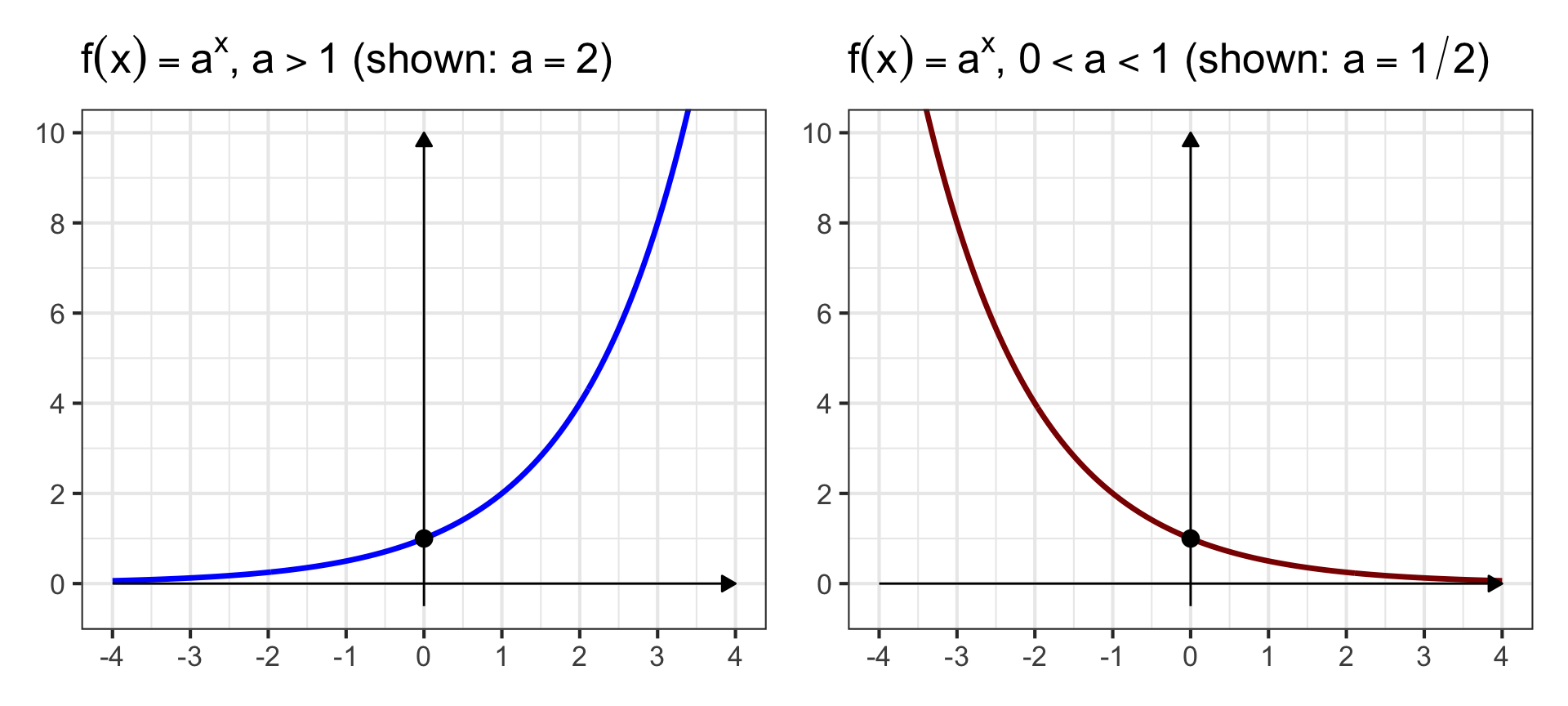
Geography of the Exponential Function
Both graphs share the following features regardless of base:
| Feature | Value |
|---|---|
| Domain | \(\left(-\infty, \infty\right)\) — all real numbers |
| Range | \(\left(0, \infty\right)\) — always positive |
| \(y\)-intercept | \(\left(0, 1\right)\) — since \(a^0 = 1\) for any premissible \(a\) |
| Horizontal asymptote | \(y = 0\) |
End behavior depends on the base:
If \(a > 1\):
\[\begin{align} \lim_{x \to -\infty} a^x &= 0\\ \lim_{x \to \infty} a^x &= \infty \end{align}\]
If \(0 < a < 1\):
\[\begin{align} \lim_{x \to -\infty} a^x &= \infty\\ \lim_{x \to \infty} a^x &= 0 \end{align}\]
The Natural Base \(e\)
One of the most interesting and widely useful bases in mathematics is Euler’s Number, \(e \approx 2.71828\ldots\).
It arises naturally from as the value of the limit \(\displaystyle{\lim_{n \to \infty}\left(1 + \frac{1}{n}\right)^n}\), which we will encounter again shortly in an application to compound interest.
The function \(f\left(x\right) = e^x\) is called the natural exponential function and is the default choice for most mathematical and scientific applications.
Its inverse is the natural logarithm \(\ln\left(x\right) = \log_e\left(x\right)\), which is why \(\ln\) appeared so naturally when solving exponential equations last class.
Transformations of Exponential Functions
Recall the general transformation framework \(g\left(x\right) = A \cdot f\left(B\left(x - H\right)\right) + K\), which
- shifts the graph of \(f\) right by \(H\),
- compresses/stretches horizontally by \(B\),
- stretches vertically by \(\left|A\right|\) (reflecting over the \(x\)-axis if \(A < 0\)), and
- shifts up by \(K\).
For exponential functions, the key effects of transformations \(\displaystyle{f\left(x\right) = A\left(a^{B\left(x - H\right)}\right) + K}\) are:
- The horizontal asymptote shifts from \(y = 0\) to \(y = K\).
- The range shifts from \(\left(0, \infty\right)\) to \(\left(K, \infty\right)\) or \(\left(-\infty, K\right)\) if \(A < 0\).
- The \(y\)-intercept changes — evaluate \(f\left(0\right)\) to find it.
- The end behavior changes accordingly. Evaluate the usual limits or reason via the transformation steps.
Analysis of Exponential Functions I
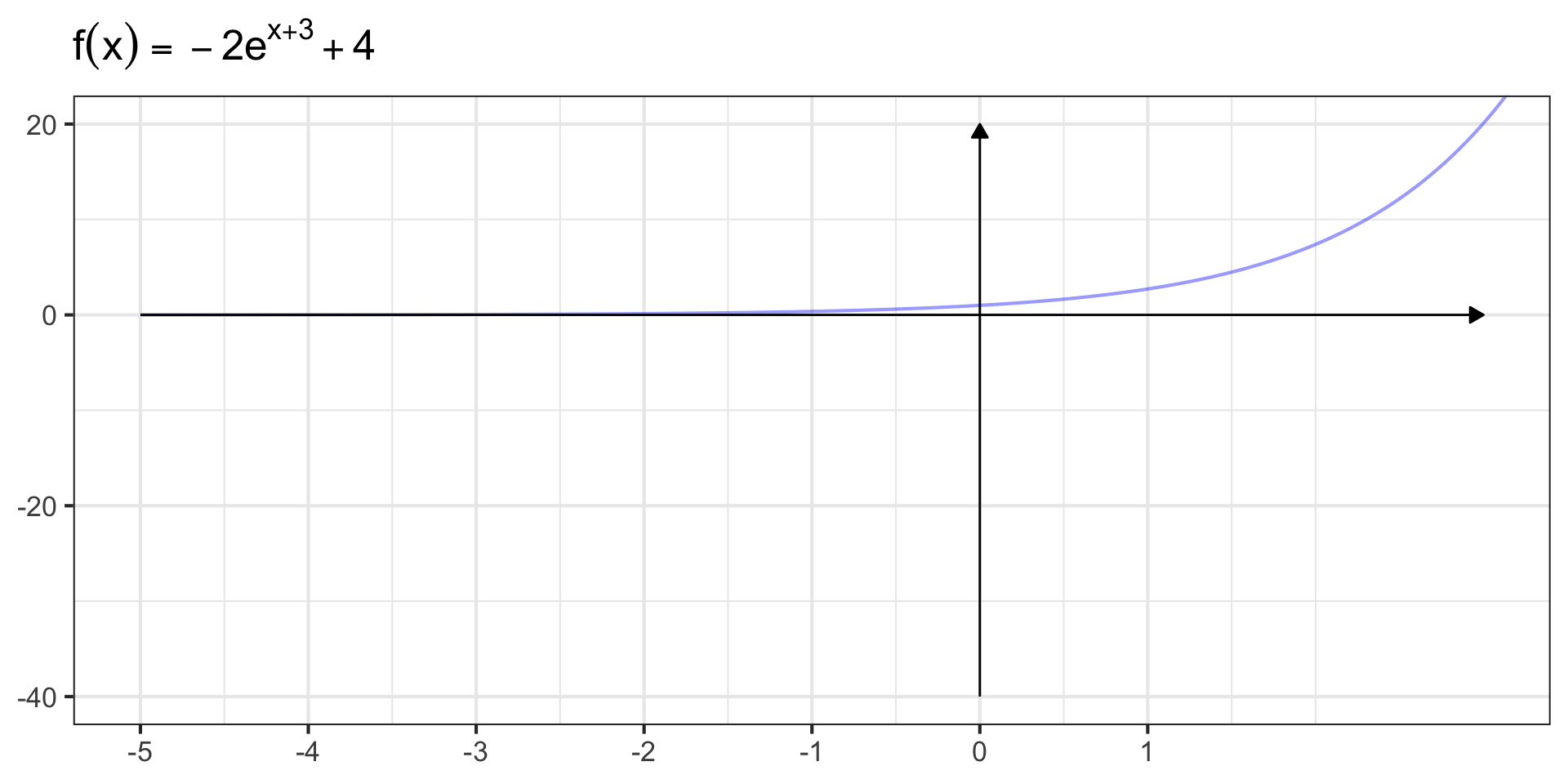
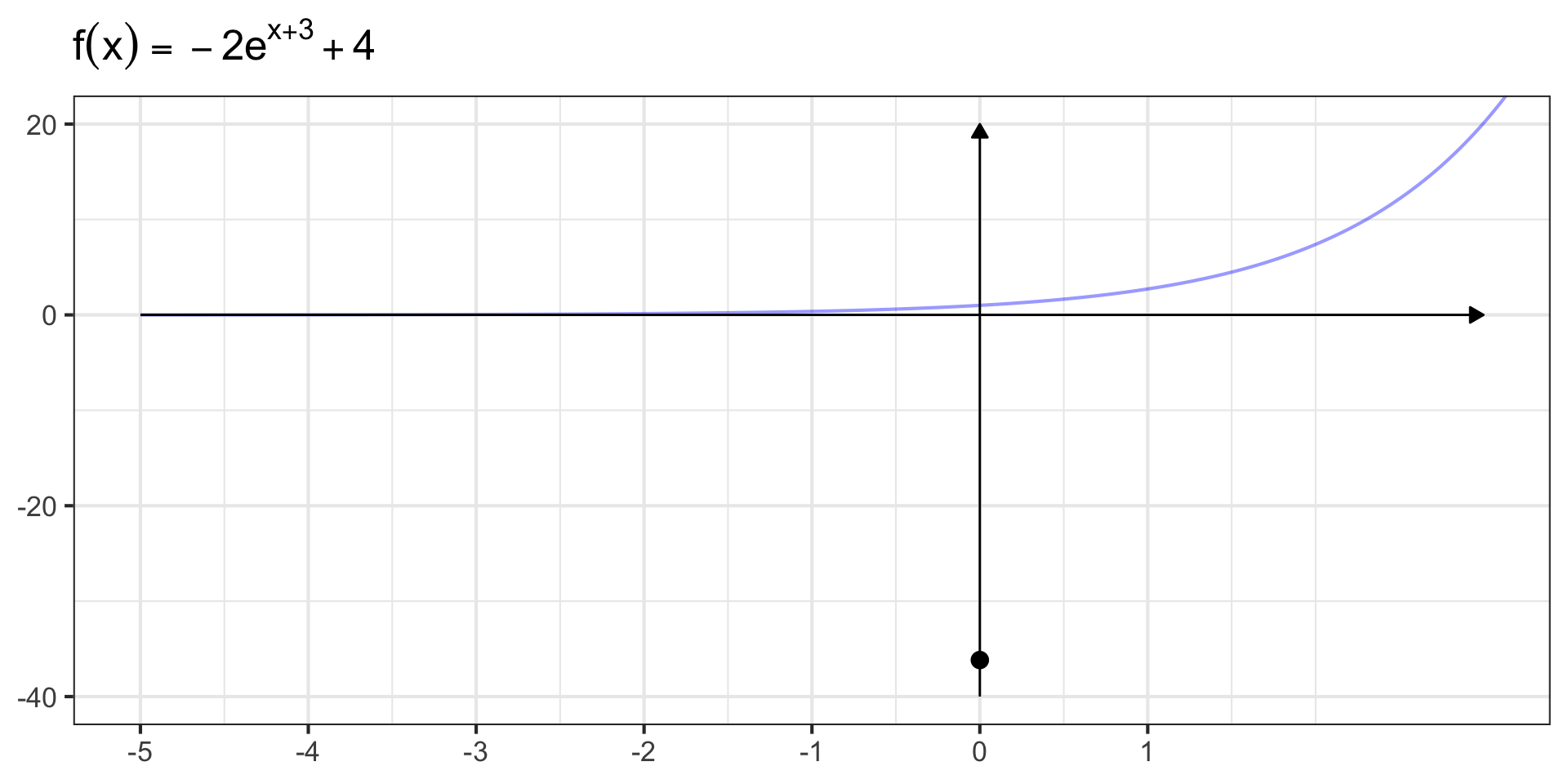
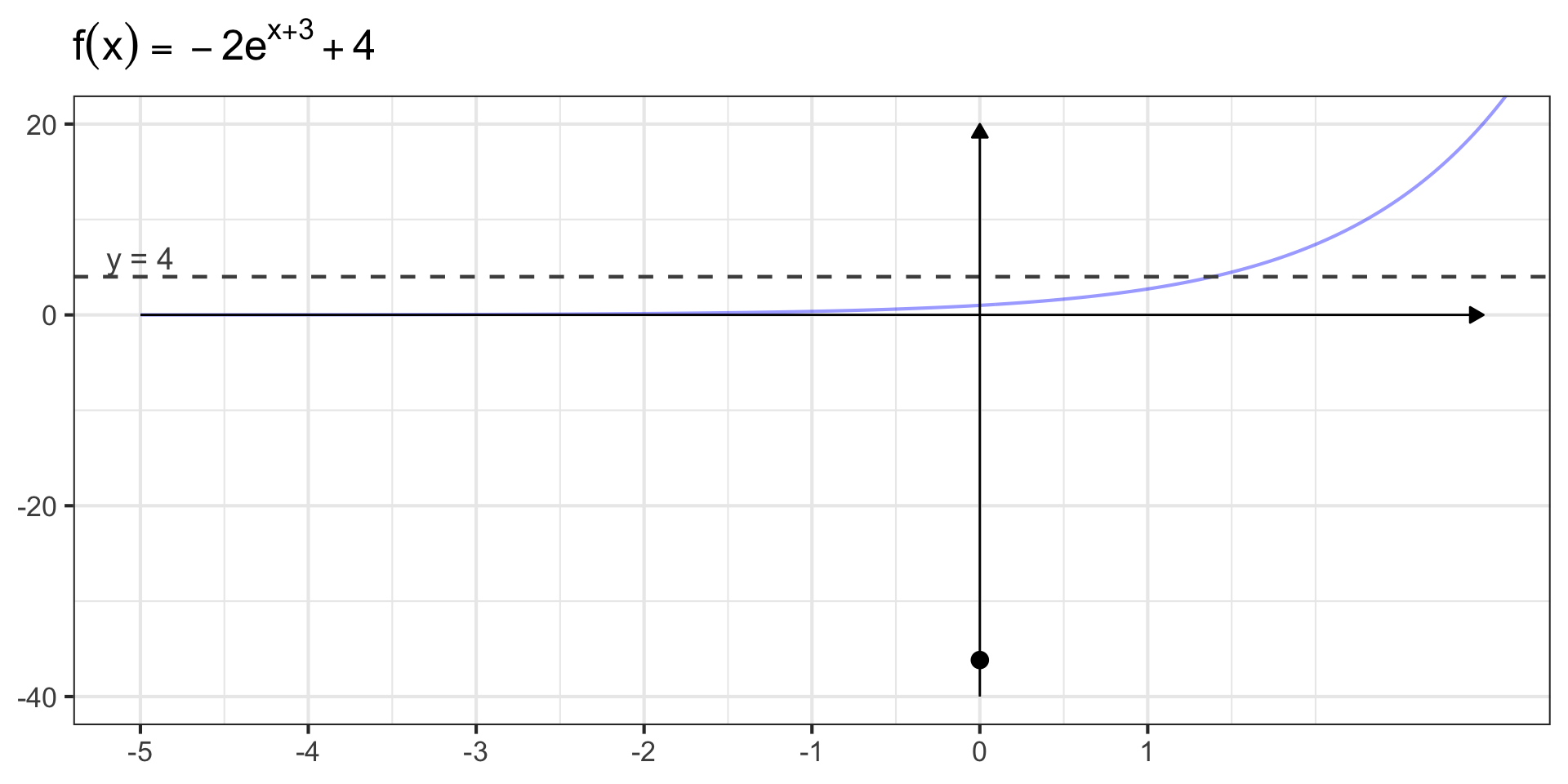
Problem: For \(\displaystyle{f\left(x\right) = -2e^{x+3} + 4}\), identify the \(y\)-intercept, horizontal asymptote, range, and end behavior. Sketch an approximate graph.
Solution. The base function is \(e^x\).
Analysis of Exponential Functions I
Problem: For \(\displaystyle{f\left(x\right) = -2e^{x+3} + 4}\), identify the \(y\)-intercept, horizontal asymptote, range, and end behavior. Sketch an approximate graph.
Solution. The base function is \(e^x\). Since \(e > 1\), the base function exhibits exponential growth – it is an increasing function.
The base function undergoes the following transformations.
- shifted left by \(3\)
- flipped over the \(x\)-axis
- stretched by a factor of \(2\)
- shifted upward by \(4\)
\(y\)-intercept: We’ll evaluate \(f\left(0\right)\)
\[\begin{align} f\left(0\right) &= -2e^{0 + 3} + 4 \end{align}\]
Analysis of Exponential Functions I
Problem: For \(\displaystyle{f\left(x\right) = -2e^{x+3} + 4}\), identify the \(y\)-intercept, horizontal asymptote, range, and end behavior. Sketch an approximate graph.
Solution. The base function is \(e^x\). Since \(e > 1\), the base function exhibits exponential growth – it is an increasing function.
The base function undergoes the following transformations.
- shifted left by \(3\)
- flipped over the \(x\)-axis
- stretched by a factor of \(2\)
- shifted upward by \(4\)
\(y\)-intercept: We’ll evaluate \(f\left(0\right)\)
\[\begin{align} f\left(0\right) &= -2e^{0 + 3} + 4\\ &= -2e^3 + 4 \end{align}\]
Horizontal Asymptote:
Analysis of Exponential Functions I
Problem: For \(\displaystyle{f\left(x\right) = -2e^{x+3} + 4}\), identify the \(y\)-intercept, horizontal asymptote, range, and end behavior. Sketch an approximate graph.
Solution. The base function is \(e^x\). Since \(e > 1\), the base function exhibits exponential growth – it is an increasing function.
The base function undergoes the following transformations.
- shifted left by \(3\)
- flipped over the \(x\)-axis
- stretched by a factor of \(2\)
- shifted upward by \(4\)
\(y\)-intercept: We’ll evaluate \(f\left(0\right)\)
\[\begin{align} f\left(0\right) &= -2e^{0 + 3} + 4\\ &= -2e^3 + 4 \end{align}\]
Horizontal Asymptote: Is moved from \(y = 0\) to \(y = 4\) because of the vertical shift.
Analysis of Exponential Functions I
Problem: For \(\displaystyle{f\left(x\right) = -2e^{x+3} + 4}\), identify the \(y\)-intercept, horizontal asymptote, range, and end behavior. Sketch an approximate graph.
Solution. The base function is \(e^x\). Since \(e > 1\), the base function exhibits exponential growth – it is an increasing function.
The base function undergoes the following transformations.
- shifted left by \(3\)
- flipped over the \(x\)-axis
- stretched by a factor of \(2\)
- shifted upward by \(4\)
\(y\)-intercept: We’ll evaluate \(f\left(0\right)\)
\[\begin{align} f\left(0\right) &= -2e^{0 + 3} + 4\\ &= -2e^3 + 4 \end{align}\]
Horizontal Asymptote: Is moved from \(y = 0\) to \(y = 4\) because of the vertical shift.
\(x\)-intercept:
Analysis of Exponential Functions I
Problem: For \(\displaystyle{f\left(x\right) = -2e^{x+3} + 4}\), identify the \(y\)-intercept, horizontal asymptote, range, and end behavior. Sketch an approximate graph.
Solution. The base function is \(e^x\). Since \(e > 1\), the base function exhibits exponential growth – it is an increasing function.
The base function undergoes the following transformations.
- shifted left by \(3\)
- flipped over the \(x\)-axis
- stretched by a factor of \(2\)
- shifted upward by \(4\)
\(y\)-intercept: We’ll evaluate \(f\left(0\right)\)
\[\begin{align} f\left(0\right) &= -2e^{0 + 3} + 4\\ &= -2e^3 + 4 \end{align}\]
Horizontal Asymptote: Is moved from \(y = 0\) to \(y = 4\) because of the vertical shift.
\(x\)-intercept: The book function has no \(x\)-intercept, but due to the flipping and vertical shift, the function \(f\left(x\right)\) will have one.
\[\begin{align} f\left(x\right) &= 0 \end{align}\]
Analysis of Exponential Functions I
Problem: For \(\displaystyle{f\left(x\right) = -2e^{x+3} + 4}\), identify the \(y\)-intercept, horizontal asymptote, range, and end behavior. Sketch an approximate graph.
Solution. The base function is \(e^x\). Since \(e > 1\), the base function exhibits exponential growth – it is an increasing function.
The base function undergoes the following transformations.
- shifted left by \(3\)
- flipped over the \(x\)-axis
- stretched by a factor of \(2\)
- shifted upward by \(4\)
\(y\)-intercept: We’ll evaluate \(f\left(0\right)\)
\[\begin{align} f\left(0\right) &= -2e^{0 + 3} + 4\\ &= -2e^3 + 4 \end{align}\]
Horizontal Asymptote: Is moved from \(y = 0\) to \(y = 4\) because of the vertical shift.
\(x\)-intercept: The book function has no \(x\)-intercept, but due to the flipping and vertical shift, the function \(f\left(x\right)\) will have one.
\[\begin{align} f\left(x\right) &= 0\\ \implies -2e^{x + 3} + 4 &= 0 \end{align}\]
Analysis of Exponential Functions I
Problem: For \(\displaystyle{f\left(x\right) = -2e^{x+3} + 4}\), identify the \(y\)-intercept, horizontal asymptote, range, and end behavior. Sketch an approximate graph.
Solution. The base function is \(e^x\). Since \(e > 1\), the base function exhibits exponential growth – it is an increasing function.
The base function undergoes the following transformations.
- shifted left by \(3\)
- flipped over the \(x\)-axis
- stretched by a factor of \(2\)
- shifted upward by \(4\)
\(y\)-intercept: We’ll evaluate \(f\left(0\right)\)
\[\begin{align} f\left(0\right) &= -2e^{0 + 3} + 4\\ &= -2e^3 + 4 \end{align}\]
Horizontal Asymptote: Is moved from \(y = 0\) to \(y = 4\) because of the vertical shift.
\(x\)-intercept: The book function has no \(x\)-intercept, but due to the flipping and vertical shift, the function \(f\left(x\right)\) will have one.
\[\begin{align} f\left(x\right) &= 0\\ \implies -2e^{x + 3} + 4 &= 0\\ \implies -2e^{x + 3} &= -4 \end{align}\]
Analysis of Exponential Functions I
Problem: For \(\displaystyle{f\left(x\right) = -2e^{x+3} + 4}\), identify the \(y\)-intercept, horizontal asymptote, range, and end behavior. Sketch an approximate graph.
Solution. The base function is \(e^x\). Since \(e > 1\), the base function exhibits exponential growth – it is an increasing function.
The base function undergoes the following transformations.
- shifted left by \(3\)
- flipped over the \(x\)-axis
- stretched by a factor of \(2\)
- shifted upward by \(4\)
\(y\)-intercept: We’ll evaluate \(f\left(0\right)\)
\[\begin{align} f\left(0\right) &= -2e^{0 + 3} + 4\\ &= -2e^3 + 4 \end{align}\]
Horizontal Asymptote: Is moved from \(y = 0\) to \(y = 4\) because of the vertical shift.
\(x\)-intercept: The book function has no \(x\)-intercept, but due to the flipping and vertical shift, the function \(f\left(x\right)\) will have one.
\[\begin{align} f\left(x\right) &= 0\\ \implies -2e^{x + 3} + 4 &= 0\\ \implies -2e^{x + 3} &= -4\\ \implies e^{x + 3} &= 2 \end{align}\]
Analysis of Exponential Functions I
Problem: For \(\displaystyle{f\left(x\right) = -2e^{x+3} + 4}\), identify the \(y\)-intercept, horizontal asymptote, range, and end behavior. Sketch an approximate graph.
Solution. The base function is \(e^x\). Since \(e > 1\), the base function exhibits exponential growth – it is an increasing function.
The base function undergoes the following transformations.
- shifted left by \(3\)
- flipped over the \(x\)-axis
- stretched by a factor of \(2\)
- shifted upward by \(4\)
\(y\)-intercept: We’ll evaluate \(f\left(0\right)\)
\[\begin{align} f\left(0\right) &= -2e^{0 + 3} + 4\\ &= -2e^3 + 4 \end{align}\]
Horizontal Asymptote: Is moved from \(y = 0\) to \(y = 4\) because of the vertical shift.
\(x\)-intercept: The book function has no \(x\)-intercept, but due to the flipping and vertical shift, the function \(f\left(x\right)\) will have one.
\[\begin{align} f\left(x\right) &= 0\\ \implies -2e^{x + 3} + 4 &= 0\\ \implies -2e^{x + 3} &= -4\\ \implies e^{x + 3} &= 2\\ \implies \ln\left(e^{x + 3}\right) &= \ln\left(2\right) \end{align}\]
Analysis of Exponential Functions I
Problem: For \(\displaystyle{f\left(x\right) = -2e^{x+3} + 4}\), identify the \(y\)-intercept, horizontal asymptote, range, and end behavior. Sketch an approximate graph.
Solution. The base function is \(e^x\). Since \(e > 1\), the base function exhibits exponential growth – it is an increasing function.
The base function undergoes the following transformations.
- shifted left by \(3\)
- flipped over the \(x\)-axis
- stretched by a factor of \(2\)
- shifted upward by \(4\)
\(y\)-intercept: We’ll evaluate \(f\left(0\right)\)
\[\begin{align} f\left(0\right) &= -2e^{0 + 3} + 4\\ &= -2e^3 + 4 \end{align}\]
Horizontal Asymptote: Is moved from \(y = 0\) to \(y = 4\) because of the vertical shift.
\(x\)-intercept: The book function has no \(x\)-intercept, but due to the flipping and vertical shift, the function \(f\left(x\right)\) will have one.
\[\begin{align} f\left(x\right) &= 0\\ \implies -2e^{x + 3} + 4 &= 0\\ \implies -2e^{x + 3} &= -4\\ \implies e^{x + 3} &= 2\\ \implies \ln\left(e^{x + 3}\right) &= \ln\left(2\right)\\ \implies \left(x + 3\right)\ln\left(e\right) &= \ln\left(2\right) \end{align}\]
Analysis of Exponential Functions I
Problem: For \(\displaystyle{f\left(x\right) = -2e^{x+3} + 4}\), identify the \(y\)-intercept, horizontal asymptote, range, and end behavior. Sketch an approximate graph.
Solution. The base function is \(e^x\). Since \(e > 1\), the base function exhibits exponential growth – it is an increasing function.
The base function undergoes the following transformations.
- shifted left by \(3\)
- flipped over the \(x\)-axis
- stretched by a factor of \(2\)
- shifted upward by \(4\)
\(y\)-intercept: We’ll evaluate \(f\left(0\right)\)
\[\begin{align} f\left(0\right) &= -2e^{0 + 3} + 4\\ &= -2e^3 + 4 \end{align}\]
Horizontal Asymptote: Is moved from \(y = 0\) to \(y = 4\) because of the vertical shift.
\(x\)-intercept: The book function has no \(x\)-intercept, but due to the flipping and vertical shift, the function \(f\left(x\right)\) will have one.
\[\begin{align} f\left(x\right) &= 0\\ \implies -2e^{x + 3} + 4 &= 0\\ \implies -2e^{x + 3} &= -4\\ \implies e^{x + 3} &= 2\\ \implies \ln\left(e^{x + 3}\right) &= \ln\left(2\right)\\ \implies \left(x + 3\right)\ln\left(e\right) &= \ln\left(2\right)\\ \implies x + 3 &= \ln\left(2\right) \end{align}\]
Analysis of Exponential Functions I
Problem: For \(\displaystyle{f\left(x\right) = -2e^{x+3} + 4}\), identify the \(y\)-intercept, horizontal asymptote, range, and end behavior. Sketch an approximate graph.
Solution. The base function is \(e^x\). Since \(e > 1\), the base function exhibits exponential growth – it is an increasing function.
The base function undergoes the following transformations.
- shifted left by \(3\)
- flipped over the \(x\)-axis
- stretched by a factor of \(2\)
- shifted upward by \(4\)
\(y\)-intercept: We’ll evaluate \(f\left(0\right)\)
\[\begin{align} f\left(0\right) &= -2e^{0 + 3} + 4\\ &= -2e^3 + 4 \end{align}\]
Horizontal Asymptote: Is moved from \(y = 0\) to \(y = 4\) because of the vertical shift.
\(x\)-intercept: The book function has no \(x\)-intercept, but due to the flipping and vertical shift, the function \(f\left(x\right)\) will have one.
\[\begin{align} f\left(x\right) &= 0\\ \implies -2e^{x + 3} + 4 &= 0\\ \implies -2e^{x + 3} &= -4\\ \implies e^{x + 3} &= 2\\ \implies \ln\left(e^{x + 3}\right) &= \ln\left(2\right)\\ \implies \left(x + 3\right)\ln\left(e\right) &= \ln\left(2\right)\\ \implies x + 3 &= \ln\left(2\right)\\ \implies x &= \ln\left(2\right) - 3 \end{align}\]
Analysis of Exponential Functions I
Problem: For \(\displaystyle{f\left(x\right) = -2e^{x+3} + 4}\), identify the \(y\)-intercept, horizontal asymptote, range, and end behavior. Sketch an approximate graph.
Solution. The base function is \(e^x\). Since \(e > 1\), the base function exhibits exponential growth – it is an increasing function.
The base function undergoes the following transformations.
- shifted left by \(3\)
- flipped over the \(x\)-axis
- stretched by a factor of \(2\)
- shifted upward by \(4\)
\(y\)-intercept: We’ll evaluate \(f\left(0\right)\)
\[\begin{align} f\left(0\right) &= -2e^{0 + 3} + 4\\ &= -2e^3 + 4 \end{align}\]
Horizontal Asymptote: Is moved from \(y = 0\) to \(y = 4\) because of the vertical shift.
\(x\)-intercept: \(\displaystyle{\left(\ln\left(2\right) - 3, 0\right)}\)
End Behavior:
\[\begin{align} \lim_{x\to -\infty}{-2e^{x + 3} + 4} \end{align}\]
Analysis of Exponential Functions I
Problem: For \(\displaystyle{f\left(x\right) = -2e^{x+3} + 4}\), identify the \(y\)-intercept, horizontal asymptote, range, and end behavior. Sketch an approximate graph.
Solution. The base function is \(e^x\). Since \(e > 1\), the base function exhibits exponential growth – it is an increasing function.
The base function undergoes the following transformations.
- shifted left by \(3\)
- flipped over the \(x\)-axis
- stretched by a factor of \(2\)
- shifted upward by \(4\)
\(y\)-intercept: We’ll evaluate \(f\left(0\right)\)
\[\begin{align} f\left(0\right) &= -2e^{0 + 3} + 4\\ &= -2e^3 + 4 \end{align}\]
Horizontal Asymptote: Is moved from \(y = 0\) to \(y = 4\) because of the vertical shift.
\(x\)-intercept: \(\displaystyle{\left(\ln\left(2\right) - 3, 0\right)}\)
End Behavior:
\[\begin{align} \lim_{x\to -\infty}{-2e^{x + 3} + 4} &= -2\left(0\right) + 4 \end{align}\]
Analysis of Exponential Functions I
Problem: For \(\displaystyle{f\left(x\right) = -2e^{x+3} + 4}\), identify the \(y\)-intercept, horizontal asymptote, range, and end behavior. Sketch an approximate graph.
Solution. The base function is \(e^x\). Since \(e > 1\), the base function exhibits exponential growth – it is an increasing function.
The base function undergoes the following transformations.
- shifted left by \(3\)
- flipped over the \(x\)-axis
- stretched by a factor of \(2\)
- shifted upward by \(4\)
\(y\)-intercept: We’ll evaluate \(f\left(0\right)\)
\[\begin{align} f\left(0\right) &= -2e^{0 + 3} + 4\\ &= -2e^3 + 4 \end{align}\]
Horizontal Asymptote: Is moved from \(y = 0\) to \(y = 4\) because of the vertical shift.
\(x\)-intercept: \(\displaystyle{\left(\ln\left(2\right) - 3, 0\right)}\)
End Behavior:
\[\begin{align} \lim_{x\to -\infty}{-2e^{x + 3} + 4} &= -2\left(0\right) + 4\\ &= 4 \end{align}\]
\[\begin{align} \lim_{x\to \infty}{-2e^{x + 3} + 4} \end{align}\]
Analysis of Exponential Functions I
Problem: For \(\displaystyle{f\left(x\right) = -2e^{x+3} + 4}\), identify the \(y\)-intercept, horizontal asymptote, range, and end behavior. Sketch an approximate graph.
Solution. The base function is \(e^x\). Since \(e > 1\), the base function exhibits exponential growth – it is an increasing function.
The base function undergoes the following transformations.
- shifted left by \(3\)
- flipped over the \(x\)-axis
- stretched by a factor of \(2\)
- shifted upward by \(4\)
\(y\)-intercept: We’ll evaluate \(f\left(0\right)\)
\[\begin{align} f\left(0\right) &= -2e^{0 + 3} + 4\\ &= -2e^3 + 4 \end{align}\]
Horizontal Asymptote: Is moved from \(y = 0\) to \(y = 4\) because of the vertical shift.
\(x\)-intercept: \(\displaystyle{\left(\ln\left(2\right) - 3, 0\right)}\)
End Behavior:
\[\begin{align} \lim_{x\to -\infty}{-2e^{x + 3} + 4} &= -2\left(0\right) + 4\\ &= 4 \end{align}\]
\[\begin{align} \lim_{x\to \infty}{-2e^{x + 3} + 4} &= -\infty \end{align}\]
Analysis of Exponential Functions I
Problem: For \(\displaystyle{f\left(x\right) = -2e^{x+3} + 4}\), identify the \(y\)-intercept, horizontal asymptote, range, and end behavior. Sketch an approximate graph.
Solution. The base function is \(e^x\). Since \(e > 1\), the base function exhibits exponential growth – it is an increasing function.
The base function undergoes the following transformations.
- shifted left by \(3\)
- flipped over the \(x\)-axis
- stretched by a factor of \(2\)
- shifted upward by \(4\)
\(y\)-intercept: We’ll evaluate \(f\left(0\right)\)
\[\begin{align} f\left(0\right) &= -2e^{0 + 3} + 4\\ &= -2e^3 + 4 \end{align}\]
Horizontal Asymptote: Is moved from \(y = 0\) to \(y = 4\) because of the vertical shift.
\(x\)-intercept: \(\displaystyle{\left(\ln\left(2\right) - 3, 0\right)}\)
End Behavior: \(\displaystyle{\lim_{x\to -\infty}{f\left(x\right)} = 4}\) and \(\displaystyle{\lim_{x\to \infty}{f\left(x\right)} = -\infty}\)
Analysis of Exponential Functions I
Problem: For \(\displaystyle{f\left(x\right) = -2e^{x+3} + 4}\), identify the \(y\)-intercept, horizontal asymptote, range, and end behavior. Sketch an approximate graph.
Solution. The base function is \(e^x\). Since \(e > 1\), the base function exhibits exponential growth – it is an increasing function.
The base function undergoes the following transformations.
- shifted left by \(3\)
- flipped over the \(x\)-axis
- stretched by a factor of \(2\)
- shifted upward by \(4\)
\(y\)-intercept: We’ll evaluate \(f\left(0\right)\)
\[\begin{align} f\left(0\right) &= -2e^{0 + 3} + 4\\ &= -2e^3 + 4 \end{align}\]
Horizontal Asymptote: Is moved from \(y = 0\) to \(y = 4\) because of the vertical shift.
\(x\)-intercept: \(\displaystyle{\left(\ln\left(2\right) - 3, 0\right)}\)
End Behavior: \(\displaystyle{\lim_{x\to -\infty}{f\left(x\right)} = 4}\) and \(\displaystyle{\lim_{x\to \infty}{f\left(x\right)} = -\infty}\)
Analysis of Exponential Functions I
Problem: For \(\displaystyle{f\left(x\right) = -2e^{x+3} + 4}\), identify the \(y\)-intercept, horizontal asymptote, range, and end behavior. Sketch an approximate graph.
Solution. The base function is \(e^x\). Since \(e > 1\), the base function exhibits exponential growth – it is an increasing function.
The base function undergoes the following transformations.
- shifted left by \(3\)
- flipped over the \(x\)-axis
- stretched by a factor of \(2\)
- shifted upward by \(4\)
\(y\)-intercept: We’ll evaluate \(f\left(0\right)\)
\[\begin{align} f\left(0\right) &= -2e^{0 + 3} + 4\\ &= -2e^3 + 4 \end{align}\]
Horizontal Asymptote: Is moved from \(y = 0\) to \(y = 4\) because of the vertical shift.
\(x\)-intercept: \(\displaystyle{\left(\ln\left(2\right) - 3, 0\right)}\)
End Behavior: \(\displaystyle{\lim_{x\to -\infty}{f\left(x\right)} = 4}\) and \(\displaystyle{\lim_{x\to \infty}{f\left(x\right)} = -\infty}\)
Analysis of Exponential Functions I
Problem: For \(\displaystyle{f\left(x\right) = -2e^{x+3} + 4}\), identify the \(y\)-intercept, horizontal asymptote, range, and end behavior. Sketch an approximate graph.
Solution. The base function is \(e^x\). Since \(e > 1\), the base function exhibits exponential growth – it is an increasing function.
The base function undergoes the following transformations.
- shifted left by \(3\)
- flipped over the \(x\)-axis
- stretched by a factor of \(2\)
- shifted upward by \(4\)
\(y\)-intercept: We’ll evaluate \(f\left(0\right)\)
\[\begin{align} f\left(0\right) &= -2e^{0 + 3} + 4\\ &= -2e^3 + 4 \end{align}\]
Horizontal Asymptote: Is moved from \(y = 0\) to \(y = 4\) because of the vertical shift.
\(x\)-intercept: \(\displaystyle{\left(\ln\left(2\right) - 3, 0\right)}\)
End Behavior: \(\displaystyle{\lim_{x\to -\infty}{f\left(x\right)} = 4}\) and \(\displaystyle{\lim_{x\to \infty}{f\left(x\right)} = -\infty}\)
Analysis of Exponential Functions I
Problem: For \(\displaystyle{f\left(x\right) = -2e^{x+3} + 4}\), identify the \(y\)-intercept, horizontal asymptote, range, and end behavior. Sketch an approximate graph.
Solution. The base function is \(e^x\). Since \(e > 1\), the base function exhibits exponential growth – it is an increasing function.
The base function undergoes the following transformations.
- shifted left by \(3\)
- flipped over the \(x\)-axis
- stretched by a factor of \(2\)
- shifted upward by \(4\)
\(y\)-intercept: We’ll evaluate \(f\left(0\right)\)
\[\begin{align} f\left(0\right) &= -2e^{0 + 3} + 4\\ &= -2e^3 + 4 \end{align}\]
Horizontal Asymptote: Is moved from \(y = 0\) to \(y = 4\) because of the vertical shift.
\(x\)-intercept: \(\displaystyle{\left(\ln\left(2\right) - 3, 0\right)}\)
End Behavior: \(\displaystyle{\lim_{x\to -\infty}{f\left(x\right)} = 4}\) and \(\displaystyle{\lim_{x\to \infty}{f\left(x\right)} = -\infty}\)
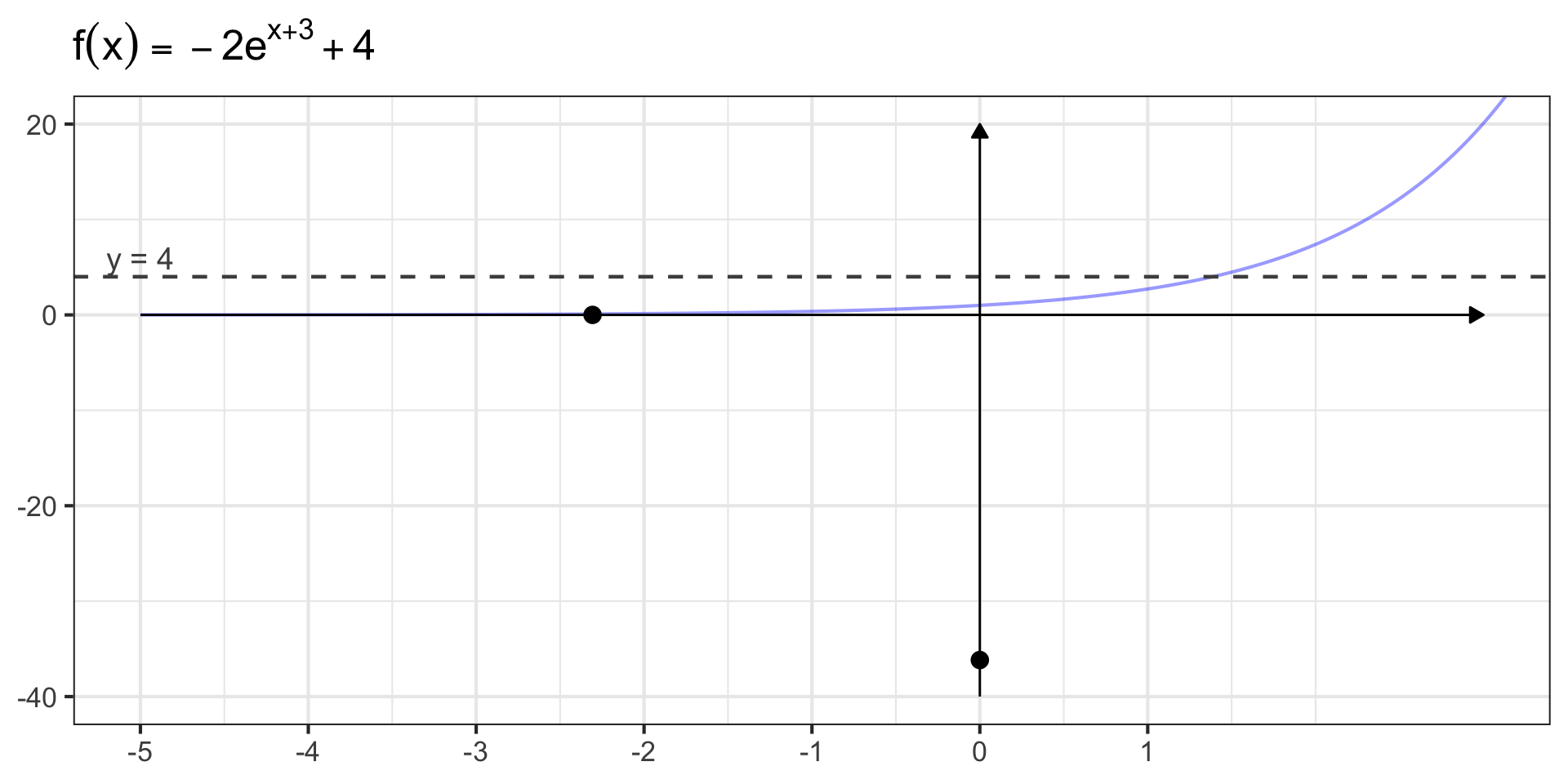
Analysis of Exponential Functions I
Problem: For \(\displaystyle{f\left(x\right) = -2e^{x+3} + 4}\), identify the \(y\)-intercept, horizontal asymptote, range, and end behavior. Sketch an approximate graph.
Solution. The base function is \(e^x\). Since \(e > 1\), the base function exhibits exponential growth – it is an increasing function.
The base function undergoes the following transformations.
- shifted left by \(3\)
- flipped over the \(x\)-axis
- stretched by a factor of \(2\)
- shifted upward by \(4\)
\(y\)-intercept: We’ll evaluate \(f\left(0\right)\)
\[\begin{align} f\left(0\right) &= -2e^{0 + 3} + 4\\ &= -2e^3 + 4 \end{align}\]
Horizontal Asymptote: Is moved from \(y = 0\) to \(y = 4\) because of the vertical shift.
\(x\)-intercept: \(\displaystyle{\left(\ln\left(2\right) - 3, 0\right)}\)
End Behavior: \(\displaystyle{\lim_{x\to -\infty}{f\left(x\right)} = 4}\) and \(\displaystyle{\lim_{x\to \infty}{f\left(x\right)} = -\infty}\)
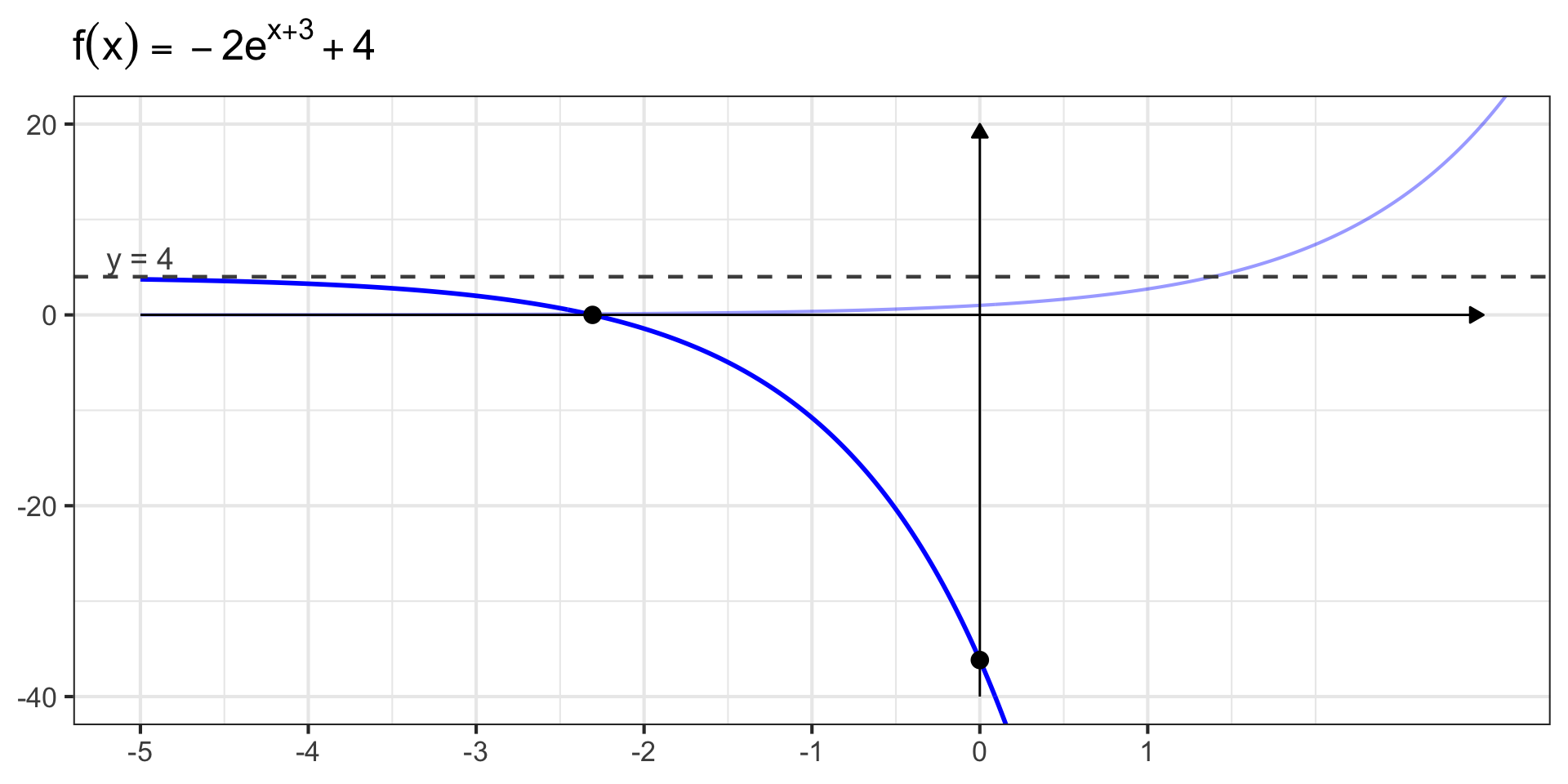
Analysis of Exponential Functions II
Problem: For \(g\left(x\right) = 8\left(\frac{1}{2}\right)^{10-2x} - 1\), identify the \(y\)-intercept, horizontal asymptote, range, and end behavior. Sketch an approximate graph.
Solution. Working with a horizontal flip (a negative \(B\) value) is difficult, so we’ll rewrite the function first.
\[\begin{align} g\left(x\right) &= 8\left(\frac{1}{2}\right)^{10-2x} \end{align}\]
Analysis of Exponential Functions II
Problem: For \(g\left(x\right) = 8\left(\frac{1}{2}\right)^{10-2x} - 1\), identify the \(y\)-intercept, horizontal asymptote, range, and end behavior. Sketch an approximate graph.
Solution. Working with a horizontal flip (a negative \(B\) value) is difficult, so we’ll rewrite the function first.
\[\begin{align} g\left(x\right) &= 8\left(\frac{1}{2}\right)^{10-2x}\\ &= 8\left(\frac{1}{2}\right)^{-\left(2x - 10\right)} - 1 \end{align}\]
Analysis of Exponential Functions II
Problem: For \(g\left(x\right) = 8\left(\frac{1}{2}\right)^{10-2x} - 1\), identify the \(y\)-intercept, horizontal asymptote, range, and end behavior. Sketch an approximate graph.
Solution. Working with a horizontal flip (a negative \(B\) value) is difficult, so we’ll rewrite the function first.
\[\begin{align} g\left(x\right) &= 8\left(\frac{1}{2}\right)^{10-2x}\\ &= 8\left(\frac{1}{2}\right)^{-\left(2x - 10\right)} - 1\\ &= 8\left(2^{2x - 10}\right) - 1 \end{align}\]
Analysis of Exponential Functions II
Problem: For \(g\left(x\right) = 8\left(\frac{1}{2}\right)^{10-2x} - 1\), identify the \(y\)-intercept, horizontal asymptote, range, and end behavior. Sketch an approximate graph.
Solution. Working with a horizontal flip (a negative \(B\) value) is difficult, so we’ll rewrite the function first.
\[\begin{align} g\left(x\right) &= 8\left(\frac{1}{2}\right)^{10-2x}\\ &= 8\left(\frac{1}{2}\right)^{-\left(2x - 10\right)} - 1\\ &= 8\left(2^{2x - 10}\right) - 1\\ &= 8\left(2^{2\left(x - 5\right)}\right) - 1 \end{align}\]
Analysis of Exponential Functions II
Problem: For \(g\left(x\right) = 8\left(\frac{1}{2}\right)^{10-2x} - 1\), identify the \(y\)-intercept, horizontal asymptote, range, and end behavior. Sketch an approximate graph.
Solution. Working with a horizontal flip (a negative \(B\) value) is difficult, so we’ll rewrite the function first.
\[\begin{align} g\left(x\right) &= 8\left(2^{2\left(x - 5\right)}\right) - 1 \end{align}\]
Analysis of Exponential Functions II
Problem: For \(g\left(x\right) = 8\left(\frac{1}{2}\right)^{10-2x} - 1\), identify the \(y\)-intercept, horizontal asymptote, range, and end behavior. Sketch an approximate graph.
Solution. Working with a horizontal flip (a negative \(B\) value) is difficult, so we’ll rewrite the function first.
\[\begin{align} g\left(x\right) &= 8\left(2^{2\left(x - 5\right)}\right) - 1 \end{align}\]
The comparison function is \(f\left(x\right) = 2^x\), which is exponential growth since the base exceeds \(1\).
The comparison function undergoes the following transformations.
- shifted right by \(5\)
- horizontally compressed (sped up) by a factor of \(2\)
- vertically stretched by a factor of \(8\)
- shifted downward by \(1\)
\(y\)-intercept:
Analysis of Exponential Functions II
Problem: For \(g\left(x\right) = 8\left(\frac{1}{2}\right)^{10-2x} - 1\), identify the \(y\)-intercept, horizontal asymptote, range, and end behavior. Sketch an approximate graph.
Solution. Working with a horizontal flip (a negative \(B\) value) is difficult, so we’ll rewrite the function first.
\[\begin{align} g\left(x\right) &= 8\left(2^{2\left(x - 5\right)}\right) - 1 \end{align}\]
The comparison function is \(f\left(x\right) = 2^x\), which is exponential growth since the base exceeds \(1\).
The comparison function undergoes the following transformations.
- shifted right by \(5\)
- horizontally compressed (sped up) by a factor of \(2\)
- vertically stretched by a factor of \(8\)
- shifted downward by \(1\)
\(y\)-intercept: We’ll evaluate \(g\left(0\right)\)
\(\displaystyle{g\left(0\right)}\)
Analysis of Exponential Functions II
Problem: For \(g\left(x\right) = 8\left(\frac{1}{2}\right)^{10-2x} - 1\), identify the \(y\)-intercept, horizontal asymptote, range, and end behavior. Sketch an approximate graph.
Solution. Working with a horizontal flip (a negative \(B\) value) is difficult, so we’ll rewrite the function first.
\[\begin{align} g\left(x\right) &= 8\left(2^{2\left(x - 5\right)}\right) - 1 \end{align}\]
The comparison function is \(f\left(x\right) = 2^x\), which is exponential growth since the base exceeds \(1\).
The comparison function undergoes the following transformations.
- shifted right by \(5\)
- horizontally compressed (sped up) by a factor of \(2\)
- vertically stretched by a factor of \(8\)
- shifted downward by \(1\)
\(y\)-intercept: We’ll evaluate \(g\left(0\right)\)
\(\displaystyle{g\left(0\right)= 8\left(2^{2\left(0 - 5\right)}\right) - 1}\)
Analysis of Exponential Functions II
Problem: For \(g\left(x\right) = 8\left(\frac{1}{2}\right)^{10-2x} - 1\), identify the \(y\)-intercept, horizontal asymptote, range, and end behavior. Sketch an approximate graph.
Solution. Working with a horizontal flip (a negative \(B\) value) is difficult, so we’ll rewrite the function first.
\[\begin{align} g\left(x\right) &= 8\left(2^{2\left(x - 5\right)}\right) - 1 \end{align}\]
The comparison function is \(f\left(x\right) = 2^x\), which is exponential growth since the base exceeds \(1\).
The comparison function undergoes the following transformations.
- shifted right by \(5\)
- horizontally compressed (sped up) by a factor of \(2\)
- vertically stretched by a factor of \(8\)
- shifted downward by \(1\)
\(y\)-intercept: We’ll evaluate \(g\left(0\right)\)
\(\displaystyle{g\left(0\right)= 8\left(2^{2\left(0 - 5\right)}\right) - 1 = 8\left(2^{-10}\right) - 1}\)
Analysis of Exponential Functions II
Problem: For \(g\left(x\right) = 8\left(\frac{1}{2}\right)^{10-2x} - 1\), identify the \(y\)-intercept, horizontal asymptote, range, and end behavior. Sketch an approximate graph.
Solution. Working with a horizontal flip (a negative \(B\) value) is difficult, so we’ll rewrite the function first.
\[\begin{align} g\left(x\right) &= 8\left(2^{2\left(x - 5\right)}\right) - 1 \end{align}\]
The comparison function is \(f\left(x\right) = 2^x\), which is exponential growth since the base exceeds \(1\).
The comparison function undergoes the following transformations.
- shifted right by \(5\)
- horizontally compressed (sped up) by a factor of \(2\)
- vertically stretched by a factor of \(8\)
- shifted downward by \(1\)
\(y\)-intercept: \(\displaystyle{\left(0, 8\left(2^{-10}\right) - 1\right)}\)
Horizontal Asymptote:
Analysis of Exponential Functions II
Problem: For \(g\left(x\right) = 8\left(\frac{1}{2}\right)^{10-2x} - 1\), identify the \(y\)-intercept, horizontal asymptote, range, and end behavior. Sketch an approximate graph.
Solution. Working with a horizontal flip (a negative \(B\) value) is difficult, so we’ll rewrite the function first.
\[\begin{align} g\left(x\right) &= 8\left(2^{2\left(x - 5\right)}\right) - 1 \end{align}\]
The comparison function is \(f\left(x\right) = 2^x\), which is exponential growth since the base exceeds \(1\).
The comparison function undergoes the following transformations.
- shifted right by \(5\)
- horizontally compressed (sped up) by a factor of \(2\)
- vertically stretched by a factor of \(8\)
- shifted downward by \(1\)
\(y\)-intercept: \(\displaystyle{\left(0, 8\left(2^{-10}\right) - 1\right)}\)
Horizontal Asymptote: Shifted from \(y = 0\) to \(y = -1\) due to the vertical shift.
Analysis of Exponential Functions II
Problem: For \(g\left(x\right) = 8\left(\frac{1}{2}\right)^{10-2x} - 1\), identify the \(y\)-intercept, horizontal asymptote, range, and end behavior. Sketch an approximate graph.
Solution. Working with a horizontal flip (a negative \(B\) value) is difficult, so we’ll rewrite the function first.
\[\begin{align} g\left(x\right) &= 8\left(2^{2\left(x - 5\right)}\right) - 1 \end{align}\]
The comparison function is \(f\left(x\right) = 2^x\), which is exponential growth since the base exceeds \(1\).
The comparison function undergoes the following transformations.
- shifted right by \(5\)
- horizontally compressed (sped up) by a factor of \(2\)
- vertically stretched by a factor of \(8\)
- shifted downward by \(1\)
\(y\)-intercept: \(\displaystyle{\left(0, 8\left(2^{-10}\right) - 1\right)}\)
Horizontal Asymptote: \(y = -1\)
\(x\)-intercept: Again, due to the vertical shift, the function will have an \(x\)-intercept.
We’ll solve \(g\left(x\right) = 0\).
\[\begin{align} g\left(x\right) &= 0 \end{align}\]
Analysis of Exponential Functions II
Problem: For \(g\left(x\right) = 8\left(\frac{1}{2}\right)^{10-2x} - 1\), identify the \(y\)-intercept, horizontal asymptote, range, and end behavior. Sketch an approximate graph.
Solution. Working with a horizontal flip (a negative \(B\) value) is difficult, so we’ll rewrite the function first.
\[\begin{align} g\left(x\right) &= 8\left(2^{2\left(x - 5\right)}\right) - 1 \end{align}\]
The comparison function is \(f\left(x\right) = 2^x\), which is exponential growth since the base exceeds \(1\).
The comparison function undergoes the following transformations.
- shifted right by \(5\)
- horizontally compressed (sped up) by a factor of \(2\)
- vertically stretched by a factor of \(8\)
- shifted downward by \(1\)
\(y\)-intercept: \(\displaystyle{\left(0, 8\left(2^{-10}\right) - 1\right)}\)
Horizontal Asymptote: \(y = -1\)
\(x\)-intercept: Again, due to the vertical shift, the function will have an \(x\)-intercept.
We’ll solve \(g\left(x\right) = 0\).
\[\begin{align} g\left(x\right) &= 0\\ \implies 8\left(2^{2\left(x - 5\right)}\right) - 1 &= 0 \end{align}\]
Analysis of Exponential Functions II
Problem: For \(g\left(x\right) = 8\left(\frac{1}{2}\right)^{10-2x} - 1\), identify the \(y\)-intercept, horizontal asymptote, range, and end behavior. Sketch an approximate graph.
Solution. Working with a horizontal flip (a negative \(B\) value) is difficult, so we’ll rewrite the function first.
\[\begin{align} g\left(x\right) &= 8\left(2^{2\left(x - 5\right)}\right) - 1 \end{align}\]
The comparison function is \(f\left(x\right) = 2^x\), which is exponential growth since the base exceeds \(1\).
The comparison function undergoes the following transformations.
- shifted right by \(5\)
- horizontally compressed (sped up) by a factor of \(2\)
- vertically stretched by a factor of \(8\)
- shifted downward by \(1\)
\(y\)-intercept: \(\displaystyle{\left(0, 8\left(2^{-10}\right) - 1\right)}\)
Horizontal Asymptote: \(y = -1\)
\(x\)-intercept: Again, due to the vertical shift, the function will have an \(x\)-intercept.
We’ll solve \(g\left(x\right) = 0\).
\[\begin{align} g\left(x\right) &= 0\\ \implies 8\left(2^{2\left(x - 5\right)}\right) - 1 &= 0\\ \implies 8\left(2^{2\left(x - 5\right)}\right) &= 1 \end{align}\]
Analysis of Exponential Functions II
Problem: For \(g\left(x\right) = 8\left(\frac{1}{2}\right)^{10-2x} - 1\), identify the \(y\)-intercept, horizontal asymptote, range, and end behavior. Sketch an approximate graph.
Solution. Working with a horizontal flip (a negative \(B\) value) is difficult, so we’ll rewrite the function first.
\[\begin{align} g\left(x\right) &= 8\left(2^{2\left(x - 5\right)}\right) - 1 \end{align}\]
The comparison function is \(f\left(x\right) = 2^x\), which is exponential growth since the base exceeds \(1\).
The comparison function undergoes the following transformations.
- shifted right by \(5\)
- horizontally compressed (sped up) by a factor of \(2\)
- vertically stretched by a factor of \(8\)
- shifted downward by \(1\)
\(y\)-intercept: \(\displaystyle{\left(0, 8\left(2^{-10}\right) - 1\right)}\)
Horizontal Asymptote: \(y = -1\)
\(x\)-intercept: Again, due to the vertical shift, the function will have an \(x\)-intercept.
We’ll solve \(g\left(x\right) = 0\).
\[\begin{align} g\left(x\right) &= 0\\ \implies 8\left(2^{2\left(x - 5\right)}\right) - 1 &= 0\\ \implies 8\left(2^{2\left(x - 5\right)}\right) &= 1\\ \implies 2^{2\left(x - 5\right)} &= \frac{1}{8} \end{align}\]
Analysis of Exponential Functions II
Problem: For \(g\left(x\right) = 8\left(\frac{1}{2}\right)^{10-2x} - 1\), identify the \(y\)-intercept, horizontal asymptote, range, and end behavior. Sketch an approximate graph.
Solution. Working with a horizontal flip (a negative \(B\) value) is difficult, so we’ll rewrite the function first.
\[\begin{align} g\left(x\right) &= 8\left(2^{2\left(x - 5\right)}\right) - 1 \end{align}\]
The comparison function is \(f\left(x\right) = 2^x\), which is exponential growth since the base exceeds \(1\).
The comparison function undergoes the following transformations.
- shifted right by \(5\)
- horizontally compressed (sped up) by a factor of \(2\)
- vertically stretched by a factor of \(8\)
- shifted downward by \(1\)
\(y\)-intercept: \(\displaystyle{\left(0, 8\left(2^{-10}\right) - 1\right)}\)
Horizontal Asymptote: \(y = -1\)
\(x\)-intercept: Again, due to the vertical shift, the function will have an \(x\)-intercept.
We’ll solve \(g\left(x\right) = 0\).
\[\begin{align} g\left(x\right) &= 0\\ \implies 8\left(2^{2\left(x - 5\right)}\right) - 1 &= 0\\ \implies 8\left(2^{2\left(x - 5\right)}\right) &= 1\\ \implies 2^{2\left(x - 5\right)} &= \frac{1}{8}\\ \implies \ln\left(2^{2\left(x - 5\right)}\right) &= \ln\left(\frac{1}{8}\right) \end{align}\]
Analysis of Exponential Functions II
Problem: For \(g\left(x\right) = 8\left(\frac{1}{2}\right)^{10-2x} - 1\), identify the \(y\)-intercept, horizontal asymptote, range, and end behavior. Sketch an approximate graph.
Solution. Working with a horizontal flip (a negative \(B\) value) is difficult, so we’ll rewrite the function first.
\[\begin{align} g\left(x\right) &= 8\left(2^{2\left(x - 5\right)}\right) - 1 \end{align}\]
The comparison function is \(f\left(x\right) = 2^x\), which is exponential growth since the base exceeds \(1\).
The comparison function undergoes the following transformations.
- shifted right by \(5\)
- horizontally compressed (sped up) by a factor of \(2\)
- vertically stretched by a factor of \(8\)
- shifted downward by \(1\)
\(y\)-intercept: \(\displaystyle{\left(0, 8\left(2^{-10}\right) - 1\right)}\)
Horizontal Asymptote: \(y = -1\)
\(x\)-intercept: Again, due to the vertical shift, the function will have an \(x\)-intercept.
We’ll solve \(g\left(x\right) = 0\).
\[\begin{align} g\left(x\right) &= 0\\ \implies \ln\left(2^{2\left(x - 5\right)}\right) &= \ln\left(\frac{1}{8}\right) \end{align}\]
Analysis of Exponential Functions II
Problem: For \(g\left(x\right) = 8\left(\frac{1}{2}\right)^{10-2x} - 1\), identify the \(y\)-intercept, horizontal asymptote, range, and end behavior. Sketch an approximate graph.
Solution. Working with a horizontal flip (a negative \(B\) value) is difficult, so we’ll rewrite the function first.
\[\begin{align} g\left(x\right) &= 8\left(2^{2\left(x - 5\right)}\right) - 1 \end{align}\]
The comparison function is \(f\left(x\right) = 2^x\), which is exponential growth since the base exceeds \(1\).
The comparison function undergoes the following transformations.
- shifted right by \(5\)
- horizontally compressed (sped up) by a factor of \(2\)
- vertically stretched by a factor of \(8\)
- shifted downward by \(1\)
\(y\)-intercept: \(\displaystyle{\left(0, 8\left(2^{-10}\right) - 1\right)}\)
Horizontal Asymptote: \(y = -1\)
\(x\)-intercept: Again, due to the vertical shift, the function will have an \(x\)-intercept.
We’ll solve \(g\left(x\right) = 0\).
\[\begin{align} g\left(x\right) &= 0\\ \implies \ln\left(2^{2\left(x - 5\right)}\right) &= \ln\left(\frac{1}{8}\right)\\ \implies 2\left(x - 5\right)\ln\left(2\right) &= \ln\left(\frac{1}{8}\right) \end{align}\]
Analysis of Exponential Functions II
Problem: For \(g\left(x\right) = 8\left(\frac{1}{2}\right)^{10-2x} - 1\), identify the \(y\)-intercept, horizontal asymptote, range, and end behavior. Sketch an approximate graph.
Solution. Working with a horizontal flip (a negative \(B\) value) is difficult, so we’ll rewrite the function first.
\[\begin{align} g\left(x\right) &= 8\left(2^{2\left(x - 5\right)}\right) - 1 \end{align}\]
The comparison function is \(f\left(x\right) = 2^x\), which is exponential growth since the base exceeds \(1\).
The comparison function undergoes the following transformations.
- shifted right by \(5\)
- horizontally compressed (sped up) by a factor of \(2\)
- vertically stretched by a factor of \(8\)
- shifted downward by \(1\)
\(y\)-intercept: \(\displaystyle{\left(0, 8\left(2^{-10}\right) - 1\right)}\)
Horizontal Asymptote: \(y = -1\)
\(x\)-intercept: Again, due to the vertical shift, the function will have an \(x\)-intercept.
We’ll solve \(g\left(x\right) = 0\).
\[\begin{align} g\left(x\right) &= 0\\ \implies \ln\left(2^{2\left(x - 5\right)}\right) &= \ln\left(\frac{1}{8}\right)\\ \implies 2\left(x - 5\right)\ln\left(2\right) &= \ln\left(\frac{1}{8}\right)\\ \implies x - 5 &= \frac{\ln\left(\frac{1}{8}\right)}{2\ln\left(2\right)} \end{align}\]
Analysis of Exponential Functions II
Problem: For \(g\left(x\right) = 8\left(\frac{1}{2}\right)^{10-2x} - 1\), identify the \(y\)-intercept, horizontal asymptote, range, and end behavior. Sketch an approximate graph.
Solution. Working with a horizontal flip (a negative \(B\) value) is difficult, so we’ll rewrite the function first.
\[\begin{align} g\left(x\right) &= 8\left(2^{2\left(x - 5\right)}\right) - 1 \end{align}\]
The comparison function is \(f\left(x\right) = 2^x\), which is exponential growth since the base exceeds \(1\).
The comparison function undergoes the following transformations.
- shifted right by \(5\)
- horizontally compressed (sped up) by a factor of \(2\)
- vertically stretched by a factor of \(8\)
- shifted downward by \(1\)
\(y\)-intercept: \(\displaystyle{\left(0, 8\left(2^{-10}\right) - 1\right)}\)
Horizontal Asymptote: \(y = -1\)
\(x\)-intercept: Again, due to the vertical shift, the function will have an \(x\)-intercept.
We’ll solve \(g\left(x\right) = 0\).
\[\begin{align} g\left(x\right) &= 0\\ \implies x - 5 &= \frac{\ln\left(\frac{1}{8}\right)}{2\ln\left(2\right)} \end{align}\]
Analysis of Exponential Functions II
Problem: For \(g\left(x\right) = 8\left(\frac{1}{2}\right)^{10-2x} - 1\), identify the \(y\)-intercept, horizontal asymptote, range, and end behavior. Sketch an approximate graph.
Solution. Working with a horizontal flip (a negative \(B\) value) is difficult, so we’ll rewrite the function first.
\[\begin{align} g\left(x\right) &= 8\left(2^{2\left(x - 5\right)}\right) - 1 \end{align}\]
The comparison function is \(f\left(x\right) = 2^x\), which is exponential growth since the base exceeds \(1\).
The comparison function undergoes the following transformations.
- shifted right by \(5\)
- horizontally compressed (sped up) by a factor of \(2\)
- vertically stretched by a factor of \(8\)
- shifted downward by \(1\)
\(y\)-intercept: \(\displaystyle{\left(0, 8\left(2^{-10}\right) - 1\right)}\)
Horizontal Asymptote: \(y = -1\)
\(x\)-intercept: Again, due to the vertical shift, the function will have an \(x\)-intercept.
We’ll solve \(g\left(x\right) = 0\).
\[\begin{align} g\left(x\right) &= 0\\ \implies x - 5 &= \frac{\ln\left(\frac{1}{8}\right)}{2\ln\left(2\right)}\\ \implies x &= 5 + \frac{\ln\left(\frac{1}{8}\right)}{2\ln\left(2\right)} \end{align}\]
Analysis of Exponential Functions II
Problem: For \(g\left(x\right) = 8\left(\frac{1}{2}\right)^{10-2x} - 1\), identify the \(y\)-intercept, horizontal asymptote, range, and end behavior. Sketch an approximate graph.
Solution. Working with a horizontal flip (a negative \(B\) value) is difficult, so we’ll rewrite the function first.
\[\begin{align} g\left(x\right) &= 8\left(2^{2\left(x - 5\right)}\right) - 1 \end{align}\]
The comparison function is \(f\left(x\right) = 2^x\), which is exponential growth since the base exceeds \(1\).
The comparison function undergoes the following transformations.
- shifted right by \(5\)
- horizontally compressed (sped up) by a factor of \(2\)
- vertically stretched by a factor of \(8\)
- shifted downward by \(1\)
\(y\)-intercept: \(\displaystyle{\left(0, 8\left(2^{-10}\right) - 1\right)}\)
Horizontal Asymptote: \(y = -1\)
\(x\)-intercept: \(\displaystyle{\left(5 + \frac{\ln\left(\frac{1}{8}\right)}{2\ln\left(2\right)}, 0\right)}\)
End Behavior:
Analysis of Exponential Functions II
Problem: For \(g\left(x\right) = 8\left(\frac{1}{2}\right)^{10-2x} - 1\), identify the \(y\)-intercept, horizontal asymptote, range, and end behavior. Sketch an approximate graph.
Solution. Working with a horizontal flip (a negative \(B\) value) is difficult, so we’ll rewrite the function first.
\[\begin{align} g\left(x\right) &= 8\left(2^{2\left(x - 5\right)}\right) - 1 \end{align}\]
The comparison function is \(f\left(x\right) = 2^x\), which is exponential growth since the base exceeds \(1\).
The comparison function undergoes the following transformations.
- shifted right by \(5\)
- horizontally compressed (sped up) by a factor of \(2\)
- vertically stretched by a factor of \(8\)
- shifted downward by \(1\)
\(y\)-intercept: \(\displaystyle{\left(0, 8\left(2^{-10}\right) - 1\right)}\)
Horizontal Asymptote: \(y = -1\)
\(x\)-intercept: \(\displaystyle{\left(5 + \frac{\ln\left(\frac{1}{8}\right)}{2\ln\left(2\right)}, 0\right)}\)
End Behavior: As an alternative to using formal limits, we can analyse the impact of the transformations on the comparison function.
The comparison function exhibited exponential growth.
Analysis of Exponential Functions II
Problem: For \(g\left(x\right) = 8\left(\frac{1}{2}\right)^{10-2x} - 1\), identify the \(y\)-intercept, horizontal asymptote, range, and end behavior. Sketch an approximate graph.
Solution. Working with a horizontal flip (a negative \(B\) value) is difficult, so we’ll rewrite the function first.
\[\begin{align} g\left(x\right) &= 8\left(2^{2\left(x - 5\right)}\right) - 1 \end{align}\]
The comparison function is \(f\left(x\right) = 2^x\), which is exponential growth since the base exceeds \(1\).
The comparison function undergoes the following transformations.
- shifted right by \(5\)
- horizontally compressed (sped up) by a factor of \(2\)
- vertically stretched by a factor of \(8\)
- shifted downward by \(1\)
\(y\)-intercept: \(\displaystyle{\left(0, 8\left(2^{-10}\right) - 1\right)}\)
Horizontal Asymptote: \(y = -1\)
\(x\)-intercept: \(\displaystyle{\left(5 + \frac{\ln\left(\frac{1}{8}\right)}{2\ln\left(2\right)}, 0\right)}\)
End Behavior: As an alternative to using formal limits, we can analyse the impact of the transformations on the comparison function.
The comparison function exhibited exponential growth. The transformed function also exhibits exponential growth because there was no vertical flip.
The end behavior to the left approaches the horizontal asymptote at \(y = -1\).
Analysis of Exponential Functions II
Problem: For \(g\left(x\right) = 8\left(\frac{1}{2}\right)^{10-2x} - 1\), identify the \(y\)-intercept, horizontal asymptote, range, and end behavior. Sketch an approximate graph.
Solution. Working with a horizontal flip (a negative \(B\) value) is difficult, so we’ll rewrite the function first.
\[\begin{align} g\left(x\right) &= 8\left(2^{2\left(x - 5\right)}\right) - 1 \end{align}\]
The comparison function is \(f\left(x\right) = 2^x\), which is exponential growth since the base exceeds \(1\).
The comparison function undergoes the following transformations.
- shifted right by \(5\)
- horizontally compressed (sped up) by a factor of \(2\)
- vertically stretched by a factor of \(8\)
- shifted downward by \(1\)
\(y\)-intercept: \(\displaystyle{\left(0, 8\left(2^{-10}\right) - 1\right)}\)
Horizontal Asymptote: \(y = -1\)
\(x\)-intercept: \(\displaystyle{\left(5 + \frac{\ln\left(\frac{1}{8}\right)}{2\ln\left(2\right)}, 0\right)}\)
End Behavior: \(\displaystyle{\lim_{x\to -\infty}{g\left(x\right)} = -1}\) and \(\displaystyle{\lim_{x\to \infty}{g\left(x\right)} = \infty}\)
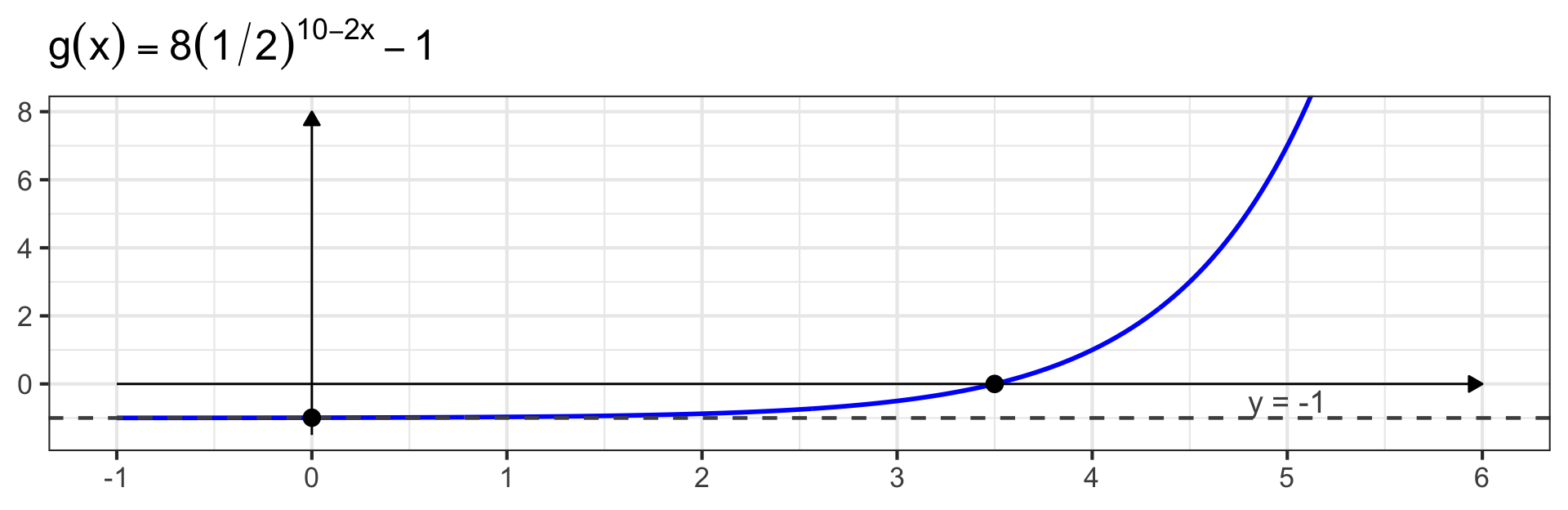
Exponential Function Practice
Try It! 1: For \(f\left(x\right) = 3^{x - 2} + 1\), identify the \(y\)-intercept, horizontal asymptote, range, and end behavior. Sketch an approximate graph.
Try It! 2: For \(g\left(x\right) = -\left(\frac{1}{3}\right)^{x+1} + 5\), identify the same features and sketch a graph.
Before sketching: The negative leading coefficient will flip the graph. How does that affect the range and end behavior compared to the basic \(\left(\frac{1}{3}\right)^x\) function?
Inverses of Exponential Functions
Since exponential functions are one-to-one (they pass both the vertical and horizontal line tests), they are invertible. Their inverses are logarithmic functions — which is exactly the connection we’ve been building toward.
Strategy (Reminder): The swap-and-solve method for finding \(f^{-1}\left(x\right)\), given a one-to-one function \(f\left(x\right)\).
- Replace \(f\left(x\right)\) with \(y\).
- Swap \(x\) and \(y\).
- Solve for \(y\) — this will require using logarithms to undo the exponential.
- Replace \(y\) with \(f^{-1}\left(x\right)\).
Finding the Inverse of an Exponential Function I
Example 3: Find the inverse of \(\displaystyle{f\left(x\right) = -2e^{x+3} + 4}\).
Solution. Replace \(f\left(x\right)\) with \(y\), swap, then solve.
\[\begin{align} y &= -2e^{x+3} + 4 \end{align}\]
Finding the Inverse of an Exponential Function I
Example 3: Find the inverse of \(\displaystyle{f\left(x\right) = -2e^{x+3} + 4}\).
Solution. Replace \(f\left(x\right)\) with \(y\), swap, then solve.
\[\begin{align} y &= -2e^{x+3} + 4\\ \stackrel{\text{swap}}{} x &= -2e^{y + 3} + 4 \end{align}\]
Finding the Inverse of an Exponential Function I
Example 3: Find the inverse of \(\displaystyle{f\left(x\right) = -2e^{x+3} + 4}\).
Solution. Replace \(f\left(x\right)\) with \(y\), swap, then solve.
\[\begin{align} y &= -2e^{x+3} + 4\\ \stackrel{\text{swap}}{} x &= -2e^{y + 3} + 4\\ \implies -2e^{y + 3} &= x - 4 \end{align}\]
Finding the Inverse of an Exponential Function I
Example 3: Find the inverse of \(\displaystyle{f\left(x\right) = -2e^{x+3} + 4}\).
Solution. Replace \(f\left(x\right)\) with \(y\), swap, then solve.
\[\begin{align} y &= -2e^{x+3} + 4\\ \stackrel{\text{swap}}{} x &= -2e^{y + 3} + 4\\ \implies -2e^{y + 3} &= x - 4\\ \implies e^{y + 3} &= \frac{x - 4}{-2} \end{align}\]
Finding the Inverse of an Exponential Function I
Example 3: Find the inverse of \(\displaystyle{f\left(x\right) = -2e^{x+3} + 4}\).
Solution. Replace \(f\left(x\right)\) with \(y\), swap, then solve.
\[\begin{align} y &= -2e^{x+3} + 4\\ \stackrel{\text{swap}}{} x &= -2e^{y + 3} + 4\\ \implies -2e^{y + 3} &= x - 4\\ \implies e^{y + 3} &= \frac{x - 4}{-2}\\ \implies e^{y + 3} &= \frac{4 - x}{2} \end{align}\]
Finding the Inverse of an Exponential Function I
Example 3: Find the inverse of \(\displaystyle{f\left(x\right) = -2e^{x+3} + 4}\).
Solution. Replace \(f\left(x\right)\) with \(y\), swap, then solve.
\[\begin{align} y &= -2e^{x+3} + 4\\ \stackrel{\text{swap}}{} x &= -2e^{y + 3} + 4\\ \implies -2e^{y + 3} &= x - 4\\ \implies e^{y + 3} &= \frac{x - 4}{-2}\\ \implies e^{y + 3} &= \frac{4 - x}{2}\\ \implies \ln\left(e^{y + 3}\right) &= \ln\left(\frac{4 - x}{2}\right) \end{align}\]
Finding the Inverse of an Exponential Function I
Example 3: Find the inverse of \(\displaystyle{f\left(x\right) = -2e^{x+3} + 4}\).
Solution. Replace \(f\left(x\right)\) with \(y\), swap, then solve.
\[\begin{align} y &= -2e^{x+3} + 4\\ \stackrel{\text{swap}}{} x &= -2e^{y + 3} + 4\\ \implies -2e^{y + 3} &= x - 4\\ \implies e^{y + 3} &= \frac{x - 4}{-2}\\ \implies e^{y + 3} &= \frac{4 - x}{2}\\ \implies \ln\left(e^{y + 3}\right) &= \ln\left(\frac{4 - x}{2}\right)\\ \implies \left(y + 3\right) &= \ln\left(\frac{4 - x}{2}\right) \end{align}\]
Finding the Inverse of an Exponential Function I
Example 3: Find the inverse of \(\displaystyle{f\left(x\right) = -2e^{x+3} + 4}\).
Solution. Replace \(f\left(x\right)\) with \(y\), swap, then solve.
\[\begin{align} y &= -2e^{x+3} + 4\\ \stackrel{\text{swap}}{} x &= -2e^{y + 3} + 4\\ \implies -2e^{y + 3} &= x - 4\\ \implies e^{y + 3} &= \frac{x - 4}{-2}\\ \implies e^{y + 3} &= \frac{4 - x}{2}\\ \implies \ln\left(e^{y + 3}\right) &= \ln\left(\frac{4 - x}{2}\right)\\ \implies \left(y + 3\right) &= \ln\left(\frac{4 - x}{2}\right)\\ \implies y &= \ln\left(\frac{4 - x}{2}\right) - 3 \end{align}\]
So \(\boxed{~\displaystyle{f^{-1}\left(x\right) = \ln\left(\frac{4 - x}{2}\right) - 3}~}\).
Finding the Inverse of an Exponential Function II
Example 4: Find the inverse of \(\displaystyle{g\left(x\right) = 8\left(\frac{1}{2}\right)^{10-2x} - 1}\).
Solution.
\[\begin{align} y &= 8\left(\frac{1}{2}\right)^{10-2x} - 1 \end{align}\]
Finding the Inverse of an Exponential Function II
Example 4: Find the inverse of \(\displaystyle{g\left(x\right) = 8\left(\frac{1}{2}\right)^{10-2x} - 1}\).
Solution.
\[\begin{align} y &= 8\left(\frac{1}{2}\right)^{10-2x} - 1\\ \stackrel{\text{swap}}{} x &= 8\left(\frac{1}{2}\right)^{10 - 2y} - 1 \end{align}\]
Finding the Inverse of an Exponential Function II
Example 4: Find the inverse of \(\displaystyle{g\left(x\right) = 8\left(\frac{1}{2}\right)^{10-2x} - 1}\).
Solution.
\[\begin{align} y &= 8\left(\frac{1}{2}\right)^{10-2x} - 1\\ \stackrel{\text{swap}}{} x &= 8\left(\frac{1}{2}\right)^{10 - 2y} - 1\\ \implies 8\left(\frac{1}{2}\right)^{10 - 2y} &= x + 1 \end{align}\]
Finding the Inverse of an Exponential Function II
Example 4: Find the inverse of \(\displaystyle{g\left(x\right) = 8\left(\frac{1}{2}\right)^{10-2x} - 1}\).
Solution.
\[\begin{align} y &= 8\left(\frac{1}{2}\right)^{10-2x} - 1\\ \stackrel{\text{swap}}{} x &= 8\left(\frac{1}{2}\right)^{10 - 2y} - 1\\ \implies 8\left(\frac{1}{2}\right)^{10 - 2y} &= x + 1\\ \implies \left(\frac{1}{2}\right)^{10 - 2y} &= \frac{x + 1}{8} \end{align}\]
Finding the Inverse of an Exponential Function II
Example 4: Find the inverse of \(\displaystyle{g\left(x\right) = 8\left(\frac{1}{2}\right)^{10-2x} - 1}\).
Solution.
\[\begin{align} y &= 8\left(\frac{1}{2}\right)^{10-2x} - 1\\ \stackrel{\text{swap}}{} x &= 8\left(\frac{1}{2}\right)^{10 - 2y} - 1\\ \implies 8\left(\frac{1}{2}\right)^{10 - 2y} &= x + 1\\ \implies \left(\frac{1}{2}\right)^{10 - 2y} &= \frac{x + 1}{8}\\ \implies \ln\left(\left(\frac{1}{2}\right)^{10 - 2y}\right) &= \ln\left(\frac{x + 1}{8}\right) \end{align}\]
Finding the Inverse of an Exponential Function II
Example 4: Find the inverse of \(\displaystyle{g\left(x\right) = 8\left(\frac{1}{2}\right)^{10-2x} - 1}\).
Solution.
\[\begin{align} y &= 8\left(\frac{1}{2}\right)^{10-2x} - 1\\ \stackrel{\text{swap}}{} x &= 8\left(\frac{1}{2}\right)^{10 - 2y} - 1\\ \implies 8\left(\frac{1}{2}\right)^{10 - 2y} &= x + 1\\ \implies \left(\frac{1}{2}\right)^{10 - 2y} &= \frac{x + 1}{8}\\ \implies \ln\left(\left(\frac{1}{2}\right)^{10 - 2y}\right) &= \ln\left(\frac{x + 1}{8}\right)\\ \implies \left(10 - 2y\right)\ln\left(\frac{1}{2}\right) &= \ln\left(\frac{x + 1}{8}\right) \end{align}\]
Finding the Inverse of an Exponential Function II
Example 4: Find the inverse of \(\displaystyle{g\left(x\right) = 8\left(\frac{1}{2}\right)^{10-2x} - 1}\).
Solution.
\[\begin{align} y &= 8\left(\frac{1}{2}\right)^{10-2x} - 1\\ \stackrel{\text{swap}}{} x &= 8\left(\frac{1}{2}\right)^{10 - 2y} - 1\\ \implies 8\left(\frac{1}{2}\right)^{10 - 2y} &= x + 1\\ \implies \left(\frac{1}{2}\right)^{10 - 2y} &= \frac{x + 1}{8}\\ \implies \ln\left(\left(\frac{1}{2}\right)^{10 - 2y}\right) &= \ln\left(\frac{x + 1}{8}\right)\\ \implies \left(10 - 2y\right)\ln\left(\frac{1}{2}\right) &= \ln\left(\frac{x + 1}{8}\right)\\ \implies 10 - 2y &= \frac{\ln\left(\frac{x + 1}{8}\right)}{\ln\left(1/2\right)} \end{align}\]
\[\begin{align} \implies -2y &= \frac{\ln\left(\frac{x + 1}{8}\right)}{\ln\left(1/2\right)} - 10 \end{align}\]
Finding the Inverse of an Exponential Function II
Example 4: Find the inverse of \(\displaystyle{g\left(x\right) = 8\left(\frac{1}{2}\right)^{10-2x} - 1}\).
Solution.
\[\begin{align} y &= 8\left(\frac{1}{2}\right)^{10-2x} - 1\\ \stackrel{\text{swap}}{} x &= 8\left(\frac{1}{2}\right)^{10 - 2y} - 1\\ \implies 8\left(\frac{1}{2}\right)^{10 - 2y} &= x + 1\\ \implies \left(\frac{1}{2}\right)^{10 - 2y} &= \frac{x + 1}{8}\\ \implies \ln\left(\left(\frac{1}{2}\right)^{10 - 2y}\right) &= \ln\left(\frac{x + 1}{8}\right)\\ \implies \left(10 - 2y\right)\ln\left(\frac{1}{2}\right) &= \ln\left(\frac{x + 1}{8}\right)\\ \implies 10 - 2y &= \frac{\ln\left(\frac{x + 1}{8}\right)}{\ln\left(1/2\right)} \end{align}\]
\[\begin{align} \implies -2y &= \frac{\ln\left(\frac{x + 1}{8}\right)}{\ln\left(1/2\right)} - 10\\ \implies y &= \frac{\frac{\ln\left(\frac{x + 1}{8}\right)}{\ln\left(1/2\right)} - 10}{-2} \end{align}\]
Finding the Inverse of an Exponential Function II
Example 4: Find the inverse of \(\displaystyle{g\left(x\right) = 8\left(\frac{1}{2}\right)^{10-2x} - 1}\).
Solution.
\[\begin{align} y &= 8\left(\frac{1}{2}\right)^{10-2x} - 1\\ \stackrel{\text{swap}}{} x &= 8\left(\frac{1}{2}\right)^{10 - 2y} - 1\\ \implies 8\left(\frac{1}{2}\right)^{10 - 2y} &= x + 1\\ \implies \left(\frac{1}{2}\right)^{10 - 2y} &= \frac{x + 1}{8}\\ \implies \ln\left(\left(\frac{1}{2}\right)^{10 - 2y}\right) &= \ln\left(\frac{x + 1}{8}\right)\\ \implies \left(10 - 2y\right)\ln\left(\frac{1}{2}\right) &= \ln\left(\frac{x + 1}{8}\right)\\ \implies 10 - 2y &= \frac{\ln\left(\frac{x + 1}{8}\right)}{\ln\left(1/2\right)} \end{align}\]
\[\begin{align} \implies -2y &= \frac{\ln\left(\frac{x + 1}{8}\right)}{\ln\left(1/2\right)} - 10\\ \implies y &= \frac{\frac{\ln\left(\frac{x + 1}{8}\right)}{\ln\left(1/2\right)} - 10}{-2}\\ \implies y &= 5 - \frac{\ln\left(\frac{x + 1}{8}\right)}{2\ln\left(\frac{1}{2}\right)} \end{align}\]
Finding the Inverse of an Exponential Function II
Example 4: Find the inverse of \(\displaystyle{g\left(x\right) = 8\left(\frac{1}{2}\right)^{10-2x} - 1}\).
Solution.
\[\begin{align} y &= 8\left(\frac{1}{2}\right)^{10-2x} - 1\\ \stackrel{\text{swap}}{} x &= 8\left(\frac{1}{2}\right)^{10 - 2y} - 1\\ \implies 8\left(\frac{1}{2}\right)^{10 - 2y} &= x + 1\\ \implies \left(\frac{1}{2}\right)^{10 - 2y} &= \frac{x + 1}{8}\\ \implies \ln\left(\left(\frac{1}{2}\right)^{10 - 2y}\right) &= \ln\left(\frac{x + 1}{8}\right)\\ \implies \left(10 - 2y\right)\ln\left(\frac{1}{2}\right) &= \ln\left(\frac{x + 1}{8}\right)\\ \implies 10 - 2y &= \frac{\ln\left(\frac{x + 1}{8}\right)}{\ln\left(1/2\right)} \end{align}\]
\[\begin{align} \implies -2y &= \frac{\ln\left(\frac{x + 1}{8}\right)}{\ln\left(1/2\right)} - 10\\ \implies y &= \frac{\frac{\ln\left(\frac{x + 1}{8}\right)}{\ln\left(1/2\right)} - 10}{-2}\\ \implies y &= 5 - \frac{\ln\left(\frac{x + 1}{8}\right)}{2\ln\left(\frac{1}{2}\right)} \end{align}\]
So \(\boxed{~\displaystyle{f^{-1}\left(x\right) = 5 - \frac{\ln\left(\frac{x + 1}{8}\right)}{2\ln\left(\frac{1}{2}\right)}}~}\)
Using the change of base formula simplifies the function form slightly to \(\boxed{~\displaystyle{f^{-1}\left(x\right) = 5 - \frac{1}{2}\log_{1/2}\left(\frac{x + 1}{8}\right)}~}\)
Inverse Practice
Try It! 3: Find the inverse of \(f\left(x\right) = 3^{x-2} + 1\) from Try It! 1. State the domain of \(f^{-1}\).
Try It! 4: Find the inverse of \(g\left(x\right) = -\left(\frac{1}{3}\right)^{x+1} + 5\) from Try It! 2. State the domain of \(g^{-1}\).
Compound Interest
Definition: If \(P\) dollars (the principal) earns interest at annual rate \(r\), compounded \(n\) times per year, then the account value after \(t\) years is:
\[A = P\left(1 + \frac{r}{n}\right)^{nt}\]
Continuous compounding is the limiting case as \(n \to \infty\). Using the definition of \(e\), this gives:
\[A = Pe^{rt}\]
The factor \(e^{rt}\) is why the natural exponential appears so frequently in finance and science — it is what exponential growth looks like when compounding happens at every instant.
Application to Compound Interest
Problem: $1,000 is deposited into an account earning 2% annual interest.
\(\left(a\right)\) Find the account value after 5 years if interest is compounded quarterly.
\(\left(b\right)\) Find the account value after 5 years if interest is compounded continuously.
(a) Quarterly (\(n = 4\), \(P = 1000\), \(r = 0.02\), \(t = 5\)):
\[\begin{align} A &= 1000\left(1 + \frac{0.02}{4}\right)^{4 \cdot 5}\\ &= 1000\left(1.005\right)^{20}\\ &\approx \boxed{~\$1{,}104.90~} \end{align}\]
(b) Continuous (\(P = 1000\), \(r = 0.02\), \(t = 5\)):
\[\begin{align} A &= 1000 \cdot e^{0.02 \cdot 5}\\ &= 1000 \cdot e^{0.1}\\ &\approx \boxed{~\$1{,}105.17~} \end{align}\]
The difference after 5 years is about 27 cents.
Investment Doubling Time
Problem: How long does it take to double the initial $1,000 investment under each compounding method?
(a) Quarterly: Solve \(2000 = 1000\left(1.005\right)^{4t}\).
\[\begin{align} 2 &= \left(1.005\right)^{4t}\\ \implies \ln\left(2\right) &= 4t \cdot \ln\left(1.005\right)\\ \implies t &= \frac{\ln\left(2\right)}{4\ln\left(1.005\right)}\\ &\approx \boxed{~34.74 \text{ years}~} \end{align}\]
(b) Continuous: Solve \(2000 = 1000e^{0.02t}\).
\[\begin{align} 2 &= e^{0.02t}\\ \implies \ln\left(2\right) &= 0.02t\\ \implies t &= \frac{\ln\left(2\right)}{0.02}\\ &\approx \boxed{~34.66 \text{ years}~} \end{align}\]
The difference is less than two weeks over a 35-year investment. At low interest rates, continuous compounding sounds much better than it actually is.
The Rule of 72
A useful approximation: dividing \(72\) by the annual interest rate (as a percentage) gives the approximate doubling time in years. At 2%, that’s \(72/2 = 36\) years — close to our exact answer of ~34.7.
Application to Carbon Dating
Try It! 5: Carbon-14 is a radioactive isotope used in archaeological dating. It decays according to \(\displaystyle{A = A_0 \left(\frac{1}{2}\right)^{t/5730}}\), where \(A_0\) is the initial amount and \(t\) is time in years. A bone fragment is found to contain \(40\%\) of its original carbon-14. How old is the fragment? Round to the nearest year.
Try It! 6: Using the same decay model, what percentage of the original carbon-14 remains in a sample after \(2{,}000\) years? Round to the nearest hundredth of a percent.
Exit Ticket Task
Navigate to our MAT142 Exit Ticket Form, answer the questions, and complete the task below.
Note. Today’s discussion is listed as 17. Exponential Functions and Equations

Task: Consider \(h\left(x\right) = 4e^{x - 2} - 3\).
\(\left(a\right)\) Find the \(y\)-intercept, horizontal asymptote, and range.
\(\left(b\right)\) Find \(h^{-1}\!\left(x\right)\) and state its domain.
Summary and Next Time…
- \(f\left(x\right) = a^x\) is the exponential book function. Domain: all reals. Range: \(\left(0, \infty\right)\). Asymptote: \(y = 0\). \(y\)-intercept: \(\left(0, 1\right)\).
- If \(a > 1\): increasing. If \(0 < a < 1\): decreasing.
- Transformations shift the asymptote, change the range, and alter end behavior in predictable ways.
- The inverse of \(f\left(x\right) = a^x\) is \(f^{-1}\left(x\right) = \log_a\left(x\right)\)
- Use the swap and solve method to construct function inverses.
- Exponential functions are involved in many applications involving growth or decay.
- Next class we do the same analysis for logarithmic functions — graphs, transformations, inverses, and applications.
- Since logarithmic and exponential functions are inverses, their graphs are reflections of each other across \(y = x\). Everything we learned today carries over directly.
Logarithmic Functions
Continue Homework 11 on MyOpenMath