MAT 142: Radical Functions and Equations
July 28, 2026
More Domains of Radical Functions
Example 3: Find the domain of the radical function \(\displaystyle{f\left(x\right) = \left(x^2 -5x - 14\right)^{1/8}}\)
Solution.
Since the root is even order (8th root), we need to consider domain restrictions.
The function \(f\left(x\right)\) will only be defined when \(x^2 - 5x - 14 \geq 0\).
We’ll start by finding the boundary values where \(x^2 - 5x - 14 = 0\).
\[\begin{align} x^2 - 5x - 14 &= 0\\ \implies \left(x - 7\right)\left(x + 2\right) &= 0\\ \implies x = 7 &\text{ or } x = -2 \end{align}\]
The analysis above results in three sub-intervals where the expression under the root is not zero: \(\left(-\infty, -2\right)\), \(\left(-2, 7\right)\), and \(\left(7, \infty\right)\).

More Domains of Radical Functions
Example 3: Find the domain of the radical function \(\displaystyle{f\left(x\right) = \left(x^2 -5x - 14\right)^{1/8}}\)
Solution.
Since the root is even order (8th root), we need to consider domain restrictions.
The function \(f\left(x\right)\) will only be defined when \(x^2 - 5x - 14 \geq 0\).
We’ll start by finding the boundary values where \(x^2 - 5x - 14 = 0\).
\[\begin{align} x^2 - 5x - 14 &= 0\\ \implies \left(x - 7\right)\left(x + 2\right) &= 0\\ \implies x = 7 &\text{ or } x = -2 \end{align}\]
Can either evaluate the sign (positive/negative) from \(x^2 - 5x - 14\) or \(\left(x - 7\right)\left(x + 2\right)\).
The analysis above results in three sub-intervals where the expression under the root is not zero: \(\left(-\infty, -2\right)\), \(\left(-2, 7\right)\), and \(\left(7, \infty\right)\).

More Domains of Radical Functions
Example 3: Find the domain of the radical function \(\displaystyle{f\left(x\right) = \left(x^2 -5x - 14\right)^{1/8}}\)
Solution.
Since the root is even order (8th root), we need to consider domain restrictions.
The function \(f\left(x\right)\) will only be defined when \(x^2 - 5x - 14 \geq 0\).
We’ll start by finding the boundary values where \(x^2 - 5x - 14 = 0\).
\[\begin{align} x^2 - 5x - 14 &= 0\\ \implies \left(x - 7\right)\left(x + 2\right) &= 0\\ \implies x = 7 &\text{ or } x = -2 \end{align}\]
Can either evaluate the sign (positive/negative) from \(x^2 - 5x - 14\) or \(\left(x - 7\right)\left(x + 2\right)\).
The analysis above results in three sub-intervals where the expression under the root is not zero: \(\left(-\infty, -2\right)\), \(\left(-2, 7\right)\), and \(\left(7, \infty\right)\).

More Domains of Radical Functions
Example 3: Find the domain of the radical function \(\displaystyle{f\left(x\right) = \left(x^2 -5x - 14\right)^{1/8}}\)
Solution.
Since the root is even order (8th root), we need to consider domain restrictions.
The function \(f\left(x\right)\) will only be defined when \(x^2 - 5x - 14 \geq 0\).
We’ll start by finding the boundary values where \(x^2 - 5x - 14 = 0\).
\[\begin{align} x^2 - 5x - 14 &= 0\\ \implies \left(x - 7\right)\left(x + 2\right) &= 0\\ \implies x = 7 &\text{ or } x = -2 \end{align}\]
Can either evaluate the sign (positive/negative) from \(x^2 - 5x - 14\) or \(\left(x - 7\right)\left(x + 2\right)\).
The analysis above results in three sub-intervals where the expression under the root is not zero: \(\left(-\infty, -2\right)\), \(\left(-2, 7\right)\), and \(\left(7, \infty\right)\).

More Domains of Radical Functions
Example 3: Find the domain of the radical function \(\displaystyle{f\left(x\right) = \left(x^2 -5x - 14\right)^{1/8}}\)
Solution.
Since the root is even order (8th root), we need to consider domain restrictions.
The function \(f\left(x\right)\) will only be defined when \(x^2 - 5x - 14 \geq 0\).
We’ll start by finding the boundary values where \(x^2 - 5x - 14 = 0\).
\[\begin{align} x^2 - 5x - 14 &= 0\\ \implies \left(x - 7\right)\left(x + 2\right) &= 0\\ \implies x = 7 &\text{ or } x = -2 \end{align}\]
Can either evaluate the sign (positive/negative) from \(x^2 - 5x - 14\) or \(\left(x - 7\right)\left(x + 2\right)\).
The analysis above results in three sub-intervals where the expression under the root is not zero: \(\left(-\infty, -2\right)\), \(\left(-2, 7\right)\), and \(\left(7, \infty\right)\).

More Domains of Radical Functions
Example 3: Find the domain of the radical function \(\displaystyle{f\left(x\right) = \left(x^2 -5x - 14\right)^{1/8}}\)
Solution.
Since the root is even order (8th root), we need to consider domain restrictions.
The function \(f\left(x\right)\) will only be defined when \(x^2 - 5x - 14 \geq 0\).
We’ll start by finding the boundary values where \(x^2 - 5x - 14 = 0\).
\[\begin{align} x^2 - 5x - 14 &= 0\\ \implies \left(x - 7\right)\left(x + 2\right) &= 0\\ \implies x = 7 &\text{ or } x = -2 \end{align}\]
Can either evaluate the sign (positive/negative) from \(x^2 - 5x - 14\) or \(\left(x - 7\right)\left(x + 2\right)\).
The analysis above results in three sub-intervals where the expression under the root is not zero: \(\left(-\infty, -2\right)\), \(\left(-2, 7\right)\), and \(\left(7, \infty\right)\).

More Domains of Radical Functions
Example 3: Find the domain of the radical function \(\displaystyle{f\left(x\right) = \left(x^2 -5x - 14\right)^{1/8}}\)
Solution.
Since the root is even order (8th root), we need to consider domain restrictions.
The function \(f\left(x\right)\) will only be defined when \(x^2 - 5x - 14 \geq 0\).
We’ll start by finding the boundary values where \(x^2 - 5x - 14 = 0\).
\[\begin{align} x^2 - 5x - 14 &= 0\\ \implies \left(x - 7\right)\left(x + 2\right) &= 0\\ \implies x = 7 &\text{ or } x = -2 \end{align}\]
Can either evaluate the sign (positive/negative) from \(x^2 - 5x - 14\) or \(\left(x - 7\right)\left(x + 2\right)\).
The analysis above results in three sub-intervals where the expression under the root is not zero: \(\left(-\infty, -2\right)\), \(\left(-2, 7\right)\), and \(\left(7, \infty\right)\).

More Domains of Radical Functions
Example 3: Find the domain of the radical function \(\displaystyle{f\left(x\right) = \left(x^2 -5x - 14\right)^{1/8}}\)
Solution.
Since the root is even order (8th root), we need to consider domain restrictions.
The function \(f\left(x\right)\) will only be defined when \(x^2 - 5x - 14 \geq 0\).
We’ll start by finding the boundary values where \(x^2 - 5x - 14 = 0\).
\[\begin{align} x^2 - 5x - 14 &= 0\\ \implies \left(x - 7\right)\left(x + 2\right) &= 0\\ \implies x = 7 &\text{ or } x = -2 \end{align}\]
Can either evaluate the sign (positive/negative) from \(x^2 - 5x - 14\) or \(\left(x - 7\right)\left(x + 2\right)\).
Domain: \(\boxed{~\left(-\infty, -2\right]\cup \left[7, \infty\right)~}\)
The analysis above results in three sub-intervals where the expression under the root is not zero: \(\left(-\infty, -2\right)\), \(\left(-2, 7\right)\), and \(\left(7, \infty\right)\).

More Domains of Radical Functions
Example 4: Find the domain of the radical function \(\displaystyle{g\left(x\right) = \left(\left(x + 5\right)\left(x + 1\right)\left(x - 2\right)^2\left(x - 6\right)\right)^{1/2}}\)
Solution.
Again, we need the expression under the root to be non-negative.
Notice that the boundary values (the \(x\)-values resulting in \(0\) under the radical) are \(x = -5\), \(-1\), \(2\), and \(6\)
We’ll draw a number line and conduct the sign analysis.

More Domains of Radical Functions
Example 4: Find the domain of the radical function \(\displaystyle{g\left(x\right) = \left(\left(x + 5\right)\left(x + 1\right)\left(x - 2\right)^2\left(x - 6\right)\right)^{1/2}}\)
Solution.
Again, we need the expression under the root to be non-negative.
Notice that the boundary values (the \(x\)-values resulting in \(0\) under the radical) are \(x = -5\), \(-1\), \(2\), and \(6\)
We’ll draw a number line and conduct the sign analysis.

More Domains of Radical Functions
Example 4: Find the domain of the radical function \(\displaystyle{g\left(x\right) = \left(\left(x + 5\right)\left(x + 1\right)\left(x - 2\right)^2\left(x - 6\right)\right)^{1/2}}\)
Solution.
Again, we need the expression under the root to be non-negative.
Notice that the boundary values (the \(x\)-values resulting in \(0\) under the radical) are \(x = -5\), \(-1\), \(2\), and \(6\)
We’ll draw a number line and conduct the sign analysis.

More Domains of Radical Functions
Example 4: Find the domain of the radical function \(\displaystyle{g\left(x\right) = \left(\left(x + 5\right)\left(x + 1\right)\left(x - 2\right)^2\left(x - 6\right)\right)^{1/2}}\)
Solution.
Again, we need the expression under the root to be non-negative.
Notice that the boundary values (the \(x\)-values resulting in \(0\) under the radical) are \(x = -5\), \(-1\), \(2\), and \(6\)
We’ll draw a number line and conduct the sign analysis.

More Domains of Radical Functions
Example 4: Find the domain of the radical function \(\displaystyle{g\left(x\right) = \left(\left(x + 5\right)\left(x + 1\right)\left(x - 2\right)^2\left(x - 6\right)\right)^{1/2}}\)
Solution.
Again, we need the expression under the root to be non-negative.
Notice that the boundary values (the \(x\)-values resulting in \(0\) under the radical) are \(x = -5\), \(-1\), \(2\), and \(6\)
We’ll draw a number line and conduct the sign analysis.

More Domains of Radical Functions
Example 4: Find the domain of the radical function \(\displaystyle{g\left(x\right) = \left(\left(x + 5\right)\left(x + 1\right)\left(x - 2\right)^2\left(x - 6\right)\right)^{1/2}}\)
Solution.
Again, we need the expression under the root to be non-negative.
Notice that the boundary values (the \(x\)-values resulting in \(0\) under the radical) are \(x = -5\), \(-1\), \(2\), and \(6\)
We’ll draw a number line and conduct the sign analysis.

More Domains of Radical Functions
Example 4: Find the domain of the radical function \(\displaystyle{g\left(x\right) = \left(\left(x + 5\right)\left(x + 1\right)\left(x - 2\right)^2\left(x - 6\right)\right)^{1/2}}\)
Solution.
Again, we need the expression under the root to be non-negative.
Notice that the boundary values (the \(x\)-values resulting in \(0\) under the radical) are \(x = -5\), \(-1\), \(2\), and \(6\)
We’ll draw a number line and conduct the sign analysis.

More Domains of Radical Functions
Example 4: Find the domain of the radical function \(\displaystyle{g\left(x\right) = \left(\left(x + 5\right)\left(x + 1\right)\left(x - 2\right)^2\left(x - 6\right)\right)^{1/2}}\)
Solution.
Again, we need the expression under the root to be non-negative.
Notice that the boundary values (the \(x\)-values resulting in \(0\) under the radical) are \(x = -5\), \(-1\), \(2\), and \(6\)
We’ll draw a number line and conduct the sign analysis.

More Domains of Radical Functions
Example 4: Find the domain of the radical function \(\displaystyle{g\left(x\right) = \left(\left(x + 5\right)\left(x + 1\right)\left(x - 2\right)^2\left(x - 6\right)\right)^{1/2}}\)
Solution.
Again, we need the expression under the root to be non-negative.
Notice that the boundary values (the \(x\)-values resulting in \(0\) under the radical) are \(x = -5\), \(-1\), \(2\), and \(6\)
We’ll draw a number line and conduct the sign analysis.

More Domains of Radical Functions
Example 4: Find the domain of the radical function \(\displaystyle{g\left(x\right) = \left(\left(x + 5\right)\left(x + 1\right)\left(x - 2\right)^2\left(x - 6\right)\right)^{1/2}}\)
Solution.
Again, we need the expression under the root to be non-negative.
Notice that the boundary values (the \(x\)-values resulting in \(0\) under the radical) are \(x = -5\), \(-1\), \(2\), and \(6\)
We’ll draw a number line and conduct the sign analysis.

More Domains of Radical Functions
Example 4: Find the domain of the radical function \(\displaystyle{g\left(x\right) = \left(\left(x + 5\right)\left(x + 1\right)\left(x - 2\right)^2\left(x - 6\right)\right)^{1/2}}\)
Solution.
Again, we need the expression under the root to be non-negative.
Notice that the boundary values (the \(x\)-values resulting in \(0\) under the radical) are \(x = -5\), \(-1\), \(2\), and \(6\)
We’ll draw a number line and conduct the sign analysis.

More Domains of Radical Functions
Example 4: Find the domain of the radical function \(\displaystyle{g\left(x\right) = \left(\left(x + 5\right)\left(x + 1\right)\left(x - 2\right)^2\left(x - 6\right)\right)^{1/2}}\)
Solution.
Again, we need the expression under the root to be non-negative.
Notice that the boundary values (the \(x\)-values resulting in \(0\) under the radical) are \(x = -5\), \(-1\), \(2\), and \(6\)
We’ll draw a number line and conduct the sign analysis.

More Domains of Radical Functions
Example 4: Find the domain of the radical function \(\displaystyle{g\left(x\right) = \left(\left(x + 5\right)\left(x + 1\right)\left(x - 2\right)^2\left(x - 6\right)\right)^{1/2}}\)
Solution.
Again, we need the expression under the root to be non-negative.
Notice that the boundary values (the \(x\)-values resulting in \(0\) under the radical) are \(x = -5\), \(-1\), \(2\), and \(6\)
We’ll draw a number line and conduct the sign analysis.

More Domains of Radical Functions
Example 4: Find the domain of the radical function \(\displaystyle{g\left(x\right) = \left(\left(x + 5\right)\left(x + 1\right)\left(x - 2\right)^2\left(x - 6\right)\right)^{1/2}}\)
Solution.
Again, we need the expression under the root to be non-negative.
Notice that the boundary values (the \(x\)-values resulting in \(0\) under the radical) are \(x = -5\), \(-1\), \(2\), and \(6\)
We’ll draw a number line and conduct the sign analysis.

More Domains of Radical Functions
Example 4: Find the domain of the radical function \(\displaystyle{g\left(x\right) = \left(\left(x + 5\right)\left(x + 1\right)\left(x - 2\right)^2\left(x - 6\right)\right)^{1/2}}\)
Solution.
Again, we need the expression under the root to be non-negative.
Notice that the boundary values (the \(x\)-values resulting in \(0\) under the radical) are \(x = -5\), \(-1\), \(2\), and \(6\)
We’ll draw a number line and conduct the sign analysis.

All of the boundary values and the segments corresponding to positive values under the radical are included in the domain.
We’ll use \(\{2\}\) to indicate the single value \(2\) when we write the domain.
Domain: \(\boxed{~\left[-5, -1\right]\cup\left\{2\right\}\cup\left[6, \infty\right)~}\)
Note. As seen here, intervals won’t necessarily alternate signs. Test them all.
Analysis of Radical Functions I
Example 5: Find the domain, roots, \(y\)-intercept, and end behavior of \(\displaystyle{f\left(x\right) = \sqrt{\left(x^2 - 11x - 26\right)}}\). Use your results to sketch the graph of \(f\left(x\right)\)
Solution.
Since the index is \(2\) (even), we need \(x^2 - 11x - 26 \geq 0\).
Step 1: Find roots of \(x^2 - 11x - 26 = 0\).
\[\begin{align} x^2 - 11x - 26 &= 0\\ \implies \left(x - 13\right)\left(x + 2\right) &= 0\\ \implies x = 13 &\text{ or } x = -2 \end{align}\]
Step 2: These roots create three intervals
\(\left(-\infty, -2\right)\), \(\left(-2, 13\right)\), and \(\left(13, \infty\right)\)

Analysis of Radical Functions I
Example 5: Find the domain, roots, \(y\)-intercept, and end behavior of \(\displaystyle{f\left(x\right) = \sqrt{\left(x^2 - 11x - 26\right)}}\). Use your results to sketch the graph of \(f\left(x\right)\)
Solution.
Since the index is \(2\) (even), we need \(x^2 - 11x - 26 \geq 0\).
Step 1: Find roots of \(x^2 - 11x - 26 = 0\).
\[\begin{align} x^2 - 11x - 26 &= 0\\ \implies \left(x - 13\right)\left(x + 2\right) &= 0\\ \implies x = 13 &\text{ or } x = -2 \end{align}\]
Step 2: These roots create three intervals
\(\left(-\infty, -2\right)\), \(\left(-2, 13\right)\), and \(\left(13, \infty\right)\)

Analysis of Radical Functions I
Example 5: Find the domain, roots, \(y\)-intercept, and end behavior of \(\displaystyle{f\left(x\right) = \sqrt{\left(x^2 - 11x - 26\right)}}\). Use your results to sketch the graph of \(f\left(x\right)\)
Solution.
Since the index is \(2\) (even), we need \(x^2 - 11x - 26 \geq 0\).
Step 1: Find roots of \(x^2 - 11x - 26 = 0\).
\[\begin{align} x^2 - 11x - 26 &= 0\\ \implies \left(x - 13\right)\left(x + 2\right) &= 0\\ \implies x = 13 &\text{ or } x = -2 \end{align}\]
Step 2: These roots create three intervals
\(\left(-\infty, -2\right)\), \(\left(-2, 13\right)\), and \(\left(13, \infty\right)\)
Step 3: Test one point in each interval.

Analysis of Radical Functions I
Example 5: Find the domain, roots, \(y\)-intercept, and end behavior of \(\displaystyle{f\left(x\right) = \sqrt{\left(x^2 - 11x - 26\right)}}\). Use your results to sketch the graph of \(f\left(x\right)\)
Solution.
Since the index is \(2\) (even), we need \(x^2 - 11x - 26 \geq 0\).
Step 1: Find roots of \(x^2 - 11x - 26 = 0\).
\[\begin{align} x^2 - 11x - 26 &= 0\\ \implies \left(x - 13\right)\left(x + 2\right) &= 0\\ \implies x = 13 &\text{ or } x = -2 \end{align}\]
Step 2: These roots create three intervals
\(\left(-\infty, -2\right)\), \(\left(-2, 13\right)\), and \(\left(13, \infty\right)\)
Step 3: Test one point in each interval.
\(\displaystyle{g\left(-10\right) = \left(-10\right)^2 - 11\left(-10\right) - 26}\)

Analysis of Radical Functions I
Example 5: Find the domain, roots, \(y\)-intercept, and end behavior of \(\displaystyle{f\left(x\right) = \sqrt{\left(x^2 - 11x - 26\right)}}\). Use your results to sketch the graph of \(f\left(x\right)\)
Solution.
Since the index is \(2\) (even), we need \(x^2 - 11x - 26 \geq 0\).
Step 1: Find roots of \(x^2 - 11x - 26 = 0\).
\[\begin{align} x^2 - 11x - 26 &= 0\\ \implies \left(x - 13\right)\left(x + 2\right) &= 0\\ \implies x = 13 &\text{ or } x = -2 \end{align}\]
Step 2: These roots create three intervals
\(\left(-\infty, -2\right)\), \(\left(-2, 13\right)\), and \(\left(13, \infty\right)\)
Step 3: Test one point in each interval.
\(\displaystyle{g\left(-10\right) = \left(100 + 110 - 26\right)}\)

Analysis of Radical Functions I
Example 5: Find the domain, roots, \(y\)-intercept, and end behavior of \(\displaystyle{f\left(x\right) = \sqrt{\left(x^2 - 11x - 26\right)}}\). Use your results to sketch the graph of \(f\left(x\right)\)
Solution.
Since the index is \(2\) (even), we need \(x^2 - 11x - 26 \geq 0\).
Step 1: Find roots of \(x^2 - 11x - 26 = 0\).
\[\begin{align} x^2 - 11x - 26 &= 0\\ \implies \left(x - 13\right)\left(x + 2\right) &= 0\\ \implies x = 13 &\text{ or } x = -2 \end{align}\]
Step 2: These roots create three intervals
\(\left(-\infty, -2\right)\), \(\left(-2, 13\right)\), and \(\left(13, \infty\right)\)
Step 3: Test one point in each interval.
\(\displaystyle{g\left(-10\right) = 184}\)

Analysis of Radical Functions I
Example 5: Find the domain, roots, \(y\)-intercept, and end behavior of \(\displaystyle{f\left(x\right) = \sqrt{\left(x^2 - 11x - 26\right)}}\). Use your results to sketch the graph of \(f\left(x\right)\)
Solution.
Since the index is \(2\) (even), we need \(x^2 - 11x - 26 \geq 0\).
Step 1: Find roots of \(x^2 - 11x - 26 = 0\).
\[\begin{align} x^2 - 11x - 26 &= 0\\ \implies \left(x - 13\right)\left(x + 2\right) &= 0\\ \implies x = 13 &\text{ or } x = -2 \end{align}\]
Step 2: These roots create three intervals
\(\left(-\infty, -2\right)\), \(\left(-2, 13\right)\), and \(\left(13, \infty\right)\)
Step 3: Test one point in each interval.
\(\displaystyle{g\left(-10\right) = 184}\)

Analysis of Radical Functions I
Example 5: Find the domain, roots, \(y\)-intercept, and end behavior of \(\displaystyle{f\left(x\right) = \sqrt{\left(x^2 - 11x - 26\right)}}\). Use your results to sketch the graph of \(f\left(x\right)\)
Solution.
Since the index is \(2\) (even), we need \(x^2 - 11x - 26 \geq 0\).
Step 1: Find roots of \(x^2 - 11x - 26 = 0\).
\[\begin{align} x^2 - 11x - 26 &= 0\\ \implies \left(x - 13\right)\left(x + 2\right) &= 0\\ \implies x = 13 &\text{ or } x = -2 \end{align}\]
Step 2: These roots create three intervals
\(\left(-\infty, -2\right)\), \(\left(-2, 13\right)\), and \(\left(13, \infty\right)\)
Step 3: Test one point in each interval.
\(\displaystyle{g\left(-10\right) = 184}\)
\(\displaystyle{g\left(0\right) = \left(0\right)^2 - 11\left(0\right) - 26}\)

Analysis of Radical Functions I
Example 5: Find the domain, roots, \(y\)-intercept, and end behavior of \(\displaystyle{f\left(x\right) = \sqrt{\left(x^2 - 11x - 26\right)}}\). Use your results to sketch the graph of \(f\left(x\right)\)
Solution.
Since the index is \(2\) (even), we need \(x^2 - 11x - 26 \geq 0\).
Step 1: Find roots of \(x^2 - 11x - 26 = 0\).
\[\begin{align} x^2 - 11x - 26 &= 0\\ \implies \left(x - 13\right)\left(x + 2\right) &= 0\\ \implies x = 13 &\text{ or } x = -2 \end{align}\]
Step 2: These roots create three intervals
\(\left(-\infty, -2\right)\), \(\left(-2, 13\right)\), and \(\left(13, \infty\right)\)
Step 3: Test one point in each interval.
\(\displaystyle{g\left(-10\right) = 184}\)
\(\displaystyle{g\left(0\right) = - 26}\)

Analysis of Radical Functions I
Example 5: Find the domain, roots, \(y\)-intercept, and end behavior of \(\displaystyle{f\left(x\right) = \sqrt{\left(x^2 - 11x - 26\right)}}\). Use your results to sketch the graph of \(f\left(x\right)\)
Solution.
Since the index is \(2\) (even), we need \(x^2 - 11x - 26 \geq 0\).
Step 1: Find roots of \(x^2 - 11x - 26 = 0\).
\[\begin{align} x^2 - 11x - 26 &= 0\\ \implies \left(x - 13\right)\left(x + 2\right) &= 0\\ \implies x = 13 &\text{ or } x = -2 \end{align}\]
Step 2: These roots create three intervals
\(\left(-\infty, -2\right)\), \(\left(-2, 13\right)\), and \(\left(13, \infty\right)\)
Step 3: Test one point in each interval.
\(\displaystyle{g\left(-10\right) = 184}\)
\(\displaystyle{g\left(0\right) = - 26}\)
\(\displaystyle{g\left(15\right) = \left(15\right)^2 - 11\left(15\right) - 26}\)

Analysis of Radical Functions I
Example 5: Find the domain, roots, \(y\)-intercept, and end behavior of \(\displaystyle{f\left(x\right) = \sqrt{\left(x^2 - 11x - 26\right)}}\). Use your results to sketch the graph of \(f\left(x\right)\)
Solution.
Since the index is \(2\) (even), we need \(x^2 - 11x - 26 \geq 0\).
Step 1: Find roots of \(x^2 - 11x - 26 = 0\).
\[\begin{align} x^2 - 11x - 26 &= 0\\ \implies \left(x - 13\right)\left(x + 2\right) &= 0\\ \implies x = 13 &\text{ or } x = -2 \end{align}\]
Step 2: These roots create three intervals
\(\left(-\infty, -2\right)\), \(\left(-2, 13\right)\), and \(\left(13, \infty\right)\)
Step 3: Test one point in each interval.
\(\displaystyle{g\left(-10\right) = 184}\)
\(\displaystyle{g\left(0\right) = - 26}\)
\(\displaystyle{g\left(15\right) = 225 - 165 - 26}\)

Analysis of Radical Functions I
Example 5: Find the domain, roots, \(y\)-intercept, and end behavior of \(\displaystyle{f\left(x\right) = \sqrt{\left(x^2 - 11x - 26\right)}}\). Use your results to sketch the graph of \(f\left(x\right)\)
Solution.
Since the index is \(2\) (even), we need \(x^2 - 11x - 26 \geq 0\).
Step 1: Find roots of \(x^2 - 11x - 26 = 0\).
\[\begin{align} x^2 - 11x - 26 &= 0\\ \implies \left(x - 13\right)\left(x + 2\right) &= 0\\ \implies x = 13 &\text{ or } x = -2 \end{align}\]
Step 2: These roots create three intervals
\(\left(-\infty, -2\right)\), \(\left(-2, 13\right)\), and \(\left(13, \infty\right)\)
Step 3: Test one point in each interval.
\(\displaystyle{g\left(-10\right) = 184}\)
\(\displaystyle{g\left(0\right) = - 26}\)
\(\displaystyle{g\left(15\right) = 34}\)

Analysis of Radical Functions I
Example 5: Find the domain, roots, \(y\)-intercept, and end behavior of \(\displaystyle{f\left(x\right) = \sqrt{\left(x^2 - 11x - 26\right)}}\). Use your results to sketch the graph of \(f\left(x\right)\)
Solution.
Since the index is \(2\) (even), we need \(x^2 - 11x - 26 \geq 0\).
Step 1: Find roots of \(x^2 - 11x - 26 = 0\).
\[\begin{align} x^2 - 11x - 26 &= 0\\ \implies \left(x - 13\right)\left(x + 2\right) &= 0\\ \implies x = 13 &\text{ or } x = -2 \end{align}\]
Step 2: These roots create three intervals
\(\left(-\infty, -2\right)\), \(\left(-2, 13\right)\), and \(\left(13, \infty\right)\)
Step 3: Test one point in each interval.
\(\displaystyle{g\left(-10\right) = 184}\)
\(\displaystyle{g\left(0\right) = - 26}\)
\(\displaystyle{g\left(15\right) = 34}\)
Domain: \(\boxed{~\left(-\infty, -2\right] \cup \left[13, \infty\right)~}\)

Analysis of Radical Functions I
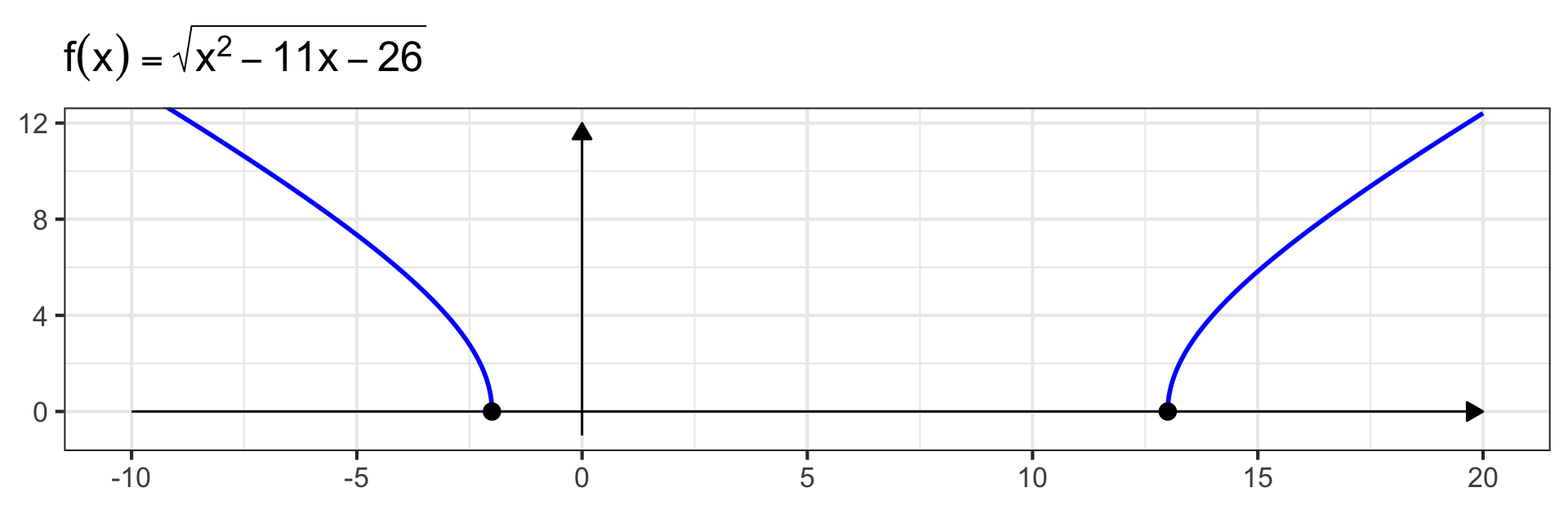
Example 5: Find the domain, roots, \(y\)-intercept, and end behavior of \(\displaystyle{f\left(x\right) = \sqrt{\left(x^2 - 11x - 26\right)}}\). Use your results to sketch the graph of \(f\left(x\right)\)
Solution.
Domain: \(\boxed{~\left(-\infty, -2\right]\cup \left[13, \infty\right)~}\)
Roots: The roots of \(f\left(x\right)\) are at \(\boxed{~\left(-2, 0\right)~}\) and \(\boxed{~\left(13, 0\right)~}\)
\(y\)-intercept: Note that \(x = 0\) is not in the domain of the function. This means that there is no \(y\)-intercept.
End behavior: We’ve found \(\displaystyle{\lim_{x\to -\infty}{f\left(x\right)} = \infty}\) and \(\displaystyle{\lim_{x\to \infty}{f\left(x\right)} = \infty}\)
Analysis of Radical Functions II
Example 6: Find the domain, roots, \(y\)-intercept, and end behavior of \(\displaystyle{g\left(x\right) = \sqrt{\left(16 - x^2\right)}}\). Use your results to sketch the graph of \(g\left(x\right)\).
Solution.
Domain: We’ll start by finding the boundary values.
\[\begin{align} 16 - x^2 &= 0\\ \implies x^2 &= 16\\ \implies x &= \pm 4 \end{align}\]

Analysis of Radical Functions II
Example 6: Find the domain, roots, \(y\)-intercept, and end behavior of \(\displaystyle{g\left(x\right) = \sqrt{\left(16 - x^2\right)}}\). Use your results to sketch the graph of \(g\left(x\right)\).
Solution.
Domain: We’ll start by finding the boundary values.
\[\begin{align} 16 - x^2 &= 0\\ \implies x^2 &= 16\\ \implies x &= \pm 4 \end{align}\]

Analysis of Radical Functions II
Example 6: Find the domain, roots, \(y\)-intercept, and end behavior of \(\displaystyle{g\left(x\right) = \sqrt{\left(16 - x^2\right)}}\). Use your results to sketch the graph of \(g\left(x\right)\).
Solution.
Domain: We’ll start by finding the boundary values.
\[\begin{align} 16 - x^2 &= 0\\ \implies x^2 &= 16\\ \implies x &= \pm 4 \end{align}\]

Analysis of Radical Functions II
Example 6: Find the domain, roots, \(y\)-intercept, and end behavior of \(\displaystyle{g\left(x\right) = \sqrt{\left(16 - x^2\right)}}\). Use your results to sketch the graph of \(g\left(x\right)\).
Solution.
Domain: We’ll start by finding the boundary values.
\[\begin{align} 16 - x^2 &= 0\\ \implies x^2 &= 16\\ \implies x &= \pm 4 \end{align}\]

Analysis of Radical Functions II
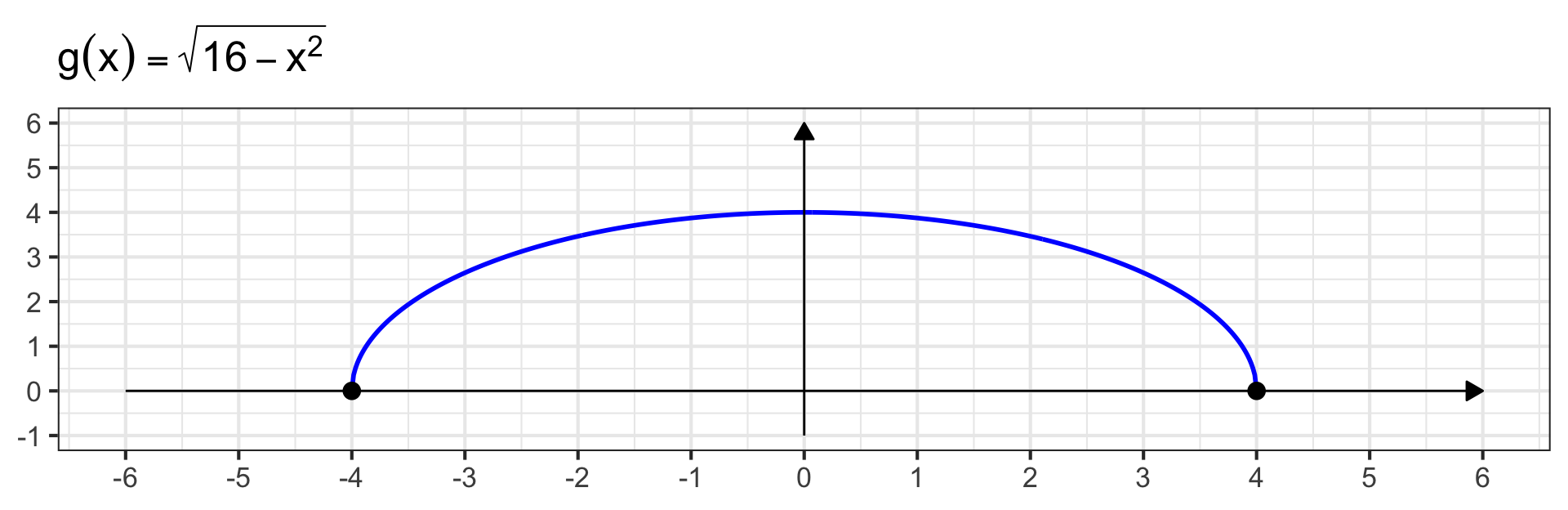
Example 6: Find the domain, roots, \(y\)-intercept, and end behavior of \(\displaystyle{g\left(x\right) = \sqrt{\left(16 - x^2\right)}}\). Use your results to sketch the graph of \(g\left(x\right)\).
Solution.
Domain: \(\left[-4, 4\right]\)
Roots: The roots of \(g\left(x\right)\) are at \(\left(-4, 0 \right)\) and \(\left(4, 0\right)\).
\(y\)-intercept: The \(y\)-intercept of the function is at \(\left(0, 4\right)\).
End Behavior: Not applicable since the domain does not extend toward positive or negative infinity.
Exit Ticket Task
Navigate to our MAT142 Exit Ticket Form, answer the questions, and complete the task below.
Note. Today’s discussion is listed as 15. Radical Functions and Equations

Task: Consider \(\displaystyle{f\left(x\right) = \sqrt{\left(x^2 - 4x - 12\right)}}\).
\(\left(a\right)\) Find the domain of \(f\left(x\right)\) using sign testing.
\(\left(b\right)\) Find any roots and the \(y\)-intercept (if one exists).
\(\left(c\right)\) Sketch a rough graph.