June 8, 2026
At our last meeting, we encountered and utilized two tools for working with polynomials in expanded form:
Try the following warm-up problems.
Problem 1: Use polynomial long division to factor \(p\left(x\right) = x^3 + x^2 - 21x - 45\) and sketch a graph. (Hint: \(\left(x + 3\right)\) is a factor.)
Problem 2: Find the domain of \(\displaystyle{f\left(x\right) = \frac{x^2 - 5x}{x^2 - 25}}\).
Problem 3: Find the domain of \(\displaystyle{f\left(x\right) = \frac{x + 8}{\sqrt{\left(x^2 - 36\right)}}}\).
Note: Problems 2 and 3 both involve domain restrictions, but for different reasons. Think about what makes each one different.
Today we’ll leverage those tools from polynomial functions to analyse rational functions, which are ratios of polynomials.
Rational functions introduce genuinely new geometric features that our previous classes of functions don’t have.
After today’s class meeting, you should be able to:
Definition (Rational Function): A function \(f\left(x\right)\) is a rational function if it can be written as
\[r\left(x\right) = \frac{p\left(x\right)}{q\left(x\right)}\]
where \(p\left(x\right)\) and \(q\left(x\right)\) are polynomials.
A few notes:
Consider the general rational function \(\displaystyle{r\left(x\right) = \frac{p\left(x\right)}{q\left(x\right)}}\)
Domain: Since division by zero is undefined, the domain of \(r\left(x\right)\) excludes all \(x\) where \(q\left(x\right) = 0\).
Roots: A fraction equals zero only when its numerator is zero (and its denominator is not). So roots occur where \(p\left(x\right) = 0\), provided \(q\left(x\right) \neq 0\) at those points.
\(y\)-Intercept: Evaluate \(r\left(0\right)\), provided \(0\) is in the domain. If \(x = 0\) is not a permissible input, then there is no \(y\)-intercept.
Example 1: For \(\displaystyle{r\left(x\right) = \frac{2x^2 - 8x + 6}{x^2 - x - 20}}\), find the domain, roots, and \(y\)-intercept.
Solution.
Domain: Solve \(x^2 - x - 20 \neq 0\).
\[\begin{align} x^2 - x - 20 &\neq 0 \end{align}\]
Example 1: For \(\displaystyle{r\left(x\right) = \frac{2x^2 - 8x + 6}{x^2 - x - 20}}\), find the domain, roots, and \(y\)-intercept.
Solution.
Domain: Solve \(x^2 - x - 20 \neq 0\).
\[\begin{align} x^2 - x - 20 &\neq 0\\ \implies \left(x - 5\right)\left(x + 4\right) &\neq 0 \end{align}\]
Example 1: For \(\displaystyle{r\left(x\right) = \frac{2x^2 - 8x + 6}{x^2 - x - 20}}\), find the domain, roots, and \(y\)-intercept.
Solution.
Domain: Solve \(x^2 - x - 20 \neq 0\).
\[\begin{align} x^2 - x - 20 &\neq 0\\ \implies \left(x - 5\right)\left(x + 4\right) &\neq 0\\ \implies x \neq 5 &\text{ or } x \neq -4 \end{align}\]
Example 1: For \(\displaystyle{r\left(x\right) = \frac{2x^2 - 8x + 6}{x^2 - x - 20}}\), find the domain, roots, and \(y\)-intercept.
Solution.
Domain: Solve \(x^2 - x - 20 \neq 0\).
\[\begin{align} x^2 - x - 20 &\neq 0\\ \implies \left(x - 5\right)\left(x + 4\right) &\neq 0\\ \implies x \neq 5 &\text{ or } x \neq -4 \end{align}\]
So the domain is \(x \neq -4\) and \(x \neq 5\), or \(\boxed{~\left(-\infty, -4\right)\cup\left(-4, 5\right)\cup\left(5, \infty\right)~}\).
Roots: Solve \(\displaystyle{\frac{2x^2 - 8x + 6}{x^2 - x - 20} = 0}\)
\[\begin{align} \frac{2x^2 - 8x + 6}{x^2 - x - 20} &= 0 \end{align}\]
Example 1: For \(\displaystyle{r\left(x\right) = \frac{2x^2 - 8x + 6}{x^2 - x - 20}}\), find the domain, roots, and \(y\)-intercept.
Solution.
Domain: Solve \(x^2 - x - 20 \neq 0\).
\[\begin{align} x^2 - x - 20 &\neq 0\\ \implies \left(x - 5\right)\left(x + 4\right) &\neq 0\\ \implies x \neq 5 &\text{ or } x \neq -4 \end{align}\]
So the domain is \(x \neq -4\) and \(x \neq 5\), or \(\boxed{~\left(-\infty, -4\right)\cup\left(-4, 5\right)\cup\left(5, \infty\right)~}\).
Roots: Solve \(\displaystyle{\frac{2x^2 - 8x + 6}{x^2 - x - 20} = 0}\)
\[\begin{align} \frac{2x^2 - 8x + 6}{x^2 - x - 20} &= 0\\ \implies 2x^2 - 8x + 6 &= 0 \end{align}\]
Example 1: For \(\displaystyle{r\left(x\right) = \frac{2x^2 - 8x + 6}{x^2 - x - 20}}\), find the domain, roots, and \(y\)-intercept.
Solution.
Domain: Solve \(x^2 - x - 20 \neq 0\).
\[\begin{align} x^2 - x - 20 &\neq 0\\ \implies \left(x - 5\right)\left(x + 4\right) &\neq 0\\ \implies x \neq 5 &\text{ or } x \neq -4 \end{align}\]
So the domain is \(x \neq -4\) and \(x \neq 5\), or \(\boxed{~\left(-\infty, -4\right)\cup\left(-4, 5\right)\cup\left(5, \infty\right)~}\).
Roots: Solve \(\displaystyle{\frac{2x^2 - 8x + 6}{x^2 - x - 20} = 0}\)
\[\begin{align} \frac{2x^2 - 8x + 6}{x^2 - x - 20} &= 0\\ \implies 2x^2 - 8x + 6 &= 0\\ \implies 2\left(x^2 - 4x + 3\right)&= 0 \end{align}\]
Example 1: For \(\displaystyle{r\left(x\right) = \frac{2x^2 - 8x + 6}{x^2 - x - 20}}\), find the domain, roots, and \(y\)-intercept.
Solution.
Domain: Solve \(x^2 - x - 20 \neq 0\).
\[\begin{align} x^2 - x - 20 &\neq 0\\ \implies \left(x - 5\right)\left(x + 4\right) &\neq 0\\ \implies x \neq 5 &\text{ or } x \neq -4 \end{align}\]
So the domain is \(x \neq -4\) and \(x \neq 5\), or \(\boxed{~\left(-\infty, -4\right)\cup\left(-4, 5\right)\cup\left(5, \infty\right)~}\).
Roots: Solve \(\displaystyle{\frac{2x^2 - 8x + 6}{x^2 - x - 20} = 0}\)
\[\begin{align} \frac{2x^2 - 8x + 6}{x^2 - x - 20} &= 0\\ \implies 2x^2 - 8x + 6 &= 0\\ \implies 2\left(x^2 - 4x + 3\right) &= 0\\ \implies x^2 - 4x + 3 &= 0 \end{align}\]
Example 1: For \(\displaystyle{r\left(x\right) = \frac{2x^2 - 8x + 6}{x^2 - x - 20}}\), find the domain, roots, and \(y\)-intercept.
Solution.
Domain: Solve \(x^2 - x - 20 \neq 0\).
\[\begin{align} x^2 - x - 20 &\neq 0\\ \implies \left(x - 5\right)\left(x + 4\right) &\neq 0\\ \implies x \neq 5 &\text{ or } x \neq -4 \end{align}\]
So the domain is \(x \neq -4\) and \(x \neq 5\), or \(\boxed{~\left(-\infty, -4\right)\cup\left(-4, 5\right)\cup\left(5, \infty\right)~}\).
Roots: Solve \(\displaystyle{\frac{2x^2 - 8x + 6}{x^2 - x - 20} = 0}\)
\[\begin{align} \frac{2x^2 - 8x + 6}{x^2 - x - 20} &= 0\\ \implies 2x^2 - 8x + 6 &= 0\\ \implies 2\left(x^2 - 4x + 3\right) &= 0\\ \implies x^2 - 4x + 3 &= 0\\ \implies \left(x - 3\right)\left(x - 1\right) &= 0 \end{align}\]
Example 1: For \(\displaystyle{r\left(x\right) = \frac{2x^2 - 8x + 6}{x^2 - x - 20}}\), find the domain, roots, and \(y\)-intercept.
Solution.
Domain: Solve \(x^2 - x - 20 \neq 0\).
\[\begin{align} x^2 - x - 20 &\neq 0\\ \implies \left(x - 5\right)\left(x + 4\right) &\neq 0\\ \implies x \neq 5 &\text{ or } x \neq -4 \end{align}\]
So the domain is \(x \neq -4\) and \(x \neq 5\), or \(\boxed{~\left(-\infty, -4\right)\cup\left(-4, 5\right)\cup\left(5, \infty\right)~}\).
Roots: Solve \(\displaystyle{\frac{2x^2 - 8x + 6}{x^2 - x - 20} = 0}\)
\[\begin{align} \frac{2x^2 - 8x + 6}{x^2 - x - 20} &= 0\\ \implies 2x^2 - 8x + 6 &= 0\\ \implies 2\left(x^2 - 4x + 3\right) &= 0\\ \implies x^2 - 4x + 3 &= 0\\ \implies \left(x - 3\right)\left(x - 1\right) &= 0\\ \implies x - 3 = 0 &\text{ or } x - 1 = 0 \end{align}\]
Example 1: For \(\displaystyle{r\left(x\right) = \frac{2x^2 - 8x + 6}{x^2 - x - 20}}\), find the domain, roots, and \(y\)-intercept.
Solution.
Domain: Solve \(x^2 - x - 20 \neq 0\).
\[\begin{align} x^2 - x - 20 &\neq 0\\ \implies \left(x - 5\right)\left(x + 4\right) &\neq 0\\ \implies x \neq 5 &\text{ or } x \neq -4 \end{align}\]
So the domain is \(x \neq -4\) and \(x \neq 5\), or \(\boxed{~\left(-\infty, -4\right)\cup\left(-4, 5\right)\cup\left(5, \infty\right)~}\).
Roots: Solve \(\displaystyle{\frac{2x^2 - 8x + 6}{x^2 - x - 20} = 0}\)
\[\begin{align} \frac{2x^2 - 8x + 6}{x^2 - x - 20} &= 0\\ \implies 2x^2 - 8x + 6 &= 0\\ \implies 2\left(x^2 - 4x + 3\right) &= 0\\ \implies x^2 - 4x + 3 &= 0\\ \implies \left(x - 3\right)\left(x - 1\right) &= 0\\ \implies x - 3 = 0 &\text{ or } x - 1 = 0\\ \implies x = 3 &\text{ or } x = 1 \end{align}\]
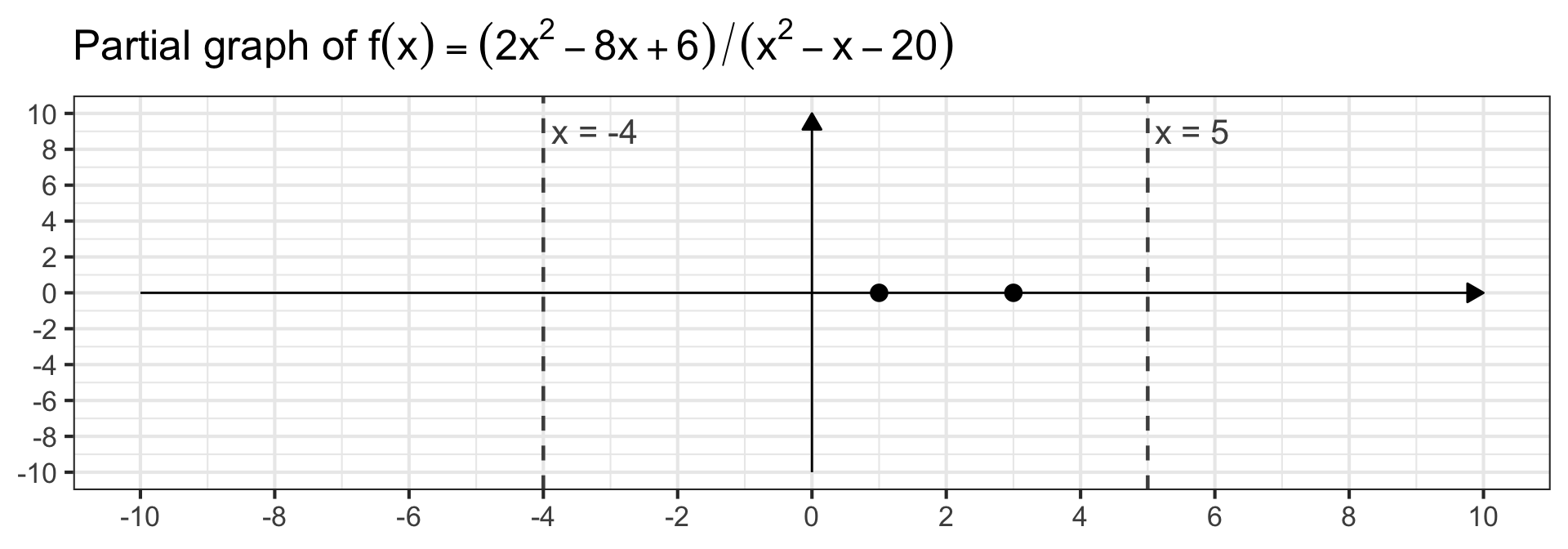
So the function \(r\left(x\right)\) has roots at \(\boxed{~\left(1, 0\right)~}\) and \(\boxed{~\left(3, 0\right)~}\)
Example 1: For \(\displaystyle{r\left(x\right) = \frac{2x^2 - 8x + 6}{x^2 - x - 20}}\), find the domain, roots, and \(y\)-intercept.
Solution.
Domain: Solve \(x^2 - x - 20 \neq 0\).
\[\begin{align} x^2 - x - 20 &\neq 0\\ \implies \left(x - 5\right)\left(x + 4\right) &\neq 0\\ \implies x \neq 5 &\text{ or } x \neq -4 \end{align}\]
So the domain is \(x \neq -4\) and \(x \neq 5\), or \(\boxed{~\left(-\infty, -4\right)\cup\left(-4, 5\right)\cup\left(5, \infty\right)~}\).
\(y\)-intecept: Since \(x = 0\) is in the domain of \(r\left(x\right)\), the function has a \(y\)-intercept.
We’ll find it by evaluating \(r\left(0\right)\).
\(\displaystyle{r\left(0\right) = \frac{2\left(0\right)^2 - 8\left(0\right) + 6}{\left(0\right)^2 - \left(0\right) - 20}}\)
Roots: Solve \(\displaystyle{\frac{2x^2 - 8x + 6}{x^2 - x - 20} = 0}\)
\[\begin{align} \frac{2x^2 - 8x + 6}{x^2 - x - 20} &= 0\\ \implies 2x^2 - 8x + 6 &= 0\\ \implies 2\left(x^2 - 4x + 3\right) &= 0\\ \implies x^2 - 4x + 3 &= 0\\ \implies \left(x - 3\right)\left(x - 1\right) &= 0\\ \implies x - 3 = 0 &\text{ or } x - 1 = 0\\ \implies x = 3 &\text{ or } x = 1 \end{align}\]
So the function \(r\left(x\right)\) has roots at \(\boxed{~\left(1, 0\right)~}\) and \(\boxed{~\left(3, 0\right)~}\)
Example 1: For \(\displaystyle{r\left(x\right) = \frac{2x^2 - 8x + 6}{x^2 - x - 20}}\), find the domain, roots, and \(y\)-intercept.
Solution.
Domain: Solve \(x^2 - x - 20 \neq 0\).
\[\begin{align} x^2 - x - 20 &\neq 0\\ \implies \left(x - 5\right)\left(x + 4\right) &\neq 0\\ \implies x \neq 5 &\text{ or } x \neq -4 \end{align}\]
So the domain is \(x \neq -4\) and \(x \neq 5\), or \(\boxed{~\left(-\infty, -4\right)\cup\left(-4, 5\right)\cup\left(5, \infty\right)~}\).
\(y\)-intecept: Since \(x = 0\) is in the domain of \(r\left(x\right)\), the function has a \(y\)-intercept.
We’ll find it by evaluating \(r\left(0\right)\).
\(\displaystyle{r\left(0\right) = \frac{2\left(0\right)^2 - 8\left(0\right) + 6}{\left(0\right)^2 - \left(0\right) - 20} = \frac{6}{-20}}\)
Roots: Solve \(\displaystyle{\frac{2x^2 - 8x + 6}{x^2 - x - 20} = 0}\)
\[\begin{align} \frac{2x^2 - 8x + 6}{x^2 - x - 20} &= 0\\ \implies 2x^2 - 8x + 6 &= 0\\ \implies 2\left(x^2 - 4x + 3\right) &= 0\\ \implies x^2 - 4x + 3 &= 0\\ \implies \left(x - 3\right)\left(x - 1\right) &= 0\\ \implies x - 3 = 0 &\text{ or } x - 1 = 0\\ \implies x = 3 &\text{ or } x = 1 \end{align}\]
So the function \(r\left(x\right)\) has roots at \(\boxed{~\left(1, 0\right)~}\) and \(\boxed{~\left(3, 0\right)~}\)
Example 1: For \(\displaystyle{r\left(x\right) = \frac{2x^2 - 8x + 6}{x^2 - x - 20}}\), find the domain, roots, and \(y\)-intercept.
Solution.
Domain: Solve \(x^2 - x - 20 \neq 0\).
\[\begin{align} x^2 - x - 20 &\neq 0\\ \implies \left(x - 5\right)\left(x + 4\right) &\neq 0\\ \implies x \neq 5 &\text{ or } x \neq -4 \end{align}\]
So the domain is \(x \neq -4\) and \(x \neq 5\), or \(\boxed{~\left(-\infty, -4\right)\cup\left(-4, 5\right)\cup\left(5, \infty\right)~}\).
\(y\)-intecept: Since \(x = 0\) is in the domain of \(r\left(x\right)\), the function has a \(y\)-intercept.
We’ll find it by evaluating \(r\left(0\right)\).
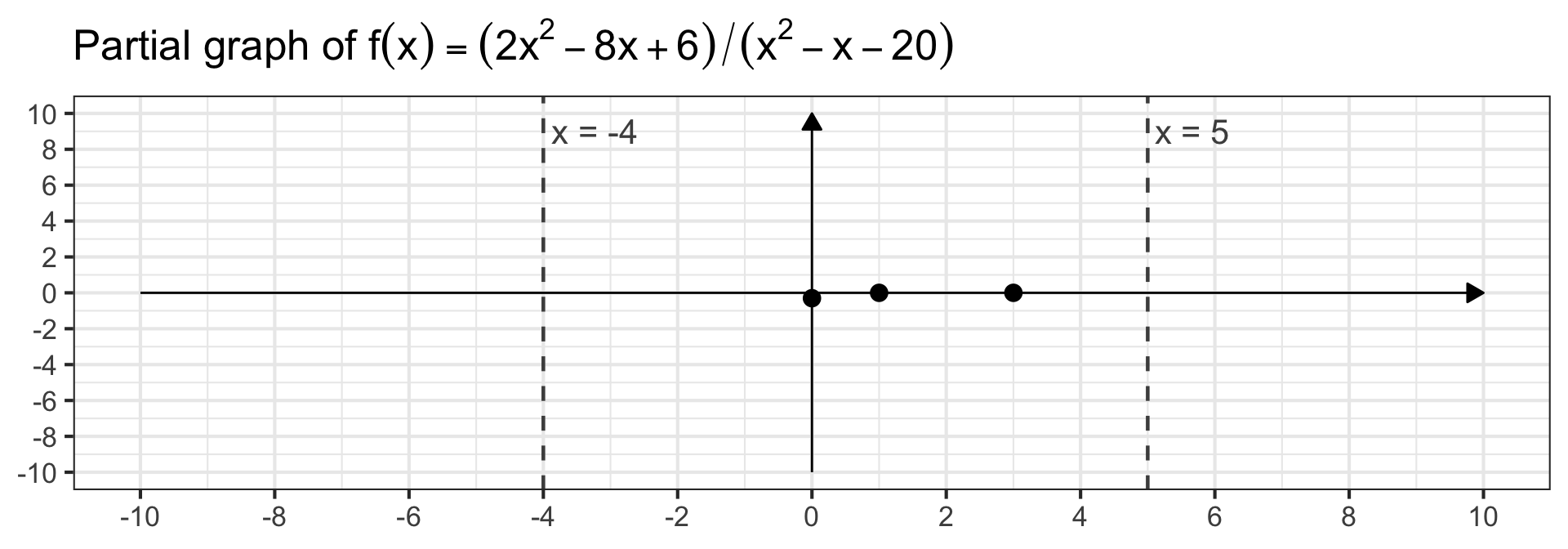
\(\displaystyle{r\left(0\right) = \frac{2\left(0\right)^2 - 8\left(0\right) + 6}{\left(0\right)^2 - \left(0\right) - 20} = \frac{6}{-20} = \boxed{~\frac{-3}{10}~}}\)
Roots: Solve \(\displaystyle{\frac{2x^2 - 8x + 6}{x^2 - x - 20} = 0}\)
\[\begin{align} \frac{2x^2 - 8x + 6}{x^2 - x - 20} &= 0\\ \implies 2x^2 - 8x + 6 &= 0\\ \implies 2\left(x^2 - 4x + 3\right) &= 0\\ \implies x^2 - 4x + 3 &= 0\\ \implies \left(x - 3\right)\left(x - 1\right) &= 0\\ \implies x - 3 = 0 &\text{ or } x - 1 = 0\\ \implies x = 3 &\text{ or } x = 1 \end{align}\]
So the function \(r\left(x\right)\) has roots at \(\boxed{~\left(1, 0\right)~}\) and \(\boxed{~\left(3, 0\right)~}\)
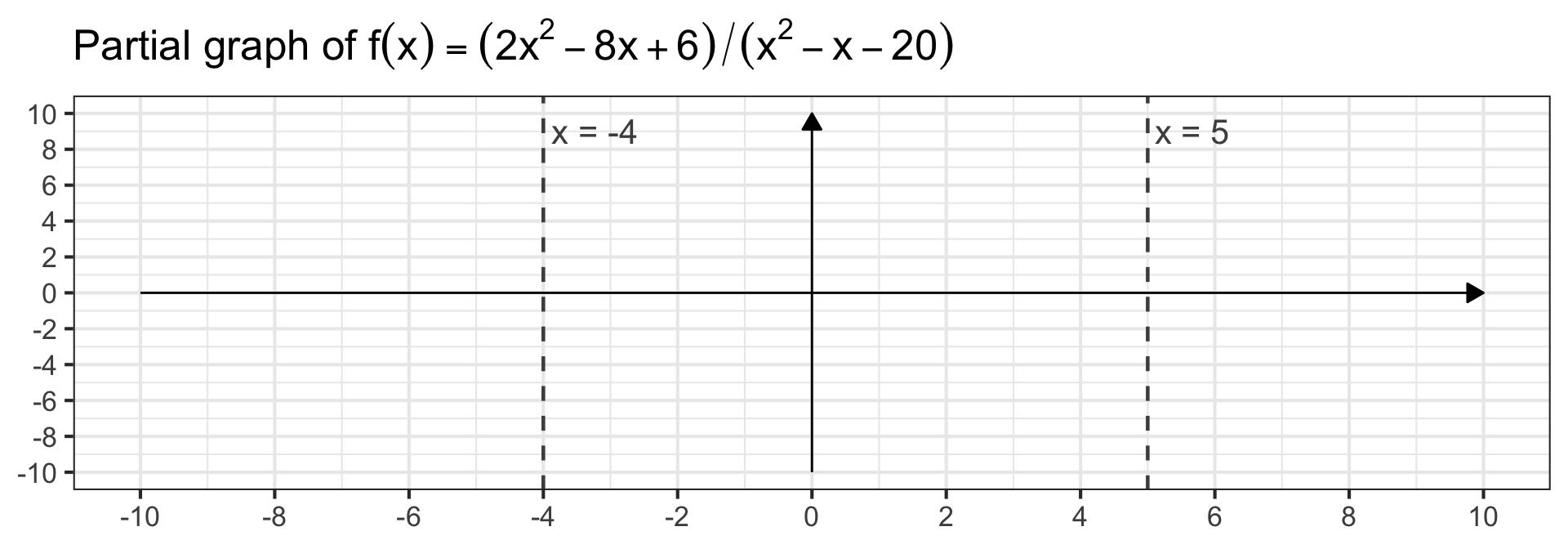
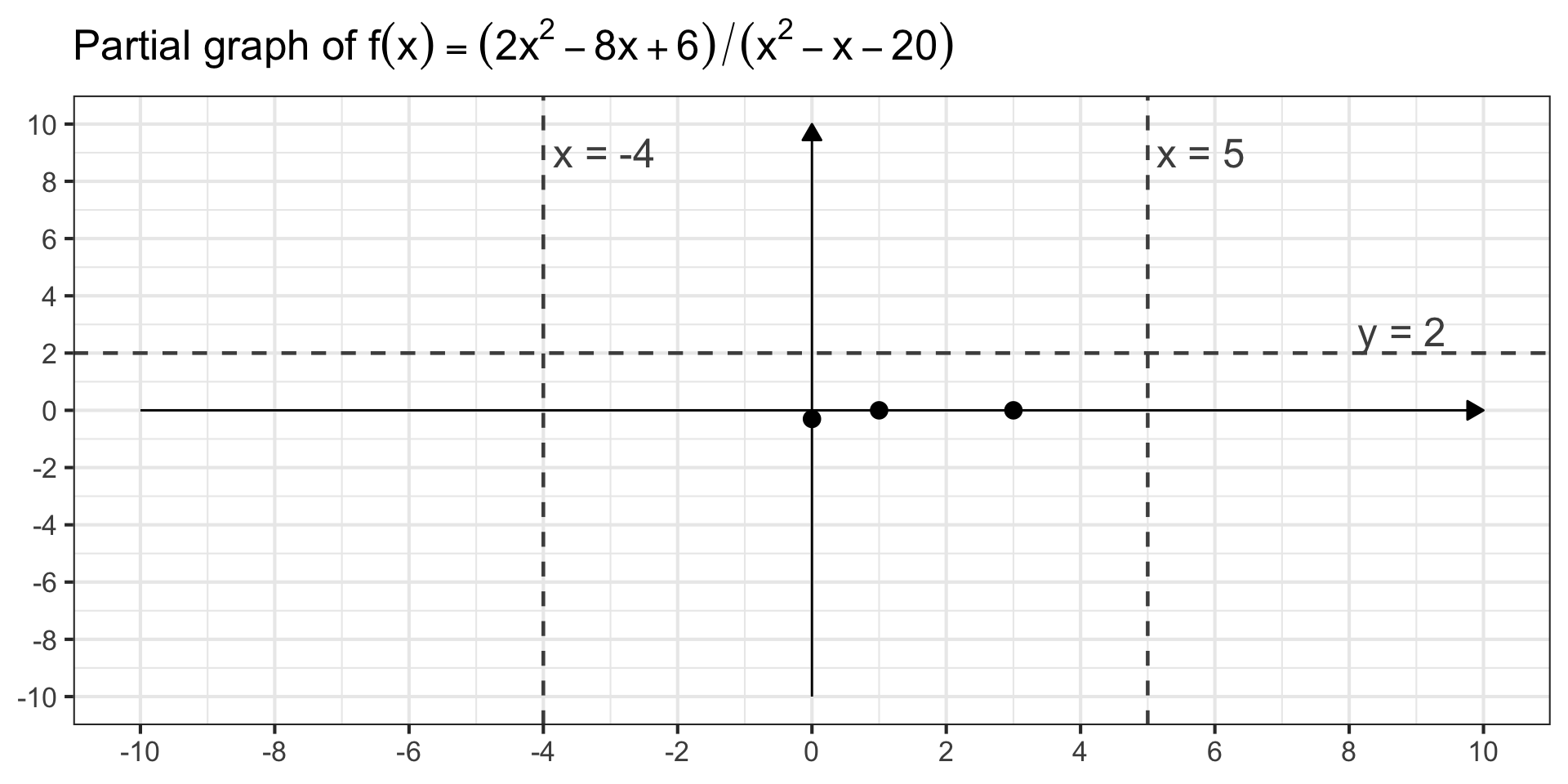
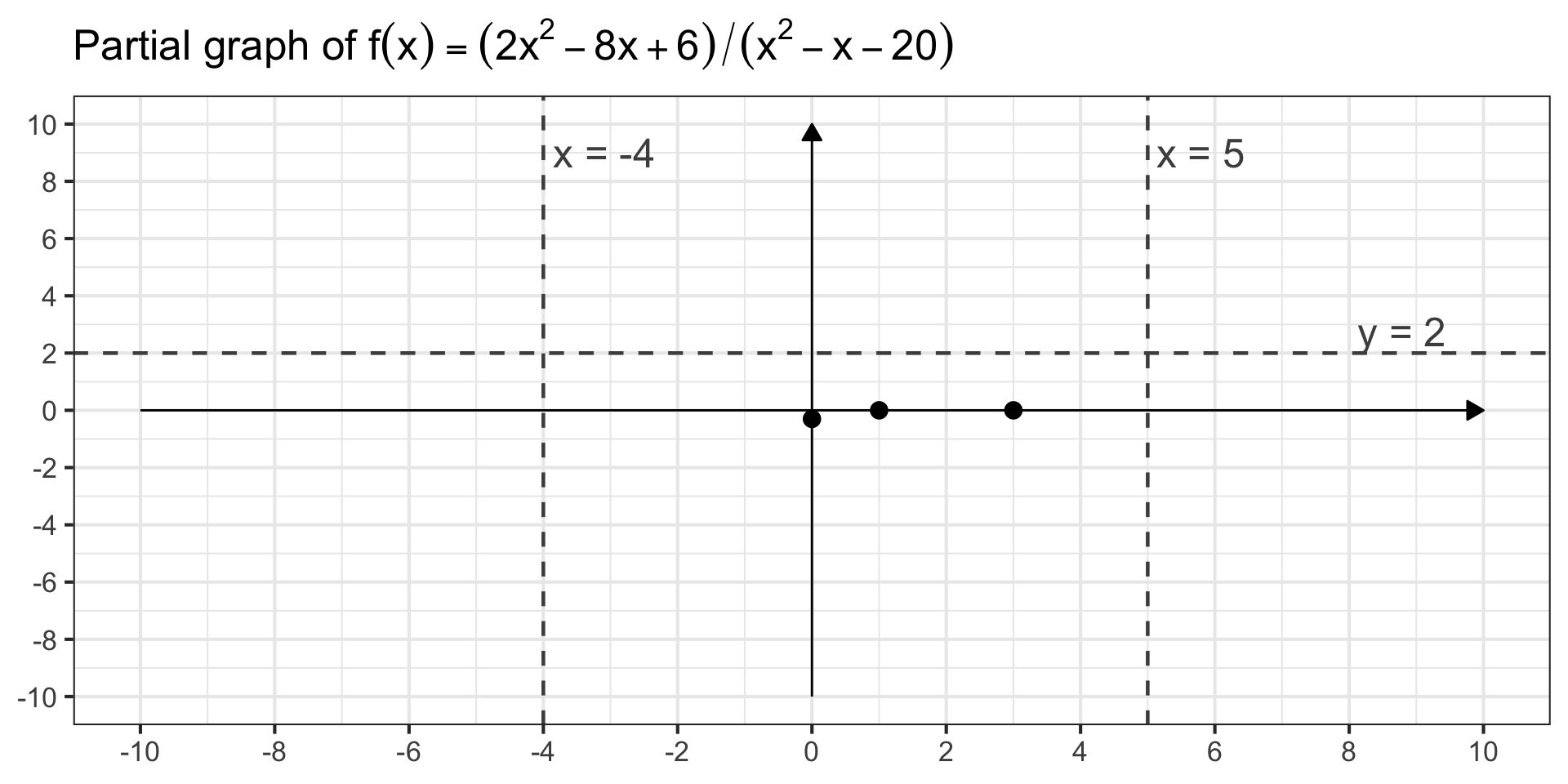
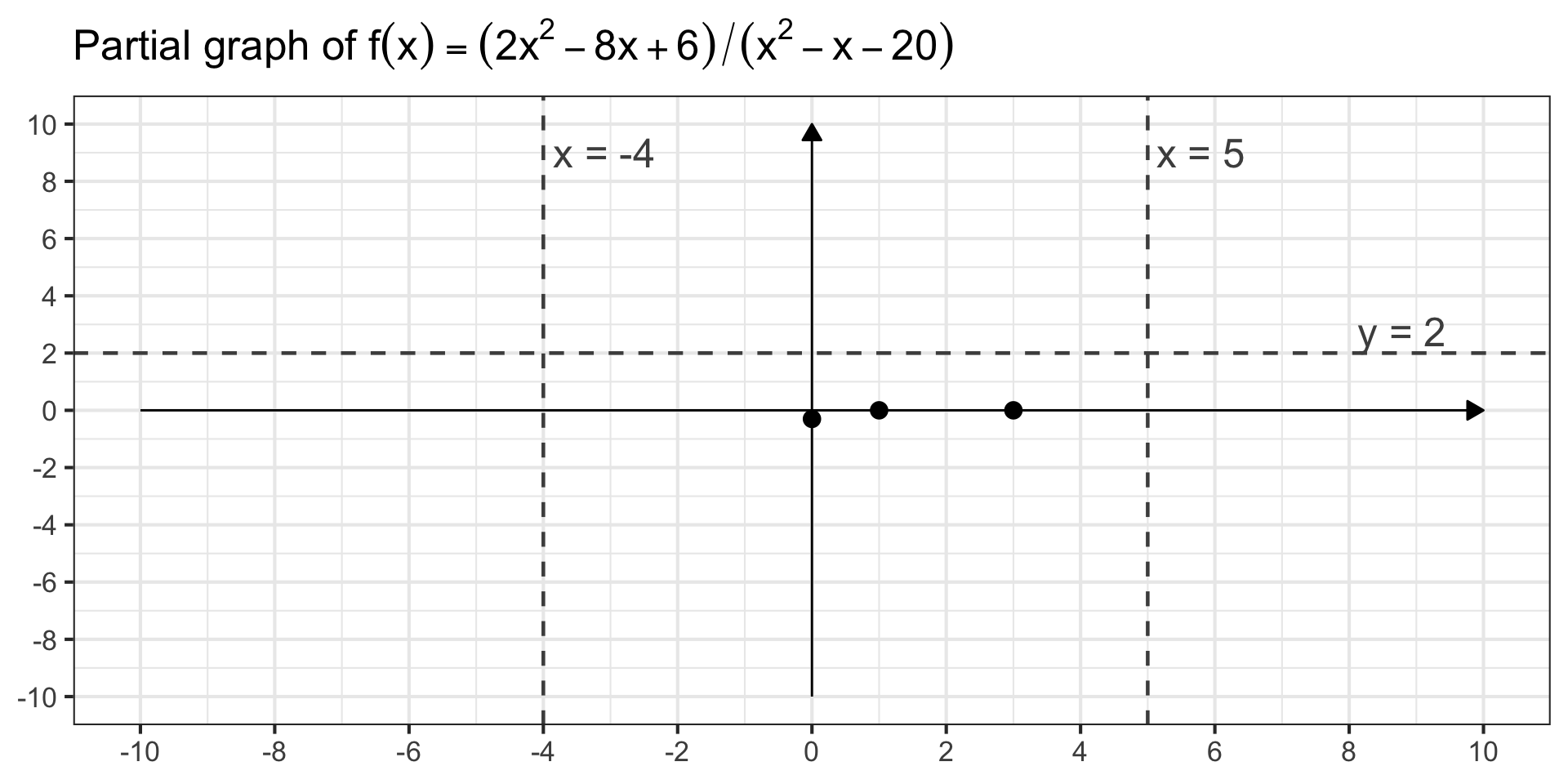
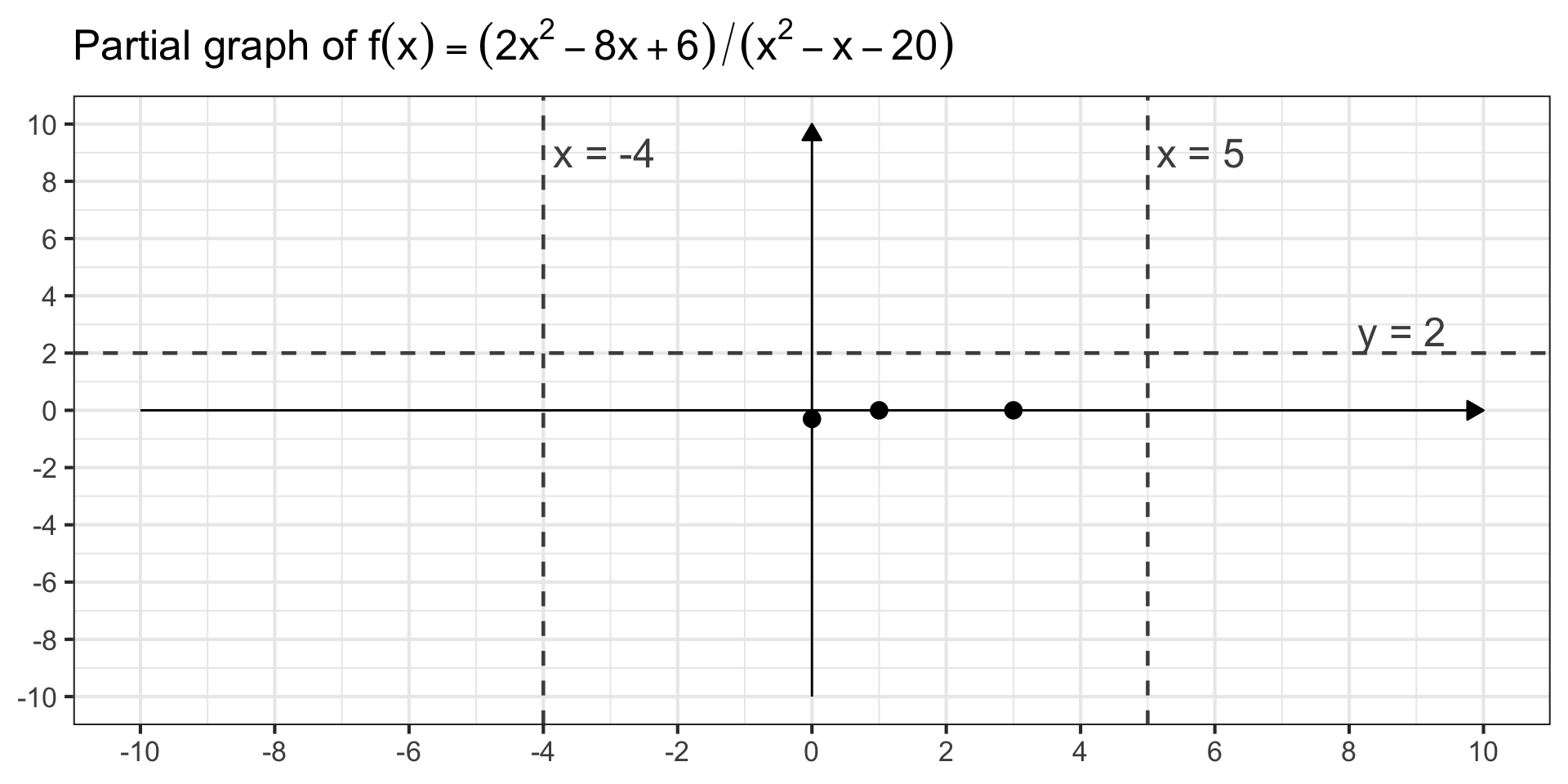
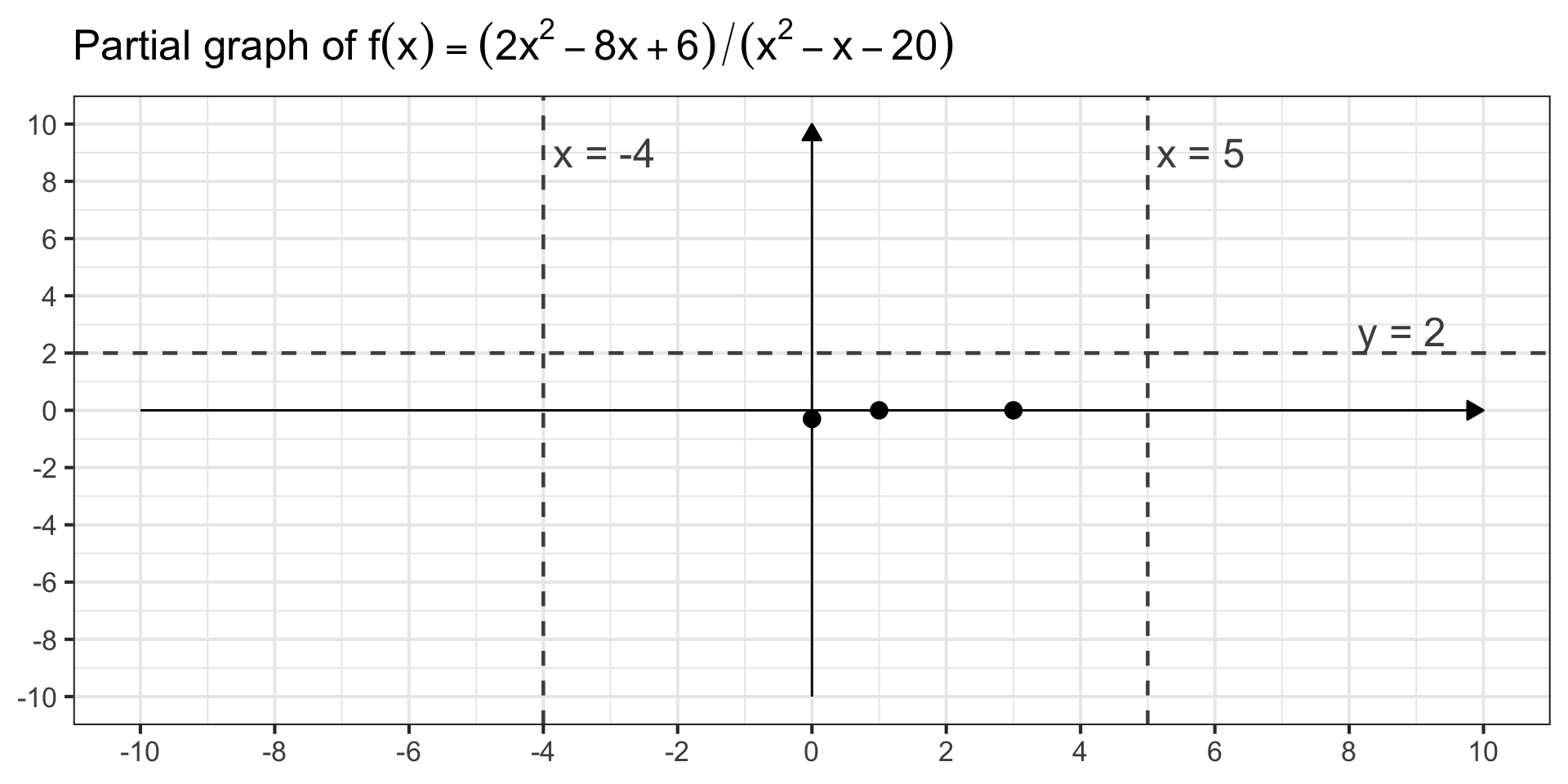
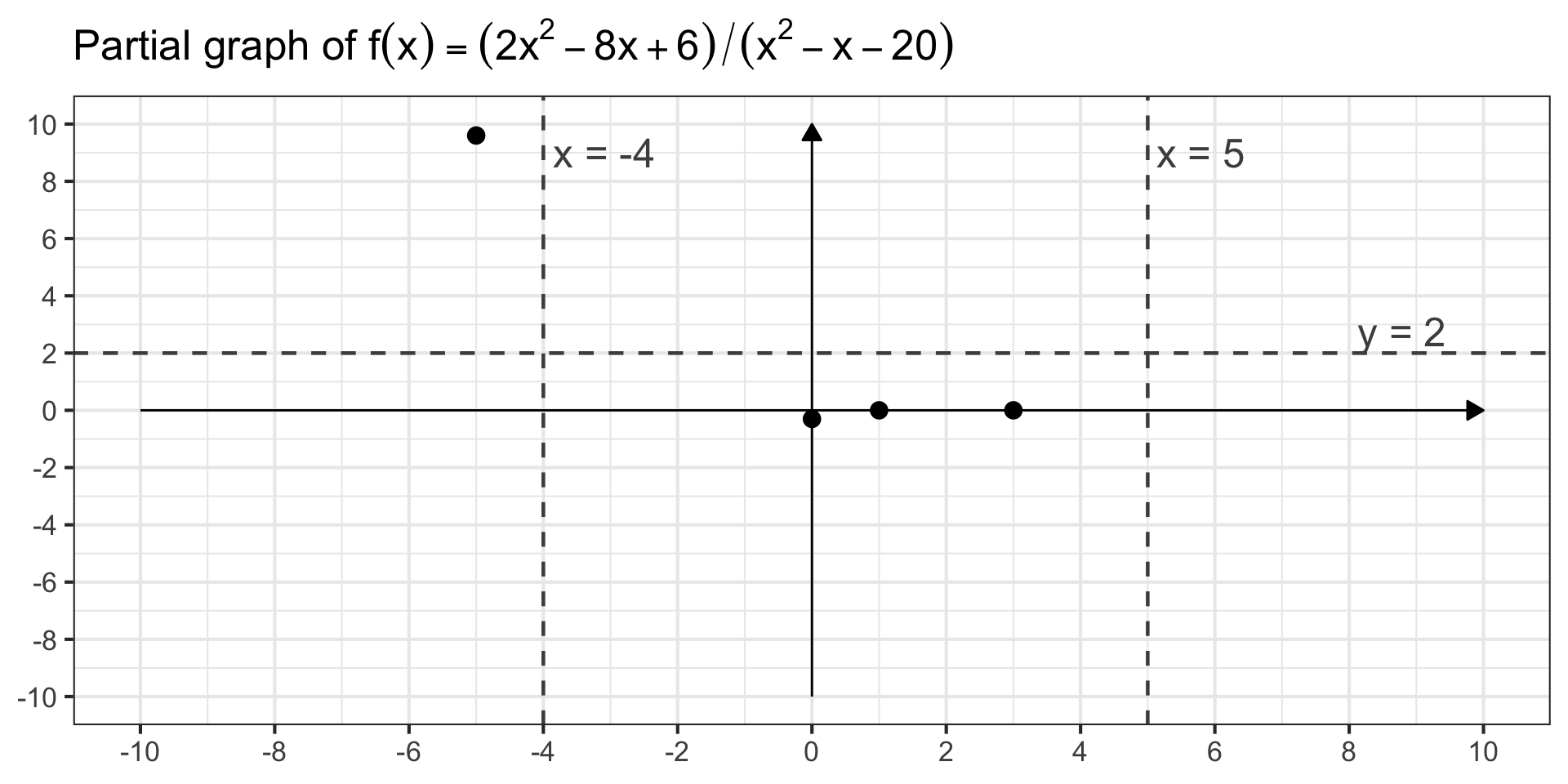
We can now draw a partial graph of the function \(\displaystyle{r\left(x\right) = \frac{2x^2 - 8x + 6}{x^2 - x - 20}}\).
As a reminder, \(r\left(x\right)\) has
We can now draw a partial graph of the function \(\displaystyle{r\left(x\right) = \frac{2x^2 - 8x + 6}{x^2 - x - 20}}\).
As a reminder, \(r\left(x\right)\) has

We can now draw a partial graph of the function \(\displaystyle{r\left(x\right) = \frac{2x^2 - 8x + 6}{x^2 - x - 20}}\).
As a reminder, \(r\left(x\right)\) has

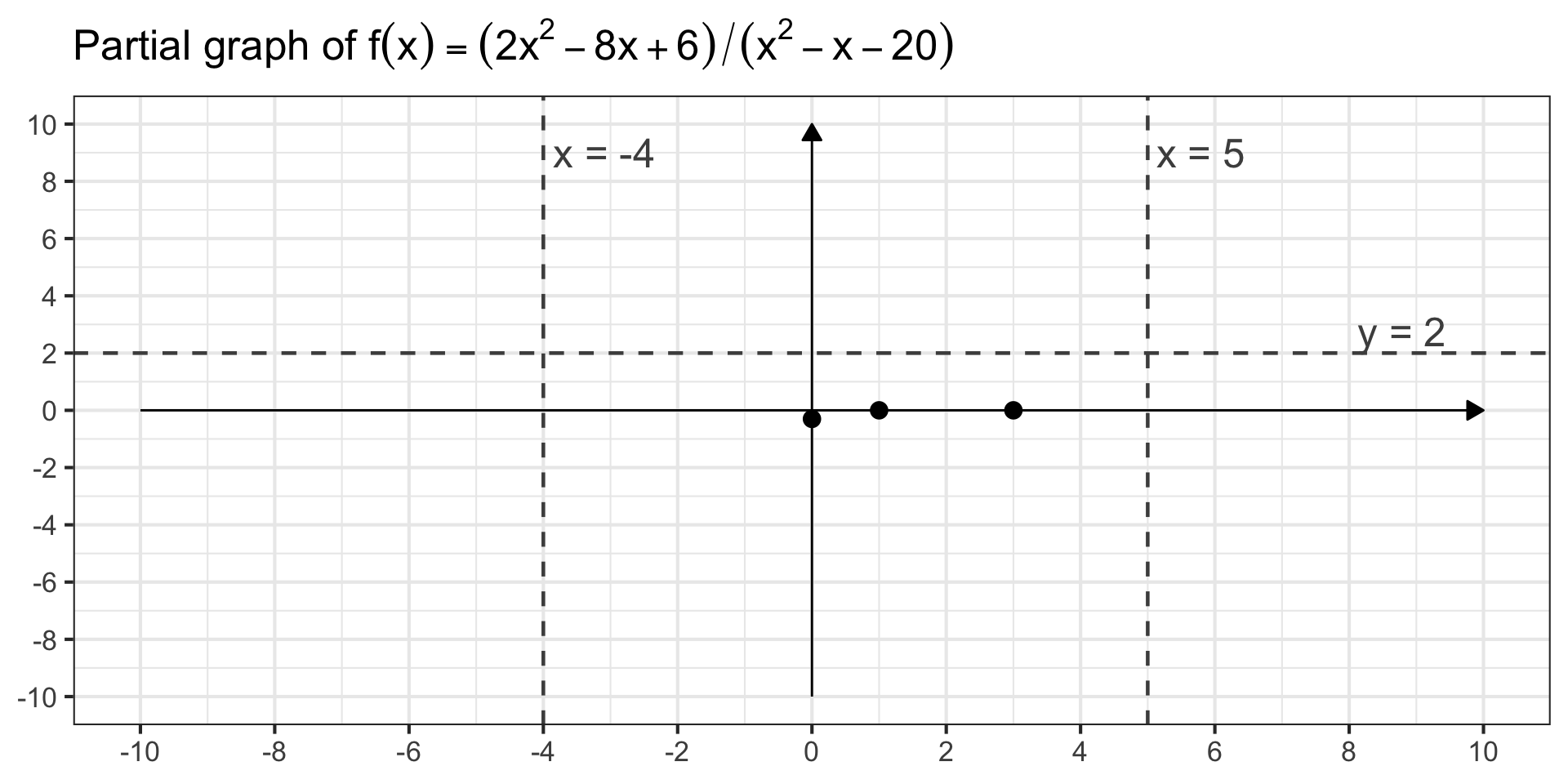
We can now draw a partial graph of the function \(\displaystyle{r\left(x\right) = \frac{2x^2 - 8x + 6}{x^2 - x - 20}}\).
As a reminder, \(r\left(x\right)\) has

Try It! 1: Identify the domain, roots, and \(y\)-intercept for the function \(\displaystyle{g\left(x\right) = \frac{-4x^2 - 4x + 24}{5x^2 + 5x - 100}}\). Draw a partial graph of the function by identifying locations for discontinuities, the \(y\)-intercept, and any roots.
Definition (Asymptote): An asymptote is a line (or curve) that a function approaches arbitrarily closely. Rational functions can have vertical, horizontal, or slant asymptotes.
A Common Misconception
You may have previously heard that “A function can never cross its asymptote”, but this is not generally true. A function can never cross its vertical asymptotes, but it can cross its horizontal or slant asymptote.
Definition (Vertical Asymptote): The line \(x = a\) is a vertical asymptote of \(\displaystyle{\frac{p(x)}{q(x)}}\) if \(q\left(a\right) = 0\) and \(p\left(a\right) \neq 0\).
Types of Discontinuities
There are two types of discontinuity that a rational function \(\displaystyle{r\left(x\right) = \frac{p\left(x\right)}{q\left(x\right)}}\) may have.
Definition (Vertical Asymptote): The line \(x = a\) is a vertical asymptote of \(\displaystyle{\frac{p(x)}{q(x)}}\) if \(q\left(a\right) = 0\) and \(p\left(a\right) \neq 0\).
Types of Discontinuities
There are two types of discontinuity that a rational function \(\displaystyle{r\left(x\right) = \frac{p\left(x\right)}{q\left(x\right)}}\) may have.
Strategy: Solve \(q\left(x\right) = 0\). Each solution is either the location of a vertical asymptote or of a hole.
For \(\displaystyle{r\left(x\right) = \frac{2x^2 - 8x + 6}{x^2 - x - 20}}\), we already found that \(q\left(x\right) = 0\) at \(x = -4\) and \(x = 5\).
Since neither of these are also roots of \(p\left(x\right)\), the discontinuities don’t cancel out – they aren’t holes.
Both of these discontinuities result in vertical asymptotes, represented by the dashed lines in the partial graph we produced earlier.
Try It! 2: Determine whether the domain restrictions of \(\displaystyle{g\left(x\right) = \frac{-4x^2 - 4x + 24}{5x^2 + 5x - 100}}\) correspond to vertical asymptotes or holes.
Definition (Horizontal Asymptote): The line \(y = b\) is a horizontal asymptote of \(r\left(x\right)\) if \(\displaystyle{\lim_{x\to\infty}{f\left(x\right)} = b}\) or \(\displaystyle{\lim_{x\to-\infty}{f\left(x\right)} = b}\).
Strategy: Divide numerator and denominator by \(x^n\), where \(n\) is the highest degree in the entire expression. Then take the limit — terms with \(x\) in the denominator vanish.
Example 2: Find any horizontal asmyptotes of the function \(\displaystyle{f\left(x\right) = \frac{2x^2 - 8x + 6}{x^2 - x - 20}}\).
*Solution.
\[\begin{align} \lim_{x\to -\infty} \frac{2x^2 - 8x + 6}{x^2 - x - 20} \end{align}\]
Definition (Horizontal Asymptote): The line \(y = b\) is a horizontal asymptote of \(r\left(x\right)\) if \(\displaystyle{\lim_{x\to\infty}{f\left(x\right)} = b}\) or \(\displaystyle{\lim_{x\to-\infty}{f\left(x\right)} = b}\).
Strategy: Divide numerator and denominator by \(x^n\), where \(n\) is the highest degree in the entire expression. Then take the limit — terms with \(x\) in the denominator vanish.
Example 2: Find any horizontal asmyptotes of the function \(\displaystyle{f\left(x\right) = \frac{2x^2 - 8x + 6}{x^2 - x - 20}}\).
*Solution.
\[\begin{align} \lim_{x\to -\infty} \frac{2x^2 - 8x + 6}{x^2 - x - 20} &= \lim_{x\to -\infty}{\frac{\frac{2x^2}{x^2} - \frac{8x}{x^2} + \frac{6}{x^2}}{\frac{x^2}{x^2} - \frac{x}{x^2} - \frac{20}{x^2}}} \end{align}\]
Definition (Horizontal Asymptote): The line \(y = b\) is a horizontal asymptote of \(r\left(x\right)\) if \(\displaystyle{\lim_{x\to\infty}{f\left(x\right)} = b}\) or \(\displaystyle{\lim_{x\to-\infty}{f\left(x\right)} = b}\).
Strategy: Divide numerator and denominator by \(x^n\), where \(n\) is the highest degree in the entire expression. Then take the limit — terms with \(x\) in the denominator vanish.
Example 2: Find any horizontal asmyptotes of the function \(\displaystyle{f\left(x\right) = \frac{2x^2 - 8x + 6}{x^2 - x - 20}}\).
Solution.
\[\begin{align} \lim_{x\to -\infty} \frac{2x^2 - 8x + 6}{x^2 - x - 20} &= \lim_{x\to -\infty}{\frac{\frac{2x^2}{x^2} - \frac{8x}{x^2} + \frac{6}{x^2}}{\frac{x^2}{x^2} - \frac{x}{x^2} - \frac{20}{x^2}}}\\ &= \lim_{x\to -\infty}{\frac{2 - \frac{8}{x} + \frac{6}{x^2}}{1 - \frac{1}{x} - \frac{20}{x^2}}} \end{align}\]
Definition (Horizontal Asymptote): The line \(y = b\) is a horizontal asymptote of \(r\left(x\right)\) if \(\displaystyle{\lim_{x\to\infty}{f\left(x\right)} = b}\) or \(\displaystyle{\lim_{x\to-\infty}{f\left(x\right)} = b}\).
Strategy: Divide numerator and denominator by \(x^n\), where \(n\) is the highest degree in the entire expression. Then take the limit — terms with \(x\) in the denominator vanish.
Example 2: Find any horizontal asmyptotes of the function \(\displaystyle{f\left(x\right) = \frac{2x^2 - 8x + 6}{x^2 - x - 20}}\).
Solution.
\[\begin{align} \lim_{x\to -\infty} \frac{2x^2 - 8x + 6}{x^2 - x - 20} &= \lim_{x\to -\infty}{\frac{\frac{2x^2}{x^2} - \frac{8x}{x^2} + \frac{6}{x^2}}{\frac{x^2}{x^2} - \frac{x}{x^2} - \frac{20}{x^2}}}\\ &= \lim_{x\to -\infty}{\frac{2 - \frac{8}{x} + \frac{6}{x^2}}{1 - \frac{1}{x} - \frac{20}{x^2}}}\\ &= \frac{2}{1} \end{align}\]
Definition (Horizontal Asymptote): The line \(y = b\) is a horizontal asymptote of \(r\left(x\right)\) if \(\displaystyle{\lim_{x\to\infty}{f\left(x\right)} = b}\) or \(\displaystyle{\lim_{x\to-\infty}{f\left(x\right)} = b}\).
Strategy: Divide numerator and denominator by \(x^n\), where \(n\) is the highest degree in the entire expression. Then take the limit — terms with \(x\) in the denominator vanish.
Example 2: Find any horizontal asmyptotes of the function \(\displaystyle{f\left(x\right) = \frac{2x^2 - 8x + 6}{x^2 - x - 20}}\).
Solution.
\[\begin{align} \lim_{x\to \infty} \frac{2x^2 - 8x + 6}{x^2 - x - 20} &= \lim_{x\to \infty}{\frac{\frac{2x^2}{x^2} - \frac{8x}{x^2} + \frac{6}{x^2}}{\frac{x^2}{x^2} - \frac{x}{x^2} - \frac{20}{x^2}}}\\ &= \lim_{x\to \infty}{\frac{2 - \frac{8}{x} + \frac{6}{x^2}}{1 - \frac{1}{x} - \frac{20}{x^2}}}\\ &= \frac{2}{1}\\ &= 2 \end{align}\]
So \(r\left(x\right)\) has a horizontal asymptote at \(y = 2\).
Note that the exact same analysis would show that \(\displaystyle{\lim_{x\to -\infty}}{r\left(x\right)} = 2\).
If the end behavior of a rational function approaches a finite limit, then it will always be the case that \(\displaystyle{\lim_{x\to -\infty}{r\left(x\right)} = \lim_{x\to \infty}{r\left(x\right)}}\).
This is not the case for all function classes though.
Try It! 3: Determine whether the function \(\displaystyle{g\left(x\right) = \frac{-4x^2 - 4x + 24}{5x^2 + 5x - 100}}\) has a horizontal asymptote. Write the equation of the horizontal asymptote, if so.
We now know a great deal about \(\displaystyle{r\left(x\right) = \frac{2x^2 - 8x + 6}{x^2 - x - 20}}\). It has…

We now know a great deal about \(\displaystyle{r\left(x\right) = \frac{2x^2 - 8x + 6}{x^2 - x - 20}}\). It has…
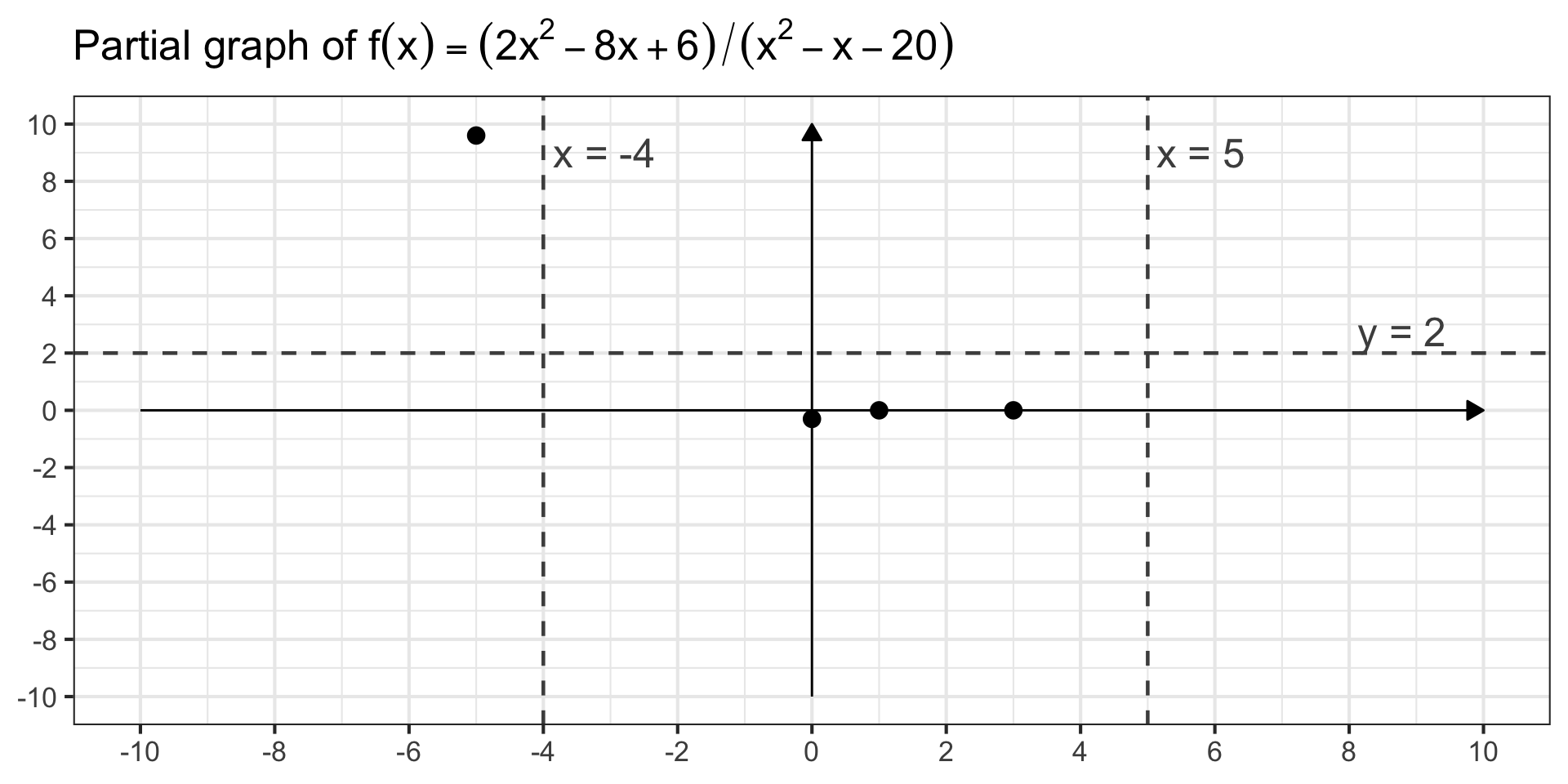
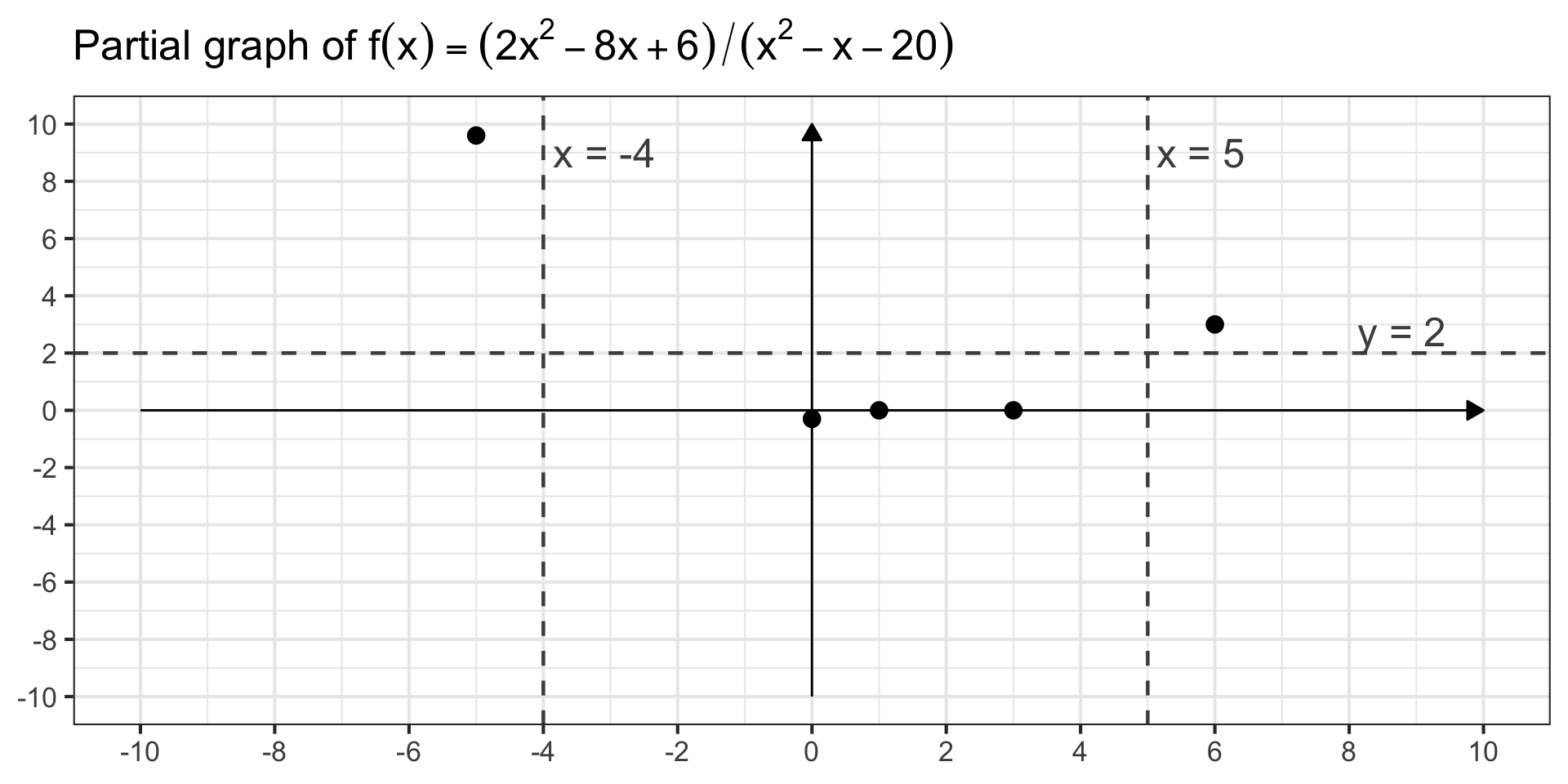
To complete the sketch, we’ll need reference points from each of the domain regions. We’ll find one to the left of \(x = -4\) and one to the right of \(x = 5\) because we already have reference points in the middle section.
We now know a great deal about \(\displaystyle{r\left(x\right) = \frac{2x^2 - 8x + 6}{x^2 - x - 20}}\). It has…
To complete the sketch, we’ll need reference points from each of the domain regions. We’ll find one to the left of \(x = -4\) and one to the right of \(x = 5\) because we already have reference points in the middle section.
\(\displaystyle{r\left(-5\right) = \frac{2\left(-5\right)^2 - 8\left(-5\right) + 6}{\left(-5\right)^2 - \left(-5\right) - 20}}\)
We now know a great deal about \(\displaystyle{r\left(x\right) = \frac{2x^2 - 8x + 6}{x^2 - x - 20}}\). It has…
To complete the sketch, we’ll need reference points from each of the domain regions. We’ll find one to the left of \(x = -4\) and one to the right of \(x = 5\) because we already have reference points in the middle section.
\(\displaystyle{r\left(-5\right) = \frac{2\left(-5\right)^2 - 8\left(-5\right) + 6}{\left(-5\right)^2 - \left(-5\right) - 20} = \frac{50 + 40 + 6}{25 + 5 - 20}}\)
We now know a great deal about \(\displaystyle{r\left(x\right) = \frac{2x^2 - 8x + 6}{x^2 - x - 20}}\). It has…
To complete the sketch, we’ll need reference points from each of the domain regions. We’ll find one to the left of \(x = -4\) and one to the right of \(x = 5\) because we already have reference points in the middle section.
\(\displaystyle{r\left(-5\right) = \frac{2\left(-5\right)^2 - 8\left(-5\right) + 6}{\left(-5\right)^2 - \left(-5\right) - 20} = \frac{96}{10}}\)
We now know a great deal about \(\displaystyle{r\left(x\right) = \frac{2x^2 - 8x + 6}{x^2 - x - 20}}\). It has…
To complete the sketch, we’ll need reference points from each of the domain regions. We’ll find one to the left of \(x = -4\) and one to the right of \(x = 5\) because we already have reference points in the middle section.
\(\displaystyle{r\left(-5\right) = \frac{2\left(-5\right)^2 - 8\left(-5\right) + 6}{\left(-5\right)^2 - \left(-5\right) - 20} = \frac{48}{5}}\)
We now know a great deal about \(\displaystyle{r\left(x\right) = \frac{2x^2 - 8x + 6}{x^2 - x - 20}}\). It has…
To complete the sketch, we’ll need reference points from each of the domain regions. We’ll find one to the left of \(x = -4\) and one to the right of \(x = 5\) because we already have reference points in the middle section.
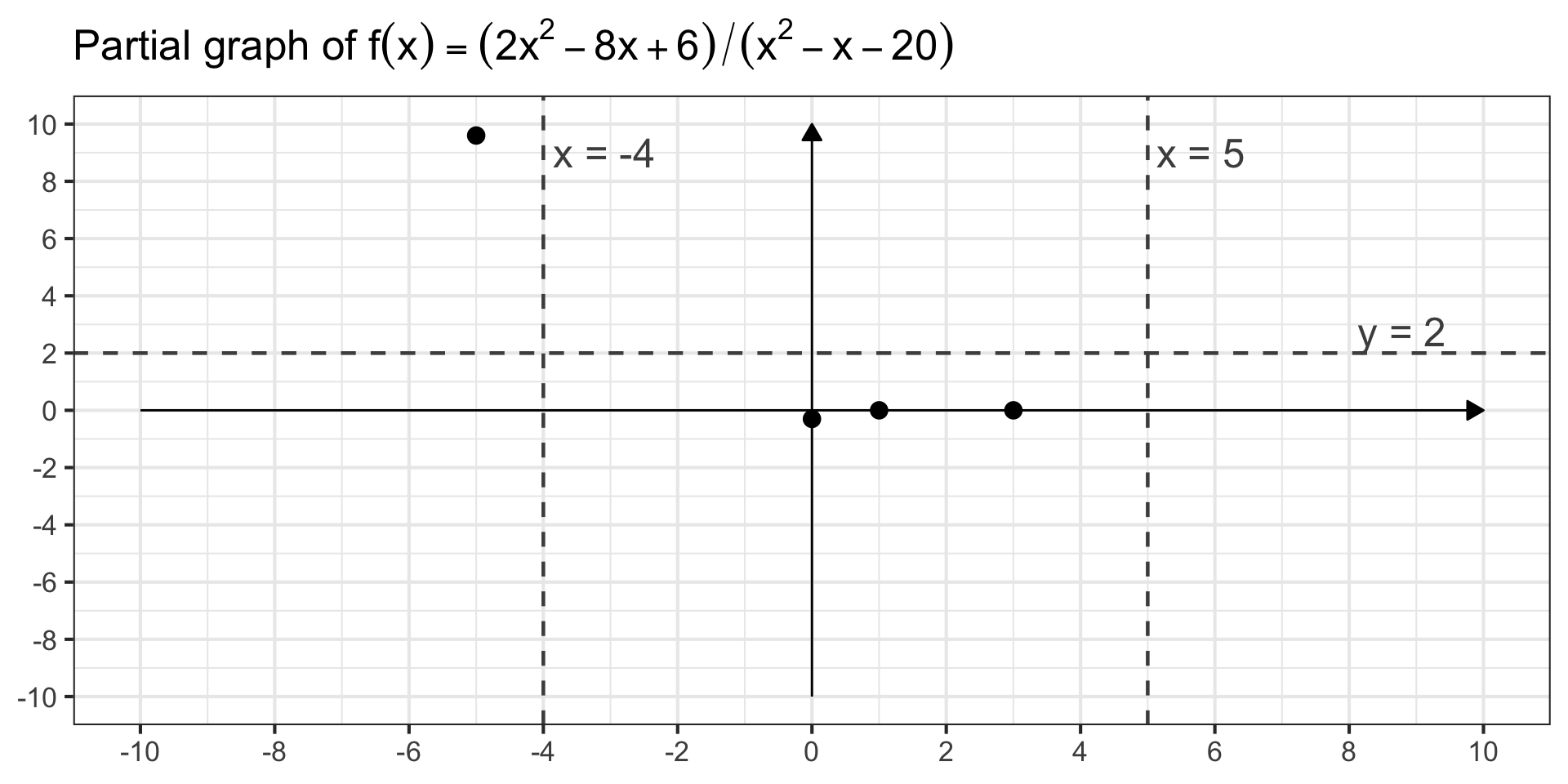
\(\displaystyle{r\left(-5\right) = \frac{2\left(-5\right)^2 - 8\left(-5\right) + 6}{\left(-5\right)^2 - \left(-5\right) - 20} = \frac{48}{5} > 2}\)
We now know a great deal about \(\displaystyle{r\left(x\right) = \frac{2x^2 - 8x + 6}{x^2 - x - 20}}\). It has…
To complete the sketch, we’ll need reference points from each of the domain regions. We’ll find one to the left of \(x = -4\) and one to the right of \(x = 5\) because we already have reference points in the middle section.
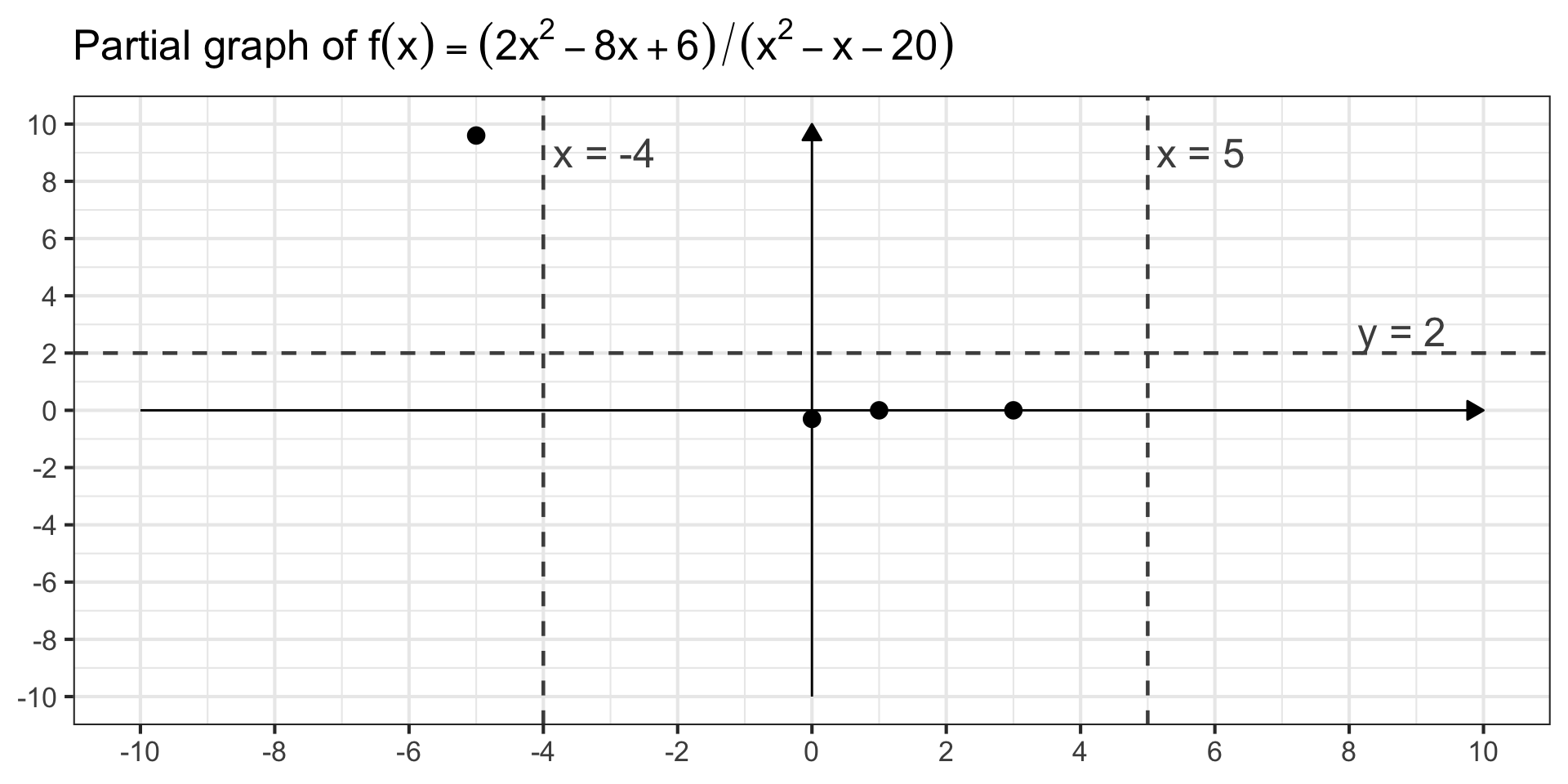
\(\displaystyle{r\left(-5\right) = \frac{2\left(-5\right)^2 - 8\left(-5\right) + 6}{\left(-5\right)^2 - \left(-5\right) - 20} = \frac{48}{5} > 2}\)
\(\displaystyle{r\left(6\right) = \frac{2\left(6\right)^2 - 8\left(6\right) + 6}{\left(6\right)^2 - \left(6\right) - 20}}\)
We now know a great deal about \(\displaystyle{r\left(x\right) = \frac{2x^2 - 8x + 6}{x^2 - x - 20}}\). It has…
To complete the sketch, we’ll need reference points from each of the domain regions. We’ll find one to the left of \(x = -4\) and one to the right of \(x = 5\) because we already have reference points in the middle section.
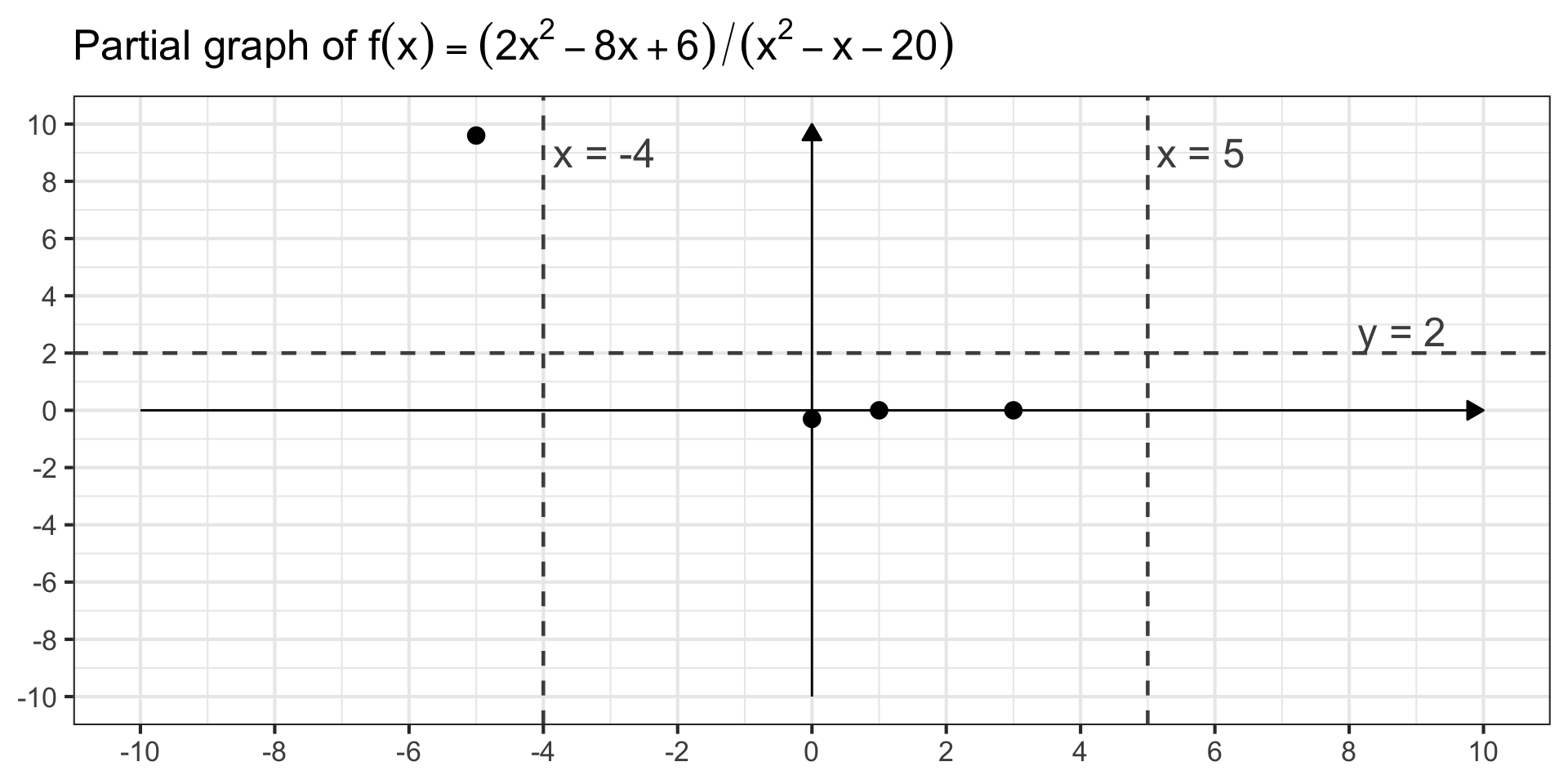
\(\displaystyle{r\left(-5\right) = \frac{2\left(-5\right)^2 - 8\left(-5\right) + 6}{\left(-5\right)^2 - \left(-5\right) - 20} = \frac{48}{5} > 2}\)
\(\displaystyle{r\left(6\right) = \frac{2\left(6\right)^2 - 8\left(6\right) + 6}{\left(6\right)^2 - \left(6\right) - 20} = \frac{72 - 48 + 6}{36 - 6 - 20}}\)
We now know a great deal about \(\displaystyle{r\left(x\right) = \frac{2x^2 - 8x + 6}{x^2 - x - 20}}\). It has…
To complete the sketch, we’ll need reference points from each of the domain regions. We’ll find one to the left of \(x = -4\) and one to the right of \(x = 5\) because we already have reference points in the middle section.
\(\displaystyle{r\left(-5\right) = \frac{2\left(-5\right)^2 - 8\left(-5\right) + 6}{\left(-5\right)^2 - \left(-5\right) - 20} = \frac{48}{5} > 2}\)
\(\displaystyle{r\left(6\right) = \frac{2\left(6\right)^2 - 8\left(6\right) + 6}{\left(6\right)^2 - \left(6\right) - 20} = \frac{30}{10}}\)
We now know a great deal about \(\displaystyle{r\left(x\right) = \frac{2x^2 - 8x + 6}{x^2 - x - 20}}\). It has…
To complete the sketch, we’ll need reference points from each of the domain regions. We’ll find one to the left of \(x = -4\) and one to the right of \(x = 5\) because we already have reference points in the middle section.
\(\displaystyle{r\left(-5\right) = \frac{2\left(-5\right)^2 - 8\left(-5\right) + 6}{\left(-5\right)^2 - \left(-5\right) - 20} = \frac{48}{5} > 2}\)
\(\displaystyle{r\left(6\right) = \frac{2\left(6\right)^2 - 8\left(6\right) + 6}{\left(6\right)^2 - \left(6\right) - 20} = 3}\)
We now know a great deal about \(\displaystyle{r\left(x\right) = \frac{2x^2 - 8x + 6}{x^2 - x - 20}}\). It has…
To complete the sketch, we’ll need reference points from each of the domain regions. We’ll find one to the left of \(x = -4\) and one to the right of \(x = 5\) because we already have reference points in the middle section.
\(\displaystyle{r\left(-5\right) = \frac{2\left(-5\right)^2 - 8\left(-5\right) + 6}{\left(-5\right)^2 - \left(-5\right) - 20} = \frac{48}{5} > 2}\)
\(\displaystyle{r\left(6\right) = \frac{2\left(6\right)^2 - 8\left(6\right) + 6}{\left(6\right)^2 - \left(6\right) - 20} = 3 > 2}\)
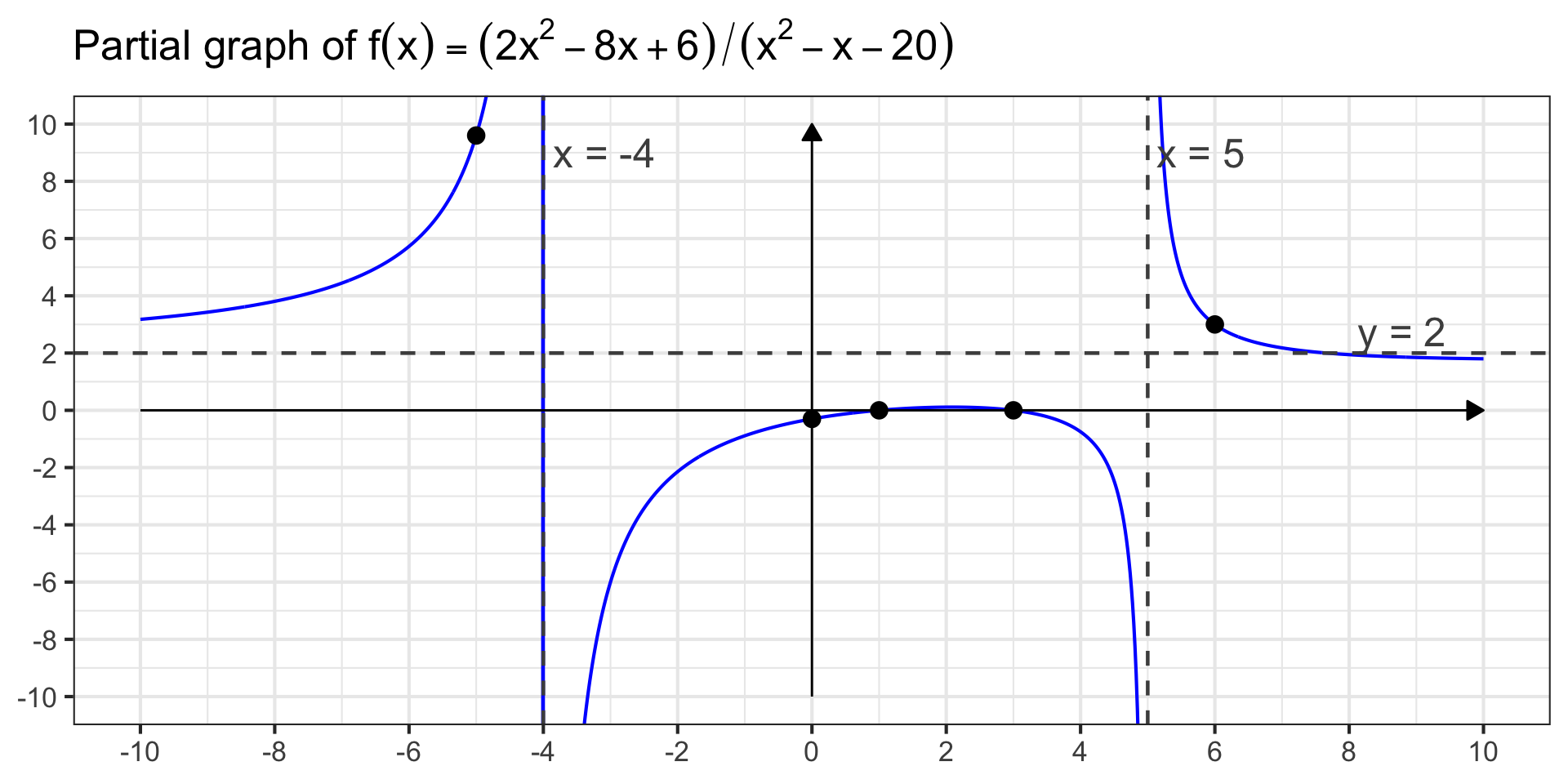
Now we draw an approximate graph respecting all asymptotes and reference points.
We now know a great deal about \(\displaystyle{r\left(x\right) = \frac{2x^2 - 8x + 6}{x^2 - x - 20}}\). It has…
To complete the sketch, we’ll need reference points from each of the domain regions. We’ll find one to the left of \(x = -4\) and one to the right of \(x = 5\) because we already have reference points in the middle section.
\(\displaystyle{r\left(-5\right) = \frac{2\left(-5\right)^2 - 8\left(-5\right) + 6}{\left(-5\right)^2 - \left(-5\right) - 20} = \frac{48}{5} > 2}\)
\(\displaystyle{r\left(6\right) = \frac{2\left(6\right)^2 - 8\left(6\right) + 6}{\left(6\right)^2 - \left(6\right) - 20} = 3 > 2}\)
Now we draw an approximate graph respecting all asymptotes and reference points.
Try It! 4: Use your findings from the earlier Try It! activities to sketch the graph of \(\displaystyle{g\left(x\right) = \frac{-4x^2 - 4x + 24}{5x^2 + 5x - 100}}\). Be sure to include any holes, vertical asymptotes, horizontal asymptote, roots, the \(y\)-intercept, and at least one reference point from each region.
Before sketching: Based on your analysis of the function \(g\left(x\right)\) so far, how many separate “pieces” will the graph have? In which region will each root appear?
Strategy (Analyzing and Graphing a Rational Function): Consider the rational function \(\displaystyle{r\left(x\right) = \frac{p\left(x\right)}{q\left(x\right)}}\).
Try It! 5: Conduct a full analysis of the rational function \(\displaystyle{h\left(x\right) = \frac{x^4 - 7x^3 - 9x^2 + 115x - 100}{x^4 - 7x^3 - 25x^2 + 151x - 120}}\)
Hints. The expression \(x^4 - 7x^3 - 9x^2 + 115x -100\) factors into \(\left(x + 4\right)\left(x - 1\right)\left(x - 5\right)^2\). Similarly, the expression \(x^4 - 7x^3 - 25x^2 + 151x - 120\) factors into \(\left(x+ 5\right)\left(x - 1\right)\left(x - 3\right)\left(x - 8\right)\).
Navigate to our MAT142 Exit Ticket Form, answer the questions, and complete the task below.
Note. Today’s discussion is listed as 14. Rational Functions and Equations

Task: Consider \(\displaystyle{j\left(x\right) = \frac{x - 4}{x^2 - x - 6}}\).
\(\left(a\right)\) Find the domain of \(j\left(x\right)\).
\(\left(b\right)\) Find the roots of \(j\left(x\right)\), if any exist.
\(\left(c\right)\) Find any vertical and horizontal asymptotes.
\(\left(d\right)\) Sketch an approximate graph of \(j\left(x\right)\).