MAT 142: Polynomial Functions and Equations (Part II)
June 5, 2026
Reminders
At our last meeting, we introduced polynomial functions and equations in both expanded and factored (or near-factored) forms.
From expanded form \(f\left(x\right) = a_nx^n + a_{n-1}x^{n-1} + \cdots + a_1x + a_0\)…
- The leading term, \(a_nx^n\) is the term including the highest power of \(x\)
- The leading coefficient is \(a_n\), the coefficient on the term including the highest power of \(x\)
- The degree of the polynomial is the highest power that \(x\) is being raised to
We convert from the expanded/standard form to factored form in order to learn more about the function geography.
- We solve polynomial equations or find roots of polynomial functions by factoring and using the zero product property
- The multiplicity of each root tells us about the behavior of the function at those roots.
- The function passes through the \(x\)-axis at roots with odd multiplicity.
- The function bounces off the \(x\)-axis at roots with even multiplicity.
- End behavior is determining by evaluating limits as \(x\) approaches \(\pm\infty\) and analysing the leading term or by sign-tracking with each factor.
Warm-Up Problems
Try the following warm-up problems using the polynomial \(p\left(x\right) = \left(x^2 + 5x + 6\right)\left(x - 3\right)^7\left(x^2 - 25\right)^2\left(x^2 + 9\right)^3\).
Problem 1: Find the \(y\)-intercept and all roots (real and complex, with multiplicities). Verify that your solution count matches the degree of \(p\).
Problem 2: Determine the end behavior of \(p\left(x\right)\) using limits, then use all of your findings to sketch an approximate graph.
Objectives
Today we address the central limitation from last class: what do we do when a polynomial is given in expanded, unfactored form?
After today’s class meeting, you should be able to:
- Apply the Rational Roots Theorem to identify candidate rational roots of a polynomial.
- Use polynomial long division to divide a polynomial by a linear factor.
- Combine these tools to fully factor a polynomial and find all of its roots.
- Interpret a nonzero remainder from long division.
The problem we’re solving: Last class, every polynomial equation we encountered was already in factored (or near-factored) form. That made finding roots straightforward.
But what about a polynomial like \(f\left(x\right) = 2x^3 + x^2 - 4x + 1\)?
This is a degree-3 polynomial with no obvious factoring. We need new tools.
Two New Tools
- The Rational Roots Theorem tells us which rational numbers are candidates for roots.
- Once we know a root exists at \(x = r\), Polynomial Long Division allows us to factor out \(\left(x - r\right)\) and obtain another polynomial factor of reduced degree.
The Rational Roots Theorem
Theorem (Rational Roots Theorem): If the polynomial \(p\left(x\right) = a_nx^n + \cdots + a_0\) has a rational root, it must be of the form \(\displaystyle{x = \pm\frac{p}{q}}\), where \(p\) is a factor of the constant term and \(q\) is a factor of the leading coefficient.
This theorem does not guarantee that rational roots exist. It only narrows down the candidates to check.
Strategy: List all \(\displaystyle{\pm\frac{p}{q}}\) candidates, then evaluate the polynomial at each one until you find a root (or exhaust the list).
Example 1: Find all rational roots of \(p\left(x\right) = 2x^3 + x^2 - 4x + 1\).
Solution. The constant term is \(1\) (factors: \(\pm 1\)) and the leading coefficient is \(2\) (factors: \(\pm 1, \pm 2\)).
The rational root candidates are: \(x = \pm 1\) and \(\displaystyle{x = \pm\frac{1}{2}}\).
Test \(x = 1\):
\[\begin{align} p\left(1\right) &= 2\left(1\right)^3 + \left(1\right)^2 - 4\left(1\right) + 1\\ &= 2 + 1 - 4 + 1 = \boxed{0~\checkmark} \end{align}\]
\(x = 1\) is a root.
Test \(x = \frac{1}{2}\):
\[\begin{align} p\!\left(\tfrac{1}{2}\right) &= 2\!\left(\tfrac{1}{8}\right) + \tfrac{1}{4} - 4\!\left(\tfrac{1}{2}\right) + 1\\ &= \tfrac{1}{4} + \tfrac{1}{4} - 2 + 1 = \frac{-1}{2}~\text{✗} \end{align}\]
The Rational Roots Theorem
Theorem (Rational Roots Theorem): If the polynomial \(p\left(x\right) = a_nx^n + \cdots + a_0\) has a rational root, it must be of the form \(\displaystyle{x = \pm\frac{p}{q}}\), where \(p\) is a factor of the constant term and \(q\) is a factor of the leading coefficient.
This theorem does not guarantee that rational roots exist. It only narrows down the candidates to check.
Strategy: List all \(\displaystyle{\pm\frac{p}{q}}\) candidates, then evaluate the polynomial at each one until you find a root (or exhaust the list).
Example 1: Find all rational roots of \(p\left(x\right) = 2x^3 + x^2 - 4x + 1\).
Solution. The constant term is \(1\) (factors: \(\pm 1\)) and the leading coefficient is \(2\) (factors: \(\pm 1, \pm 2\)).
The rational root candidates are: \(x = \pm 1\) and \(\displaystyle{x = \pm\frac{1}{2}}\).
Test \(x = 1\):
\[\begin{align} p\left(1\right) &= 2\left(1\right)^3 + \left(1\right)^2 - 4\left(1\right) + 1\\ &= 2 + 1 - 4 + 1 = \boxed{0~\checkmark} \end{align}\]
\(x = 1\) is a root.
Test \(x = \frac{1}{2}\): \(~\text{✗}\)
Test \(x = -1\):
\[\begin{align} p\left(-1\right) &= 2\left(-1\right)^3 + \left(-1\right)^2 - 4\left(-1\right) + 1\\ &= -2 + 1 + 4 + 1 = 4~\text{✗} \end{align}\]
The Rational Roots Theorem
Theorem (Rational Roots Theorem): If the polynomial \(p\left(x\right) = a_nx^n + \cdots + a_0\) has a rational root, it must be of the form \(\displaystyle{x = \pm\frac{p}{q}}\), where \(p\) is a factor of the constant term and \(q\) is a factor of the leading coefficient.
This theorem does not guarantee that rational roots exist. It only narrows down the candidates to check.
Strategy: List all \(\displaystyle{\pm\frac{p}{q}}\) candidates, then evaluate the polynomial at each one until you find a root (or exhaust the list).
Example 1: Find all rational roots of \(p\left(x\right) = 2x^3 + x^2 - 4x + 1\).
Solution. The constant term is \(1\) (factors: \(\pm 1\)) and the leading coefficient is \(2\) (factors: \(\pm 1, \pm 2\)).
The rational root candidates are: \(x = \pm 1\) and \(\displaystyle{x = \pm\frac{1}{2}}\).
Test \(x = 1\):
\[\begin{align} p\left(1\right) &= 2\left(1\right)^3 + \left(1\right)^2 - 4\left(1\right) + 1\\ &= 2 + 1 - 4 + 1 = \boxed{0~\checkmark} \end{align}\]
\(x = 1\) is a root.
Test \(x = \frac{1}{2}\): \(~\text{✗}\)
Test \(x = -1\): \(~\text{✗}\)
Test \(x = \frac{-1}{2}\):
\[\begin{align} p\!\left(\tfrac{-1}{2}\right) &= 2\!\left(\tfrac{-1}{8}\right) + \tfrac{1}{4} - 4\!\left(\tfrac{-1}{2}\right) + 1\\ &= \tfrac{-1}{4} + \tfrac{1}{4} + 2 + 1 = 3~\text{✗} \end{align}\]
The Rational Roots Theorem
Theorem (Rational Roots Theorem): If the polynomial \(p\left(x\right) = a_nx^n + \cdots + a_0\) has a rational root, it must be of the form \(\displaystyle{x = \pm\frac{p}{q}}\), where \(p\) is a factor of the constant term and \(q\) is a factor of the leading coefficient.
This theorem does not guarantee that rational roots exist. It only narrows down the candidates to check.
Strategy: List all \(\displaystyle{\pm\frac{p}{q}}\) candidates, then evaluate the polynomial at each one until you find a root (or exhaust the list).
Example 1: Find all rational roots of \(p\left(x\right) = 2x^3 + x^2 - 4x + 1\).
Solution. The constant term is \(1\) (factors: \(\pm 1\)) and the leading coefficient is \(2\) (factors: \(\pm 1, \pm 2\)).
The rational root candidates are: \(x = \pm 1\) and \(\displaystyle{x = \pm\frac{1}{2}}\).
Test \(x = 1\):
\[\begin{align} p\left(1\right) &= 2\left(1\right)^3 + \left(1\right)^2 - 4\left(1\right) + 1\\ &= 2 + 1 - 4 + 1 = \boxed{0~\checkmark} \end{align}\]
\(x = 1\) is a root.
Test \(x = \frac{1}{2}\): \(~\text{✗}\)
Test \(x = -1\): \(~\text{✗}\)
Test \(x = \frac{-1}{2}\): \(~\text{✗}\)
The only rational root is \(x = 1\). The other two roots of this degree-3 polynomial are irrational or complex. We’ll be able to find them shortly.
Rational Roots Theorem Practice
Try It! 1: Consider the polynomial function \(p\left(x\right) = x^3 + 6x^2 + 10x + 3\). Use the rational roots theorem to (i) list all candidate roots, and (ii) determine whether any rational roots for \(p\left(x\right)\) exist.
Polynomial Long Division I
Since \(x = 1\) is a root of \(p\left(x\right) = 2x^3 + x^2 - 4x + 1\), we know \(\left(x - 1\right)\) is a factor. We can recover the other factor using polynomial long division — the same algorithm as integer long division, applied to polynomials.
Key question at each step: What must I multiply the leading term of the divisor by to match the leading term of what remains?
Example 2: Divide \(2x^3 + x^2 - 4x + 1\) by \(\left(x - 1\right)\).
Solution. Set up the long division.
\[\begin{array}{r} \phantom{2x^2 + 3x - 1}\\ x-1{\overline{\smash{\big)}\,2x^3 + x^2 - 4x + 1\phantom{)}}} \end{array}\]
Step 1: What times \(x\) gives \(2x^3\)?
Since \(x\cdot \left(2x^2\right) = 2x^3\), we’ll put \(2x^2\) on top of the division bar and subtract \(2x^2\left(x - 1\right)\) from the polynomial.
Polynomial Long Division I
Since \(x = 1\) is a root of \(p\left(x\right) = 2x^3 + x^2 - 4x + 1\), we know \(\left(x - 1\right)\) is a factor. We can recover the other factor using polynomial long division — the same algorithm as integer long division, applied to polynomials.
Key question at each step: What must I multiply the leading term of the divisor by to match the leading term of what remains?
Example 2: Divide \(2x^3 + x^2 - 4x + 1\) by \(\left(x - 1\right)\).
Solution. Set up the long division.
\[\begin{array}{r} 2x^2\phantom{{}+ 3x - 1\;\;}\\ x-1{\overline{\smash{\big)}\,2x^3 + x^2 - 4x + 1\phantom{)}}} \end{array}\]
Step 1: What times \(x\) gives \(2x^3\)?
Since \(x\cdot \left(2x^2\right) = 2x^3\), we’ll put \(2x^2\) on top of the division bar and subtract \(2x^2\left(x - 1\right)\) from the polynomial.
Polynomial Long Division I
Since \(x = 1\) is a root of \(p\left(x\right) = 2x^3 + x^2 - 4x + 1\), we know \(\left(x - 1\right)\) is a factor. We can recover the other factor using polynomial long division — the same algorithm as integer long division, applied to polynomials.
Key question at each step: What must I multiply the leading term of the divisor by to match the leading term of what remains?
Example 2: Divide \(2x^3 + x^2 - 4x + 1\) by \(\left(x - 1\right)\).
Solution. Set up the long division.
\[\begin{array}{r} 2x^2\phantom{{}+ 3x - 1\;\;}\\ x-1{\overline{\smash{\big)}\,2x^3 + x^2 - 4x + 1\phantom{)}}}\\ \underline{-(2x^3 - 2x^2)\phantom{----}} \end{array}\]
Step 1: What times \(x\) gives \(2x^3\)?
Since \(x\cdot \left(2x^2\right) = 2x^3\), we’ll put \(2x^2\) on top of the division bar and subtract \(2x^2\left(x - 1\right)\) from the polynomial.
Polynomial Long Division I
Since \(x = 1\) is a root of \(p\left(x\right) = 2x^3 + x^2 - 4x + 1\), we know \(\left(x - 1\right)\) is a factor. We can recover the other factor using polynomial long division — the same algorithm as integer long division, applied to polynomials.
Key question at each step: What must I multiply the leading term of the divisor by to match the leading term of what remains?
Example 2: Divide \(2x^3 + x^2 - 4x + 1\) by \(\left(x - 1\right)\).
Solution. Set up the long division.
\[\begin{array}{r} 2x^2\phantom{{}+ 3x - 1\;\;}\\ x-1{\overline{\smash{\big)}\,2x^3 + x^2 - 4x + 1\phantom{)}}}\\ \underline{-(2x^3 - 2x^2)\phantom{----}}\\ 3x^2 - 4x + 1\phantom{)} \end{array}\]
Step 1: What times \(x\) gives \(2x^3\)?
Since \(x\cdot \left(2x^2\right) = 2x^3\), we’ll put \(2x^2\) on top of the division bar and subtract \(2x^2\left(x - 1\right)\) from the polynomial.
Polynomial Long Division I
Since \(x = 1\) is a root of \(p\left(x\right) = 2x^3 + x^2 - 4x + 1\), we know \(\left(x - 1\right)\) is a factor. We can recover the other factor using polynomial long division — the same algorithm as integer long division, applied to polynomials.
Key question at each step: What must I multiply the leading term of the divisor by to match the leading term of what remains?
Example 2: Divide \(2x^3 + x^2 - 4x + 1\) by \(\left(x - 1\right)\).
Solution. Set up the long division.
\[\begin{array}{r} 2x^2\phantom{{}+ 3x - 1\;\;}\\ x-1{\overline{\smash{\big)}\,2x^3 + x^2 - 4x + 1\phantom{)}}}\\ \underline{-(2x^3 - 2x^2)\phantom{----}}\\ 3x^2 - 4x + 1\phantom{)} \end{array}\]
Step 2: What times \(x\) gives us \(3x^2\)?
Polynomial Long Division I
Since \(x = 1\) is a root of \(p\left(x\right) = 2x^3 + x^2 - 4x + 1\), we know \(\left(x - 1\right)\) is a factor. We can recover the other factor using polynomial long division — the same algorithm as integer long division, applied to polynomials.
Key question at each step: What must I multiply the leading term of the divisor by to match the leading term of what remains?
Example 2: Divide \(2x^3 + x^2 - 4x + 1\) by \(\left(x - 1\right)\).
Solution. Set up the long division.
\[\begin{array}{r} 2x^2\phantom{{}+ 3x - 1\;\;}\\ x-1{\overline{\smash{\big)}\,2x^3 + x^2 - 4x + 1\phantom{)}}}\\ \underline{-(2x^3 - 2x^2)\phantom{----}}\\ 3x^2 - 4x + 1\phantom{)} \end{array}\]
Step 2: What times \(x\) gives us \(3x^2\)? Using \(3x\) will do that – we’ll add \(3x\) to the quotient and subtract \(3x\left(x - 1\right)\) from what remains.
Polynomial Long Division I
Since \(x = 1\) is a root of \(p\left(x\right) = 2x^3 + x^2 - 4x + 1\), we know \(\left(x - 1\right)\) is a factor. We can recover the other factor using polynomial long division — the same algorithm as integer long division, applied to polynomials.
Key question at each step: What must I multiply the leading term of the divisor by to match the leading term of what remains?
Example 2: Divide \(2x^3 + x^2 - 4x + 1\) by \(\left(x - 1\right)\).
Solution. Set up the long division.
\[\begin{array}{r} 2x^2 + 3x\phantom{{}+ - 1\;\;}\\ x-1{\overline{\smash{\big)}\,2x^3 + x^2 - 4x + 1\phantom{)}}}\\ \underline{-(2x^3 - 2x^2)\phantom{----}}\\ 3x^2 - 4x + 1\phantom{)} \end{array}\]
Step 2: What times \(x\) gives us \(3x^2\)? Using \(3x\) will do that – we’ll add \(3x\) to the quotient and subtract \(3x\left(x - 1\right)\) from what remains.
Polynomial Long Division I
Since \(x = 1\) is a root of \(p\left(x\right) = 2x^3 + x^2 - 4x + 1\), we know \(\left(x - 1\right)\) is a factor. We can recover the other factor using polynomial long division — the same algorithm as integer long division, applied to polynomials.
Key question at each step: What must I multiply the leading term of the divisor by to match the leading term of what remains?
Example 2: Divide \(2x^3 + x^2 - 4x + 1\) by \(\left(x - 1\right)\).
Solution. Set up the long division.
\[\begin{array}{r} 2x^2 + 3x\phantom{{}+ - 1\;\;}\\ x-1{\overline{\smash{\big)}\,2x^3 + x^2 - 4x + 1\phantom{)}}}\\ \underline{-(2x^3 - 2x^2)\phantom{----}}\\ 3x^2 - 4x + 1\phantom{)}\\ \underline{-(3x^2 - 3x)\phantom{--}} \end{array}\]
Step 2: What times \(x\) gives us \(3x^2\)? Using \(3x\) will do that – we’ll add \(3x\) to the quotient and subtract \(3x\left(x - 1\right)\) from what remains.
Polynomial Long Division I
Since \(x = 1\) is a root of \(p\left(x\right) = 2x^3 + x^2 - 4x + 1\), we know \(\left(x - 1\right)\) is a factor. We can recover the other factor using polynomial long division — the same algorithm as integer long division, applied to polynomials.
Key question at each step: What must I multiply the leading term of the divisor by to match the leading term of what remains?
Example 2: Divide \(2x^3 + x^2 - 4x + 1\) by \(\left(x - 1\right)\).
Solution. Set up the long division.
\[\begin{array}{r} 2x^2 + 3x\phantom{{}+ - 1\;\;}\\ x-1{\overline{\smash{\big)}\,2x^3 + x^2 - 4x + 1\phantom{)}}}\\ \underline{-(2x^3 - 2x^2)\phantom{----}}\\ 3x^2 - 4x + 1\phantom{)}\\ \underline{-(3x^2 - 3x)\phantom{--}}\\ -x + 1\phantom{)} \end{array}\]
Step 2: What times \(x\) gives us \(3x^2\)? Using \(3x\) will do that – we’ll add \(3x\) to the quotient and subtract \(3x\left(x - 1\right)\) from what remains.
Polynomial Long Division I
Since \(x = 1\) is a root of \(p\left(x\right) = 2x^3 + x^2 - 4x + 1\), we know \(\left(x - 1\right)\) is a factor. We can recover the other factor using polynomial long division — the same algorithm as integer long division, applied to polynomials.
Key question at each step: What must I multiply the leading term of the divisor by to match the leading term of what remains?
Example 2: Divide \(2x^3 + x^2 - 4x + 1\) by \(\left(x - 1\right)\).
Solution. Set up the long division.
\[\begin{array}{r} 2x^2 + 3x\phantom{{}+ - 1\;\;}\\ x-1{\overline{\smash{\big)}\,2x^3 + x^2 - 4x + 1\phantom{)}}}\\ \underline{-(2x^3 - 2x^2)\phantom{----}}\\ 3x^2 - 4x + 1\phantom{)}\\ \underline{-(3x^2 - 3x)\phantom{--}}\\ -x + 1\phantom{)} \end{array}\]
Step 3: What times \(x\) will give us \(-x\)?
Polynomial Long Division I
Since \(x = 1\) is a root of \(p\left(x\right) = 2x^3 + x^2 - 4x + 1\), we know \(\left(x - 1\right)\) is a factor. We can recover the other factor using polynomial long division — the same algorithm as integer long division, applied to polynomials.
Key question at each step: What must I multiply the leading term of the divisor by to match the leading term of what remains?
Example 2: Divide \(2x^3 + x^2 - 4x + 1\) by \(\left(x - 1\right)\).
Solution. Set up the long division.
\[\begin{array}{r} 2x^2 + 3x\phantom{{}+ - 1\;\;}\\ x-1{\overline{\smash{\big)}\,2x^3 + x^2 - 4x + 1\phantom{)}}}\\ \underline{-(2x^3 - 2x^2)\phantom{----}}\\ 3x^2 - 4x + 1\phantom{)}\\ \underline{-(3x^2 - 3x)\phantom{--}}\\ -x + 1\phantom{)} \end{array}\]
Step 3: What times \(x\) will give us \(-x\)? Since \(-1\) is the value, we’ll add it to the quotient, subtract \(-1\left(x - 1\right)\), and see what remains.
Polynomial Long Division I
Since \(x = 1\) is a root of \(p\left(x\right) = 2x^3 + x^2 - 4x + 1\), we know \(\left(x - 1\right)\) is a factor. We can recover the other factor using polynomial long division — the same algorithm as integer long division, applied to polynomials.
Key question at each step: What must I multiply the leading term of the divisor by to match the leading term of what remains?
Example 2: Divide \(2x^3 + x^2 - 4x + 1\) by \(\left(x - 1\right)\).
Solution. Set up the long division.
\[\begin{array}{r} 2x^2 + 3x - 1\phantom{\;\;}\\ x-1{\overline{\smash{\big)}\,2x^3 + x^2 - 4x + 1\phantom{)}}}\\ \underline{-(2x^3 - 2x^2)\phantom{----}}\\ 3x^2 - 4x + 1\phantom{)}\\ \underline{-(3x^2 - 3x)\phantom{--}}\\ -x + 1\phantom{)} \end{array}\]
Polynomial Long Division I
Since \(x = 1\) is a root of \(p\left(x\right) = 2x^3 + x^2 - 4x + 1\), we know \(\left(x - 1\right)\) is a factor. We can recover the other factor using polynomial long division — the same algorithm as integer long division, applied to polynomials.
Key question at each step: What must I multiply the leading term of the divisor by to match the leading term of what remains?
Example 2: Divide \(2x^3 + x^2 - 4x + 1\) by \(\left(x - 1\right)\).
Solution. Set up the long division.
\[\begin{array}{r} 2x^2 + 3x - 1\phantom{\;\;}\\ x-1{\overline{\smash{\big)}\,2x^3 + x^2 - 4x + 1\phantom{)}}}\\ \underline{-(2x^3 - 2x^2)\phantom{----}}\\ 3x^2 - 4x + 1\phantom{)}\\ \underline{-(3x^2 - 3x)\phantom{--}}\\ -x + 1\phantom{)}\\ \underline{-(-x + 1)\phantom{}} \end{array}\]
Polynomial Long Division I
Since \(x = 1\) is a root of \(p\left(x\right) = 2x^3 + x^2 - 4x + 1\), we know \(\left(x - 1\right)\) is a factor. We can recover the other factor using polynomial long division — the same algorithm as integer long division, applied to polynomials.
Key question at each step: What must I multiply the leading term of the divisor by to match the leading term of what remains?
Example 2: Divide \(2x^3 + x^2 - 4x + 1\) by \(\left(x - 1\right)\).
Solution. Set up the long division.
\[\begin{array}{r} 2x^2 + 3x - 1\phantom{\;\;}\\ x-1{\overline{\smash{\big)}\,2x^3 + x^2 - 4x + 1\phantom{)}}}\\ \underline{-(2x^3 - 2x^2)\phantom{----}}\\ 3x^2 - 4x + 1\phantom{)}\\ \underline{-(3x^2 - 3x)\phantom{--}}\\ -x + 1\phantom{)}\\ \underline{-(-x + 1)\phantom{}}\\ 0 \end{array}\]
Since we’ve obtained a remainder of \(0\), we know that \(2x^3 + x^2 - 4x + 1\) factors into \(\left(x - 1\right)\left(2x^2 + 3x - 1\right)\).
This means that the polynomial \(p\left(x\right)\) factors into \(p\left(x\right) = \left(x - 1\right)\left(2x^2 + 3x - 1\right)\).
From the factored form, we can see immediately that \(p\left(x\right)\) has a root at \(x = 1\), since the first factor will evaluate to \(0\).
We also see a quadratic factor remaining. That’s where our final two roots will come from.
Polynomial Long Division II
Example 3: Divide \(f\left(x\right) = 3x^4 - 15x^2 + 12\) by \(\left(x + 2\right)\).
Solution. Note that the \(x^3\) and \(x\) terms are missing. We write them in explicitly with coefficient \(0\) to keep columns aligned.
\[\begin{array}{r} \phantom{3x^3 - 6x^2 - 3x + 6}\\ x+2{\overline{\smash{\big)}\,3x^4 + 0x^3 - 15x^2 + 0x + 12\phantom{)}}} \end{array}\]
Step 1: What times \(x\) gives \(3x^4\)?
Since \(x \cdot \left(3x^3\right) = 3x^4\), we put \(3x^3\) on top and subtract \(3x^3\left(x + 2\right)\) from the polynomial.
Polynomial Long Division II
Example 3: Divide \(f\left(x\right) = 3x^4 - 15x^2 + 12\) by \(\left(x + 2\right)\).
Solution. The \(x^3\) and \(x\) terms have coefficient \(0\) — written in explicitly to keep columns aligned.
\[\begin{array}{r} 3x^3\phantom{{} - 6x^2 - 3x + 6\;\;\;\;\;}\\ x+2{\overline{\smash{\big)}\,3x^4 + 0x^3 - 15x^2 + 0x + 12\phantom{)}}} \end{array}\]
Step 1: Since \(x \cdot \left(3x^3\right) = 3x^4\), we put \(3x^3\) on top and subtract \(3x^3\left(x + 2\right)\) from the polynomial.
Polynomial Long Division II
Example 3: Divide \(f\left(x\right) = 3x^4 - 15x^2 + 12\) by \(\left(x + 2\right)\).
Solution. The \(x^3\) and \(x\) terms have coefficient \(0\) — written in explicitly to keep columns aligned.
\[\begin{array}{r} 3x^3\phantom{{} - 6x^2 - 3x + 6\;\;\;\;\;}\\ x+2{\overline{\smash{\big)}\,3x^4 + 0x^3 - 15x^2 + 0x + 12\phantom{)}}}\\ \underline{-(3x^4 + 6x^3)\phantom{--------}} \end{array}\]
Step 1: Since \(x \cdot \left(3x^3\right) = 3x^4\), we put \(3x^3\) on top and subtract \(3x^3\left(x + 2\right)\) from the polynomial.
Polynomial Long Division II
Example 3: Divide \(f\left(x\right) = 3x^4 - 15x^2 + 12\) by \(\left(x + 2\right)\).
Solution. The \(x^3\) and \(x\) terms have coefficient \(0\) — written in explicitly to keep columns aligned.
\[\begin{array}{r} 3x^3\phantom{{} - 6x^2 - 3x + 6\;\;\;\;\;}\\ x+2{\overline{\smash{\big)}\,3x^4 + 0x^3 - 15x^2 + 0x + 12\phantom{)}}}\\ \underline{-(3x^4 + 6x^3)\phantom{--------}}\\ -6x^3 - 15x^2 + 0x + 12\phantom{)} \end{array}\]
Step 2: What times \(x\) gives \(-6x^3\)?
Polynomial Long Division II
Example 3: Divide \(f\left(x\right) = 3x^4 - 15x^2 + 12\) by \(\left(x + 2\right)\).
Solution. The \(x^3\) and \(x\) terms have coefficient \(0\) — written in explicitly to keep columns aligned.
\[\begin{array}{r} 3x^3 - 6x^2\phantom{{} - 3x + 6\;\;\;\;\;}\\ x+2{\overline{\smash{\big)}\,3x^4 + 0x^3 - 15x^2 + 0x + 12\phantom{)}}}\\ \underline{-(3x^4 + 6x^3)\phantom{--------}}\\ -6x^3 - 15x^2 + 0x + 12\phantom{)} \end{array}\]
Step 2: Since \(x \cdot \left(-6x^2\right) = -6x^3\), we put \(-6x^2\) on top and subtract \(-6x^2\left(x + 2\right)\) from what remains.
Polynomial Long Division II
Example 3: Divide \(f\left(x\right) = 3x^4 - 15x^2 + 12\) by \(\left(x + 2\right)\).
Solution. The \(x^3\) and \(x\) terms have coefficient \(0\) — written in explicitly to keep columns aligned.
\[\begin{array}{r} 3x^3 - 6x^2\phantom{{} - 3x + 6\;\;\;\;\;}\\ x+2{\overline{\smash{\big)}\,3x^4 + 0x^3 - 15x^2 + 0x + 12\phantom{)}}}\\ \underline{-(3x^4 + 6x^3)\phantom{--------}}\\ -6x^3 - 15x^2 + 0x + 12\phantom{)}\\ \underline{-(-6x^3 - 12x^2)\phantom{----\;}} \end{array}\]
Step 2: Since \(x \cdot \left(-6x^2\right) = -6x^3\), we put \(-6x^2\) on top and subtract \(-6x^2\left(x + 2\right)\) from what remains.
Polynomial Long Division II
Example 3: Divide \(f\left(x\right) = 3x^4 - 15x^2 + 12\) by \(\left(x + 2\right)\).
Solution. The \(x^3\) and \(x\) terms have coefficient \(0\) — written in explicitly to keep columns aligned.
\[\begin{array}{r} 3x^3 - 6x^2\phantom{{} - 3x + 6\;\;\;\;\;}\\ x+2{\overline{\smash{\big)}\,3x^4 + 0x^3 - 15x^2 + 0x + 12\phantom{)}}}\\ \underline{-(3x^4 + 6x^3)\phantom{--------}}\\ -6x^3 - 15x^2 + 0x + 12\phantom{)}\\ \underline{-(-6x^3 - 12x^2)\phantom{----\;}}\\ -3x^2 + 0x + 12\phantom{)} \end{array}\]
Step 3: What times \(x\) gives \(-3x^2\)?
Polynomial Long Division II
Example 3: Divide \(f\left(x\right) = 3x^4 - 15x^2 + 12\) by \(\left(x + 2\right)\).
Solution. The \(x^3\) and \(x\) terms have coefficient \(0\) — written in explicitly to keep columns aligned.
\[\begin{array}{r} 3x^3 - 6x^2 - 3x\phantom{{} + 6\;\;\;\;\;}\\ x+2{\overline{\smash{\big)}\,3x^4 + 0x^3 - 15x^2 + 0x + 12\phantom{)}}}\\ \underline{-(3x^4 + 6x^3)\phantom{--------}}\\ -6x^3 - 15x^2 + 0x + 12\phantom{)}\\ \underline{-(-6x^3 - 12x^2)\phantom{----\;}}\\ -3x^2 + 0x + 12\phantom{)} \end{array}\]
Step 3: Since \(x \cdot \left(-3x\right) = -3x^2\), we put \(-3x\) on top and subtract \(-3x\left(x + 2\right)\) from what remains.
Polynomial Long Division II
Example 3: Divide \(f\left(x\right) = 3x^4 - 15x^2 + 12\) by \(\left(x + 2\right)\).
Solution. The \(x^3\) and \(x\) terms have coefficient \(0\) — written in explicitly to keep columns aligned.
\[\begin{array}{r} 3x^3 - 6x^2 - 3x\phantom{{} + 6\;\;\;\;\;}\\ x+2{\overline{\smash{\big)}\,3x^4 + 0x^3 - 15x^2 + 0x + 12\phantom{)}}}\\ \underline{-(3x^4 + 6x^3)\phantom{--------}}\\ -6x^3 - 15x^2 + 0x + 12\phantom{)}\\ \underline{-(-6x^3 - 12x^2)\phantom{----\;}}\\ -3x^2 + 0x + 12\phantom{)}\\ \underline{-(-3x^2 - 6x)\phantom{--\;}} \end{array}\]
Step 3: Since \(x \cdot \left(-3x\right) = -3x^2\), we put \(-3x\) on top and subtract \(-3x\left(x + 2\right)\) from what remains.
Polynomial Long Division II
Example 3: Divide \(f\left(x\right) = 3x^4 - 15x^2 + 12\) by \(\left(x + 2\right)\).
Solution. The \(x^3\) and \(x\) terms have coefficient \(0\) — written in explicitly to keep columns aligned.
\[\begin{array}{r} 3x^3 - 6x^2 - 3x\phantom{{} + 6\;\;\;\;\;}\\ x+2{\overline{\smash{\big)}\,3x^4 + 0x^3 - 15x^2 + 0x + 12\phantom{)}}}\\ \underline{-(3x^4 + 6x^3)\phantom{--------}}\\ -6x^3 - 15x^2 + 0x + 12\phantom{)}\\ \underline{-(-6x^3 - 12x^2)\phantom{----\;}}\\ -3x^2 + 0x + 12\phantom{)}\\ \underline{-(-3x^2 - 6x)\phantom{--\;}}\\ 6x + 12\phantom{)} \end{array}\]
Step 4: What times \(x\) gives \(6x\)?
Polynomial Long Division II
Example 3: Divide \(f\left(x\right) = 3x^4 - 15x^2 + 12\) by \(\left(x + 2\right)\).
Solution. The \(x^3\) and \(x\) terms have coefficient \(0\) — written in explicitly to keep columns aligned.
\[\begin{array}{r} 3x^3 - 6x^2 - 3x + 6\phantom{\;\;\;\;\;}\\ x+2{\overline{\smash{\big)}\,3x^4 + 0x^3 - 15x^2 + 0x + 12\phantom{)}}}\\ \underline{-(3x^4 + 6x^3)\phantom{--------}}\\ -6x^3 - 15x^2 + 0x + 12\phantom{)}\\ \underline{-(-6x^3 - 12x^2)\phantom{----\;}}\\ -3x^2 + 0x + 12\phantom{)}\\ \underline{-(-3x^2 - 6x)\phantom{--\;}}\\ 6x + 12\phantom{)} \end{array}\]
Step 4: Since \(x \cdot 6 = 6x\), we put \(6\) on top and subtract \(6\left(x + 2\right)\) from what remains.
Polynomial Long Division II
Example 3: Divide \(f\left(x\right) = 3x^4 - 15x^2 + 12\) by \(\left(x + 2\right)\).
Solution. The \(x^3\) and \(x\) terms have coefficient \(0\) — written in explicitly to keep columns aligned.
\[\begin{array}{r} 3x^3 - 6x^2 - 3x + 6\phantom{\;\;\;\;\;}\\ x+2{\overline{\smash{\big)}\,3x^4 + 0x^3 - 15x^2 + 0x + 12\phantom{)}}}\\ \underline{-(3x^4 + 6x^3)\phantom{--------}}\\ -6x^3 - 15x^2 + 0x + 12\phantom{)}\\ \underline{-(-6x^3 - 12x^2)\phantom{----\;}}\\ -3x^2 + 0x + 12\phantom{)}\\ \underline{-(-3x^2 - 6x)\phantom{--\;}}\\ 6x + 12\phantom{)}\\ \underline{-(6x + 12)\phantom{}}\\ 0 \end{array}\]
The remainder is \(0\), confirming that \(\left(x + 2\right)\) divides \(f\left(x\right)\) evenly.
The quotient is \(\boxed{~3x^3 - 6x^2 - 3x + 6~}\), so:
\[3x^4 - 15x^2 + 12 = \left(x + 2\right)\left(3x^3 - 6x^2 - 3x + 6\right)\]
Note: The zero-coefficient terms were essential for keeping the columns aligned throughout. Without them, it’s easy to accidentally add or subtract terms from the wrong column.
Long Division Practice
Try It! 2: Divide \(p\left(x\right) = x^3 + 6x^2 + 10x + 3\) by \(\left(x + 3\right)\).
Try It! 3: Divide \(f\left(x\right) = 3x^4 - 2x^3 + x + 9\) by \(\left(x + 2\right)\).
When you finish, interpret the result: what does a nonzero remainder tell you about whether \(\left(x + 2\right)\) is a factor of \(f\)?
Finding All the Roots of a Polynomial
Example 4: Find all roots of \(p\left(x\right) = 2x^3 + x^2 - 4x + 1\).
Solution.
We began by using the Rational Roots Theorem to discover that the only rational root of \(p\left(x\right)\) was \(x = 1\).
From here, we knew that \(\left(x - 1\right)\) was a factor of \(p\left(x\right)\).
Factoring a polynomial is simply rewriting it using multiplication. We had to figure out “What times \(\left(x - 1\right)\) is equal to \(p\left(x\right)\)?”
This is a division problem, so we used polynomial long division to rewrite \(p\left(x\right) = \left(x - 1\right)q\left(x\right)\), where \(q\left(x\right)\) was of lower degree than \(p\left(x\right)\).
This allowed us to discover that \(p\left(x\right) = \left(x - 1\right)\left(2x^2 + 3x - 1\right)\).
The remaining quadratic factor \(2x^2 + 3x - 1\) doesn’t factor over integers, so we use the quadratic formula:
\[\begin{align} 2x^2 + 3x - 1 &= 0\\ \implies x &= \frac{-3 \pm \sqrt{9 + 8}}{4} = \frac{-3 \pm \sqrt{17}}{4} \end{align}\]
The three roots are \(\boxed{~\displaystyle{x = 1,\quad x = \frac{-3 - \sqrt{17}}{4},\quad x = \frac{-3 + \sqrt{17}}{4}}~}\).
Finding All Roots of a Polynomial Practice
Try It! 4: Earlier, you used long division to factor the polynomial \(p\left(x\right) = x^3 + 6x^2 + 10x + 3\) into \(p\left(x\right) = \left(x + 3\right)q\left(x\right)\). Find all of the roots of \(p\left(x\right)\) from the factored form resulting after your long division.
Plotting a Polynomial
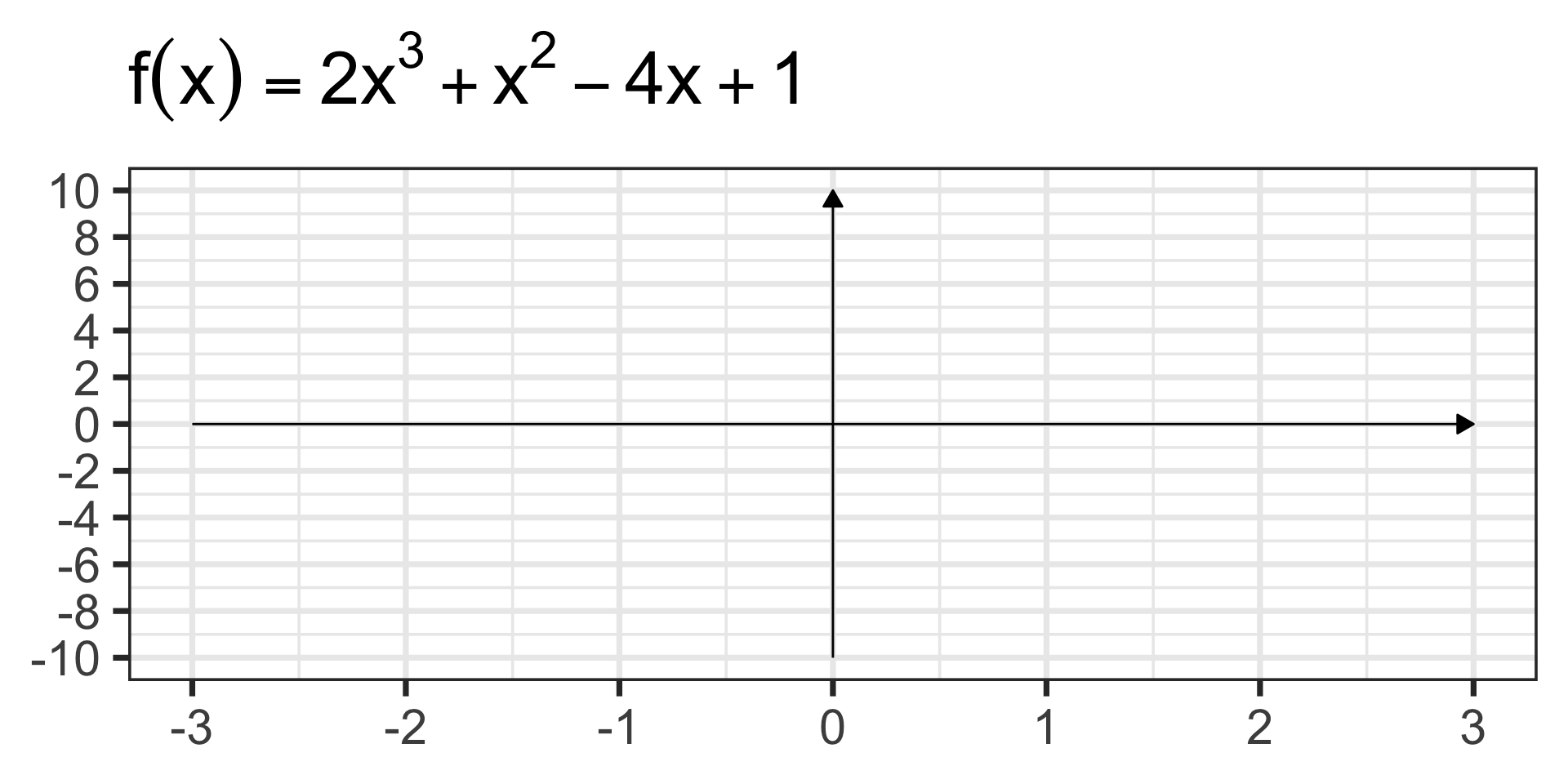
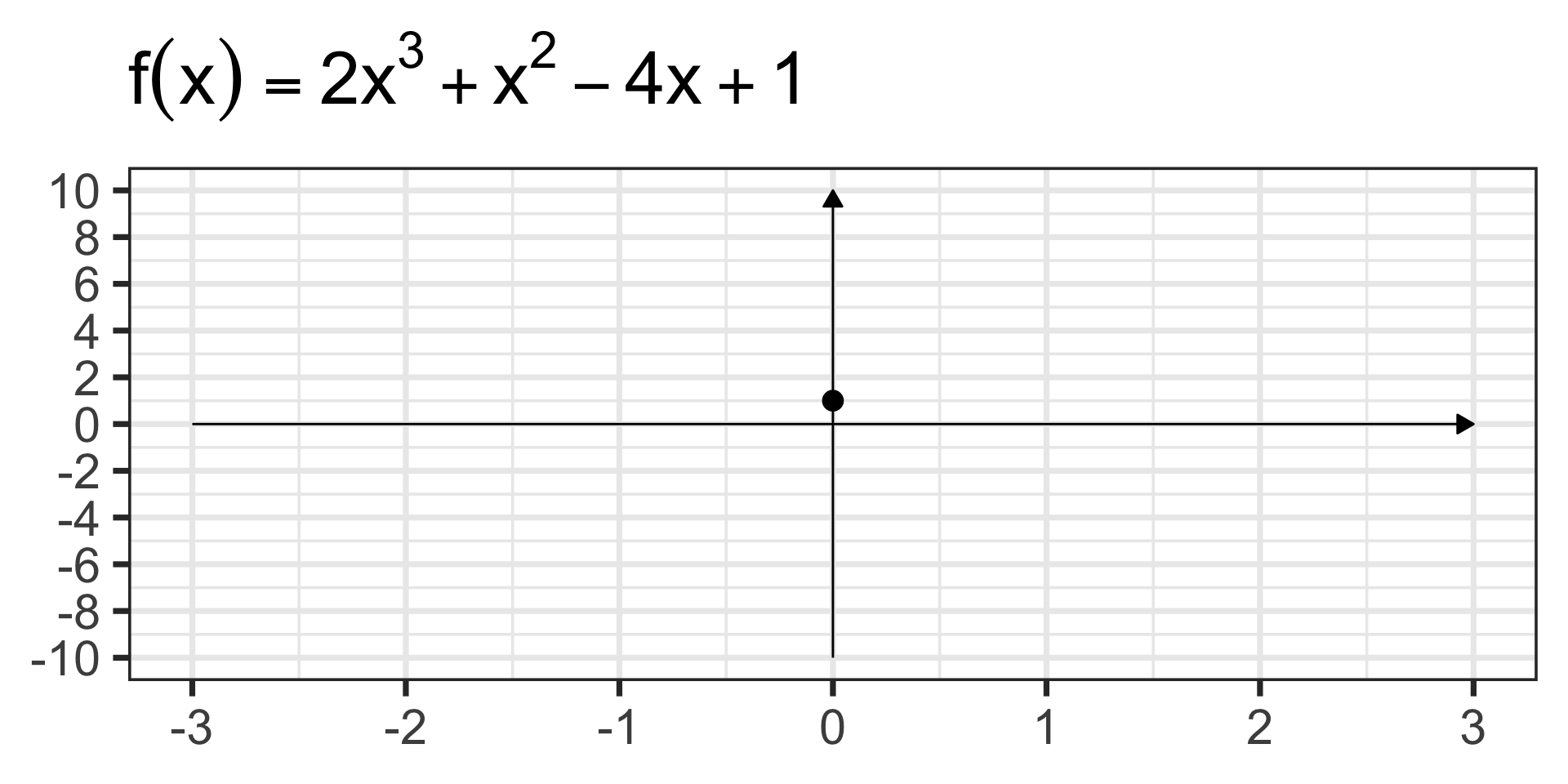
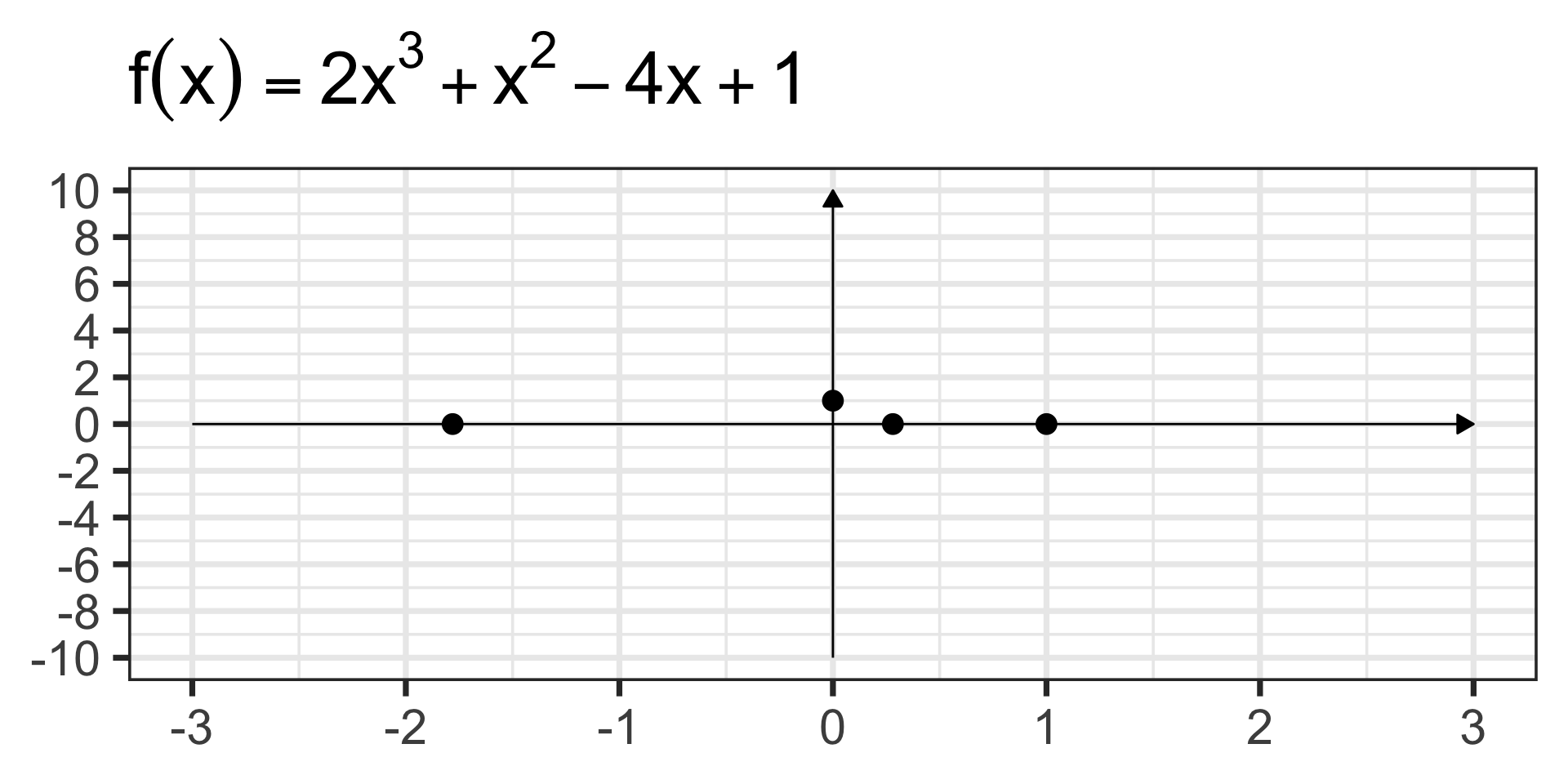
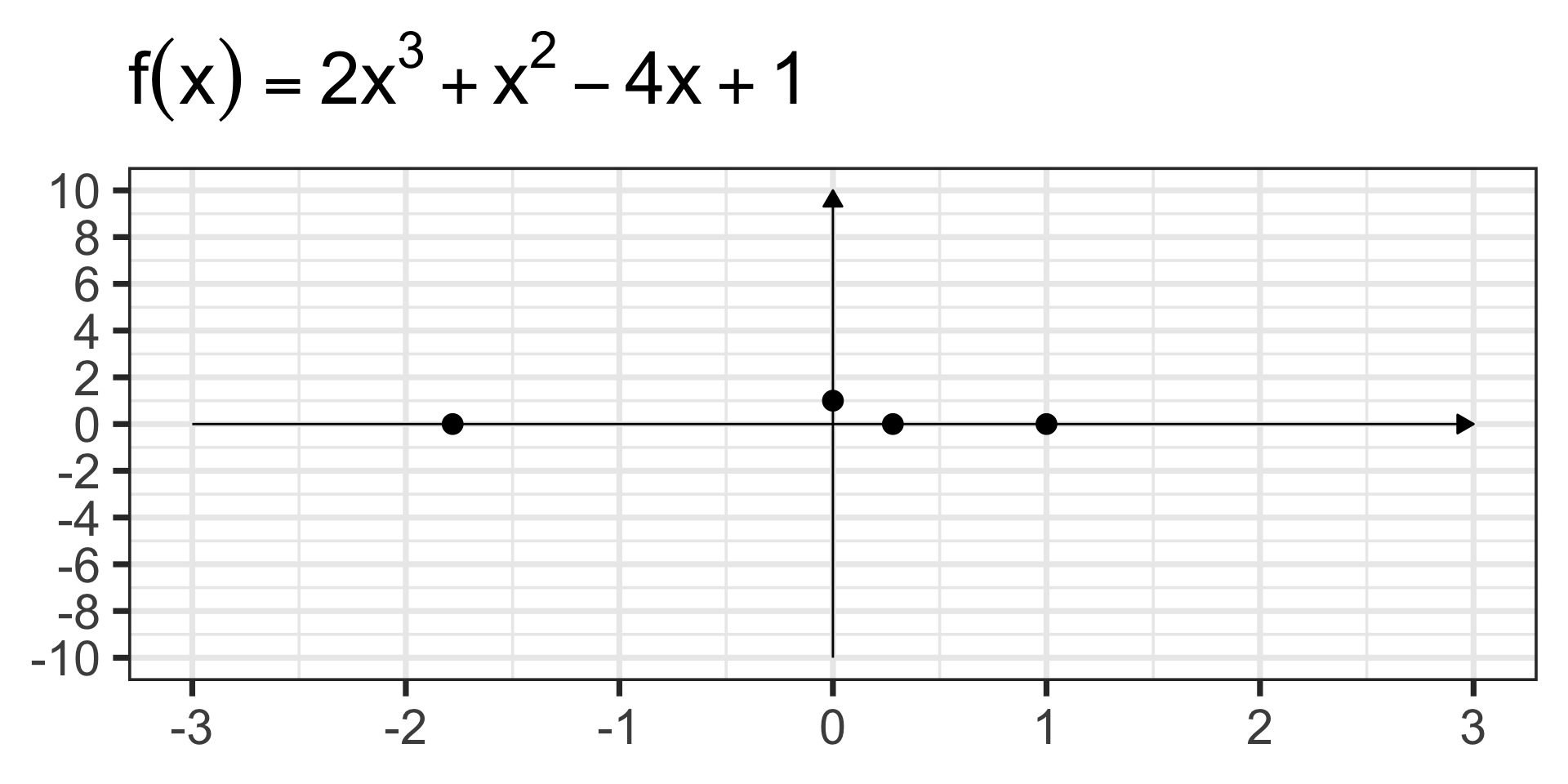
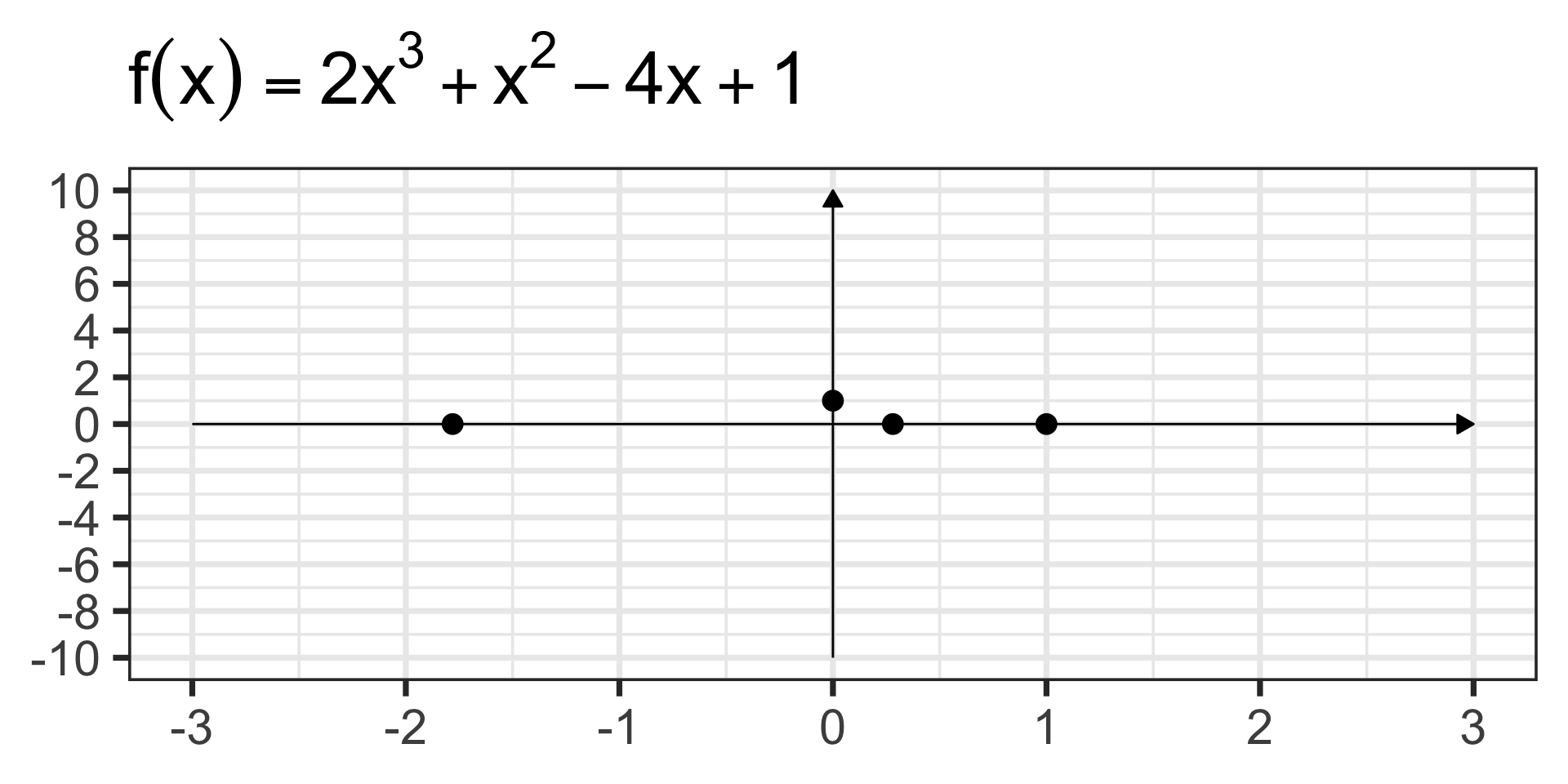
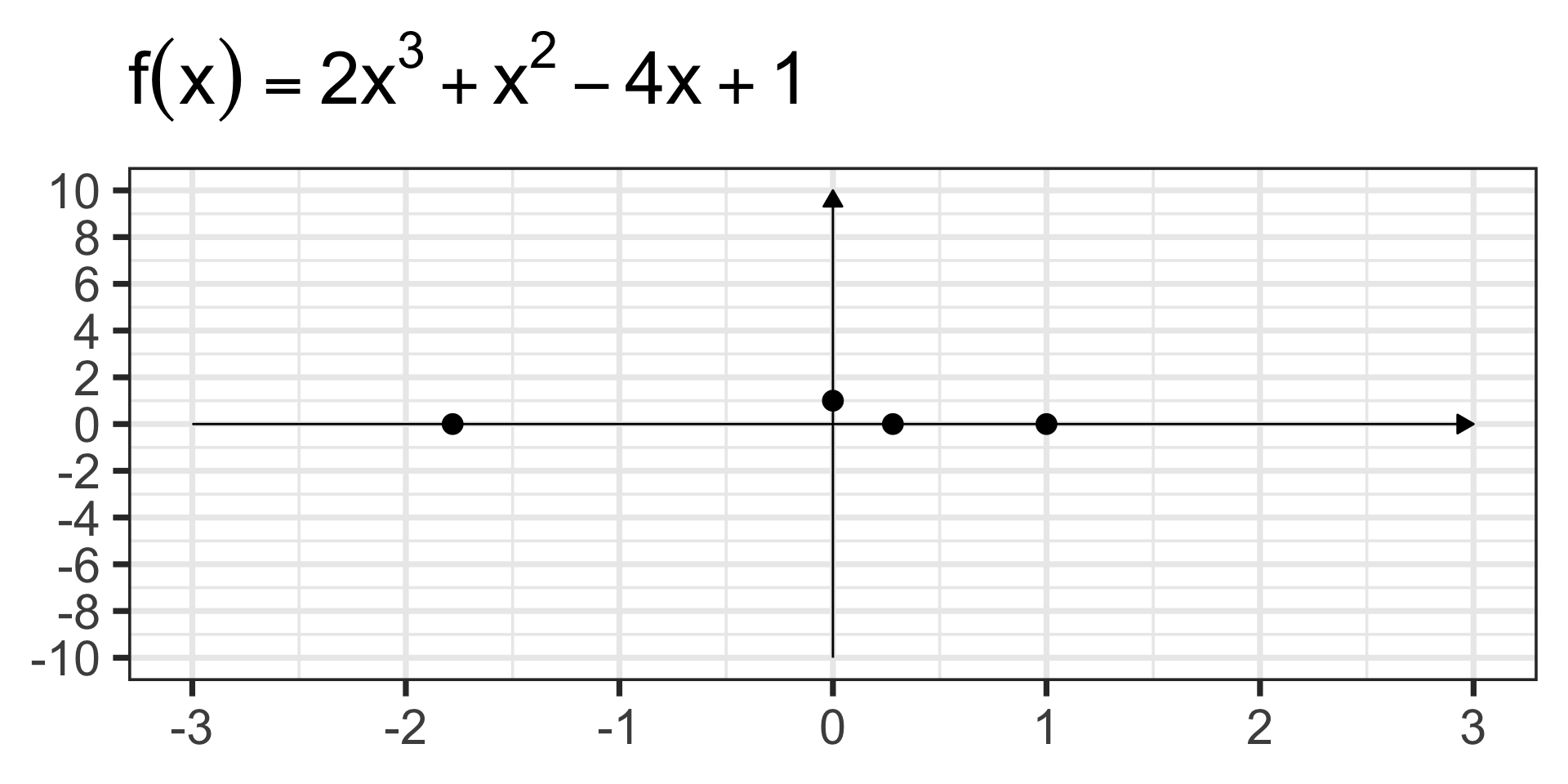
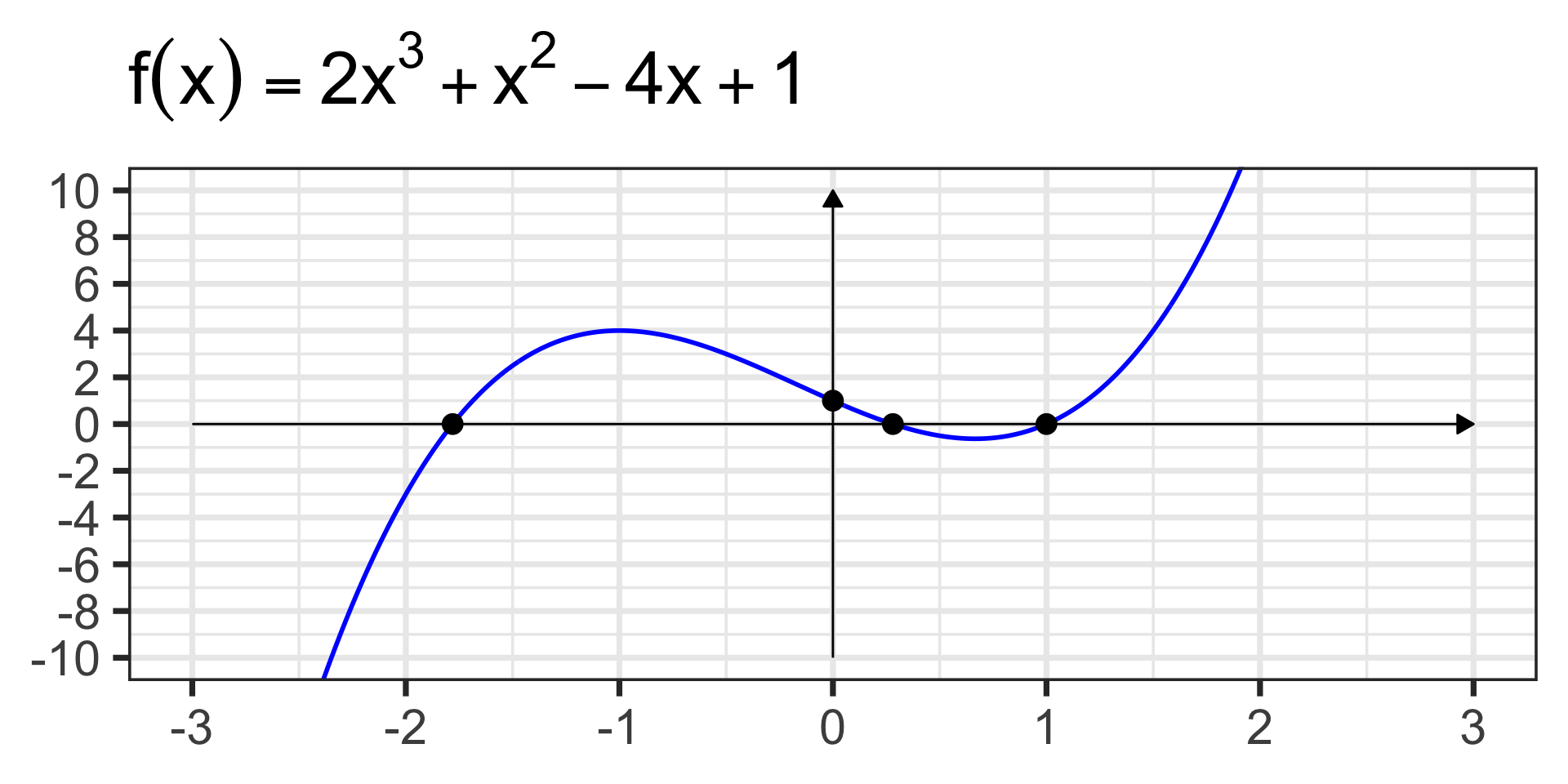
Example 5: Use your knowledge of the \(y\)-intercept, roots and multiplicities, and end behavior to sketch a graph of the function \(p\left(x\right) = 2x^3 + x^2 - 4x + 1\).
y-intercept:
Plotting a Polynomial
Example 5: Use your knowledge of the \(y\)-intercept, roots and multiplicities, and end behavior to sketch a graph of the function \(p\left(x\right) = 2x^3 + x^2 - 4x + 1\).
y-intercept: \(p\left(0\right) = 1\)
Roots:
Plotting a Polynomial
Example 5: Use your knowledge of the \(y\)-intercept, roots and multiplicities, and end behavior to sketch a graph of the function \(p\left(x\right) = 2x^3 + x^2 - 4x + 1\).
y-intercept: \(p\left(0\right) = 1\)
Roots: \(\boxed{~\displaystyle{x = 1,\quad x = \frac{-3 - \sqrt{17}}{4},\quad x = \frac{-3 + \sqrt{17}}{4}}~}\)
All roots have multiplicity 1, meaning…
Plotting a Polynomial
Example 5: Use your knowledge of the \(y\)-intercept, roots and multiplicities, and end behavior to sketch a graph of the function \(p\left(x\right) = 2x^3 + x^2 - 4x + 1\).
y-intercept: \(p\left(0\right) = 1\)
Roots: \(\boxed{~\displaystyle{x = 1,\quad x = \frac{-3 - \sqrt{17}}{4},\quad x = \frac{-3 + \sqrt{17}}{4}}~}\)
All roots have multiplicity 1, meaning that the function \(p\left(x\right)\) will pass through the \(x\)-axis at each root.
End Behavior:
- \(\displaystyle{\lim_{x\to -\infty}{p\left(x\right)}}\)
- \(\displaystyle{\lim_{x\to \infty}{p\left(x\right)}}\)
Plotting a Polynomial
Example 5: Use your knowledge of the \(y\)-intercept, roots and multiplicities, and end behavior to sketch a graph of the function \(p\left(x\right) = 2x^3 + x^2 - 4x + 1\).
y-intercept: \(p\left(0\right) = 1\)
Roots: \(\boxed{~\displaystyle{x = 1,\quad x = \frac{-3 - \sqrt{17}}{4},\quad x = \frac{-3 + \sqrt{17}}{4}}~}\)
All roots have multiplicity 1, meaning that the function \(p\left(x\right)\) will pass through the \(x\)-axis at each root.
End Behavior:
- \(\displaystyle{\lim_{x\to -\infty}{p\left(x\right)} = \lim_{x\to -\infty}{2x^3 + x^2 - 4x + 1}}\)
- \(\displaystyle{\lim_{x\to \infty}{p\left(x\right)} = \lim_{x\to \infty}{2x^3 + x^2 - 4x + 1}}\)
Plotting a Polynomial
Example 5: Use your knowledge of the \(y\)-intercept, roots and multiplicities, and end behavior to sketch a graph of the function \(p\left(x\right) = 2x^3 + x^2 - 4x + 1\).
y-intercept: \(p\left(0\right) = 1\)
Roots: \(\boxed{~\displaystyle{x = 1,\quad x = \frac{-3 - \sqrt{17}}{4},\quad x = \frac{-3 + \sqrt{17}}{4}}~}\)
All roots have multiplicity 1, meaning that the function \(p\left(x\right)\) will pass through the \(x\)-axis at each root.
End Behavior:
- \(\displaystyle{\lim_{x\to -\infty}{p\left(x\right)} = \lim_{x\to -\infty}{\stackrel{\color{red}{\left(-\right)}}{2x^3} + x^2 - 4x + 1}}\)
- \(\displaystyle{\lim_{x\to \infty}{p\left(x\right)} = \lim_{x\to \infty}{\stackrel{\color{red}{\left(+\right)}}{2x^3} + x^2 - 4x + 1}}\)
Plotting a Polynomial
Example 5: Use your knowledge of the \(y\)-intercept, roots and multiplicities, and end behavior to sketch a graph of the function \(p\left(x\right) = 2x^3 + x^2 - 4x + 1\).
y-intercept: \(p\left(0\right) = 1\)
Roots: \(\boxed{~\displaystyle{x = 1,\quad x = \frac{-3 - \sqrt{17}}{4},\quad x = \frac{-3 + \sqrt{17}}{4}}~}\)
All roots have multiplicity 1, meaning that the function \(p\left(x\right)\) will pass through the \(x\)-axis at each root.
End Behavior:
- \(\displaystyle{\lim_{x\to -\infty}{p\left(x\right)} = \lim_{x\to -\infty}{\stackrel{\color{red}{\left(-\right)}}{2x^3} + x^2 - 4x + 1} = -\infty}\)
- \(\displaystyle{\lim_{x\to \infty}{p\left(x\right)} = \lim_{x\to \infty}{\stackrel{\color{red}{\left(+\right)}}{2x^3} + x^2 - 4x + 1} = \infty}\)
Plotting a Polynomial Practice
Try It! 5: Consider the polynomial \(p\left(x\right) = x^3 + 6x^2 + 10x + 3\) you encountered in Try It! activities 1, 2, and 4. Find its \(y\)-intercept, all roots and multiplicities, and analyse its end behavior in order to sketch a graph of the polynomial function.
The Full Strategy Recap
Strategy (Finding All Roots and Graphing):
- Apply the Rational Roots Theorem to list candidates \(x = \pm\frac{p}{q}\).
- Test candidates until you find a root \(x = r\).
- Use long division to divide \(f\left(x\right)\) by \(\left(x - r\right)\), obtaining \(f\left(x\right) = \left(x - r\right)q\left(x\right)\), where the degree of \(q\left(x\right)\) is less than the degree of \(p\left(x\right)\).
- Repeat steps 1–3 on \(q\left(x\right)\) until you reach linear and quadratic factors.
- Apply the zero product property (and the quadratic formula for any remaining quadratic factors) to find all roots.
- Identify the multiplicity of each root and use it to determine behavior of the function at those roots.
- Roots with odd multiplicity will have crossings.
- Roots with even multiplicity will result in the graph bounding off the \(x\)-axis.
- Determine the \(y\)-intercept by evaluating \(p\left(0\right)\).
- Determine the end behavior by evaluating \(\displaystyle{\lim_{x\to -\infty}{p\left(x\right)}}\) and \(\displaystyle{\lim_{x\to \infty}{p\left(x\right)}}\) using either the dominance of the leading term (expanded/standard form) or by analysing the sign of each factor and determining the sign of the product (factored form).
- Sketch the function satisfying the properties you’ve discovered.
Exit Ticket Task
Navigate to our MAT142 Exit Ticket Form, answer the questions, and complete the task below.
Note. Today’s discussion is listed as 13. Polynomial Long Division and Factoring

Task: Consider \(f\left(x\right) = 2x^3 - 3x^2 - 11x + 6\).
\(\left(a\right)\) List all rational root candidates using the Rational Roots Theorem.
\(\left(b\right)\) Test \(x = 3\). Is it a root?
\(\left(c\right)\) If so, perform polynomial long division to write \(f\left(x\right) = \left(x - 3\right)q\left(x\right)\) and identify \(q\left(x\right)\).
Summary and Next Time…
- The Rational Roots Theorem says that any rational root of \(a_nx^n + \cdots + a_0\) must have the form \(\pm\frac{p}{q}\) where \(p\) divides \(a_0\) and \(q\) divides \(a_n\). It narrows candidates but doesn’t guarantee rational roots exist.
- Polynomial long division works exactly like integer long division: divide, multiply, subtract, bring down, repeat.
- A remainder of \(0\) means the divisor is a factor. A nonzero remainder means it is not.
- Together, these tools reduce any polynomial to a product of linear and quadratic factors, at which point all roots can be found.
- With polynomials complete, we move into rational functions — ratios of polynomials. The tools from the polynomial days (roots, end behavior, factoring) all carry forward, but rational functions introduce a new feature: vertical and horizontal asymptotes.
Rational Functions
Complete Homework 9 on MyOpenMath