MAT 142: Polynomial Functions and Equations (Part I)
July 28, 2026
Reminders
We’ve recently investigated quadratics:
- Quadratic Equations: \(ax^2 + bx + c = 0\)
- Solving by factoring
- Solving by the quadratic formula
- Solving by completing the square
- Quadratic functions:
- Standard form: \(f\left(x\right) = ax^2 + bx + c\)
- Vertex form: \(f\left(x\right) = a\left(x - h\right)^2 + k\)
- Geography of quadratics:
- \(y\)-intercept and roots
- Vertex and axis of symmetry
- Concavity
- End behavior (\(\displaystyle{\lim_{x\to \pm \infty}{f\left(x\right)}}\))
- Circles:
- Completing the square to obtain center-radius form: \(\left(x - h\right)^2 + \left(y - k\right)^2 = r^2\)
- Using the distance and midpoint formulas
Try the following warm-up problems.
Problem 1: Find all solutions to \(\left(x + 5\right)\left(-3x + 5\right) = 0\).
Problem 2: A student claims that the solutions to \(\left(x - 5\right)\left(x - 1\right) = 21\) are \(x = 5\) and \(x = 1\) because those values make each factor equal to zero. Is the student correct? If not, identify the error and find the actual solutions.
Note: Problem 2 is designed to surface a common mistake. Think carefully before answering.
Objectives
Today we generalize the ideas from linear and quadratic functions to the broader class of polynomial functions.
After today’s class meeting, you should be able to:
- Identify the leading term, leading coefficient, and degree of a polynomial.
- Solve polynomial equations that are in (or can be put into) factored form.
- Identify roots of a polynomial function and their multiplicities.
- Describe the behavior of a polynomial graph at each root based on multiplicity.
- Determine the end behavior of a polynomial function using limits.
- Combine all of the above to sketch the graph of a polynomial function.
Polynomial Equations
Definition (Polynomial Equation): A polynomial equation can be written in the form
\[a_nx^n + a_{n-1}x^{n-1} + \cdots + a_1x + a_0 = 0\]
For a polynomial \(a_nx^n + a_{n-1}x^{n-1} + \cdots + a_1x + a_0\):
- The leading term is \(a_nx^n\) – the term with the highest power.
- The leading coefficient is \(a_n\) – the coefficient on the highest power.
- The degree is \(n\) – the highest power of \(x\).
Linear (\(n = 1\)) and quadratic (\(n = 2\)) equations are both special cases of polynomials.
Solving Polynomial Equations
Strategy: The general approach for solving polynomial equations is the same as for quadratics:
- Write the equation with \(0\) on one side.
- Factor the expression completely.
- Apply the zero product property: if \(ab\cdots = 0\), then at least one factor equals \(0\).
Number of Solutions
A degree \(n\) polynomial equation has at most \(n\) real solutions. Counting complex solutions and multiplicities, it has exactly \(n\) solutions.
Solving Polynomial Equations I
Example 1: The polynomial equation \(4x^3 - 10x^2 -42x + 40 = 0\) can be partially factored into \(\left(2x + 5\right)\left(2x^2 - 10x + 8\right) = 0\). Find all solutions to the equation.
Solution. We already have \(0\) on the right side. Continue factoring the left side.
\[\begin{align} \left(2x + 5\right)\left(2x^2 - 10x + 8\right) &= 0 \end{align}\]
Solving Polynomial Equations I
Example 1: The polynomial equation \(4x^3 - 10x^2 -42x + 40 = 0\) can be partially factored into \(\left(2x + 5\right)\left(2x^2 - 10x + 8\right) = 0\). Find all solutions to the equation.
Solution. We already have \(0\) on the right side. Continue factoring the left side.
\[\begin{align} \left(2x + 5\right)\left(2x^2 - 10x + 8\right) &= 0\\ \implies 2\left(2x + 5\right)\left(x^2 - 5x + 4\right) &= 0 \end{align}\]
Solving Polynomial Equations I
Example 1: The polynomial equation \(4x^3 - 10x^2 -42x + 40 = 0\) can be partially factored into \(\left(2x + 5\right)\left(2x^2 - 10x + 8\right) = 0\). Find all solutions to the equation.
Solution. We already have \(0\) on the right side. Continue factoring the left side.
\[\begin{align} \left(2x + 5\right)\left(2x^2 - 10x + 8\right) &= 0\\ \implies 2\left(2x + 5\right)\left(x^2 - 5x + 4\right) &= 0\\ \implies 2\left(2x + 5\right)\left(x - 4\right)\left(x - 1\right) &= 0 \end{align}\]
From factored form, we use the zero product property.
\[\begin{align} 2x + 5 &= 0 & &\text{or} & x - 4 &= 0 & &\text{or} & x - 1 &= 0 \end{align}\]
Solving Polynomial Equations I
Example 1: The polynomial equation \(4x^3 - 10x^2 -42x + 40 = 0\) can be partially factored into \(\left(2x + 5\right)\left(2x^2 - 10x + 8\right) = 0\). Find all solutions to the equation.
Solution. We already have \(0\) on the right side. Continue factoring the left side.
\[\begin{align} \left(2x + 5\right)\left(2x^2 - 10x + 8\right) &= 0\\ \implies 2\left(2x + 5\right)\left(x^2 - 5x + 4\right) &= 0\\ \implies 2\left(2x + 5\right)\left(x - 4\right)\left(x - 1\right) &= 0 \end{align}\]
From factored form, we use the zero product property.
\[\begin{align} 2x + 5 &= 0 & &\text{or} & x - 4 &= 0 & &\text{or} & x - 1 &= 0\\ \implies 2x &= -5 & &\text{or} & x &= 4 & &\text{or} & x &= 1 \end{align}\]
Solving Polynomial Equations I
Example 1: The polynomial equation \(4x^3 - 10x^2 -42x + 40 = 0\) can be partially factored into \(\left(2x + 5\right)\left(2x^2 - 10x + 8\right) = 0\). Find all solutions to the equation.
Solution. We already have \(0\) on the right side. Continue factoring the left side.
\[\begin{align} \left(2x + 5\right)\left(2x^2 - 10x + 8\right) &= 0\\ \implies 2\left(2x + 5\right)\left(x^2 - 5x + 4\right) &= 0\\ \implies 2\left(2x + 5\right)\left(x - 4\right)\left(x - 1\right) &= 0 \end{align}\]
From factored form, we use the zero product property.
\[\begin{align} 2x + 5 &= 0 & &\text{or} & x - 4 &= 0 & &\text{or} & x - 1 &= 0\\ \implies 2x &= -5 & &\text{or} & x &= 4 & &\text{or} & x &= 1\\ \implies x &= \frac{-5}{2} & & & & & & & & \end{align}\]
So we have three distinct solutions, \(\boxed{~x = -5/2~}\), \(\boxed{~x = 4~}\), or \(\boxed{~x = 1~}\).
Notice that this was a degree-three polynomial, so three solutions is exactly what we expect (though those solutions may not all be distinct, or real, generally).
Multiplicity of a Root/Solution
Definition (Multiplicity): If \(\left(x - a\right)^k\) appears in the fully factored form of a polynomial, then \(x = a\) is a root of multiplicity \(k\).
For example, the equation \(x^2 + 6x + 9 = 0\) has factored form \(\left(x + 3\right)^2 = 0\), and has only one solution. That solution is \(x = -3\), but \(-3\) is a root of multiplicity two. It results from a factor that appears twice.
Counting multiplicities and complex solutions, a degree \(n\) polynomial always has exactly \(n\) solutions.
Solutions and their Multiplicities
Example 2: Find all solutions to \(\left(x^2 - 5x + 6\right)\left(x^2 + x + 4\right)\left(x - 8\right)^3 = 0\), including complex roots and multiplicities.
Solution.
\[\begin{align} \left(x^2 - 5x + 6\right)\left(x^2 + x + 4\right)\left(x - 8\right)^3 &= 0 \end{align}\]
Solutions and their Multiplicities
Example 2: Find all solutions to \(\left(x^2 - 5x + 6\right)\left(x^2 + x + 4\right)\left(x - 8\right)^3 = 0\), including complex roots and multiplicities.
Solution.
\[\begin{align} \left(x^2 - 5x + 6\right)\left(x^2 + x + 4\right)\left(x - 8\right)^3 &= 0\\ \implies \left(x - 3\right)\left(x - 2\right)\left(x^2 + x + 4\right)\left(x - 8\right)^3 &= 0 \end{align}\]
Reading the solutions directly from the linear factors, we have \(x = 3\) (multiplicity 1), \(x = 2\) (multiplicity 1), \(x = 8\) (multiplicity 3).
That accounts for \(1 + 1 + 3 = 5\) solutions.
The total degree of the polynomial is \(2 + 2 + 3 = 7\) (remember that we add exponents when multiplying factors with like bases, so \(x^2\cdot x^2\cdot x^3 = x^7\)).
Because of this, two solutions remain, and we know that they come from \(x^2 + x + 4 = 0\):
\[\begin{align} x &= \frac{-1 \pm \sqrt{\left(1 - 16\right)}}{2} \end{align}\]
Solutions and their Multiplicities
Example 2: Find all solutions to \(\left(x^2 - 5x + 6\right)\left(x^2 + x + 4\right)\left(x - 8\right)^3 = 0\), including complex roots and multiplicities.
Solution.
\[\begin{align} \left(x^2 - 5x + 6\right)\left(x^2 + x + 4\right)\left(x - 8\right)^3 &= 0\\ \implies \left(x - 3\right)\left(x - 2\right)\left(x^2 + x + 4\right)\left(x - 8\right)^3 &= 0 \end{align}\]
Reading the solutions directly from the linear factors, we have \(x = 3\) (multiplicity 1), \(x = 2\) (multiplicity 1), \(x = 8\) (multiplicity 3).
That accounts for \(1 + 1 + 3 = 5\) solutions.
The total degree of the polynomial is \(2 + 2 + 3 = 7\) (remember that we add exponents when multiplying factors with like bases, so \(x^2\cdot x^2\cdot x^3 = x^7\)).
Because of this, two solutions remain, and we know that they come from \(x^2 + x + 4 = 0\):
\[\begin{align} x &= \frac{-1 \pm \sqrt{\left(1 - 16\right)}}{2} = \frac{-1 \pm \sqrt{-15}}{2} \end{align}\]
Solutions and their Multiplicities
Example 2: Find all solutions to \(\left(x^2 - 5x + 6\right)\left(x^2 + x + 4\right)\left(x - 8\right)^3 = 0\), including complex roots and multiplicities.
Solution.
\[\begin{align} \left(x^2 - 5x + 6\right)\left(x^2 + x + 4\right)\left(x - 8\right)^3 &= 0\\ \implies \left(x - 3\right)\left(x - 2\right)\left(x^2 + x + 4\right)\left(x - 8\right)^3 &= 0 \end{align}\]
Reading the solutions directly from the linear factors, we have \(x = 3\) (multiplicity 1), \(x = 2\) (multiplicity 1), \(x = 8\) (multiplicity 3).
That accounts for \(1 + 1 + 3 = 5\) solutions.
The total degree of the polynomial is \(2 + 2 + 3 = 7\) (remember that we add exponents when multiplying factors with like bases, so \(x^2\cdot x^2\cdot x^3 = x^7\)).
Because of this, two solutions remain, and we know that they come from \(x^2 + x + 4 = 0\):
\[\begin{align} x &= \frac{-1 \pm \sqrt{\left(1 - 16\right)}}{2} = \frac{-1 \pm \sqrt{-15}}{2} = \frac{-1 \pm i\sqrt{15}}{2} \end{align}\]
Solutions and their Multiplicities
Example 2: Find all solutions to \(\left(x^2 - 5x + 6\right)\left(x^2 + x + 4\right)\left(x - 8\right)^3 = 0\), including complex roots and multiplicities.
Solution.
\[\begin{align} \left(x^2 - 5x + 6\right)\left(x^2 + x + 4\right)\left(x - 8\right)^3 &= 0\\ \implies \left(x - 3\right)\left(x - 2\right)\left(x^2 + x + 4\right)\left(x - 8\right)^3 &= 0 \end{align}\]
Reading the solutions directly from the linear factors, we have \(x = 3\) (multiplicity 1), \(x = 2\) (multiplicity 1), \(x = 8\) (multiplicity 3).
That accounts for \(1 + 1 + 3 = 5\) solutions.
The total degree of the polynomial is \(2 + 2 + 3 = 7\) (remember that we add exponents when multiplying factors with like bases, so \(x^2\cdot x^2\cdot x^3 = x^7\)).
Because of this, two solutions remain, and we know that they come from \(x^2 + x + 4 = 0\):
\[\begin{align} x &= \frac{-1 \pm \sqrt{\left(1 - 16\right)}}{2} = \frac{-1 \pm \sqrt{-15}}{2} = \frac{-1 \pm i\sqrt{15}}{2} = \frac{-1}{2} \pm \frac{\sqrt{15}}{2}i \end{align}\]
The two complex solutions are a conjugate pair, as expected. All \(7\) solutions accounted for. \(\checkmark\)
Solving Polynomial Equations Practice
Try It! 1: Find all solutions to \(\left(x^2 + 9\right)\left(x^2 - 11x + 30\right)^2 = 0\).
Before solving, answer: what is the degree of this polynomial? How many solutions should you find (counting multiplicities and complex solutions)?
Reminder: Check that your solution count matches the degree when you’re done.
Polynomial Functions
Definition (Polynomial Function): A function of the form
\[f\left(x\right) = a_nx^n + a_{n-1}x^{n-1} + \cdots + a_1x + a_0\]
is a polynomial function. Its graph is a smooth, continuous curve.
To sketch the graph of a polynomial function, we identify five things:
- \(y\)-intercept: evaluate \(f\left(0\right)\)
- Roots and multiplicities: solve \(f\left(x\right) = 0\)
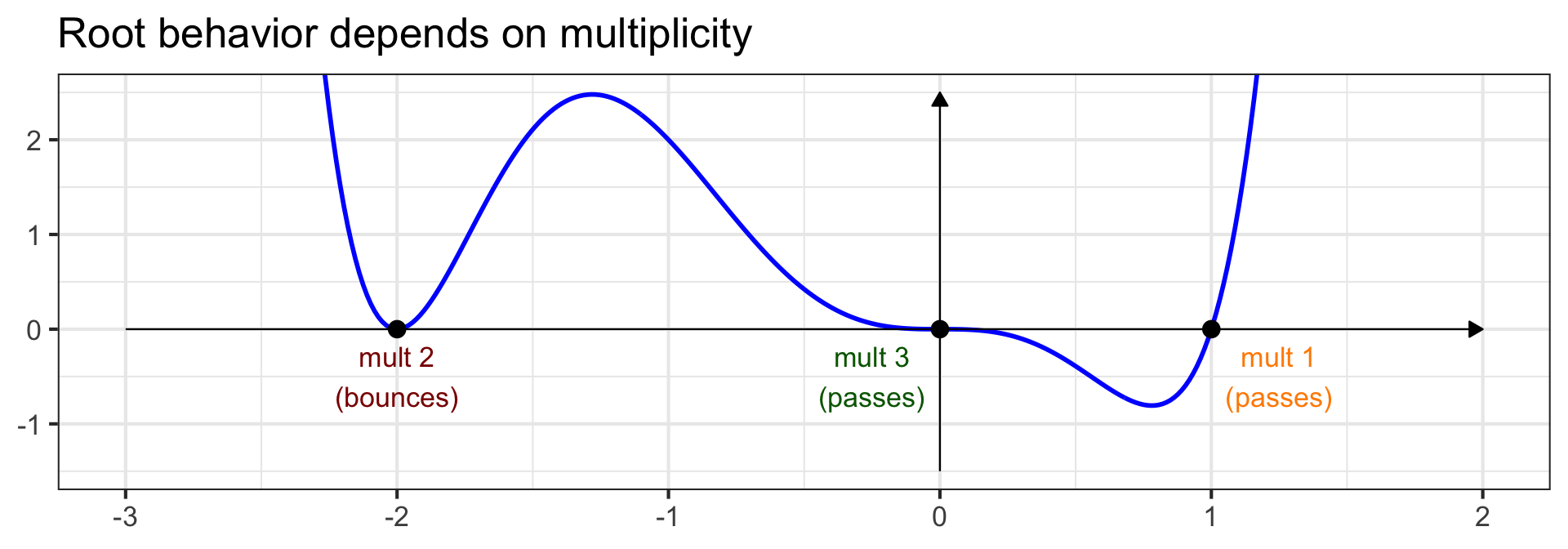
- Root behavior: The multiplicity of each root determines the function’s behavior at that point.
- If the root \(x = a\) is a root with odd multiplicity, the graph of \(f\left(x\right)\) passes through the \(x\)-axis at that root.
- If the root \(x = a\) is a root with even multiplicity, the graph of \(f\left(x\right)\) bounces off of the \(x\)-axis at that root.
- End behavior: analyze using limits by either focusing on the leading term or the sign on each of the factors in factored form.
- \(\displaystyle{\lim_{x\to -\infty}{f\left(x\right)}}\)
- \(\displaystyle{\lim_{x\to +\infty}{f\left(x\right)}}\)
- Rough shape: connect the dots using the root behavior, \(y\)-intercept, and end behavior.
Roots and Multiplicity – Graph Behavior
The multiplicity of a root determines how the graph behaves at that \(x\)-intercept:
- If the root \(x = a\) is a root with odd multiplicity, the graph of \(f\left(x\right)\) passes through the \(x\)-axis at that root.
- If the root \(x = a\) is a root with even multiplicity, the graph of \(f\left(x\right)\) bounces off of the \(x\)-axis at that root.
\[f\left(x\right) = x^3\left(x - 1\right)\left(x + 2\right)^2\]
End Behavior of Polynomial Functions
Just as with quadratics, the leading term \(a_nx^n\) determines end behavior.
| Leading coefficient | Degree | \(\displaystyle{\lim_{x\to -\infty}}\) | \(\displaystyle{\lim_{x\to \infty}}\) |
|---|---|---|---|
| \(a_n > 0\) | even | \(+\infty\) | \(+\infty\) |
| \(a_n < 0\) | even | \(-\infty\) | \(-\infty\) |
| \(a_n > 0\) | odd | \(-\infty\) | \(+\infty\) |
| \(a_n < 0\) | odd | \(+\infty\) | \(-\infty\) |
From Factored Form: If your polynomial function is in factored form, for example \(f\left(x\right) = \left(x - a_1\right)^{n_1}\left(x - a_2\right)^{n_2}\cdots\left(x - a_k\right)^{n_k}\), then analyse the limiting sign of each factor when \(x\) approaches \(-\infty\) and again when \(x\) approaches \(\infty\), and determine whether the ultimate product will be positive or negative.
Remember Your “Book Functions”
- Even-degree polynomials behave like parabolas (both ends go the same direction).
- Odd-degree polynomials behave like cubics (ends go opposite directions).
Graphing a Polynomial
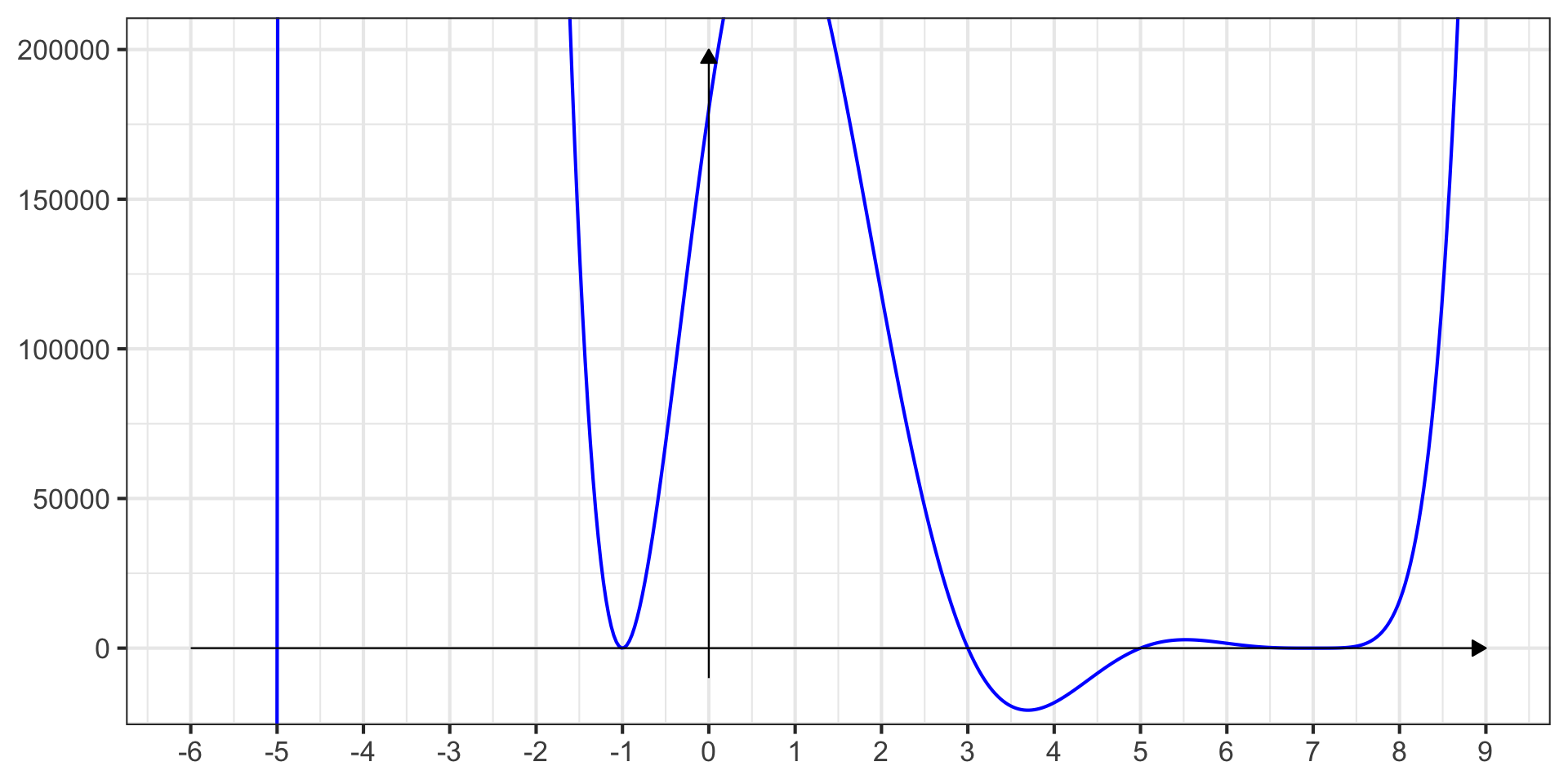
Example 3: For \(g\left(x\right) = \left(x + 5\right)\left(x + 1\right)^2\left(x - 3\right)\left(x - 5\right)\left(x - 7\right)^4\), find the \(y\)-intercept, roots and their multiplicities, determine the end behavior, and sketch an approximate graph.
Solution.
\(y\)-intercept: \(g\left(0\right) = \left(0 + 5\right)\left(0 + 1\right)^2\left(0 - 3\right)\left(0 - 5\right)\left(0 - 7\right)^4\)
Graphing a Polynomial
Example 3: For \(g\left(x\right) = \left(x + 5\right)\left(x + 1\right)^2\left(x - 3\right)\left(x - 5\right)\left(x - 7\right)^4\), find the \(y\)-intercept, roots and their multiplicities, determine the end behavior, and sketch an approximate graph.
Solution.
\(y\)-intercept: \(g\left(0\right) = 5 \cdot \left(1\right)^2 \cdot \left(-3\right) \cdot \left(-5\right) \cdot \left(-7\right)^4\)
Graphing a Polynomial
Example 3: For \(g\left(x\right) = \left(x + 5\right)\left(x + 1\right)^2\left(x - 3\right)\left(x - 5\right)\left(x - 7\right)^4\), find the \(y\)-intercept, roots and their multiplicities, determine the end behavior, and sketch an approximate graph.
Solution.
\(y\)-intercept: \(g\left(0\right) = 5 \cdot 1 \cdot \left(-3\right) \cdot \left(-5\right) \cdot 2401\)
Graphing a Polynomial
Example 3: For \(g\left(x\right) = \left(x + 5\right)\left(x + 1\right)^2\left(x - 3\right)\left(x - 5\right)\left(x - 7\right)^4\), find the \(y\)-intercept, roots and their multiplicities, determine the end behavior, and sketch an approximate graph.
Solution.
\(y\)-intercept: \(g\left(0\right) = 180{,}075\)
Roots and multiplicities:
- \(x = -5\): multiplicity \(1\), so passes through
- \(x = -1\): multiplicity \(2\), so bounces
- \(x = 3\): multiplicity \(1\), so passes through
- \(x = 5\): multiplicity \(1\), so passes through
- \(x = 7\): multiplicity \(4\), so bounces
End behavior: We’ll evaluate \(\displaystyle{\lim_{x\to -\infty}{g\left(x\right)}}\) and \(\displaystyle{\lim_{x\to \infty}{g\left(x\right)}}\) separately.
\[\begin{align} \lim_{x\to -\infty}{g\left(x\right)} &= \lim_{x\to -\infty}{\left(x + 5\right)\left(x + 1\right)^2\left(x - 3\right)\left(x - 5\right)\left(x - 7\right)^4} \end{align}\]
Graphing a Polynomial
Example 3: For \(g\left(x\right) = \left(x + 5\right)\left(x + 1\right)^2\left(x - 3\right)\left(x - 5\right)\left(x - 7\right)^4\), find the \(y\)-intercept, roots and their multiplicities, determine the end behavior, and sketch an approximate graph.
Solution.
\(y\)-intercept: \(g\left(0\right) = 180{,}075\)
Roots and multiplicities:
- \(x = -5\): multiplicity \(1\), so passes through
- \(x = -1\): multiplicity \(2\), so bounces
- \(x = 3\): multiplicity \(1\), so passes through
- \(x = 5\): multiplicity \(1\), so passes through
- \(x = 7\): multiplicity \(4\), so bounces
End behavior: We’ll evaluate \(\displaystyle{\lim_{x\to -\infty}{g\left(x\right)}}\) and \(\displaystyle{\lim_{x\to \infty}{g\left(x\right)}}\) separately.
\[\begin{align} \lim_{x\to -\infty}{g\left(x\right)} &= \lim_{x\to -\infty}{\left(x + 5\right)\left(x + 1\right)^2\left(x - 3\right)\left(x - 5\right)\left(x - 7\right)^4}\\ &= \lim_{x\to -\infty}{\stackrel{\color{red}{\left(-\right)}}{\left(x + 5\right)}\stackrel{\color{red}{\left(+\right)}}{\left(x + 1\right)^2}\stackrel{\color{red}{\left(-\right)}}{\left(x - 3\right)}\stackrel{\color{red}{\left(-\right)}}{\left(x - 5\right)}\stackrel{\color{red}{\left(+\right)}}{\left(x - 7\right)^4}} \end{align}\]
Graphing a Polynomial
Example 3: For \(g\left(x\right) = \left(x + 5\right)\left(x + 1\right)^2\left(x - 3\right)\left(x - 5\right)\left(x - 7\right)^4\), find the \(y\)-intercept, roots and their multiplicities, determine the end behavior, and sketch an approximate graph.
Solution.
\(y\)-intercept: \(g\left(0\right) = 180{,}075\)
Roots and multiplicities:
- \(x = -5\): multiplicity \(1\), so passes through
- \(x = -1\): multiplicity \(2\), so bounces
- \(x = 3\): multiplicity \(1\), so passes through
- \(x = 5\): multiplicity \(1\), so passes through
- \(x = 7\): multiplicity \(4\), so bounces
End behavior: We’ll evaluate \(\displaystyle{\lim_{x\to -\infty}{g\left(x\right)}}\) and \(\displaystyle{\lim_{x\to \infty}{g\left(x\right)}}\) separately.
\[\begin{align} \lim_{x\to -\infty}{g\left(x\right)} &= \lim_{x\to -\infty}{\left(x + 5\right)\left(x + 1\right)^2\left(x - 3\right)\left(x - 5\right)\left(x - 7\right)^4}\\ &= \lim_{x\to -\infty}{\stackrel{\color{red}{\left(-\right)}}{\left(x + 5\right)}\stackrel{\color{red}{\left(+\right)}}{\left(x + 1\right)^2}\stackrel{\color{red}{\left(-\right)}}{\left(x - 3\right)}\stackrel{\color{red}{\left(-\right)}}{\left(x - 5\right)}\stackrel{\color{red}{\left(+\right)}}{\left(x - 7\right)^4}}\\ &= -\infty \end{align}\]
Graphing a Polynomial
Example 3: For \(g\left(x\right) = \left(x + 5\right)\left(x + 1\right)^2\left(x - 3\right)\left(x - 5\right)\left(x - 7\right)^4\), find the \(y\)-intercept, roots and their multiplicities, determine the end behavior, and sketch an approximate graph.
Solution.
\(y\)-intercept: \(g\left(0\right) = 180{,}075\)
Roots and multiplicities:
- \(x = -5\): multiplicity \(1\), so passes through
- \(x = -1\): multiplicity \(2\), so bounces
- \(x = 3\): multiplicity \(1\), so passes through
- \(x = 5\): multiplicity \(1\), so passes through
- \(x = 7\): multiplicity \(4\), so bounces
End behavior: We’ll evaluate \(\displaystyle{\lim_{x\to -\infty}{g\left(x\right)}}\) and \(\displaystyle{\lim_{x\to \infty}{g\left(x\right)}}\) separately.
\[\begin{align} \lim_{x\to -\infty}{g\left(x\right)} &= \lim_{x\to -\infty}{\left(x + 5\right)\left(x + 1\right)^2\left(x - 3\right)\left(x - 5\right)\left(x - 7\right)^4}\\ &= \lim_{x\to -\infty}{\stackrel{\color{red}{\left(-\right)}}{\left(x + 5\right)}\stackrel{\color{red}{\left(+\right)}}{\left(x + 1\right)^2}\stackrel{\color{red}{\left(-\right)}}{\left(x - 3\right)}\stackrel{\color{red}{\left(-\right)}}{\left(x - 5\right)}\stackrel{\color{red}{\left(+\right)}}{\left(x - 7\right)^4}}\\ &= -\infty\\ \lim_{x\to\infty}g\left(x\right) &= \lim_{x\to \infty}{\left(x + 5\right)\left(x + 1\right)^2\left(x - 3\right)\left(x - 5\right)\left(x - 7\right)^4} \end{align}\]
Graphing a Polynomial
Example 3: For \(g\left(x\right) = \left(x + 5\right)\left(x + 1\right)^2\left(x - 3\right)\left(x - 5\right)\left(x - 7\right)^4\), find the \(y\)-intercept, roots and their multiplicities, determine the end behavior, and sketch an approximate graph.
Solution.
\(y\)-intercept: \(g\left(0\right) = 180{,}075\)
Roots and multiplicities:
- \(x = -5\): multiplicity \(1\), so passes through
- \(x = -1\): multiplicity \(2\), so bounces
- \(x = 3\): multiplicity \(1\), so passes through
- \(x = 5\): multiplicity \(1\), so passes through
- \(x = 7\): multiplicity \(4\), so bounces
End behavior: We’ll evaluate \(\displaystyle{\lim_{x\to -\infty}{g\left(x\right)}}\) and \(\displaystyle{\lim_{x\to \infty}{g\left(x\right)}}\) separately.
\[\begin{align} \lim_{x\to -\infty}{g\left(x\right)} &= \lim_{x\to -\infty}{\left(x + 5\right)\left(x + 1\right)^2\left(x - 3\right)\left(x - 5\right)\left(x - 7\right)^4}\\ &= \lim_{x\to -\infty}{\stackrel{\color{red}{\left(-\right)}}{\left(x + 5\right)}\stackrel{\color{red}{\left(+\right)}}{\left(x + 1\right)^2}\stackrel{\color{red}{\left(-\right)}}{\left(x - 3\right)}\stackrel{\color{red}{\left(-\right)}}{\left(x - 5\right)}\stackrel{\color{red}{\left(+\right)}}{\left(x - 7\right)^4}}\\ &= -\infty\\ \lim_{x\to\infty}g\left(x\right) &= \lim_{x\to \infty}{\left(x + 5\right)\left(x + 1\right)^2\left(x - 3\right)\left(x - 5\right)\left(x - 7\right)^4}\\ &= \lim_{x\to \infty}{\stackrel{\color{red}{\left(+\right)}}{\left(x + 5\right)}\stackrel{\color{red}{\left(+\right)}}{\left(x + 1\right)^2}\stackrel{\color{red}{\left(+\right)}}{\left(x - 3\right)}\stackrel{\color{red}{\left(+\right)}}{\left(x - 5\right)}\stackrel{\color{red}{\left(+\right)}}{\left(x - 7\right)^4}} \end{align}\]
Graphing a Polynomial
Example 3: For \(g\left(x\right) = \left(x + 5\right)\left(x + 1\right)^2\left(x - 3\right)\left(x - 5\right)\left(x - 7\right)^4\), find the \(y\)-intercept, roots and their multiplicities, determine the end behavior, and sketch an approximate graph.
Solution.
\(y\)-intercept: \(g\left(0\right) = 180{,}075\)
Roots and multiplicities:
- \(x = -5\): multiplicity \(1\), so passes through
- \(x = -1\): multiplicity \(2\), so bounces
- \(x = 3\): multiplicity \(1\), so passes through
- \(x = 5\): multiplicity \(1\), so passes through
- \(x = 7\): multiplicity \(4\), so bounces
End behavior: We’ll evaluate \(\displaystyle{\lim_{x\to -\infty}{g\left(x\right)}}\) and \(\displaystyle{\lim_{x\to \infty}{g\left(x\right)}}\) separately.
\[\begin{align} \lim_{x\to -\infty}{g\left(x\right)} &= \lim_{x\to -\infty}{\left(x + 5\right)\left(x + 1\right)^2\left(x - 3\right)\left(x - 5\right)\left(x - 7\right)^4}\\ &= \lim_{x\to -\infty}{\stackrel{\color{red}{\left(-\right)}}{\left(x + 5\right)}\stackrel{\color{red}{\left(+\right)}}{\left(x + 1\right)^2}\stackrel{\color{red}{\left(-\right)}}{\left(x - 3\right)}\stackrel{\color{red}{\left(-\right)}}{\left(x - 5\right)}\stackrel{\color{red}{\left(+\right)}}{\left(x - 7\right)^4}}\\ &= -\infty\\ \lim_{x\to\infty}g\left(x\right) &= \lim_{x\to \infty}{\left(x + 5\right)\left(x + 1\right)^2\left(x - 3\right)\left(x - 5\right)\left(x - 7\right)^4}\\ &= \lim_{x\to \infty}{\stackrel{\color{red}{\left(+\right)}}{\left(x + 5\right)}\stackrel{\color{red}{\left(+\right)}}{\left(x + 1\right)^2}\stackrel{\color{red}{\left(+\right)}}{\left(x - 3\right)}\stackrel{\color{red}{\left(+\right)}}{\left(x - 5\right)}\stackrel{\color{red}{\left(+\right)}}{\left(x - 7\right)^4}}\\ &= \infty \end{align}\]
Graphing a Polynomial
Example 3: For \(g\left(x\right) = \left(x + 5\right)\left(x + 1\right)^2\left(x - 3\right)\left(x - 5\right)\left(x - 7\right)^4\), find the \(y\)-intercept, roots and their multiplicities, determine the end behavior, and sketch an approximate graph.
Solution.
\(y\)-intercept: \(g\left(0\right) = 180{,}075\)
Roots and multiplicities:
- \(x = -5\): multiplicity \(1\), so passes through
- \(x = -1\): multiplicity \(2\), so bounces
- \(x = 3\): multiplicity \(1\), so passes through
- \(x = 5\): multiplicity \(1\), so passes through
- \(x = 7\): multiplicity \(4\), so bounces
End behavior: We’ll evaluate \(\displaystyle{\lim_{x\to -\infty}{g\left(x\right)}}\) and \(\displaystyle{\lim_{x\to \infty}{g\left(x\right)}}\) separately.
\[\begin{align} \lim_{x\to -\infty}{g\left(x\right)} &= \lim_{x\to -\infty}{\left(x + 5\right)\left(x + 1\right)^2\left(x - 3\right)\left(x - 5\right)\left(x - 7\right)^4}\\ &= \lim_{x\to -\infty}{\stackrel{\color{red}{\left(-\right)}}{\left(x + 5\right)}\stackrel{\color{red}{\left(+\right)}}{\left(x + 1\right)^2}\stackrel{\color{red}{\left(-\right)}}{\left(x - 3\right)}\stackrel{\color{red}{\left(-\right)}}{\left(x - 5\right)}\stackrel{\color{red}{\left(+\right)}}{\left(x - 7\right)^4}}\\ &= -\infty\\ \lim_{x\to\infty}g\left(x\right) &= \lim_{x\to \infty}{\left(x + 5\right)\left(x + 1\right)^2\left(x - 3\right)\left(x - 5\right)\left(x - 7\right)^4}\\ &= \lim_{x\to \infty}{\stackrel{\color{red}{\left(+\right)}}{\left(x + 5\right)}\stackrel{\color{red}{\left(+\right)}}{\left(x + 1\right)^2}\stackrel{\color{red}{\left(+\right)}}{\left(x - 3\right)}\stackrel{\color{red}{\left(+\right)}}{\left(x - 5\right)}\stackrel{\color{red}{\left(+\right)}}{\left(x - 7\right)^4}}\\ &= \infty \end{align}\]
Graphing Polynomials Practice
Try It! 2: For the polynomial function \(f\left(x\right) = \left(x + 3\right)^2\left(x - 1\right)\left(x - 4\right)^3\):
- Find the \(y\)-intercept.
- List all roots and their multiplicities. Does each root pass through or bounce off the \(x\)-axis?
- Determine the end behavior using limits.
- Sketch a rough graph.
Try It! 3: Before sketching anything – a sixth degree polynomial function has roots at \(x = -2\) (multiplicity 1), \(x = 0\) (multiplicity 3), and \(x = 4\) (multiplicity 2), with positive leading coefficient.
Without computing anything, predict:
- What happens at each root?
- What are the end behavior limits?
- Does the graph cross the \(x\)-axis more times than there are roots, or fewer?
Exit Ticket Task
Navigate to our MAT142 Exit Ticket Form, answer the questions, and complete the task below.
Note. Today’s discussion is listed as 12. Polynomial Functions and Equations

Task: Consider \(f\left(x\right) = \left(x + 2\right)^3\left(x - 1\right)\left(x - 4\right)^2\).
\(\left(a\right)\) What is the degree of \(f\)?
\(\left(b\right)\) List the roots and their multiplicities. At each root, does the graph pass through or bounce off the \(x\)-axis?
\(\left(c\right)\) Determine \(\displaystyle{\lim_{x\to -\infty}{f\left(x\right)}}\) and \(\displaystyle{\lim_{x\to \infty}{f\left(x\right)}}\).
Summary and Next Time…
- A polynomial equation of degree \(n\) has at most \(n\) real solutions. Counting complex solutions and multiplicities, it has exactly \(n\).
- Solving/Root-Finding Strategy: get \(0\) on one side, factor completely, apply the zero product property.
- A root of odd multiplicity passes through the \(x\)-axis; a root of even multiplicity bounces off.
- End behavior is determined using limits.
- From expanded form, the leading term dominates: even-degree polynomials have both ends going the same direction; odd-degree polynomials have ends going opposite directions.
- From factored form, analyse the sign of each term and determine whether the product will be positive or negative.
- Today we could only solve polynomial equations that were already in factored (or near-factored) form. What if the polynomial is given in standard, expanded form?
- Next class we’ll develop two tools for that situation: the Rational Roots Theorem (which narrows down candidates for roots) and polynomial long division (which reduces the degree once a root is found).
Polynomial Long Division and Factoring
Start Homework 9 on MyOpenMath