MAT 142: Quadratic Functions and Equations (Part I)
June 4, 2026
Reminders
At our last meeting, we introduced complex numbers and their arithmetic. We’ll see today why complex numbers arise naturally when studying quadratic equations.
Try the following warm-up problems.
Problem 1: Expand and simplify each of the following.
\(\left(a\right)~\left(x - 7\right)\left(x - 2\right)\)
\(\left(b\right)~\left(3x - 2\right)\left(2x + 7\right)\)
\(\left(c\right)~\left(x + 4\right)\left(x - 3\right)\)
\(\left(d\right)~\left(x - 5\right)^2\)
Problem 2: Consider the function \(f\left(x\right) = -2x^2 - 2x + 24\). Evaluate \(f\left(-\frac{1}{2}\right)\), \(f\left(-4\right)\), and \(f\left(3\right)\).
Motivating Application
A rocket is launched into the air. Its height (in meters above sea level) as a function of time (in seconds) is given by
\[h\left(t\right) = -4.9t^2 + 229t + 234\]
Find the maximum height the rocket attains.
Before we work through this, consider the following:
- What is the domain of \(h\left(t\right)\) without considering the real-life context?
- What is the practical domain of \(h\left(t\right)\) given the context of the problem?
- Why wouldn’t a linear model make sense here? What would a linear model assume about the rocket’s flight?
As usual, we’ll return to this application at the end of today’s class.
Objectives
Today’s class has two connected halves.
First half – Solving Quadratic Equations:
- Solve quadratic equations via factoring.
- Solve quadratic equations using the quadratic formula.
- Identify when solutions are complex (non-real).
Second half – Quadratic Functions and Their Graphs:
- Identify the leading coefficient and use it to determine concavity.
- Find the vertex of a parabola.
- Find roots using equation-solving techniques.
- Determine end behavior using limits.
Quadratic Equations
Definition (Quadratic Equation): A quadratic equation is an equation involving a single variable of degree \(2\). The general form is
\[ax^2 + bx + c = 0\]
Examples of quadratic equations:
- \(2x^2 - 4x - 10 = 0\)
- \(x^2 = 8 - 2x\)
- \(-3x^2 - x + 5 = 32 - 2x^2\)
- \(\displaystyle{\frac{4x^2 + 8x}{5} + 2 = x + 2}\)
- \(\left(x - 3\right)\left(5 - 2x\right) = x + 8\)
- \(x^2 = 9\)
A quadratic equation may have \(0\), \(1\), or \(2\) solutions.
Method I: Factoring
Strategy (Solving by Factoring):
- Use algebra to get \(0\) on one side of the equation.
- Factor the expression on the other side.
- Use the zero product property, which guarantees that if \(ab = 0\), then \(a = 0\) or \(b = 0\).
When to Factor
Factoring is quick when integer or rational solutions exist, but it won’t always be clear whether factors exist. If you can’t factor within about a minute, move on to the quadratic formula (which we’ll cover next).
Example 1: Solve \(x^2 - 9x + 14 = 0\) by factoring.
Solution. Look for two numbers that multiply to \(14\) and add to \(-9\).
\[\begin{align} x^2 - 9x + 14 &= 0 \end{align}\]
Method I: Factoring
Strategy (Solving by Factoring):
- Use algebra to get \(0\) on one side of the equation.
- Factor the expression on the other side.
- Use the zero product property, which guarantees that if \(ab = 0\), then \(a = 0\) or \(b = 0\).
When to Factor
Factoring is quick when integer or rational solutions exist, but it won’t always be clear whether factors exist. If you can’t factor within about a minute, move on to the quadratic formula (which we’ll cover next).
Example 1: Solve \(x^2 - 9x + 14 = 0\) by factoring.
Solution. Look for two numbers that multiply to \(14\) and add to \(-9\).
\[\begin{align} x^2 - 9x + 14 &= 0\\ \implies \left(x ~?~ \text{___}\right)\left(x ~?~ \text{___}\right) &= 0 \end{align}\]
Method I: Factoring
Strategy (Solving by Factoring):
- Use algebra to get \(0\) on one side of the equation.
- Factor the expression on the other side.
- Use the zero product property, which guarantees that if \(ab = 0\), then \(a = 0\) or \(b = 0\).
When to Factor
Factoring is quick when integer or rational solutions exist, but it won’t always be clear whether factors exist. If you can’t factor within about a minute, move on to the quadratic formula (which we’ll cover next).
Example 1: Solve \(x^2 - 9x + 14 = 0\) by factoring.
Solution. Look for two numbers that multiply to \(14\) and add to \(-9\).
\[\begin{align} x^2 - 9x + 14 &= 0\\ \implies \left(x ~?~ \text{___}\right)\left(x ~?~ \text{___}\right) &= 0\\ \implies \left(x - \text{___}\right)\left(x - \text{___}\right) &= 0 \end{align}\]
Method I: Factoring
Strategy (Solving by Factoring):
- Use algebra to get \(0\) on one side of the equation.
- Factor the expression on the other side.
- Use the zero product property, which guarantees that if \(ab = 0\), then \(a = 0\) or \(b = 0\).
When to Factor
Factoring is quick when integer or rational solutions exist, but it won’t always be clear whether factors exist. If you can’t factor within about a minute, move on to the quadratic formula (which we’ll cover next).
Example 1: Solve \(x^2 - 9x + 14 = 0\) by factoring.
Solution. Look for two numbers that multiply to \(14\) and add to \(-9\).
\[\begin{align} x^2 - 9x + 14 &= 0\\ \implies \left(x ~?~ \text{___}\right)\left(x ~?~ \text{___}\right) &= 0\\ \implies \left(x - \text{___}\right)\left(x - \text{___}\right) &= 0\\ \implies \left(x - 7\right)\left(x - 2\right) &= 0 \end{align}\]
Now, using the zero product property, we have \(x - 7 = 0\) or \(x - 2 = 0\).
\[\begin{align} x - 7 &= 0 & &\text{ or } & x - 2 &= 0 \end{align}\]
Method I: Factoring
Strategy (Solving by Factoring):
- Use algebra to get \(0\) on one side of the equation.
- Factor the expression on the other side.
- Use the zero product property, which guarantees that if \(ab = 0\), then \(a = 0\) or \(b = 0\).
When to Factor
Factoring is quick when integer or rational solutions exist, but it won’t always be clear whether factors exist. If you can’t factor within about a minute, move on to the quadratic formula (which we’ll cover next).
Example 1: Solve \(x^2 - 9x + 14 = 0\) by factoring.
Solution. Look for two numbers that multiply to \(14\) and add to \(-9\).
\[\begin{align} x^2 - 9x + 14 &= 0\\ \implies \left(x ~?~ \text{___}\right)\left(x ~?~ \text{___}\right) &= 0\\ \implies \left(x - \text{___}\right)\left(x - \text{___}\right) &= 0\\ \implies \left(x - 7\right)\left(x - 2\right) &= 0 \end{align}\]
Now, using the zero product property, we have \(x - 7 = 0\) or \(x - 2 = 0\).
\[\begin{align} x - 7 &= 0 & &\text{or} & x - 2 &= 0\\ \implies x &= 7 & &\text{or} & x &= 2 \end{align}\]
There are two solutions to the quadratic equation. We have \(\boxed{~x = 7~}\) or \(\boxed{~x = 2~}\).
Solving Quadratics by Factoring
Example 2: Solve \(4x^2 + 18x - 14 = -2x^2 + x\) by factoring.
Solution. First, collect everything on one side so that \(0\) appears on the other.
\[\begin{align} 4x^2 + 18x - 14 &= -2x^2 + x \end{align}\]
Solving Quadratics by Factoring
Example 2: Solve \(4x^2 + 18x - 14 = -2x^2 + x\) by factoring.
Solution. First, collect everything on one side so that \(0\) appears on the other.
\[\begin{align} 4x^2 + 18x - 14 &= -2x^2 + x\\ \implies 6x^2 + 17x - 14&= 0 \end{align}\]
Solving Quadratics by Factoring
Example 2: Solve \(4x^2 + 18x - 14 = -2x^2 + x\) by factoring.
Solution. First, collect everything on one side so that \(0\) appears on the other.
\[\begin{align} 4x^2 + 18x - 14 &= -2x^2 + x\\ \implies 6x^2 + 17x - 14 &= 0\\ \implies \left(\text{___}x ~?~ \text{___}\right)\left(\text{___}x ~?~ \text{___}\right) &= 0 \end{align}\]
Solving Quadratics by Factoring
Example 2: Solve \(4x^2 + 18x - 14 = -2x^2 + x\) by factoring.
Solution. First, collect everything on one side so that \(0\) appears on the other.
\[\begin{align} 4x^2 + 18x - 14 &= -2x^2 + x\\ \implies 6x^2 + 17x - 14 &= 0\\ \implies \left(\text{___}x ~?~ \text{___}\right)\left(\text{___}x ~?~ \text{___}\right) &= 0\\ \implies \left(\text{___}x + \text{___}\right)\left(\text{___}x - \text{___}\right) &= 0 \end{align}\]
Solving Quadratics by Factoring
Example 2: Solve \(4x^2 + 18x - 14 = -2x^2 + x\) by factoring.
Solution. First, collect everything on one side so that \(0\) appears on the other.
\[\begin{align} 4x^2 + 18x - 14 &= -2x^2 + x\\ \implies 6x^2 + 17x - 14 &= 0\\ \implies \left(\text{___}x ~?~ \text{___}\right)\left(\text{___}x ~?~ \text{___}\right) &= 0\\ \implies \left(\text{___}x + \text{___}\right)\left(\text{___}x - \text{___}\right) &= 0\\ \implies \left(2x + 7\right)\left(3x - 2\right) &= 0 \end{align}\]
Now we’ll use the zero product property to obtain two linear equations.
\[\begin{align} 2x + 7 &= 0 & &\text{or} & 3x - 2 &= 0 \end{align}\]
Solving Quadratics by Factoring
Example 2: Solve \(4x^2 + 18x - 14 = -2x^2 + x\) by factoring.
Solution. First, collect everything on one side so that \(0\) appears on the other.
\[\begin{align} 4x^2 + 18x - 14 &= -2x^2 + x\\ \implies 6x^2 + 17x - 14 &= 0\\ \implies \left(\text{___}x ~?~ \text{___}\right)\left(\text{___}x ~?~ \text{___}\right) &= 0\\ \implies \left(\text{___}x + \text{___}\right)\left(\text{___}x - \text{___}\right) &= 0\\ \implies \left(2x + 7\right)\left(3x - 2\right) &= 0 \end{align}\]
Now we’ll use the zero product property to obtain two linear equations.
\[\begin{align} 2x + 7 &= 0 & &\text{or} & 3x - 2 &= 0\\ \implies 2x &= -7 & &\text{or} & 3x &= 2 \end{align}\]
Solving Quadratics by Factoring
Example 2: Solve \(4x^2 + 18x - 14 = -2x^2 + x\) by factoring.
Solution. First, collect everything on one side so that \(0\) appears on the other.
\[\begin{align} 4x^2 + 18x - 14 &= -2x^2 + x\\ \implies 6x^2 + 17x - 14 &= 0\\ \implies \left(\text{___}x ~?~ \text{___}\right)\left(\text{___}x ~?~ \text{___}\right) &= 0\\ \implies \left(\text{___}x + \text{___}\right)\left(\text{___}x - \text{___}\right) &= 0\\ \implies \left(2x + 7\right)\left(3x - 2\right) &= 0 \end{align}\]
Now we’ll use the zero product property to obtain two linear equations.
\[\begin{align} 2x + 7 &= 0 & &\text{or} & 3x - 2 &= 0\\ \implies 2x &= -7 & &\text{or} & 3x &= 2\\ \implies x &= \frac{-7}{2} & &\text{or} & x &= \frac{2}{3} \end{align}\]
Again, we’ve found two possible solutions to the quadratic equation. We have either \(\boxed{~\displaystyle{x = \frac{-7}{2}}~}\) or \(\boxed{~\displaystyle{x = \frac{2}{3}}~}\).
Factoring Practice
Try It! 1: Solve the quadratic \(x^2 + x - 12 = 0\) by factoring.
Try It! 2: Solve the quadratic \(2x^2 - x - 6 = 0\) by factoring.
Try It! 3: Solve the quadratic \(x^2 - 10x + 25 = 0\) by factoring.
Method II: The Quadratic Formula
Definition (Quadratic Formula): Any solutions to the equation \(ax^2 + bx + c = 0\) are given by
\[x = \frac{-b \pm \sqrt{\left(b^2 - 4ac\right)}}{2a}\]
The expression \(b^2 - 4ac\) under the square root is called the discriminant. It tells us how many real solutions exist:
- If \(b^2 - 4ac > 0\), then there are two distinct real solutions
- If \(b^2 - 4ac = 0\), then there is exactly one real solution
- If \(b^2 - 4ac < 0\), then there are no real solutions (and there will be two complex solutions)
Strategy: Get the equation into the form \(ax^2 + bx + c = 0\), identify \(a\), \(b\), \(c\), then substitute into the formula.
Solving a Quadratic with the Quadratic Formula
Example 4: Revisit Example 2. Solve \(6x^2 + 17x - 14 = 0\) using the quadratic formula.
Solution. Here \(a = 6\), \(b = 17\), \(c = -14\).
\[\begin{align} x &= \frac{-17 \pm \sqrt{\left(17^2 - 4\left(6\right)\left(-14\right)\right)}}{2\left(6\right)} \end{align}\]
Solving a Quadratic with the Quadratic Formula
Example 4: Revisit Example 2. Solve \(6x^2 + 17x - 14 = 0\) using the quadratic formula.
Solution. Here \(a = 6\), \(b = 17\), \(c = -14\).
\[\begin{align} x &= \frac{-17 \pm \sqrt{\left(17^2 - 4\left(6\right)\left(-14\right)\right)}}{2\left(6\right)}\\ \implies x &= \frac{-17 \pm \sqrt{\left(289 - \left(-336\right)\right)}}{12} \end{align}\]
Solving a Quadratic with the Quadratic Formula
Example 4: Revisit Example 2. Solve \(6x^2 + 17x - 14 = 0\) using the quadratic formula.
Solution. Here \(a = 6\), \(b = 17\), \(c = -14\).
\[\begin{align} x &= \frac{-17 \pm \sqrt{\left(17^2 - 4\left(6\right)\left(-14\right)\right)}}{2\left(6\right)}\\ \implies x &= \frac{-17 \pm \sqrt{\left(289 - \left(-336\right)\right)}}{12}\\ \implies x &= \frac{-17 \pm \sqrt{\left(289 + 336\right)}}{12} \end{align}\]
Solving a Quadratic with the Quadratic Formula
Example 4: Revisit Example 2. Solve \(6x^2 + 17x - 14 = 0\) using the quadratic formula.
Solution. Here \(a = 6\), \(b = 17\), \(c = -14\).
\[\begin{align} x &= \frac{-17 \pm \sqrt{\left(17^2 - 4\left(6\right)\left(-14\right)\right)}}{2\left(6\right)}\\ \implies x &= \frac{-17 \pm \sqrt{\left(289 - \left(-336\right)\right)}}{12}\\ \implies x &= \frac{-17 \pm \sqrt{\left(289 + 336\right)}}{12}\\ \implies x &= \frac{-17 \pm \sqrt{625}}{12} \end{align}\]
Solving a Quadratic with the Quadratic Formula
Example 4: Revisit Example 2. Solve \(6x^2 + 17x - 14 = 0\) using the quadratic formula.
Solution. Here \(a = 6\), \(b = 17\), \(c = -14\).
\[\begin{align} x &= \frac{-17 \pm \sqrt{\left(17^2 - 4\left(6\right)\left(-14\right)\right)}}{2\left(6\right)}\\ \implies x &= \frac{-17 \pm \sqrt{\left(289 - \left(-336\right)\right)}}{12}\\ \implies x &= \frac{-17 \pm \sqrt{\left(289 + 336\right)}}{12}\\ \implies x &= \frac{-17 \pm \sqrt{625}}{12}\\ \implies x &= \frac{-17 \pm 25}{12} \end{align}\]
Now, we’ll evaluate separately – once for the sum in the numerator and then for the difference.
\[\begin{align} x &= \frac{-17 - 25}{12} & &\text{or} & x &= \frac{-17 + 25}{12} \end{align}\]
Solving a Quadratic with the Quadratic Formula
Example 4: Revisit Example 2. Solve \(6x^2 + 17x - 14 = 0\) using the quadratic formula.
Solution. Here \(a = 6\), \(b = 17\), \(c = -14\).
\[\begin{align} x &= \frac{-17 \pm \sqrt{\left(17^2 - 4\left(6\right)\left(-14\right)\right)}}{2\left(6\right)}\\ \implies x &= \frac{-17 \pm \sqrt{\left(289 - \left(-336\right)\right)}}{12}\\ \implies x &= \frac{-17 \pm \sqrt{\left(289 + 336\right)}}{12}\\ \implies x &= \frac{-17 \pm \sqrt{625}}{12}\\ \implies x &= \frac{-17 \pm 25}{12} \end{align}\]
Now, we’ll evaluate separately – once for the sum in the numerator and then for the difference.
\[\begin{align} x &= \frac{-17 - 25}{12} & &\text{or} & x &= \frac{-17 + 25}{12}\\ \implies x&= \frac{-42}{12} & &\text{or} & x &= \frac{8}{12} \end{align}\]
Solving a Quadratic with the Quadratic Formula
Example 4: Revisit Example 2. Solve \(6x^2 + 17x - 14 = 0\) using the quadratic formula.
Solution. Here \(a = 6\), \(b = 17\), \(c = -14\).
\[\begin{align} x &= \frac{-17 \pm \sqrt{\left(17^2 - 4\left(6\right)\left(-14\right)\right)}}{2\left(6\right)}\\ \implies x &= \frac{-17 \pm \sqrt{\left(289 - \left(-336\right)\right)}}{12}\\ \implies x &= \frac{-17 \pm \sqrt{\left(289 + 336\right)}}{12}\\ \implies x &= \frac{-17 \pm \sqrt{625}}{12}\\ \implies x &= \frac{-17 \pm 25}{12} \end{align}\]
Now, we’ll evaluate separately – once for the sum in the numerator and then for the difference.
\[\begin{align} x &= \frac{-17 - 25}{12} & &\text{or} & x &= \frac{-17 + 25}{12}\\ \implies x&= \frac{-42}{12} & &\text{or} & x &= \frac{8}{12}\\ \implies x&= \frac{-7}{2} & &\text{or} & x &= \frac{2}{3} \end{align}\]
We’ve landed in exactly the same spot. There are two possible solutions to the quadratic. Either \(\boxed{~\displaystyle{x = \frac{-7}{2}}~}\) or \(\boxed{~\displaystyle{x = \frac{2}{3}}~}\).
Solving a Quadratic with the Quadratic Formula
Example 5: Use the quadratic formula to solve \(3x^2 + 5x + 10 = 2x^2 + 3\).
Solution. First, collect everything on one side.
\[\begin{align} 3x^2 + 5x + 10 &= 2x^2 + 3 \end{align}\]
Solving a Quadratic with the Quadratic Formula
Example 5: Use the quadratic formula to solve \(3x^2 + 5x + 10 = 2x^2 + 3\).
Solution. First, collect everything on one side.
\[\begin{align} 3x^2 + 5x + 10 &= 2x^2 + 3\\ \implies x^2 + 5x + 7 &= 0 \end{align}\]
Here \(a = 1\), \(b = 5\), \(c = 7\).
\[\begin{align} x &= \frac{-5 \pm \sqrt{\left(5^2 - 4\left(1\right)\left(7\right)\right)}}{2\left(1\right)} \end{align}\]
Solving a Quadratic with the Quadratic Formula
Example 5: Use the quadratic formula to solve \(3x^2 + 5x + 10 = 2x^2 + 3\).
Solution. First, collect everything on one side.
\[\begin{align} 3x^2 + 5x + 10 &= 2x^2 + 3\\ \implies x^2 + 5x + 7 &= 0 \end{align}\]
Here \(a = 1\), \(b = 5\), \(c = 7\).
\[\begin{align} x &= \frac{-5 \pm \sqrt{\left(5^2 - 4\left(1\right)\left(7\right)\right)}}{2\left(1\right)}\\ \implies x&= \frac{-5 \pm \sqrt{\left(25 - 28\right)}}{2} \end{align}\]
Solving a Quadratic with the Quadratic Formula
Example 5: Use the quadratic formula to solve \(3x^2 + 5x + 10 = 2x^2 + 3\).
Solution. First, collect everything on one side.
\[\begin{align} 3x^2 + 5x + 10 &= 2x^2 + 3\\ \implies x^2 + 5x + 7 &= 0 \end{align}\]
Here \(a = 1\), \(b = 5\), \(c = 7\).
\[\begin{align} x &= \frac{-5 \pm \sqrt{\left(5^2 - 4\left(1\right)\left(7\right)\right)}}{2\left(1\right)}\\ \implies x&= \frac{-5 \pm \sqrt{\left(25 - 28\right)}}{2}\\ \implies x&= \frac{-5 \pm \sqrt{-3}}{2} \end{align}\]
The discriminant is negative, so there are no real solutions.
While there are no real solutions, there will be complex solutions instead.
We’ll show them explicitly here.
\[\begin{align} x &= \frac{-5 - \sqrt{-3}}{2} & & \text{or} & x &= \frac{-5 + \sqrt{-3}}{2} \end{align}\]
Solving a Quadratic with the Quadratic Formula
Example 5: Use the quadratic formula to solve \(3x^2 + 5x + 10 = 2x^2 + 3\).
Solution. First, collect everything on one side.
\[\begin{align} 3x^2 + 5x + 10 &= 2x^2 + 3\\ \implies x^2 + 5x + 7 &= 0 \end{align}\]
Here \(a = 1\), \(b = 5\), \(c = 7\).
\[\begin{align} x &= \frac{-5 \pm \sqrt{\left(5^2 - 4\left(1\right)\left(7\right)\right)}}{2\left(1\right)}\\ \implies x&= \frac{-5 \pm \sqrt{\left(25 - 28\right)}}{2}\\ \implies x&= \frac{-5 \pm \sqrt{-3}}{2} \end{align}\]
The discriminant is negative, so there are no real solutions.
While there are no real solutions, there will be complex solutions instead.
We’ll show them explicitly here.
\[\begin{align} x &= \frac{-5 - \sqrt{-3}}{2} & & \text{or} & x &= \frac{-5 + \sqrt{-3}}{2}\\ \implies x &= \frac{-5 - \sqrt{\left(\left(3\right)\left(-1\right)\right)}}{2} & & \text{or} & x &= \frac{-5 + \sqrt{\left(\left(3\right)\left(-1\right)\right)}}{2} \end{align}\]
Solving a Quadratic with the Quadratic Formula
Example 5: Use the quadratic formula to solve \(3x^2 + 5x + 10 = 2x^2 + 3\).
Solution. First, collect everything on one side.
\[\begin{align} 3x^2 + 5x + 10 &= 2x^2 + 3\\ \implies x^2 + 5x + 7 &= 0 \end{align}\]
Here \(a = 1\), \(b = 5\), \(c = 7\).
\[\begin{align} x &= \frac{-5 \pm \sqrt{\left(5^2 - 4\left(1\right)\left(7\right)\right)}}{2\left(1\right)}\\ \implies x&= \frac{-5 \pm \sqrt{\left(25 - 28\right)}}{2}\\ \implies x&= \frac{-5 \pm \sqrt{-3}}{2} \end{align}\]
The discriminant is negative, so there are no real solutions.
While there are no real solutions, there will be complex solutions instead.
We’ll show them explicitly here.
\[\begin{align} x &= \frac{-5 - \sqrt{-3}}{2} & & \text{or} & x &= \frac{-5 + \sqrt{-3}}{2}\\ \implies x &= \frac{-5 - \sqrt{\left(\left(3\right)\left(-1\right)\right)}}{2} & & \text{or} & x &= \frac{-5 + \sqrt{\left(\left(3\right)\left(-1\right)\right)}}{2}\\ \implies x &= \frac{-5 - i\sqrt{3}}{2} & &\text{or} & x &= \frac{-5 + i\sqrt{3}}{2} \end{align}\]
Solving a Quadratic with the Quadratic Formula
Example 5: Use the quadratic formula to solve \(3x^2 + 5x + 10 = 2x^2 + 3\).
Solution. First, collect everything on one side.
\[\begin{align} 3x^2 + 5x + 10 &= 2x^2 + 3\\ \implies x^2 + 5x + 7 &= 0 \end{align}\]
Here \(a = 1\), \(b = 5\), \(c = 7\).
\[\begin{align} x &= \frac{-5 \pm \sqrt{\left(5^2 - 4\left(1\right)\left(7\right)\right)}}{2\left(1\right)}\\ \implies x&= \frac{-5 \pm \sqrt{\left(25 - 28\right)}}{2}\\ \implies x&= \frac{-5 \pm \sqrt{-3}}{2} \end{align}\]
The discriminant is negative, so there are no real solutions.
While there are no real solutions, there will be complex solutions instead.
We’ll show them explicitly here.
\[\begin{align} x &= \frac{-5 - \sqrt{-3}}{2} & & \text{or} & x &= \frac{-5 + \sqrt{-3}}{2}\\ \implies x &= \frac{-5 - \sqrt{\left(\left(3\right)\left(-1\right)\right)}}{2} & & \text{or} & x &= \frac{-5 + \sqrt{\left(\left(3\right)\left(-1\right)\right)}}{2}\\ \implies x &= \frac{-5 - i\sqrt{3}}{2} & &\text{or} & x &= \frac{-5 + i\sqrt{3}}{2}\\ \implies x &= \frac{-5}{2} - \frac{\sqrt{3}}{2}i & &\text{or} & x &= \frac{-5}{2} + \frac{\sqrt{3}}{2}i \end{align}\]
The two solutions are complex conjugates, which will always be the case.
Quadratic Formula Practice
Try It! 4: Solve \(x^2 - 4x - 5 = 0\) using the quadratic formula.
Try It! 5: Solve \(2x^2 + 2x + 5 = 1 - x\) using the quadratic formula.
Try It! 6: Solve \(x^2 = 6x - 9\) using the quadratic formula.
Quadratic Functions and Their Graphs
Definition (Quadratic Function): A quadratic function can be written in the form
\[f\left(x\right) = ax^2 + bx + c\]
Its graph is a parabola. This is the “U”-shaped “book function” \(f\left(x\right) = x^2\) that you already know, but possibly transformed.
The key features of a parabola:
- Concavity: describes the direction (up/down) that the parabola opens and is determined by the sign of the leading coefficient, \(a\)
- Vertex: the turn-around point on the parabola (its maximum or minimum)
- Roots: the locations where \(f\left(x\right) = 0\) (there may be \(0\), \(1\), or \(2\))
- End behavior: what happens as \(x \to \pm\infty\)
Concavity and the Leading Coefficient
Definition (Leading Coefficient and Concavity): For \(f\left(x\right) = ax^2 + bx + c\), the leading coefficient is \(a\).
- If \(a > 0\): the parabola opens upward (concave up) and the vertex is a minimum.
- If \(a < 0\): the parabola opens downward (concave down) and the vertex is a maximum.
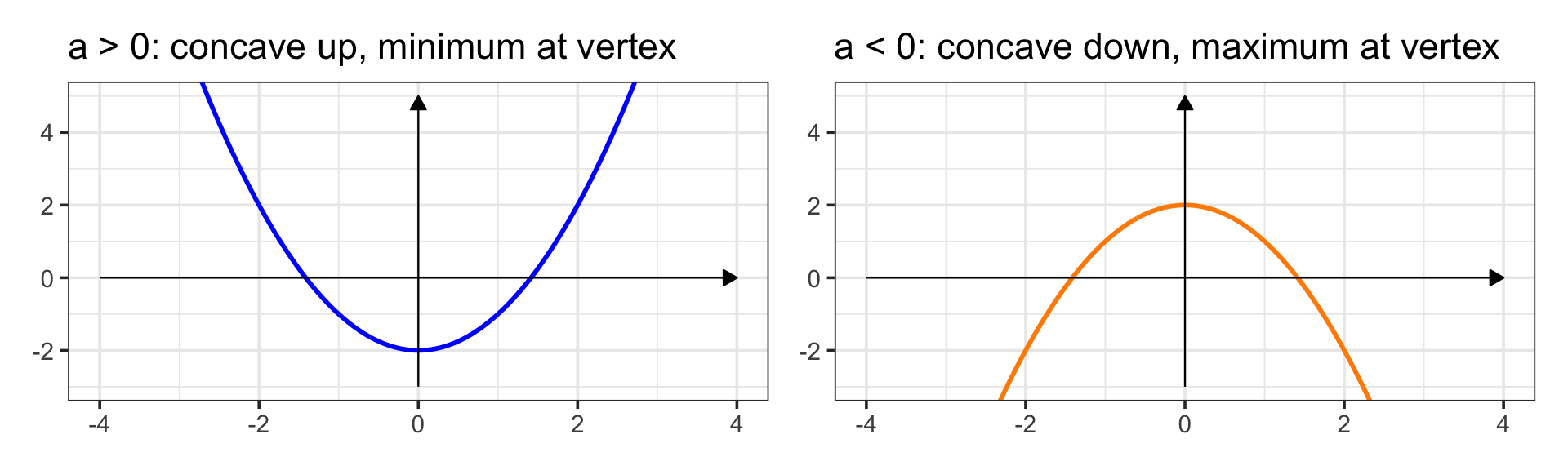
Example 6: Determine the concavity of the quadratic function \(f\left(x\right) = -2x^2 - 8x + 4\).
Solution. Since the leading coefficient (the coefficient on \(x^2\)) is negative (\(-2\)), the function is concave down.
The Vertex
Definition (Vertex): The vertex of the parabola \(f\left(x\right) = ax^2 + bx + c\) is located at
\[\left(\frac{-b}{2a},\; f\!\left(\frac{-b}{2a}\right)\right)\]
The \(x\)-coordinate \(\displaystyle{\frac{-b}{2a}}\) is the axis of symmetry. The \(y\)-coordinate is found by evaluating \(f\) at that \(x\)-value.
Example 7: Determine the vertex and the axis of symmetry of the quadratic function \(f\left(x\right) = -2x^2 - 8x + 4\).
Solution. The \(x\)-coordinate of the vertex is at \(\displaystyle{x = \frac{-b}{2a}}\).
\[\begin{align} x &= \frac{8}{2\left(-2\right)} \end{align}\]
The Vertex
Definition (Vertex): The vertex of the parabola \(f\left(x\right) = ax^2 + bx + c\) is located at
\[\left(\frac{-b}{2a},\; f\!\left(\frac{-b}{2a}\right)\right)\]
The \(x\)-coordinate \(\displaystyle{\frac{-b}{2a}}\) is the axis of symmetry. The \(y\)-coordinate is found by evaluating \(f\) at that \(x\)-value.
Example 7: Determine the vertex and the axis of symmetry of the quadratic function \(f\left(x\right) = -2x^2 - 8x + 4\).
Solution. The \(x\)-coordinate of the vertex is at \(\displaystyle{x = \frac{-b}{2a}}\).
\[\begin{align} x &= \frac{8}{2\left(-2\right)}\\ \implies x &= \frac{8}{-4} \end{align}\]
The Vertex
Definition (Vertex): The vertex of the parabola \(f\left(x\right) = ax^2 + bx + c\) is located at
\[\left(\frac{-b}{2a},\; f\!\left(\frac{-b}{2a}\right)\right)\]
The \(x\)-coordinate \(\displaystyle{\frac{-b}{2a}}\) is the axis of symmetry. The \(y\)-coordinate is found by evaluating \(f\) at that \(x\)-value.
Example 7: Determine the vertex and the axis of symmetry of the quadratic function \(f\left(x\right) = -2x^2 - 8x + 4\).
Solution. The \(x\)-coordinate of the vertex is at \(\displaystyle{x = \frac{-b}{2a}}\).
\[\begin{align} x &= \frac{8}{2\left(-2\right)}\\ \implies x &= \frac{8}{-4}\\ \implies x &= -2 \end{align}\]
So the \(x\)-coordinate of the vertex is at \(x = -2\), and we find the \(y\)-coordinate of the vertex by evaluating \(f\left(-2\right)\).
\[\begin{align} f\left(-2\right) &= -2\left(-2\right)^2 - 8\left(-2\right) + 4 \end{align}\]
The Vertex
Definition (Vertex): The vertex of the parabola \(f\left(x\right) = ax^2 + bx + c\) is located at
\[\left(\frac{-b}{2a},\; f\!\left(\frac{-b}{2a}\right)\right)\]
The \(x\)-coordinate \(\displaystyle{\frac{-b}{2a}}\) is the axis of symmetry. The \(y\)-coordinate is found by evaluating \(f\) at that \(x\)-value.
Example 7: Determine the vertex and the axis of symmetry of the quadratic function \(f\left(x\right) = -2x^2 - 8x + 4\).
Solution. The \(x\)-coordinate of the vertex is at \(\displaystyle{x = \frac{-b}{2a}}\).
\[\begin{align} x &= \frac{8}{2\left(-2\right)}\\ \implies x &= \frac{8}{-4}\\ \implies x &= -2 \end{align}\]
So the \(x\)-coordinate of the vertex is at \(x = -2\), and we find the \(y\)-coordinate of the vertex by evaluating \(f\left(-2\right)\).
\[\begin{align} f\left(-2\right) &= -2\left(-2\right)^2 - 8\left(-2\right) + 4\\ &= -8 + 16 + 4 \end{align}\]
The Vertex
Definition (Vertex): The vertex of the parabola \(f\left(x\right) = ax^2 + bx + c\) is located at
\[\left(\frac{-b}{2a},\; f\!\left(\frac{-b}{2a}\right)\right)\]
The \(x\)-coordinate \(\displaystyle{\frac{-b}{2a}}\) is the axis of symmetry. The \(y\)-coordinate is found by evaluating \(f\) at that \(x\)-value.
Example 7: Determine the vertex and the axis of symmetry of the quadratic function \(f\left(x\right) = -2x^2 - 8x + 4\).
Solution. The \(x\)-coordinate of the vertex is at \(\displaystyle{x = \frac{-b}{2a}}\).
\[\begin{align} x &= \frac{8}{2\left(-2\right)}\\ \implies x &= \frac{8}{-4}\\ \implies x &= -2 \end{align}\]
So the \(x\)-coordinate of the vertex is at \(x = -2\), and we find the \(y\)-coordinate of the vertex by evaluating \(f\left(-2\right)\).
\[\begin{align} f\left(-2\right) &= -2\left(-2\right)^2 - 8\left(-2\right) + 4\\ &= -8 + 16 + 4\\ &= 12 \end{align}\]
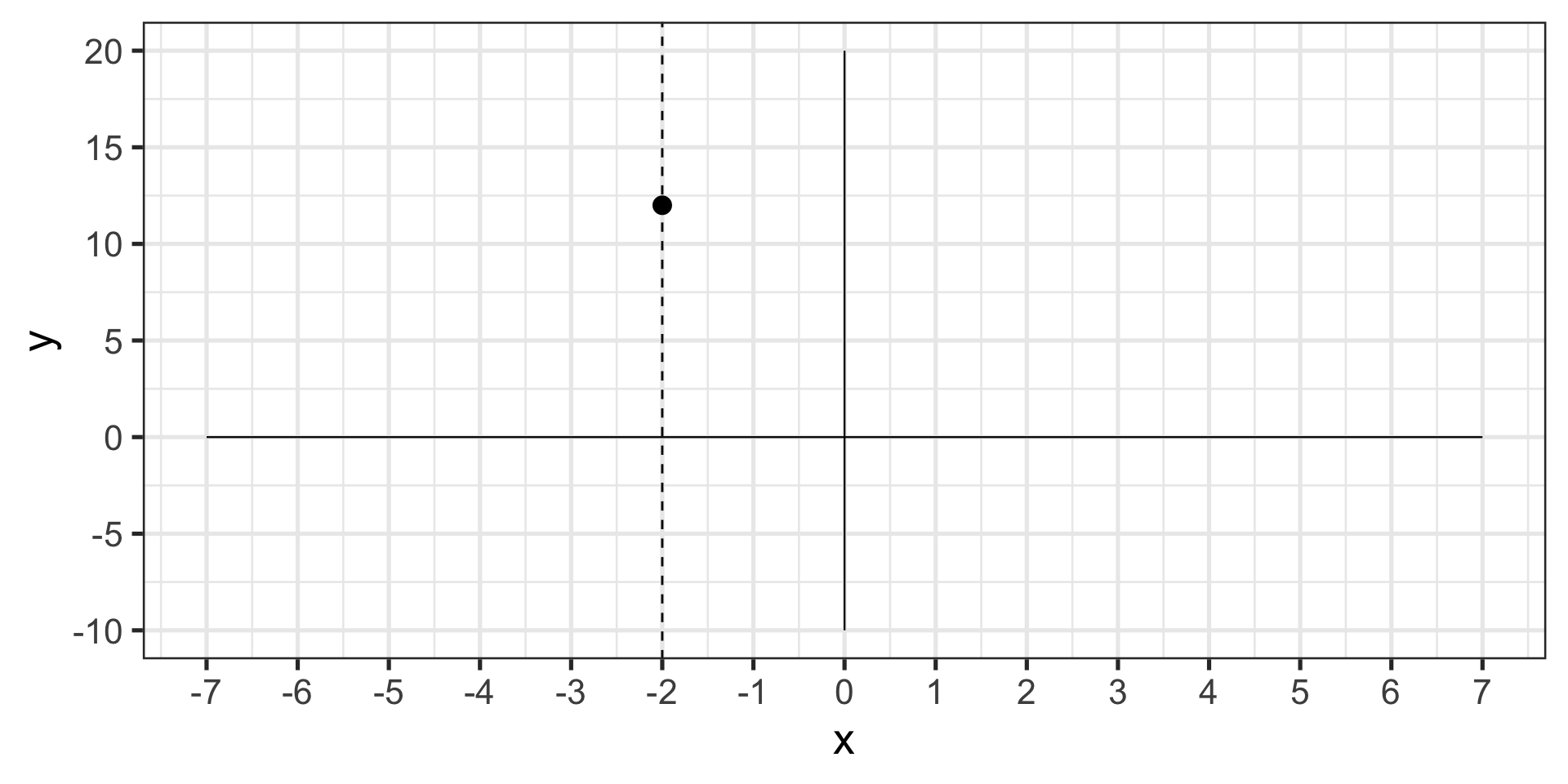
The vertex of the parabola is at the point \(\left(-2, 12\right)\) and the axis of symmetry is at \(x = -2\).
End Behavior
Definition (End Behavior): The end behavior of \(f\left(x\right)\) describes what happens as \(x \to \infty\) and \(x \to -\infty\), expressed using limits:
\[\lim_{x\to -\infty}{f\left(x\right)} \qquad \text{and} \qquad \lim_{x\to \infty}{f\left(x\right)}\]
For quadratic functions \(f\left(x\right) = ax^2 + bx + c\), the leading term \(ax^2\) dominates as \(x\) becomes large in magnitude. So:
- If \(a > 0\): \(\displaystyle{\lim_{x\to -\infty}{ax^2 + bx + c} = \infty}\) and \(\displaystyle{\lim_{x\to \infty}{ax^2 + bx + c} = \infty}\)
- If \(a < 0\): \(\displaystyle{\lim_{x\to -\infty}{ax^2 + bx + c} = -\infty}\) and \(\displaystyle{\lim_{x\to \infty}{ax^2 + bx + c} = -\infty}\)
Example 8: Determine the end behavior of the quadratic function \(f\left(x\right) = -2x^2 - 8x + 4\).
Solution.
- \(\displaystyle{\lim_{x\to -\infty}{-2x^2 - 8x + 4} = -\infty}\)
- \(\displaystyle{\lim_{x\to \infty}{-2x^2 - 8x + 4} = -\infty}\)
Note that this behavior aligns with all of the characteristics we’ve discovered so far.
- The parabola is concave down (it opens downwards)
- The vertex is a maximum
- The only possibility for the end behavior of this “U”-shaped function was to extend to negative infinity.
Finding Roots and \(y\)-Intercept
We know a lot about the function \(f\left(x\right) = -2x^2 - 8x + 4\) from the previous few examples.
The last thing we need before we can graph the function is to determine its roots.
Example 9: Find the roots and \(y\)-intercept of the function \(f\left(x\right) = -2x^2 - 8x + 4\).
Solution. We’ll solve \(f\left(x\right) = 0\), just like we did earlier today.
\[\begin{align} -2x^2 - 8x + 4 &= 0 \end{align}\]
Finding Roots and \(y\)-Intercept
We know a lot about the function \(f\left(x\right) = -2x^2 - 8x + 4\) from the previous few examples.
The last thing we need before we can graph the function is to determine its roots.
Example 9: Find the roots and \(y\)-intercept of the function \(f\left(x\right) = -2x^2 - 8x + 4\).
Solution. We’ll solve \(f\left(x\right) = 0\), just like we did earlier today.
\[\begin{align} -2x^2 - 8x + 4 &= 0\\ \implies -2\left(x^2 + 4x - 2\right) &= 0 \end{align}\]
Finding Roots and \(y\)-Intercept
We know a lot about the function \(f\left(x\right) = -2x^2 - 8x + 4\) from the previous few examples.
The last thing we need before we can graph the function is to determine its roots.
Example 9: Find the roots and \(y\)-intercept of the function \(f\left(x\right) = -2x^2 - 8x + 4\).
Solution. We’ll solve \(f\left(x\right) = 0\), just like we did earlier today.
\[\begin{align} -2x^2 - 8x + 4 &= 0\\ \implies -2\left(x^2 + 4x -2\right) &= 0\\ \implies x^2 + 4x - 2 &= 0 \end{align}\]
After deciding against factoring, we’ll use the quadratic formula.
\[\begin{align} x &= \frac{-4 \pm \sqrt{\left(4^2 - 4\left(1\right)\left(-2\right)\right)}}{2\left(1\right)} \end{align}\]
Finding Roots and \(y\)-Intercept
We know a lot about the function \(f\left(x\right) = -2x^2 - 8x + 4\) from the previous few examples.
The last thing we need before we can graph the function is to determine its roots.
Example 9: Find the roots and \(y\)-intercept of the function \(f\left(x\right) = -2x^2 - 8x + 4\).
Solution. We’ll solve \(f\left(x\right) = 0\), just like we did earlier today.
\[\begin{align} -2x^2 - 8x + 4 &= 0\\ \implies -2\left(x^2 + 4x -2\right) &= 0\\ \implies x^2 + 4x - 2 &= 0 \end{align}\]
After deciding against factoring, we’ll use the quadratic formula.
\[\begin{align} x &= \frac{-4 \pm \sqrt{\left(4^2 - 4\left(1\right)\left(-2\right)\right)}}{2\left(1\right)}\\ \implies x &= \frac{-4 \pm \sqrt{\left(16 + 8\right)}}{2} \end{align}\]
Finding Roots and \(y\)-Intercept
We know a lot about the function \(f\left(x\right) = -2x^2 - 8x + 4\) from the previous few examples.
The last thing we need before we can graph the function is to determine its roots.
Example 9: Find the roots and \(y\)-intercept of the function \(f\left(x\right) = -2x^2 - 8x + 4\).
Solution. We’ll solve \(f\left(x\right) = 0\), just like we did earlier today.
\[\begin{align} -2x^2 - 8x + 4 &= 0\\ \implies -2\left(x^2 + 4x -2\right) &= 0\\ \implies x^2 + 4x - 2 &= 0 \end{align}\]
After deciding against factoring, we’ll use the quadratic formula.
\[\begin{align} x &= \frac{-4 \pm \sqrt{\left(4^2 - 4\left(1\right)\left(-2\right)\right)}}{2\left(1\right)}\\ \implies x &= \frac{-4 \pm \sqrt{\left(16 + 8\right)}}{2}\\ \implies x &= \frac{-4 \pm \sqrt{24}}{2} \end{align}\]
Finding Roots and \(y\)-Intercept
We know a lot about the function \(f\left(x\right) = -2x^2 - 8x + 4\) from the previous few examples.
The last thing we need before we can graph the function is to determine its roots.
Example 9: Find the roots and \(y\)-intercept of the function \(f\left(x\right) = -2x^2 - 8x + 4\).
Solution. We’ll solve \(f\left(x\right) = 0\), just like we did earlier today.
\[\begin{align} -2x^2 - 8x + 4 &= 0\\ \implies -2\left(x^2 + 4x -2\right) &= 0\\ \implies x^2 + 4x - 2 &= 0 \end{align}\]
After deciding against factoring, we’ll use the quadratic formula.
\[\begin{align} x &= \frac{-4 \pm \sqrt{\left(4^2 - 4\left(1\right)\left(-2\right)\right)}}{2\left(1\right)}\\ \implies x &= \frac{-4 \pm \sqrt{\left(16 + 8\right)}}{2}\\ \implies x &= \frac{-4 \pm \sqrt{24}}{2}\\ \implies x &= \frac{-4 \pm \sqrt{\left(\left(4\right)\left(6\right)\right)}}{2} \end{align}\]
Finding Roots and \(y\)-Intercept
We know a lot about the function \(f\left(x\right) = -2x^2 - 8x + 4\) from the previous few examples.
The last thing we need before we can graph the function is to determine its roots.
Example 9: Find the roots and \(y\)-intercept of the function \(f\left(x\right) = -2x^2 - 8x + 4\).
Solution. We’ll solve \(f\left(x\right) = 0\), just like we did earlier today.
\[\begin{align} -2x^2 - 8x + 4 &= 0\\ \implies -2\left(x^2 + 4x -2\right) &= 0\\ \implies x^2 + 4x - 2 &= 0 \end{align}\]
After deciding against factoring, we’ll use the quadratic formula.
\[\begin{align} x &= \frac{-4 \pm \sqrt{\left(4^2 - 4\left(1\right)\left(-2\right)\right)}}{2\left(1\right)}\\ \implies x &= \frac{-4 \pm \sqrt{\left(16 + 8\right)}}{2}\\ \implies x &= \frac{-4 \pm \sqrt{24}}{2}\\ \implies x &= \frac{-4 \pm \sqrt{\left(\left(4\right)\left(6\right)\right)}}{2}\\ \implies x &= \frac{-4 \pm 2\sqrt{6}}{2} \end{align}\]
Finding Roots and \(y\)-Intercept
We know a lot about the function \(f\left(x\right) = -2x^2 - 8x + 4\) from the previous few examples.
The last thing we need before we can graph the function is to determine its roots.
Example 9: Find the roots and \(y\)-intercept of the function \(f\left(x\right) = -2x^2 - 8x + 4\).
Solution. We’ll solve \(f\left(x\right) = 0\), just like we did earlier today.
\[\begin{align} -2x^2 - 8x + 4 &= 0\\ \implies -2\left(x^2 + 4x -2\right) &= 0\\ \implies x^2 + 4x - 2 &= 0 \end{align}\]
After deciding against factoring, we’ll use the quadratic formula.
\[\begin{align} x &= \frac{-4 \pm \sqrt{\left(4^2 - 4\left(1\right)\left(-2\right)\right)}}{2\left(1\right)}\\ \implies x &= \frac{-4 \pm \sqrt{\left(16 + 8\right)}}{2}\\ \implies x &= \frac{-4 \pm \sqrt{24}}{2}\\ \implies x &= \frac{-4 \pm \sqrt{\left(\left(4\right)\left(6\right)\right)}}{2}\\ \implies x &= \frac{-4 \pm 2\sqrt{6}}{2}\\ \implies x &= \frac{2\left(-2 \pm \sqrt{6}\right)}{2} \end{align}\]
Finding Roots and \(y\)-Intercept
We know a lot about the function \(f\left(x\right) = -2x^2 - 8x + 4\) from the previous few examples.
The last thing we need before we can graph the function is to determine its roots.
Example 9: Find the roots and \(y\)-intercept of the function \(f\left(x\right) = -2x^2 - 8x + 4\).
Solution. We’ll solve \(f\left(x\right) = 0\), just like we did earlier today.
\[\begin{align} -2x^2 - 8x + 4 &= 0\\ \implies -2\left(x^2 + 4x -2\right) &= 0\\ \implies x^2 + 4x - 2 &= 0 \end{align}\]
After deciding against factoring, we’ll use the quadratic formula.
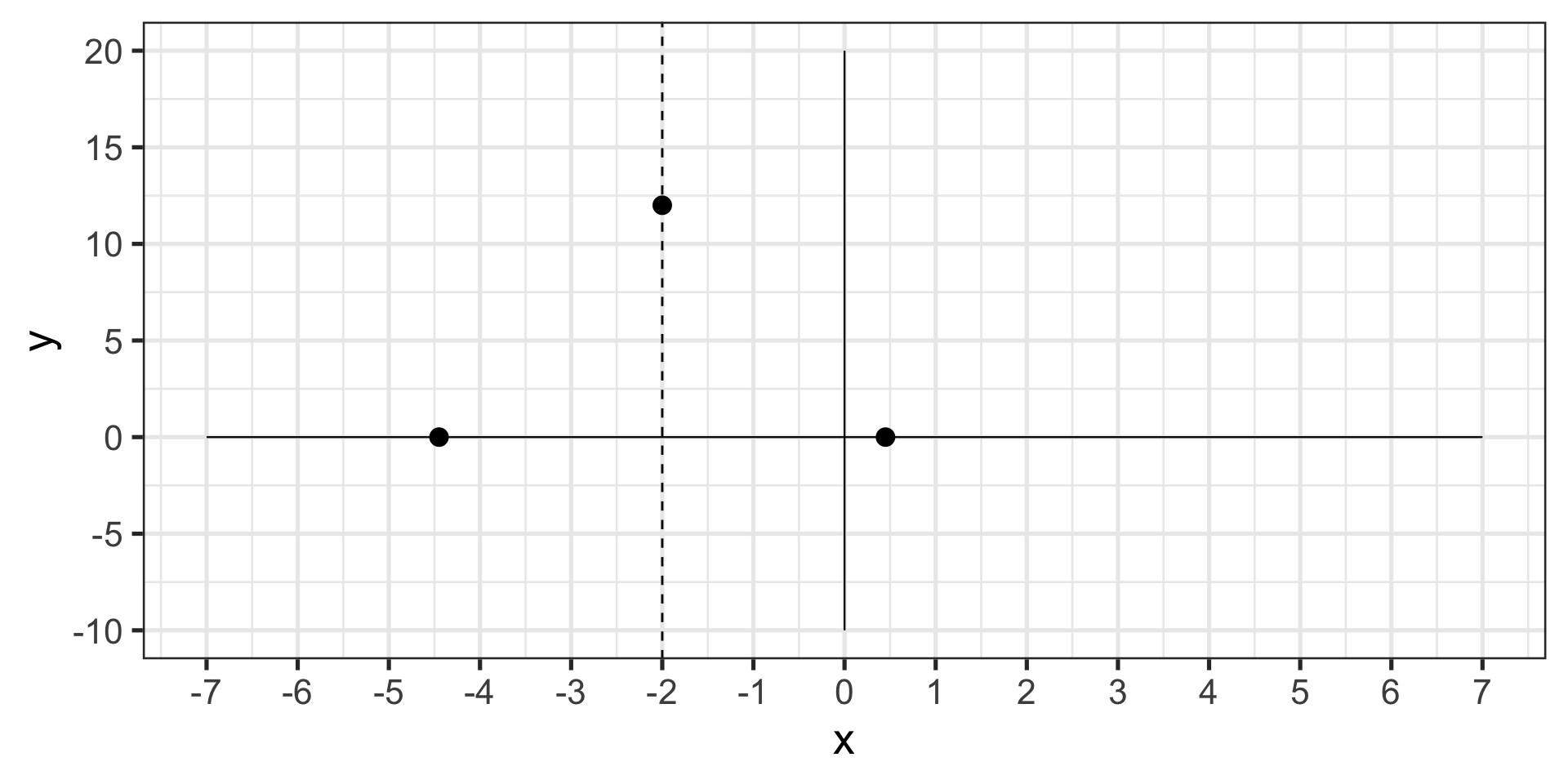
These roots, \(\boxed{~\displaystyle{x = -2 \pm \sqrt{6}}~}\) are real but won’t simplify nicely. We’ll just leave it here!
The \(y\)-intercept is much simpler to find. We’ll just evaluate \(f\left(0\right)\).
Since \(f\left(0\right) = 4\), the \(y\)-intercept is at the point \(\boxed{~\left(0, 4\right)~}\).
\[\begin{align} x &= \frac{-4 \pm \sqrt{\left(4^2 - 4\left(1\right)\left(-2\right)\right)}}{2\left(1\right)}\\ \implies x &= \frac{-4 \pm \sqrt{\left(16 + 8\right)}}{2}\\ \implies x &= \frac{-4 \pm \sqrt{24}}{2}\\ \implies x &= \frac{-4 \pm \sqrt{\left(\left(4\right)\left(6\right)\right)}}{2}\\ \implies x &= \frac{-4 \pm 2\sqrt{6}}{2}\\ \implies x &= \frac{2\left(-2 \pm \sqrt{6}\right)}{2}\\ \implies x &= -2 \pm \sqrt{6} \end{align}\]
Putting It All Together
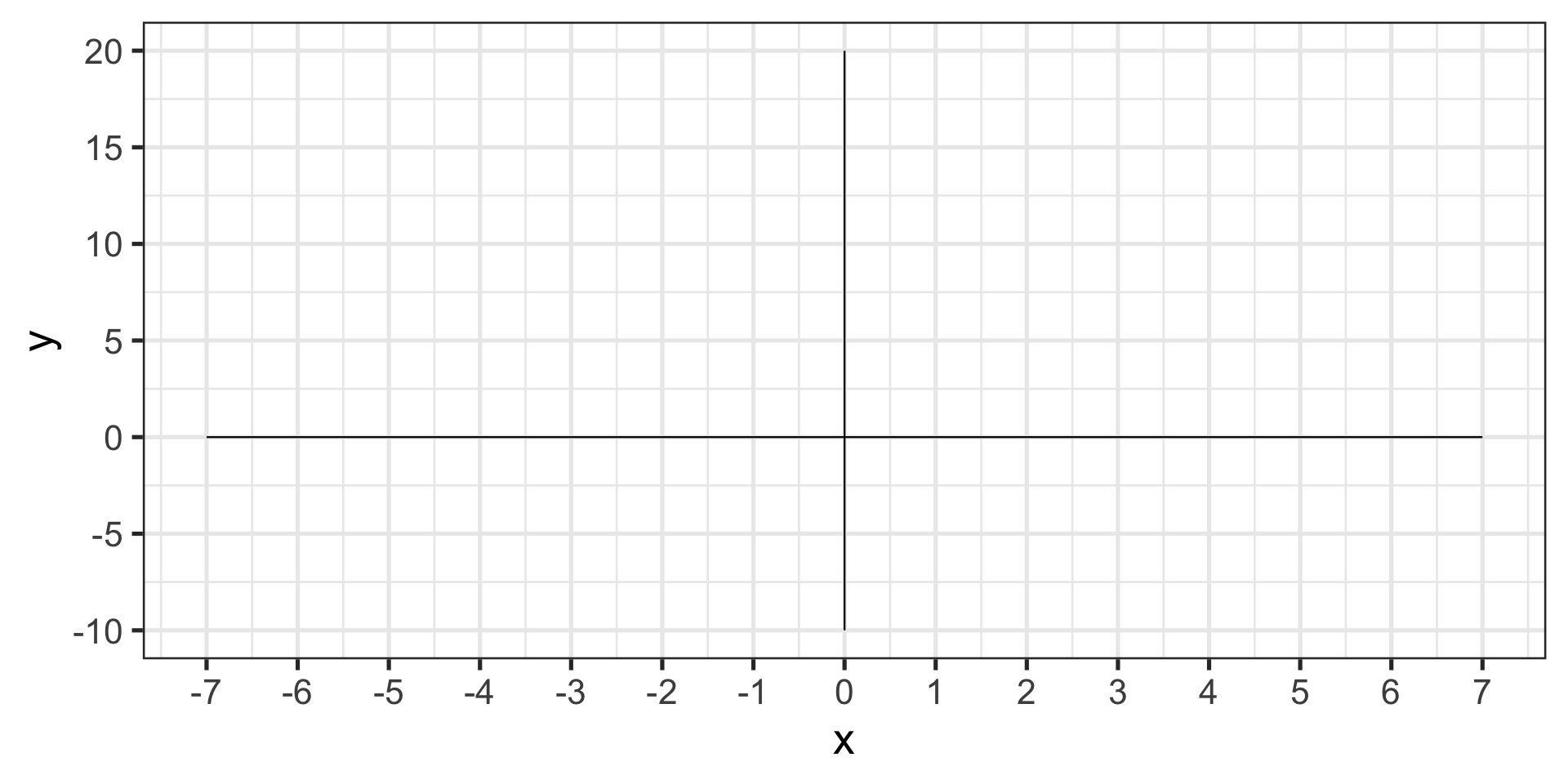
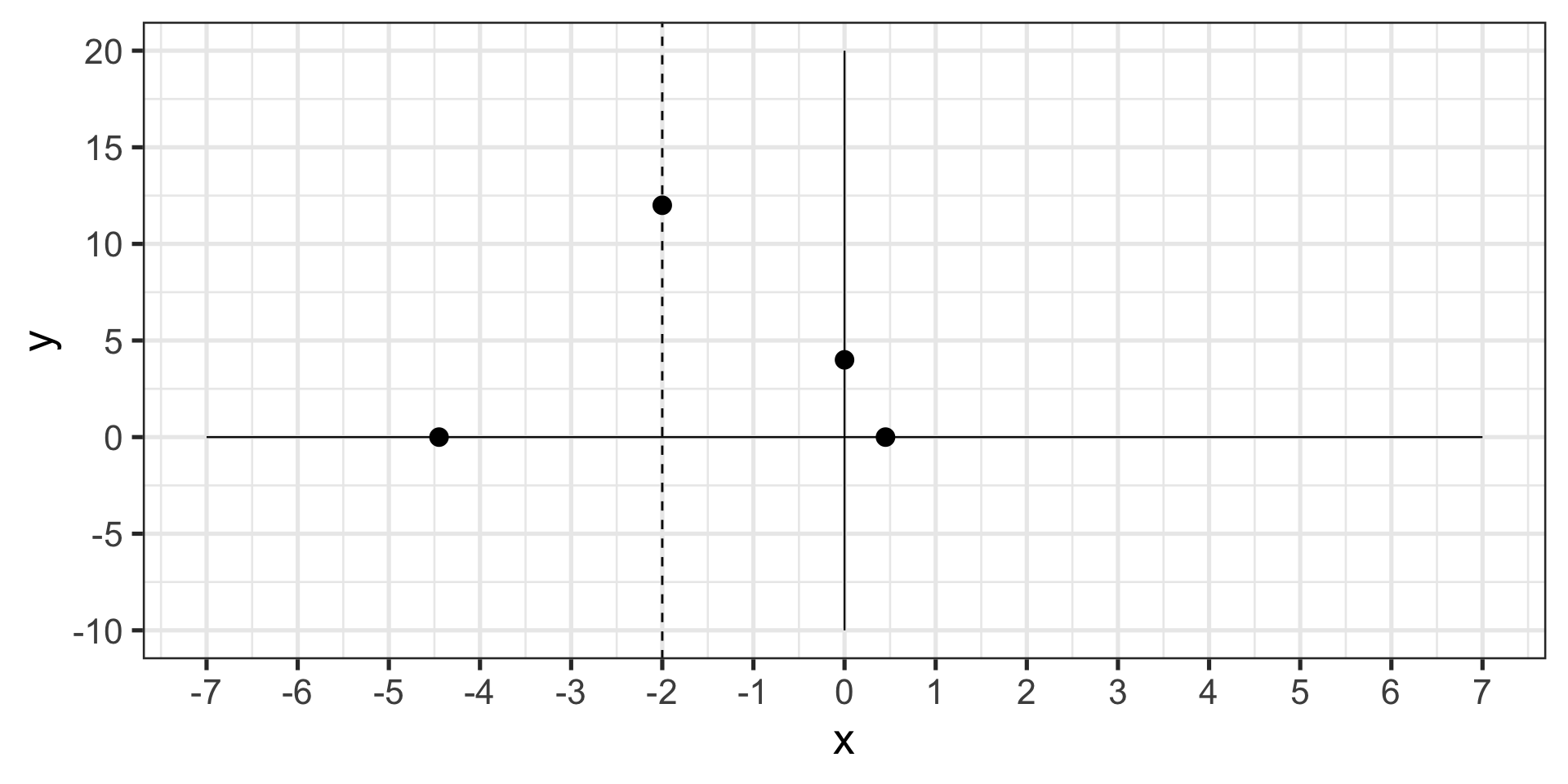
Example 10: Use information about the concavity, roots, \(y\)-intercept, vertex, axis of symmetry, and end behavior of the function \(f\left(x\right) = -2x^2 - 8x + 4\) to draw its graph.
Solution.
Over the last several examples, we’ve investigated all of these items.
Putting It All Together
Example 10: Use information about the concavity, roots, \(y\)-intercept, vertex, axis of symmetry, and end behavior of the function \(f\left(x\right) = -2x^2 - 8x + 4\) to draw its graph.
Solution.
Over the last several examples, we’ve investigated all of these items.
- The vertex is at the point \(\left(-2, 12\right)\) and the axis of symmetry is at \(x = -2\)
Putting It All Together
Example 10: Use information about the concavity, roots, \(y\)-intercept, vertex, axis of symmetry, and end behavior of the function \(f\left(x\right) = -2x^2 - 8x + 4\) to draw its graph.
Solution.
Over the last several examples, we’ve investigated all of these items.
- The vertex is at the point \(\left(-2, 12\right)\) and the axis of symmetry is at \(x = -2\)
- The roots are at the points \(\left(-2 - \sqrt{6}, 0\right)\) and \(\left(-2 + \sqrt{6}, 0\right)\)
Putting It All Together
Example 10: Use information about the concavity, roots, \(y\)-intercept, vertex, axis of symmetry, and end behavior of the function \(f\left(x\right) = -2x^2 - 8x + 4\) to draw its graph.
Solution.
Over the last several examples, we’ve investigated all of these items.
- The vertex is at the point \(\left(-2, 12\right)\) and the axis of symmetry is at \(x = -2\)
- The roots are at the points \(\left(-2 - \sqrt{6}, 0\right)\) and \(\left(-2 + \sqrt{6}, 0\right)\)
- The \(y\)-intercept is at the point \(\left(0, 4\right)\)
Putting It All Together
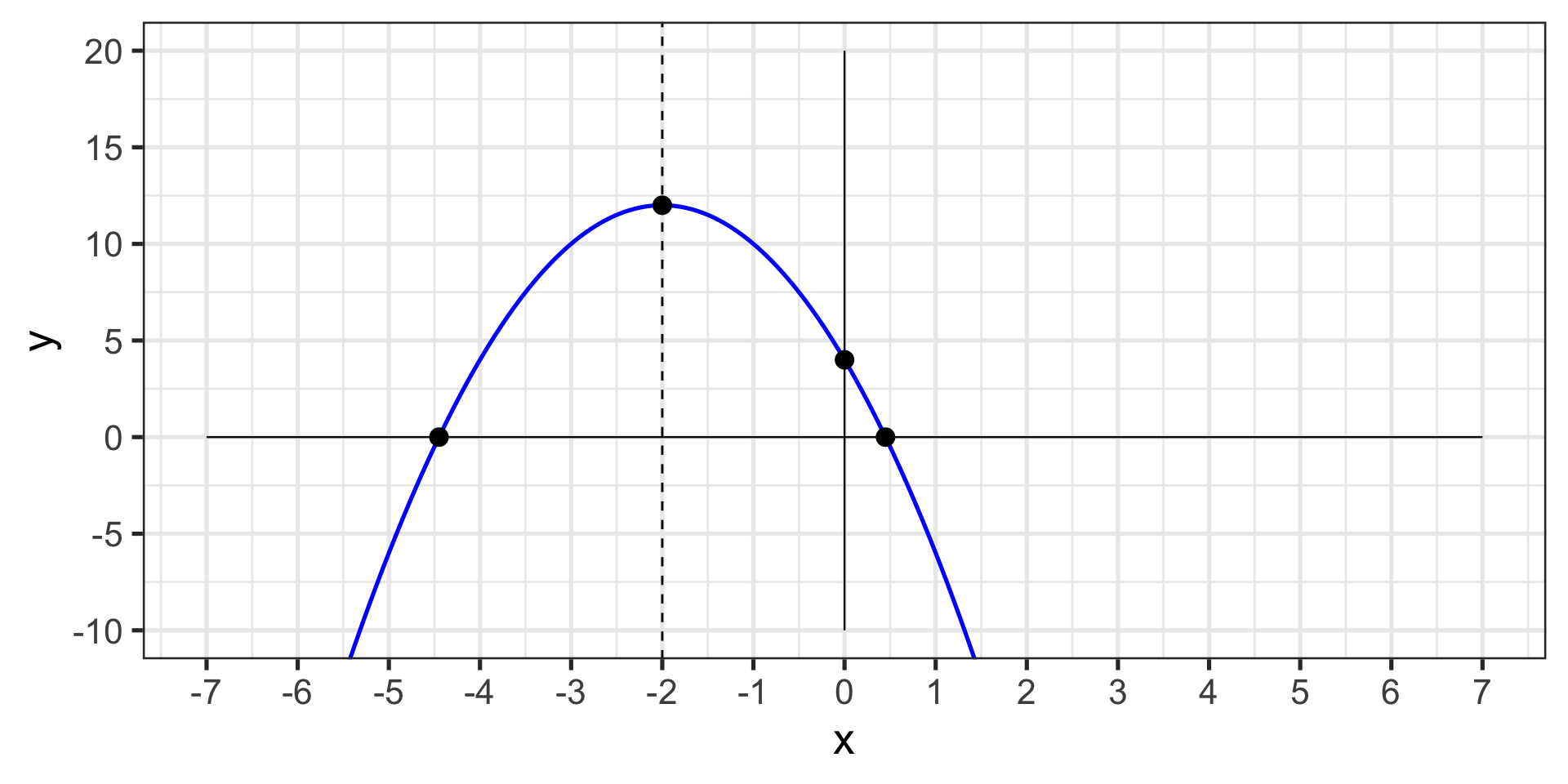
Example 10: Use information about the concavity, roots, \(y\)-intercept, vertex, axis of symmetry, and end behavior of the function \(f\left(x\right) = -2x^2 - 8x + 4\) to draw its graph.
Solution.
Over the last several examples, we’ve investigated all of these items.
- The vertex is at the point \(\left(-2, 12\right)\) and the axis of symmetry is at \(x = -2\)
- The roots are at the points \(\left(-2 - \sqrt{6}, 0\right)\) and \(\left(-2 + \sqrt{6}, 0\right)\)
- The \(y\)-intercept is at the point \(\left(0, 4\right)\)
- The function is concave down
- The end behavior indicates \(\displaystyle{\lim_{x\to -\infty}{f\left(x\right)} = -\infty}\) and \(\displaystyle{\lim_{x\to \infty}{f\left(x\right)} = -\infty}\)
- The vertex is a maximum
Plotting a Quadratic Practice
Try It! 7: Use information about the concavity, roots, \(y\)-intercept, vertex, axis of symmetry, and end behavior of the function \(f\left(x\right) = 24 - 2x - 2x^2\) to draw its graph.
Plotting a Quadratic Practice (Verified)
Try It! 7: Use information about the concavity, roots, \(y\)-intercept, vertex, axis of symmetry, and end behavior of the function \(f\left(x\right) = 24 - 2x - 2x^2\) to draw its graph.
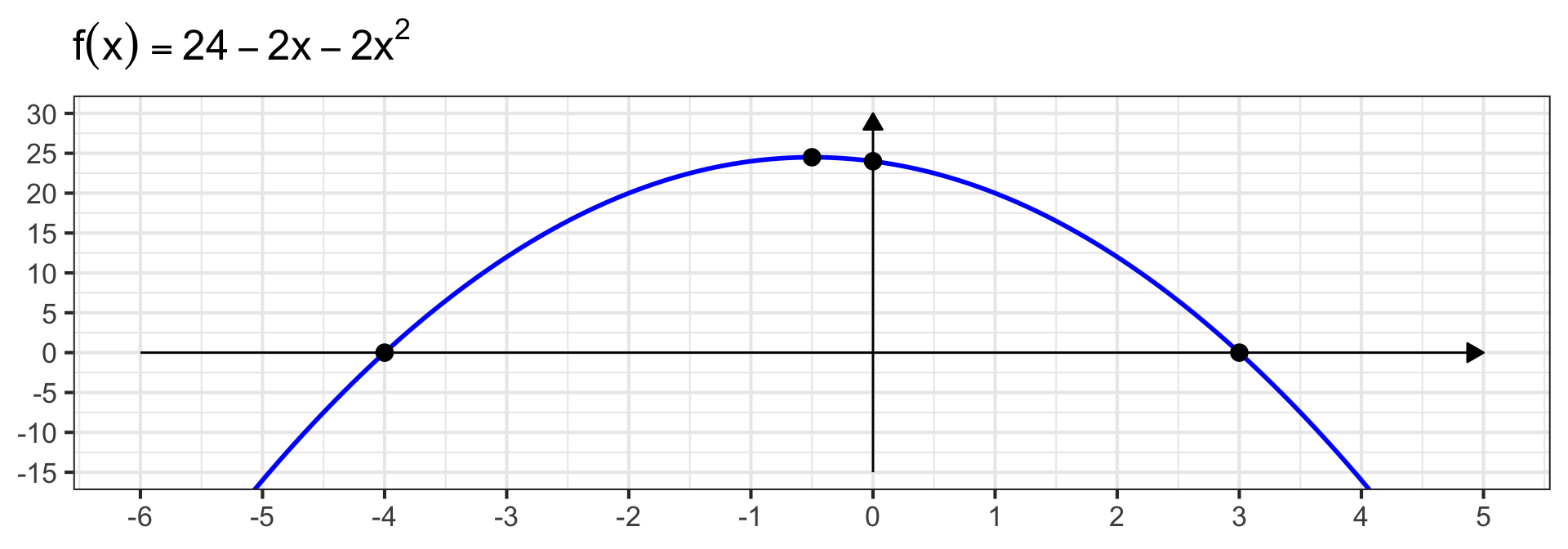
Solution. Rewriting the quadratic in standard form gives \(f\left(x\right) = -2x^2 - 2x + 24\), so \(a = -2\), \(b = -2\), \(c = 24\).
Concavity Since \(a = -2 < 0\), the parabola opens downward (concave down). The vertex is a maximum.
Vertex: The \(x\)-coordinate of the vertex: \(x = \frac{-b}{2a} = \frac{-\left(-2\right)}{2\left(-2\right)} = \frac{2}{-4} = -\frac{1}{2}\)
The \(y\)-coordinate: \(f\!\left(-\frac{1}{2}\right) = 24 - 2\!\left(-\frac{1}{2}\right) - 2\!\left(-\frac{1}{2}\right)^2 = 24 + 1 - \frac{1}{2} = \frac{49}{2}\)
Vertex: \(\displaystyle{\left(-\frac{1}{2}, \frac{49}{2}\right)}\)
Roots. Solve \(f\left(x\right) = 0\):
\[\begin{align} 24 - 2x - 2x^2 &= 0\\ \implies -2\left(x^2 + x - 12\right) &= 0\\ \implies \left(x + 4\right)\left(x - 3\right) &= 0\\ \implies x = -4 &\text{ or } x = 3 \end{align}\]
Roots at \(\left(-4, 0\right)\) and \(\left(3, 0\right)\).
\(y\)-intercept: The \(y\)-intercept is at the point \(\left(0, 24\right)\)
End behavior. The leading term is \(-2x^2\), so:
\[\lim_{x\to -\infty}{f\left(x\right)} = -\infty\]
and
\[\lim_{x\to \infty}{f\left(x\right)} = -\infty\]
Plotting a Quadratic Practice (Verified)
Try It! 7: Use information about the concavity, roots, \(y\)-intercept, vertex, axis of symmetry, and end behavior of the function \(f\left(x\right) = 24 - 2x - 2x^2\) to draw its graph.
\(\left(e\right)\) Graph. Using vertex \(\left(-\frac{1}{2}, \frac{49}{2}\right)\), roots \(\left(-4, 0\right)\) and \(\left(3, 0\right)\), \(y\)-intercept \(\left(0, 24\right)\), downward concavity, and end-behavior towards negative infinity:
Additional Practice
Try It! 8: For each quadratic function below, determine: (i) concavity, (ii) vertex, (iii) roots, (iv) end behavior, and (v) sketch a rough graph.
\(\left(a\right)~f\left(x\right) = x^2 - 4x - 5\)
\(\left(b\right)~g\left(x\right) = -x^2 + 6x - 5\)
Factoring versus the Quadratic Formula
For roots, try factoring first. If that doesn’t work within a minute, use the quadratic formula.
Applied Problems
Applied Problem 1: A rocket is launched into the air. Its height (in meters) is \(h\left(t\right) = -4.9t^2 + 229t + 234\), where \(t\) is time in seconds.
Find the maximum height the rocket attains.
Solution. The maximum occurs at the vertex.
The quadratic function describing the height of the rocket has \(a = -4.9\), \(b = 229\), and \(c = 234\).
\[\begin{align} t &= \frac{-b}{2a} = \frac{-229}{2\left(-4.9\right)} = \frac{-229}{-9.8} \approx 23.37 \text{ seconds} \end{align}\]
We can plug the time at which the maximum height is reached (\(23.37\) seconds) into the height function to determine the height of the rocket.
\[\begin{align} h\left(23.37\right) &= -4.9\left(23.37\right)^2 + 229\left(23.37\right) + 234 \approx \boxed{~2{,}909.6 \text{ meters}~} \end{align}\]
Applied Problems (Cont’d)
Applied Problem 2: The price per unit (in dollars) for a cell phone is modeled by \(p = 45 - 0.0125x\), where \(x\) is the number of phones produced (in thousands). The revenue (in thousands of dollars) is \(R = x \cdot p\).
Find the production level that maximizes revenue.
Solution. First, write \(R\) as a function of \(x\):
\[\begin{align} R\left(x\right) &= x\left(45 - 0.0125x\right) = 45x - 0.0125x^2 \end{align}\]
This is a downward-opening parabola (\(a = -0.0125 < 0\)).
The maximum revenue occurs at the vertex:
\[\begin{align} x &= \frac{-b}{2a} = \frac{-45}{2\left(-0.0125\right)} = \frac{-45}{-0.025} = \boxed{~1{,}800 ~\text{phones}~} \end{align}\]
The corresponding maximum revenue is \(R\left(1800\right) = 45\left(1800\right) - 0.0125\left(1800\right)^2 = \boxed{~\$40{,}500~}\).
Exit Ticket Task
Navigate to our MAT142 Exit Ticket Form, answer the questions, and complete the task below.
Note. Today’s discussion is listed as 10. Quadratic Functions and Equations (Part I)

Task: Consider the function \(f\left(x\right) = x^2 - 2x - 8\).
\(\left(a\right)\) Find the roots by factoring.
\(\left(b\right)\) Find the vertex.
\(\left(c\right)\) Does the parabola open upward or downward?
Summary and Next Time…
- A quadratic equation has the form \(ax^2 + bx + c = 0\) and may have \(0\), \(1\), or \(2\) real solutions.
- Factoring is fast when it works; use the quadratic formula when it doesn’t.
- The discriminant \(b^2 - 4ac\) tells you how many real solutions exist before you solve.
- The graph of a quadratic function \(f\left(x\right) = ax^2 + bx + c\) forms a parabola.
- Concavity is determined by the sign of \(a\); the vertex is at \(x = \frac{-b}{2a}\).
- The end behavior is determined by the leading term \(ax^2\).
- Next class we’ll develop completing the square as a third technique for solving quadratics – and as the key to writing quadratic functions in vertex form, which connects directly to the transformations framework.
Quadratic Functions and Equations (Part II)
Start Homework 8 on MyOpenMath