MAT 142: Linear Functions and Equations

Dr. Gilbert

June 3, 2026

Reminders

At our last meeting, we discussed each of the following:

  • The definition of inverse functions and verification via composition.
  • The horizontal line test for invertibility.
  • The swap-and-solve method for finding \(f^{-1}\left(x\right)\).
  • The geometric symmetry of a function and its inverse across \(y = x\).

Try the following warm-up problem.

Problem 1: Find the domain, range, \(y\)-intercept, roots, and the inverse (if it exists) for the function \(f\left(x\right) = 5x - 15\).

Reminders:

  • The domain of \(f\left(x\right)\) is the set of all permissible inputs.
  • The range of \(f\left(x\right)\) is the set of all attainable outputs.
    • Use what you know about the “book function” \(f\left(x\right) = x\) and transformations to find the range.
  • The \(y\)-intercept is the point \(\left(0, f\left(0\right)\right)\).
  • The roots are all solutions to \(f\left(x\right) = 0\), which are of the form \(\left(x, 0\right)\).
  • Invertible functions pass the horizontal line test; use swap-and-solve to find \(f^{-1}\).

Motivating Application

A gym membership with two personal training sessions costs $125. A gym membership with five personal training sessions costs $260.

What is the cost per session? The gym would like to offer a discounted rate for members signing up for ten sessions – they’ll take $5 off the cost for each session. How much would that membership cost?

Before we work through this, consider the following:

  • What does using a linear model assume about this scenario?
  • Can you think of alternative discount strategies the gym could offer? Would those still result in a linear model?

We’ll return to this application at the end of today’s class.

Objectives

Today’s class has two connected halves.

First half – Linear Functions:

  • Recognize functions of the form \(f\left(x\right) = mx + b\) as linear functions.
  • Identify the slope \(m\) and \(y\)-intercept \(\left(0, b\right)\).
  • Use the slope formula and point-slope form to construct the equation of a line.
  • Connect linear functions to the transformations framework from Day 8.
  • Determine whether a linear function is increasing, decreasing, or constant.

Second half – Linear Equations:

  • Solve linear equations in a single variable.
  • Interpret solving equations geometrically as finding intersections or roots.

Linear Functions

Definition (Linear Function): A function \(f\left(x\right)\) is linear if it can be written in the form

\[f\left(x\right) = mx + b\]

where \(m\) is the slope and \(\left(0, b\right)\) is the \(y\)-intercept.

The slope \(m\) measures the rate of change of the function: for every one-unit increase in \(x\), the output changes by exactly \(m\) units.

A linear function is:

  • Increasing if \(m > 0\)
  • Decreasing if \(m < 0\)
  • Constant if \(m = 0\)

Forms for the Equation of a Line

There are several forms for representing a line. The most useful are:

Name Form Best Use
Slope-Intercept \(y = mx + b\) Reading slope and \(y\)-intercept directly
Point-Slope \(y - y_0 = m\left(x - x_0\right)\) Constructing the equation of a line
Standard \(Ax + By = C\) Generalizes cleanly to higher dimensions

We’ll focus on slope-intercept and point-slope forms, since they’re the ones with the greatest practical uses in both PreCalculus and Calculus.

Slope and Intercept

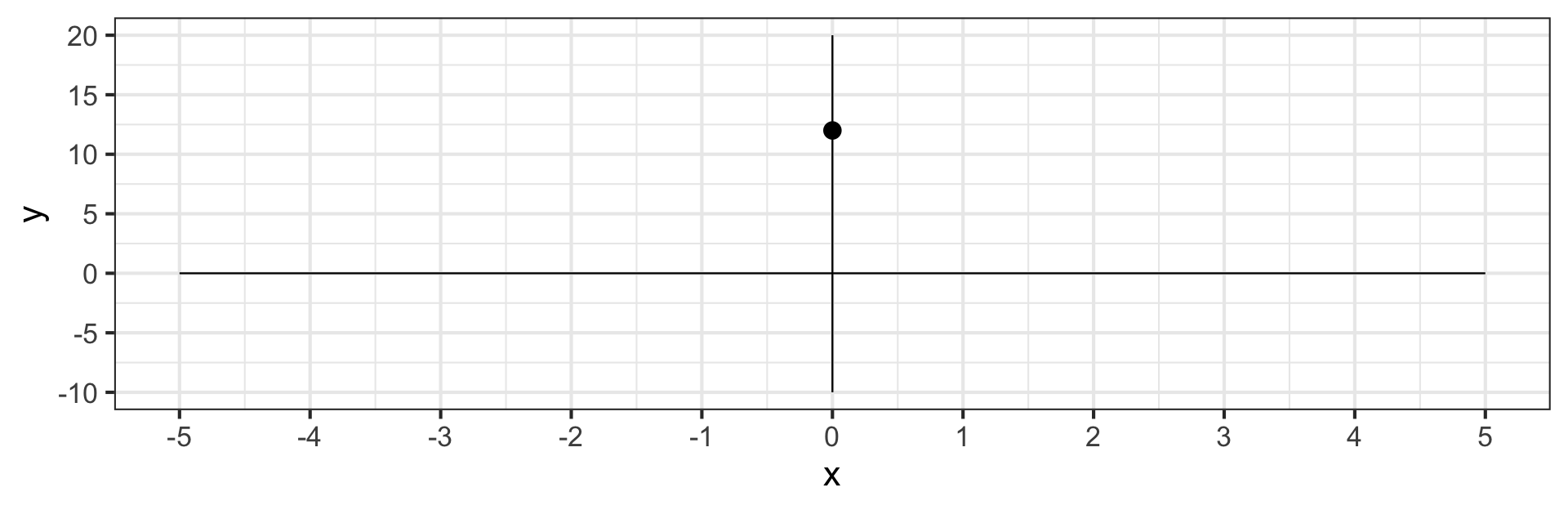
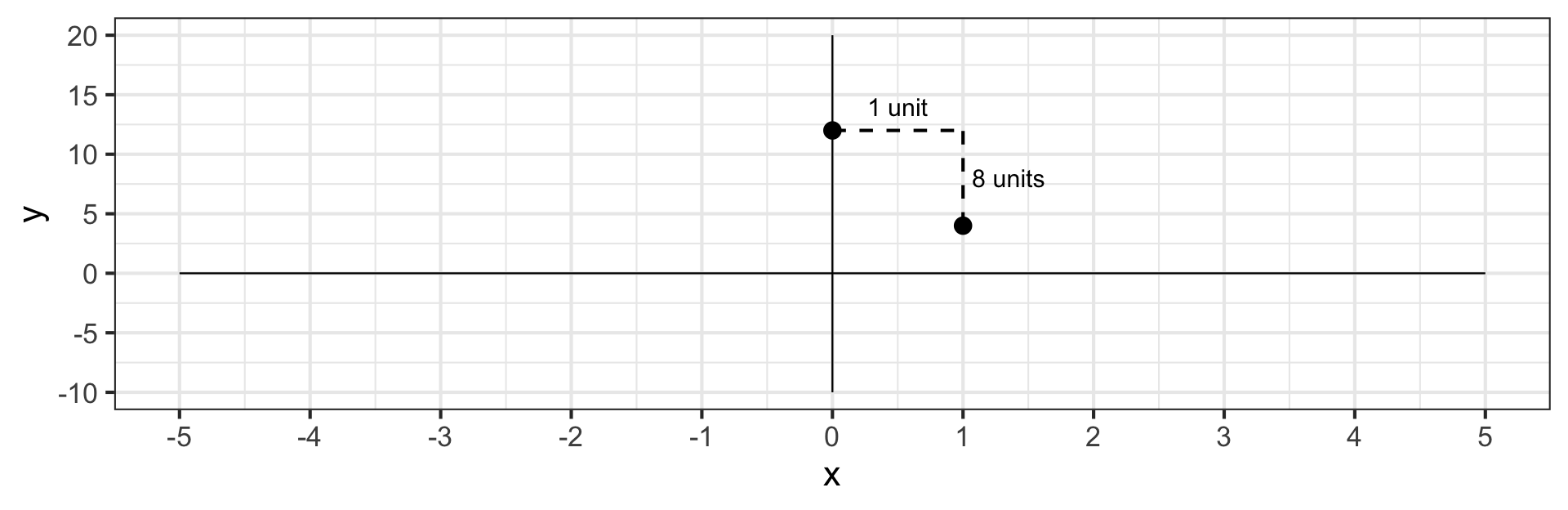
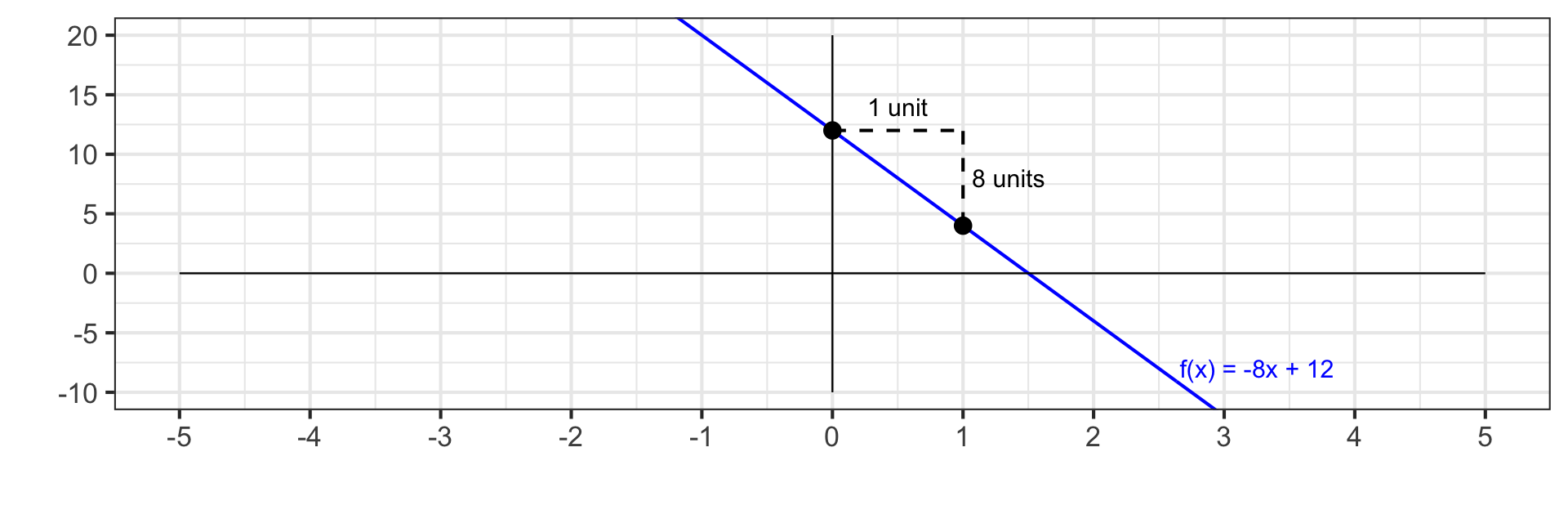
Example 1: Determine the slope and \(y\)-intercept of \(y = -8x + 12\). Once you’re done, draw a graph of the function \(f\left(x\right) = -8x + 12\).

Solution. This is already in slope-intercept form.

  • Slope: \(m = \boxed{~-8~}\)
  • \(y\)-intercept: \(\boxed{~\left(0, 12\right)~}\)

Since \(m = -8\), we have \(m < 0\) and this is a decreasing linear function.
Slope and Intercept

Example 1: Determine the slope and \(y\)-intercept of \(y = -8x + 12\). Once you’re done, draw a graph of the function \(f\left(x\right) = -8x + 12\).

Solution. This is already in slope-intercept form.

  • Slope: \(m = \boxed{~-8~}\)
  • \(y\)-intercept: \(\boxed{~\left(0, 12\right)~}\)

Since \(m = -8\), we have \(m < 0\) and this is a decreasing linear function.
Slope and Intercept

Example 1: Determine the slope and \(y\)-intercept of \(y = -8x + 12\). Once you’re done, draw a graph of the function \(f\left(x\right) = -8x + 12\).

Solution. This is already in slope-intercept form.

  • Slope: \(m = \boxed{~-8~}\)
  • \(y\)-intercept: \(\boxed{~\left(0, 12\right)~}\)

Since \(m = -8\), we have \(m < 0\) and this is a decreasing linear function.
Slope and Intercept

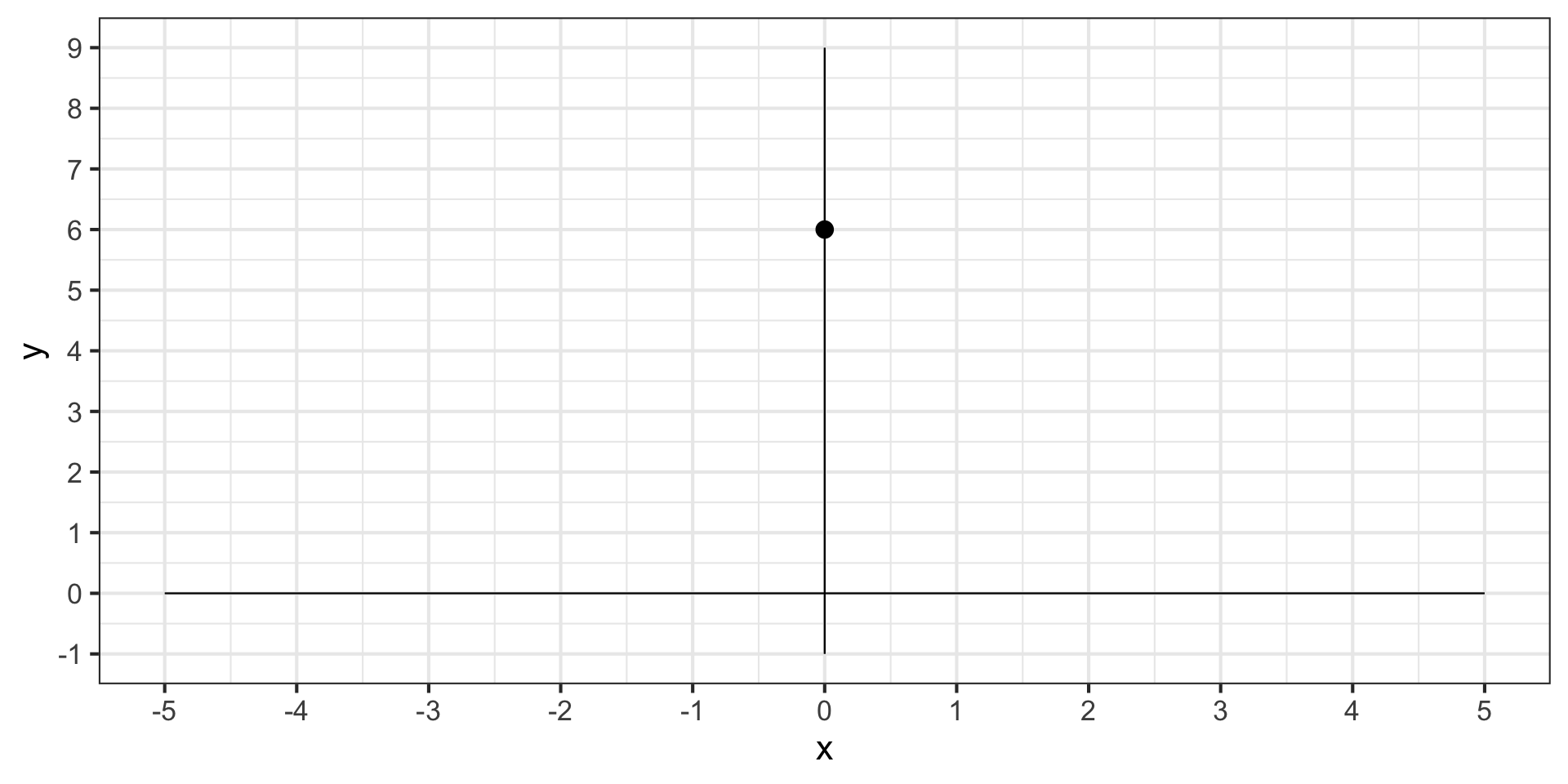
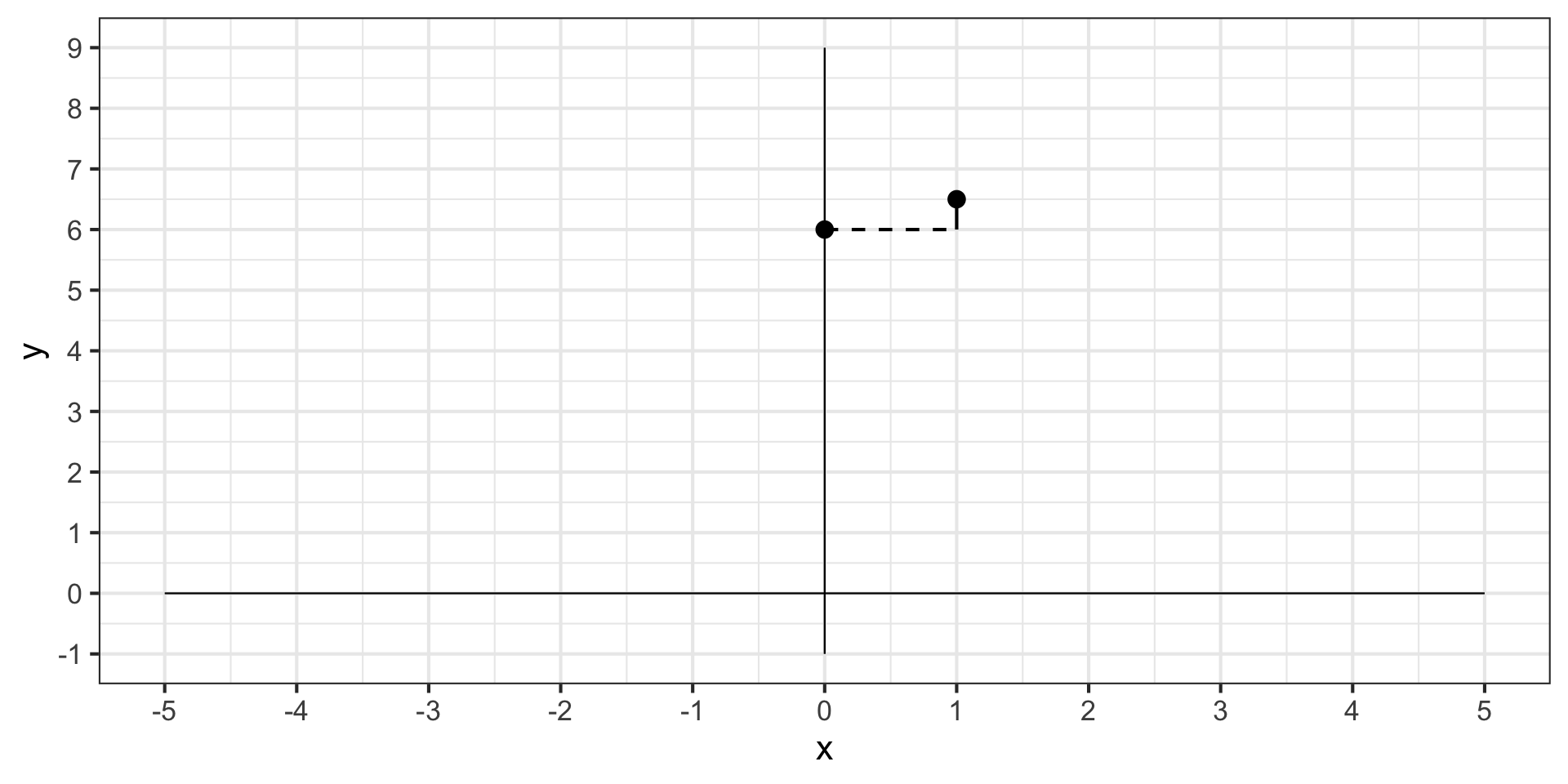
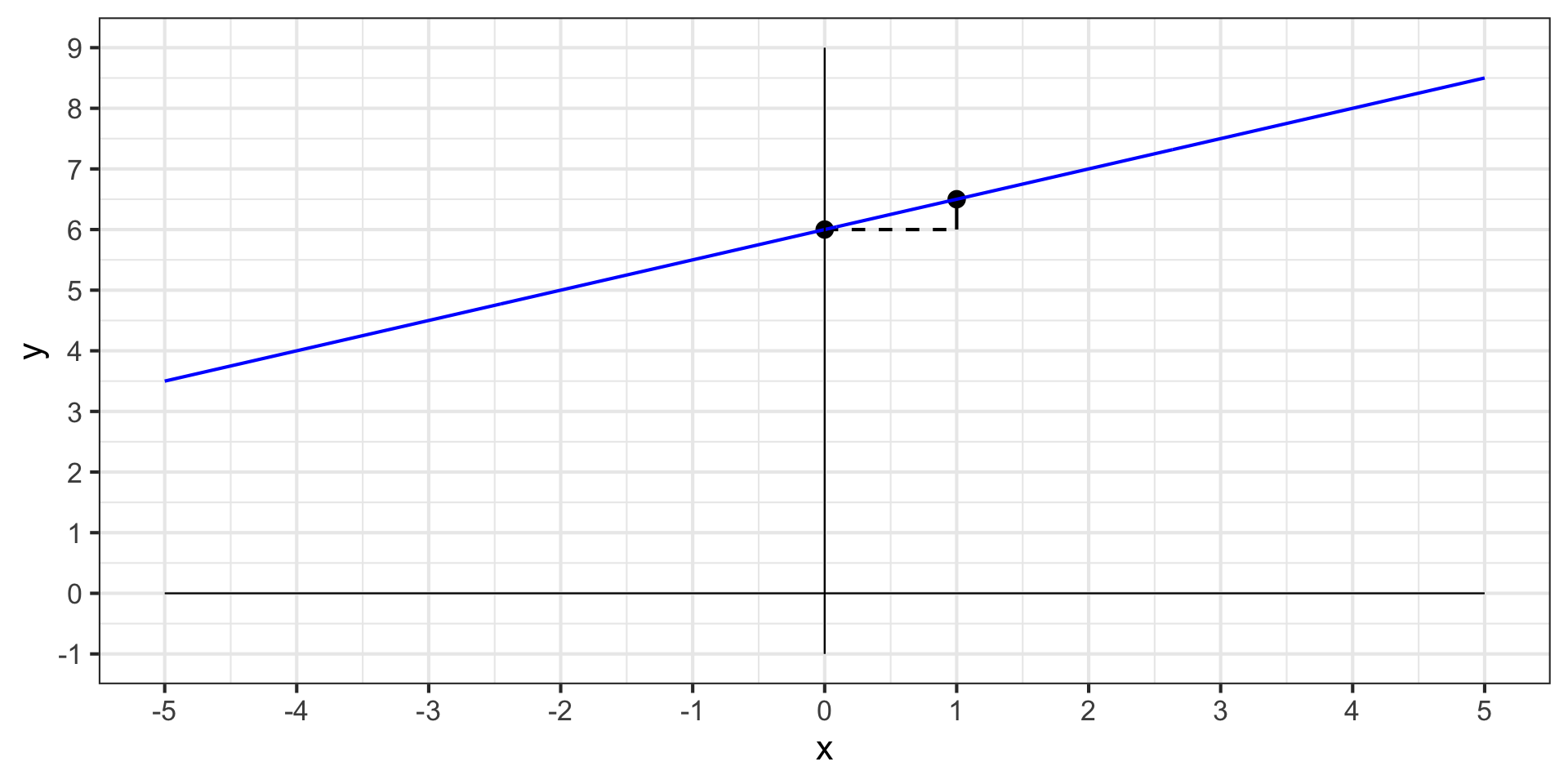
Example 2: Find the equation of the line with slope \(\displaystyle{m = \frac{1}{2}}\) passing through \(\left(-2, 5\right)\). Write it in slope-intercept form and graph the function.

Solution. Since we know \(\displaystyle{m = \frac{1}{2}}\), start with \(\displaystyle{y = \frac{1}{2}x + b}\) and substitute the known point to solve for \(b\).

\[\begin{align} 5 &= \frac{1}{2}\left(-2\right) + b \end{align}\]

Slope and Intercept

Example 2: Find the equation of the line with slope \(\displaystyle{m = \frac{1}{2}}\) passing through \(\left(-2, 5\right)\). Write it in slope-intercept form and graph the function.

Solution. Since we know \(\displaystyle{m = \frac{1}{2}}\), start with \(\displaystyle{y = \frac{1}{2}x + b}\) and substitute the known point to solve for \(b\).

\[\begin{align} 5 &= \frac{1}{2}\left(-2\right) + b\\ \implies 5 &= -1 + b \end{align}\]

Slope and Intercept

Example 2: Find the equation of the line with slope \(\displaystyle{m = \frac{1}{2}}\) passing through \(\left(-2, 5\right)\). Write it in slope-intercept form and graph the function.

Solution. Since we know \(\displaystyle{m = \frac{1}{2}}\), start with \(\displaystyle{y = \frac{1}{2}x + b}\) and substitute the known point to solve for \(b\).

\[\begin{align} 5 &= \frac{1}{2}\left(-2\right) + b\\ \implies 5 &= -1 + b\\ \implies b &= 6 \end{align}\]

So the equation is \(\boxed{~\displaystyle{y = \frac{1}{2}x + 6}~}\).
Slope and Intercept

Example 2: Find the equation of the line with slope \(\displaystyle{m = \frac{1}{2}}\) passing through \(\left(-2, 5\right)\). Write it in slope-intercept form and graph the function.

Solution. Since we know \(\displaystyle{m = \frac{1}{2}}\), start with \(\displaystyle{y = \frac{1}{2}x + b}\) and substitute the known point to solve for \(b\).

\[\begin{align} 5 &= \frac{1}{2}\left(-2\right) + b\\ \implies 5 &= -1 + b\\ \implies b &= 6 \end{align}\]

So the equation is \(\boxed{~\displaystyle{y = \frac{1}{2}x + 6}~}\).
Slope and Intercept

Example 2: Find the equation of the line with slope \(\displaystyle{m = \frac{1}{2}}\) passing through \(\left(-2, 5\right)\). Write it in slope-intercept form and graph the function.

Solution. Since we know \(\displaystyle{m = \frac{1}{2}}\), start with \(\displaystyle{y = \frac{1}{2}x + b}\) and substitute the known point to solve for \(b\).

\[\begin{align} 5 &= \frac{1}{2}\left(-2\right) + b\\ \implies 5 &= -1 + b\\ \implies b &= 6 \end{align}\]

So the equation is \(\boxed{~\displaystyle{y = \frac{1}{2}x + 6}~}\).
Use Point-Slope Form to Build Equations Instead

The approach on this slide works, but there is a more efficient, and less error proned, approach using point-slope form. We’ll revisit this example next.

Point-Slope Form

Definition (Point-Slope Form): Given a line with slope \(m\) passing through the point \(\left(x_0, y_0\right)\), the equation of the line is:

\[y - y_0 = m\left(x - x_0\right)\]

This is the most efficient form when constructing the equation of a line – you need only a slope and one point.

Example 3: Revisiting Example 2 – find the equation of the line with slope \(\displaystyle{\frac{1}{2}}\) through \(\left(-2, 5\right)\) using point-slope form.

Solution. Substitute directly:

\[\boxed{~y - 5 = \frac{1}{2}\left(x - \left(-2\right)\right)~}\]

To convert to slope-intercept form:

\[\begin{align} y - 5 &= \frac{1}{2}\left(x - \left(-2\right)\right) \end{align}\]

Point-Slope Form

Definition (Point-Slope Form): Given a line with slope \(m\) passing through the point \(\left(x_0, y_0\right)\), the equation of the line is:

\[y - y_0 = m\left(x - x_0\right)\]

This is the most efficient form when constructing the equation of a line – you need only a slope and one point.

Example 3: Revisiting Example 2 – find the equation of the line with slope \(\displaystyle{\frac{1}{2}}\) through \(\left(-2, 5\right)\) using point-slope form.

Solution. Substitute directly:

\[\boxed{~y - 5 = \frac{1}{2}\left(x - \left(-2\right)\right)~}\]

To convert to slope-intercept form:

\[\begin{align} y - 5 &= \frac{1}{2}\left(x - \left(-2\right)\right)\\ \implies y - 5 &= \frac{1}{2}\left(x + 2\right) \end{align}\]

Point-Slope Form

Definition (Point-Slope Form): Given a line with slope \(m\) passing through the point \(\left(x_0, y_0\right)\), the equation of the line is:

\[y - y_0 = m\left(x - x_0\right)\]

This is the most efficient form when constructing the equation of a line – you need only a slope and one point.

Example 3: Revisiting Example 2 – find the equation of the line with slope \(\displaystyle{\frac{1}{2}}\) through \(\left(-2, 5\right)\) using point-slope form.

Solution. Substitute directly:

\[\boxed{~y - 5 = \frac{1}{2}\left(x - \left(-2\right)\right)~}\]

To convert to slope-intercept form:

\[\begin{align} y - 5 &= \frac{1}{2}\left(x - \left(-2\right)\right)\\ \implies y - 5 &= \frac{1}{2}\left(x + 2\right)\\ \implies y - 5 &= \frac{1}{2}x + 1 \end{align}\]

Point-Slope Form

Definition (Point-Slope Form): Given a line with slope \(m\) passing through the point \(\left(x_0, y_0\right)\), the equation of the line is:

\[y - y_0 = m\left(x - x_0\right)\]

This is the most efficient form when constructing the equation of a line – you need only a slope and one point.

Example 3: Revisiting Example 2 – find the equation of the line with slope \(\displaystyle{\frac{1}{2}}\) through \(\left(-2, 5\right)\) using point-slope form.

Solution. Substitute directly:

\[\boxed{~y - 5 = \frac{1}{2}\left(x - \left(-2\right)\right)~}\]

To convert to slope-intercept form:

\[\begin{align} y - 5 &= \frac{1}{2}\left(x - \left(-2\right)\right)\\ \implies y - 5 &= \frac{1}{2}\left(x + 2\right)\\ \implies y - 5 &= \frac{1}{2}x + 1\\ \implies y &= \frac{1}{2}x + 6~\checkmark \end{align}\]

Point Slope Form

Example 4: Find the equation of the line passing through \(\left(3, 8\right)\) and \(\left(7, -4\right)\).

Solution. First compute the slope using the slope formula.

\[\begin{align} m &= \frac{y_2 - y_1}{x_2 - x_1} \end{align}\]

Point Slope Form

Example 4: Find the equation of the line passing through \(\left(3, 8\right)\) and \(\left(7, -4\right)\).

Solution. First compute the slope using the slope formula.

\[\begin{align} m &= \frac{y_2 - y_1}{x_2 - x_1}\\ &= \frac{-4 - 8}{7 - 3} \end{align}\]

Point Slope Form

Example 4: Find the equation of the line passing through \(\left(3, 8\right)\) and \(\left(7, -4\right)\).

Solution. First compute the slope using the slope formula.

\[\begin{align} m &= \frac{y_2 - y_1}{x_2 - x_1}\\ &= \frac{-4 - 8}{7 - 3}\\ &= \frac{-12}{4} = -3 \end{align}\]

Point Slope Form

Example 4: Find the equation of the line passing through \(\left(3, 8\right)\) and \(\left(7, -4\right)\).

Solution. First compute the slope using the slope formula.

\[\begin{align} m &= \frac{y_2 - y_1}{x_2 - x_1}\\ &= \frac{-4 - 8}{7 - 3}\\ &= \frac{-12}{4} = -3 \end{align}\]

Now use point-slope form with \(m = -3\) and the point \(\left(3, 8\right)\):

\[\boxed{~y - 8 = -3\left(x - 3\right)~}\]

Note: Either point works – using \(\left(7, -4\right)\) gives \(y + 4 = -3\left(x - 7\right)\), which simplifies to the same line.

Linear Functions and Transformations

Recall from Day 8 that every function class is built by transforming a book function. For linear functions, that book function is \(f\left(x\right) = x\).

Consider the function from Example 4 written as \(f\left(x\right) = -3\left(x - 3\right) + 8\).

This makes the transformation sequence explicit:

  1. Start with \(g\left(x\right) = x\)
  2. Shift right by \(3\), which is done via \(g\left(x - 3\right) = x - 3\)
  3. Reflect over the \(x\)-axis and stretch by \(3\) to get \(-3\cdot g\left(x - 3\right) = -3\left(x - 3\right)\)
  4. Shift up by \(8\), obtaining \(3\cdot g\left(x - 3\right) + 8 = -3\left(x - 3\right) + 8\)

This is exactly the point-slope form \(y - 8 = -3\left(x - 3\right)\) – written as a function! Point-slope form and the transformations framework are two descriptions of the same idea.

Vertical and Horizontal Lines

A line is horizontal if its slope is \(0\).

The equation for a horizontal line simplifies to \(y = b\), since \(y = 0x + b\) is the same as \(y = b\).

Vertical lines have undefined slopes, with equations written as \(x = a\)

Example 5: Find the equation for the horizontal line passing through the point \(\left(5, -12\right)\).

Solution. The equation will have the form \(y = b\). This means that the \(y\)-coordinate (the second coordinate) of all points on the line must remain constant at \(-12\), so the equation must be \(y = -12\).

Example 6: Find the equation of the vertical line passing through the point \(\left(4, 18\right)\).

Solution. This time, the equation will take the form \(x = a\) and the \(x\)-coordinate of every point on the line must remain constant. Since the known point has an \(x\)-coordinate at \(4\), we know that the equation of the line must be \(x = 4\).

Parallel and Perpendicular Lines

Definition: Two lines are parallel if they have the same slope. Two lines are perpendicular if their slopes are negative reciprocals of one another. That is, \(m_1 \cdot m_2 = -1\).

Example 7: Find any line parallel to \(y = -17x + 11\).

Solution. Any line with slope \(-17\) will do. For example, \(\boxed{~y = -17x - 1~}\).

Example 8: Find the equation of the line perpendicular to \(y = 3x + 8\) and passing through \(\left(-5, 12\right)\).

Solution. The perpendicular slope is \(m = -\frac{1}{3}\) (negative reciprocal of \(3\)). Using point-slope form:

\[\boxed{~y - 12 = -\frac{1}{3}\left(x + 5\right)~}\]

Equations of Lines Practice

Try It! 1: Find the equation of the line passing through \(\left(-1, 4\right)\) and \(\left(3, -8\right)\).

  • Write the equation in both point-slope and slope-intercept forms.
  • Is this line increasing or decreasing?

Try It! 2: Determine whether the following pairs of lines are parallel, perpendicular, or neither.

\(\left(a\right)\) \(y = 4x - 7\) and \(y = 4x + 2\)

\(\left(b\right)\) \(y = \frac{2}{3}x + 1\) and \(y = -\frac{3}{2}x - 5\)

\(\left(c\right)\) \(y = 5x + 3\) and \(y = -5x + 3\)

Linear Equations

Definition (Linear Equation): An equation is linear in its variable(s) if it involves no exponents on variables, no variables in denominators, no products between variables, and no special functions.

Examples of linear equations:

  • \(5x - 4 = 22\)
  • \(10x + 6 = -2\left(x - 5\right)\)
  • \(2x + 3y = 19 + x\)

Strategy (Solving Linear Equations):

  1. Collect all variable terms on one side.
  2. Move all constant terms to the other side.
  3. Combine like terms.
  4. Divide to isolate the variable.

Solving Linear Equations

Example 9: Solve \(5x - 20 = 15\).

Solution.

\[\begin{align} 5x - 20 &= 15 \end{align}\]

Solving Linear Equations

Example 9: Solve \(5x - 20 = 15\).

Solution.

\[\begin{align} 5x - 20 &= 15\\ \implies 5x &= 35 \end{align}\]

Solving Linear Equations

Problem: Solve \(5x - 20 = 15\).

Solution.

\[\begin{align} 5x - 20 &= 15\\ \implies 5x &= 35\\ \implies x &= \boxed{~7~} \end{align}\]

Example 10: Solve \(\displaystyle{2t + 18 = \frac{t + 2}{3} + 5}\).

Solution.

\[\begin{align} 2t + 18 &= \frac{t + 2}{3} + 5 \end{align}\]

Solving Linear Equations

Example 9: Solve \(5x - 20 = 15\).

Solution.

\[\begin{align} 5x - 20 &= 15\\ \implies 5x &= 35\\ \implies x &= \boxed{~7~} \end{align}\]

Example 10: Solve \(\displaystyle{2t + 18 = \frac{t + 2}{3} + 5}\).

Solution.

\[\begin{align} 2t + 18 &= \frac{t + 2}{3} + 5\\ \implies 2t + 13 &= \frac{t + 2}{3} \end{align}\]

Solving Linear Equations

Example 9: Solve \(5x - 20 = 15\).

Solution.

\[\begin{align} 5x - 20 &= 15\\ \implies 5x &= 35\\ \implies x &= \boxed{~7~} \end{align}\]

Example 10: Solve \(\displaystyle{2t + 18 = \frac{t + 2}{3} + 5}\).

Solution.

\[\begin{align} 2t + 18 &= \frac{t + 2}{3} + 5\\ \implies 2t + 13 &= \frac{t + 2}{3}\\ \implies 6t + 39 &= t + 2 \end{align}\]

Solving Linear Equations

Example 9: Solve \(5x - 20 = 15\).

Solution.

\[\begin{align} 5x - 20 &= 15\\ \implies 5x &= 35\\ \implies x &= \boxed{~7~} \end{align}\]

Example 10: Solve \(\displaystyle{2t + 18 = \frac{t + 2}{3} + 5}\).

Solution.

\[\begin{align} 2t + 18 &= \frac{t + 2}{3} + 5\\ \implies 2t + 13 &= \frac{t + 2}{3}\\ \implies 6t + 39 &= t + 2\\ \implies 5t + 39 &= 2 \end{align}\]

Solving Linear Equations

Example 9: Solve \(5x - 20 = 15\).

Solution.

\[\begin{align} 5x - 20 &= 15\\ \implies 5x &= 35\\ \implies x &= \boxed{~7~} \end{align}\]

Example 10: Solve \(\displaystyle{2t + 18 = \frac{t + 2}{3} + 5}\).

Solution.

\[\begin{align} 2t + 18 &= \frac{t + 2}{3} + 5\\ \implies 2t + 13 &= \frac{t + 2}{3}\\ \implies 6t + 39 &= t + 2\\ \implies 5t + 39 &= 2\\ \implies 5t &= -37 \end{align}\]

Solving Linear Equations

Example 9: Solve \(5x - 20 = 15\).

Solution.

\[\begin{align} 5x - 20 &= 15\\ \implies 5x &= 35\\ \implies x &= \boxed{~7~} \end{align}\]

Example 10: Solve \(\displaystyle{2t + 18 = \frac{t + 2}{3} + 5}\).

Solution.

\[\begin{align} 2t + 18 &= \frac{t + 2}{3} + 5\\ \implies 2t + 13 &= \frac{t + 2}{3}\\ \implies 6t + 39 &= t + 2\\ \implies 5t + 39 &= 2\\ \implies 5t &= -37\\ \implies t &= \boxed{~-37/5~} \end{align}\]

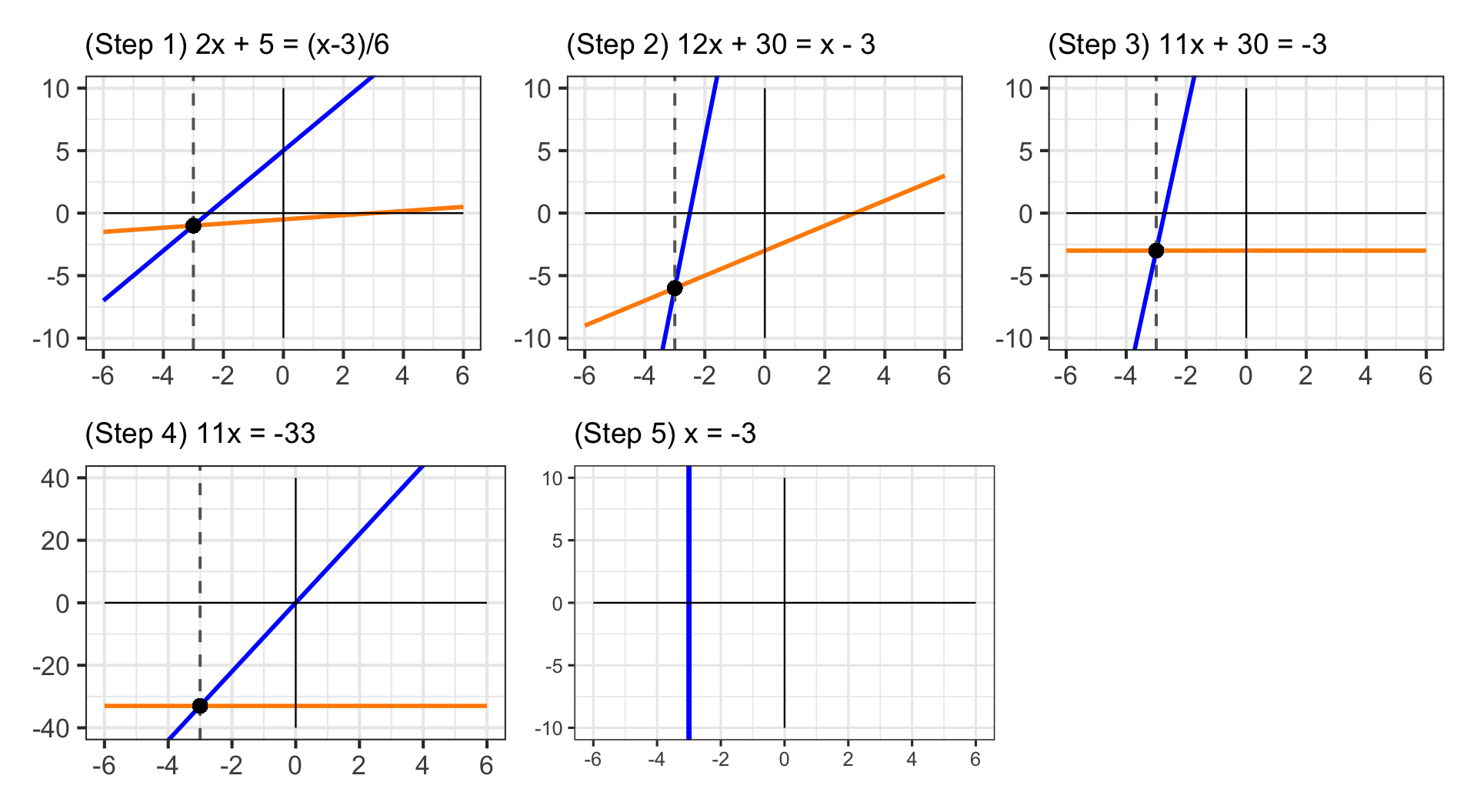
The Geometry of Solving Equations

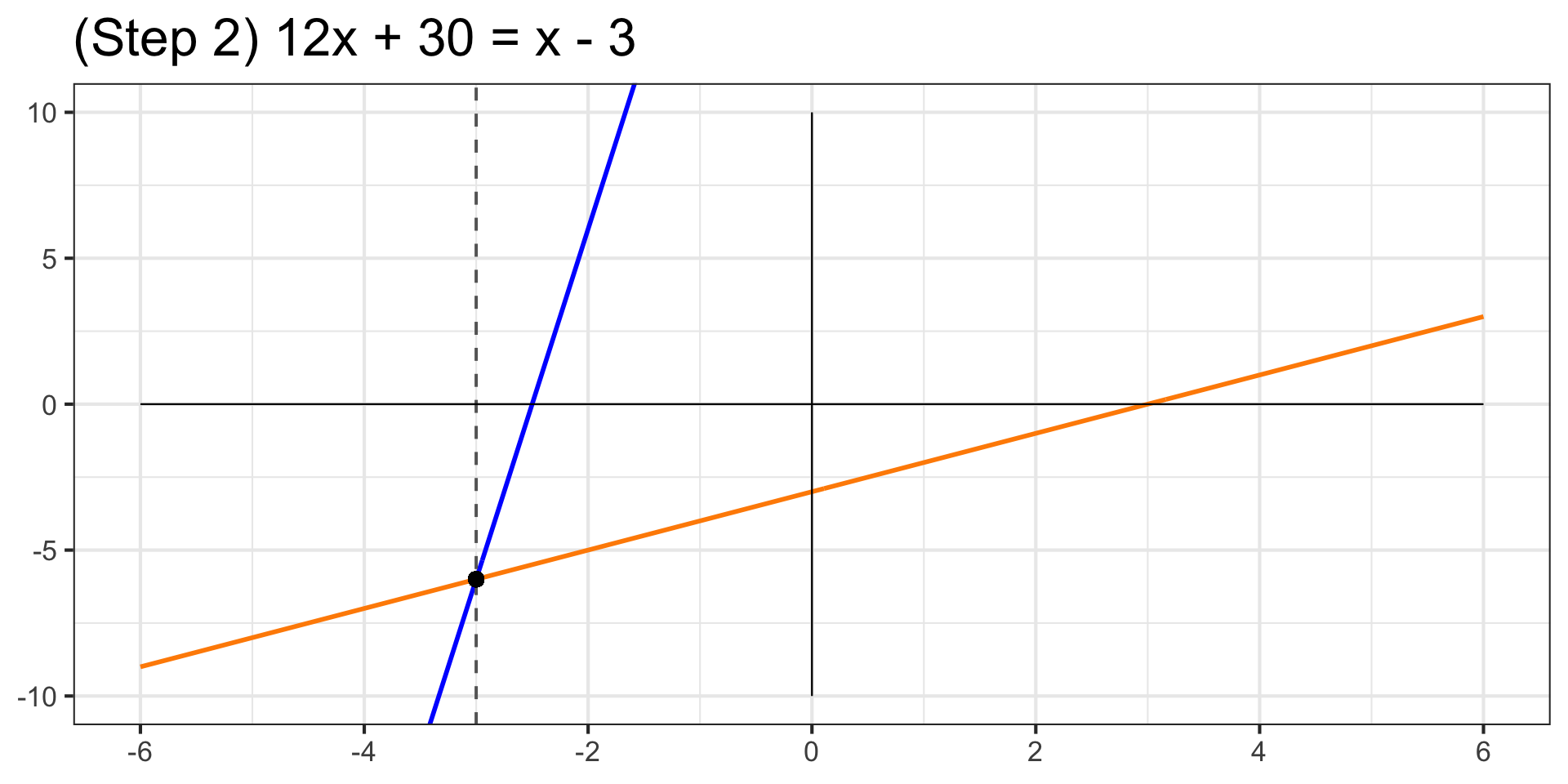
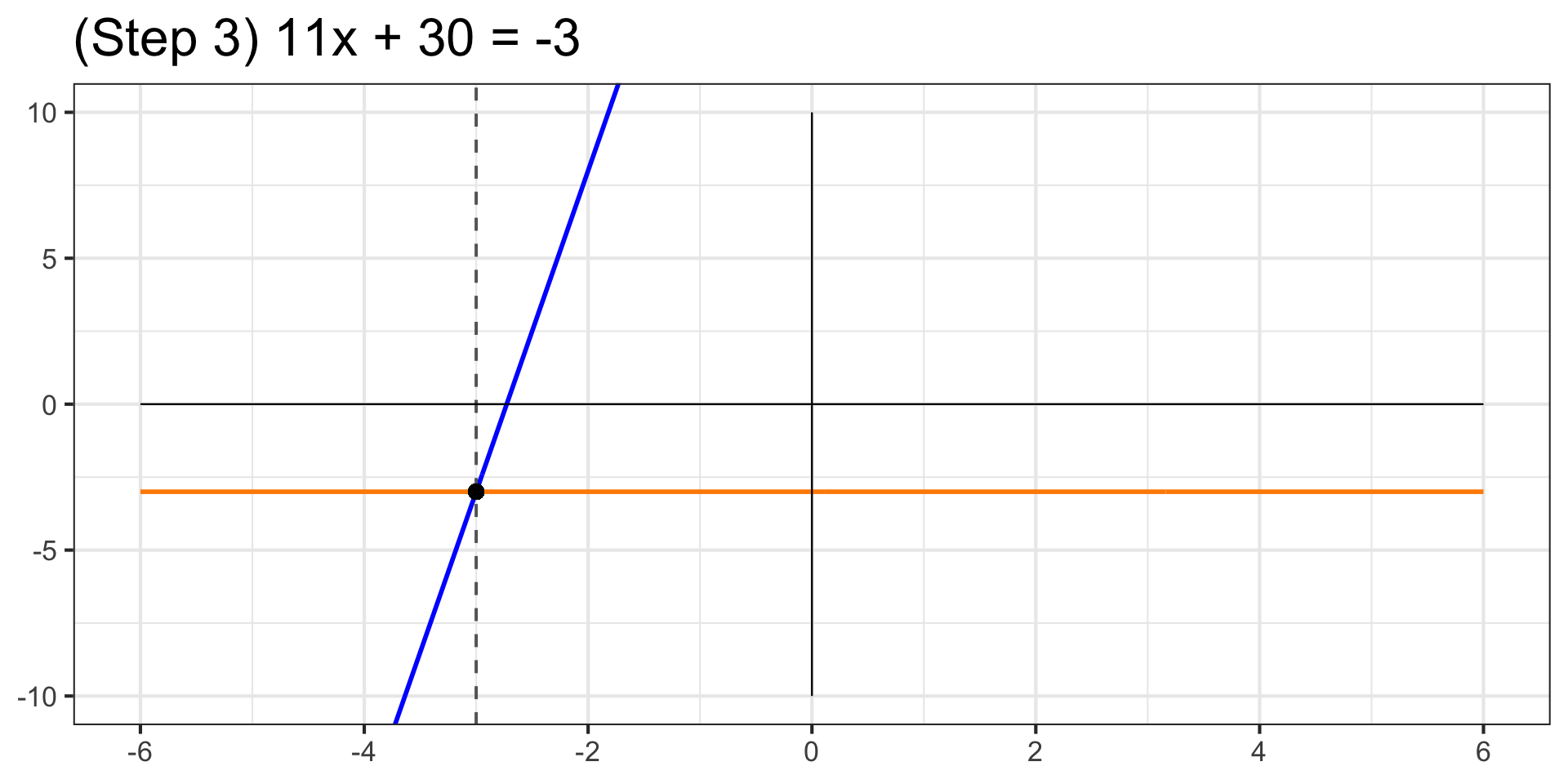
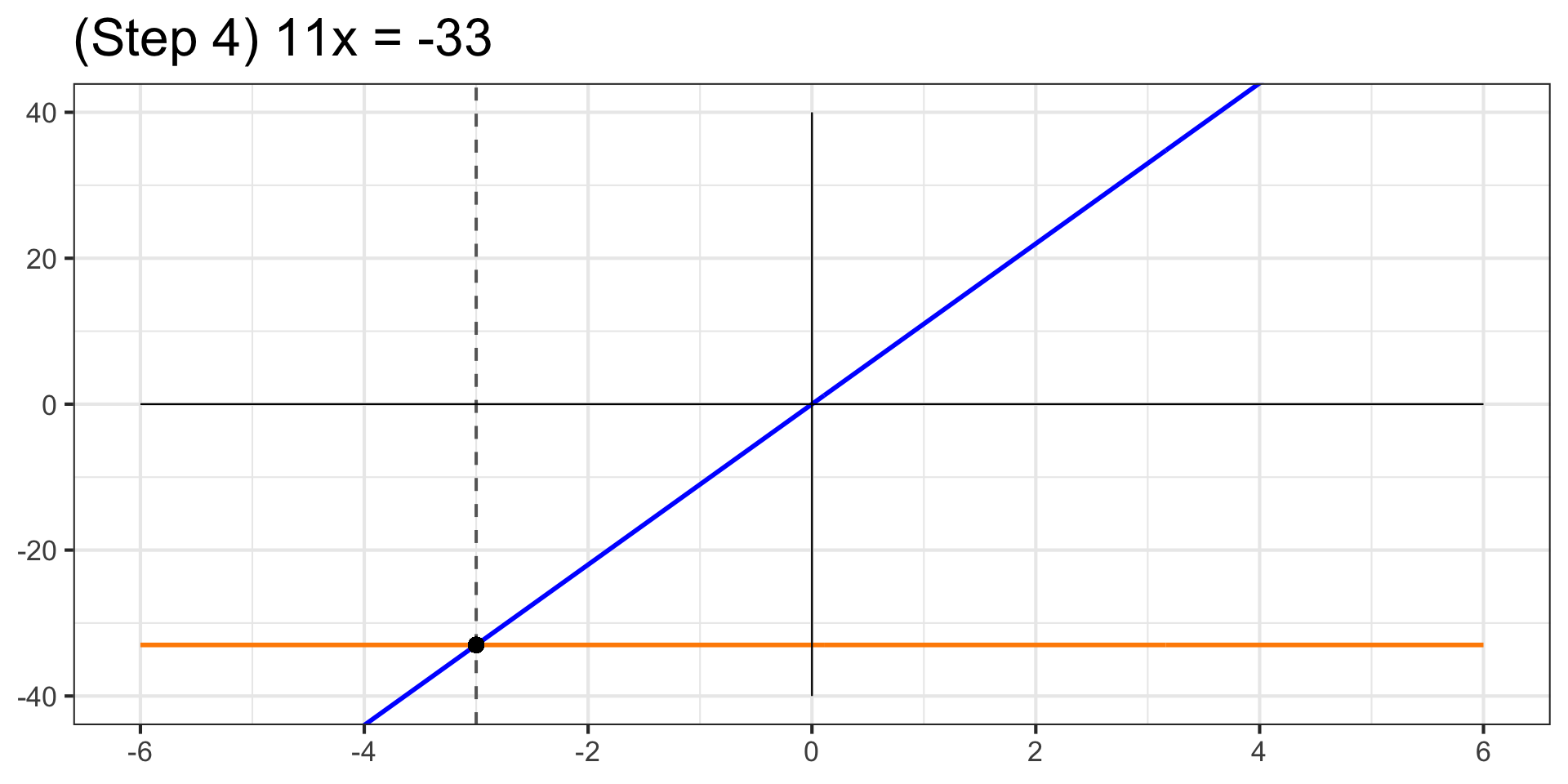
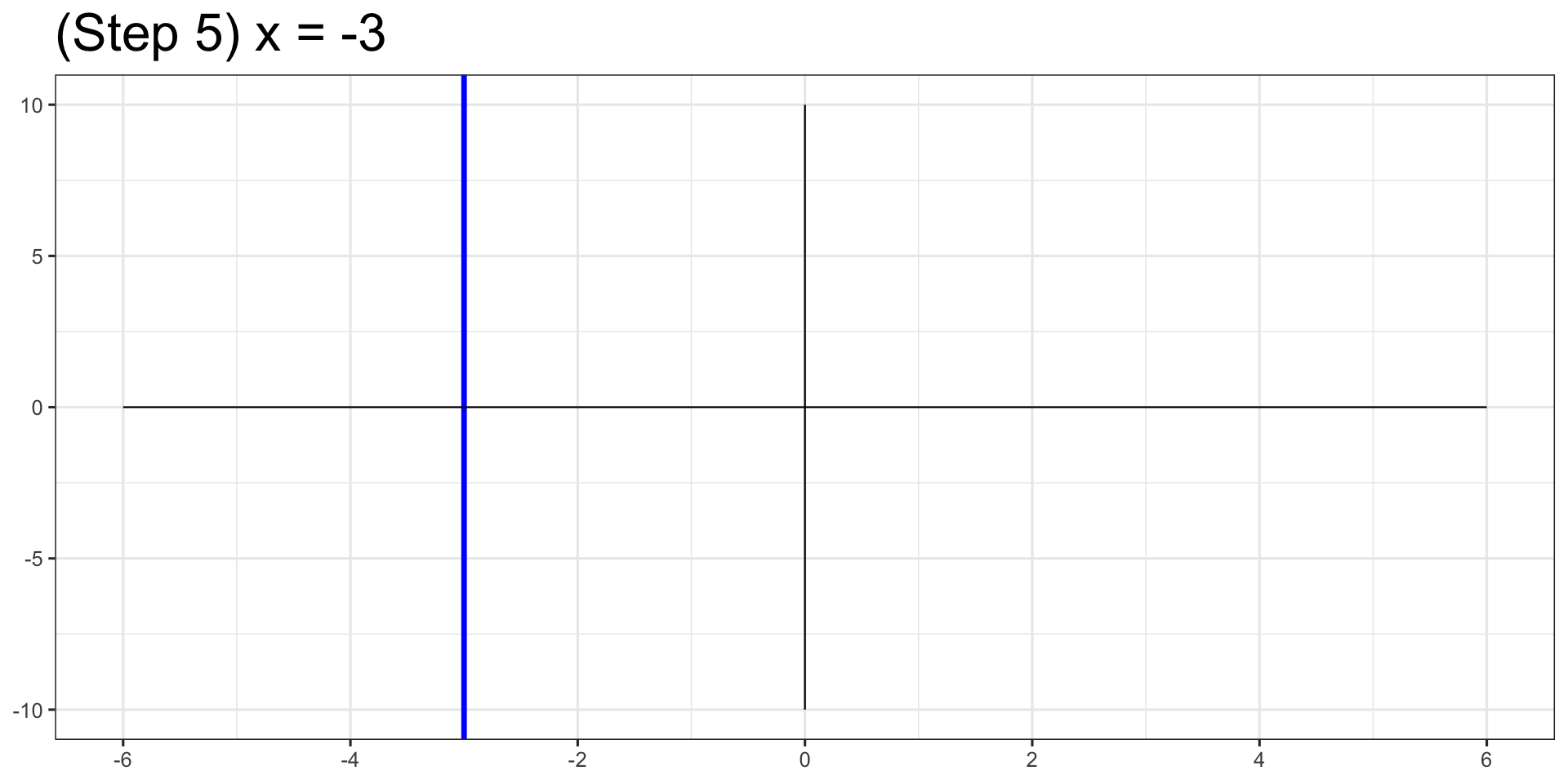
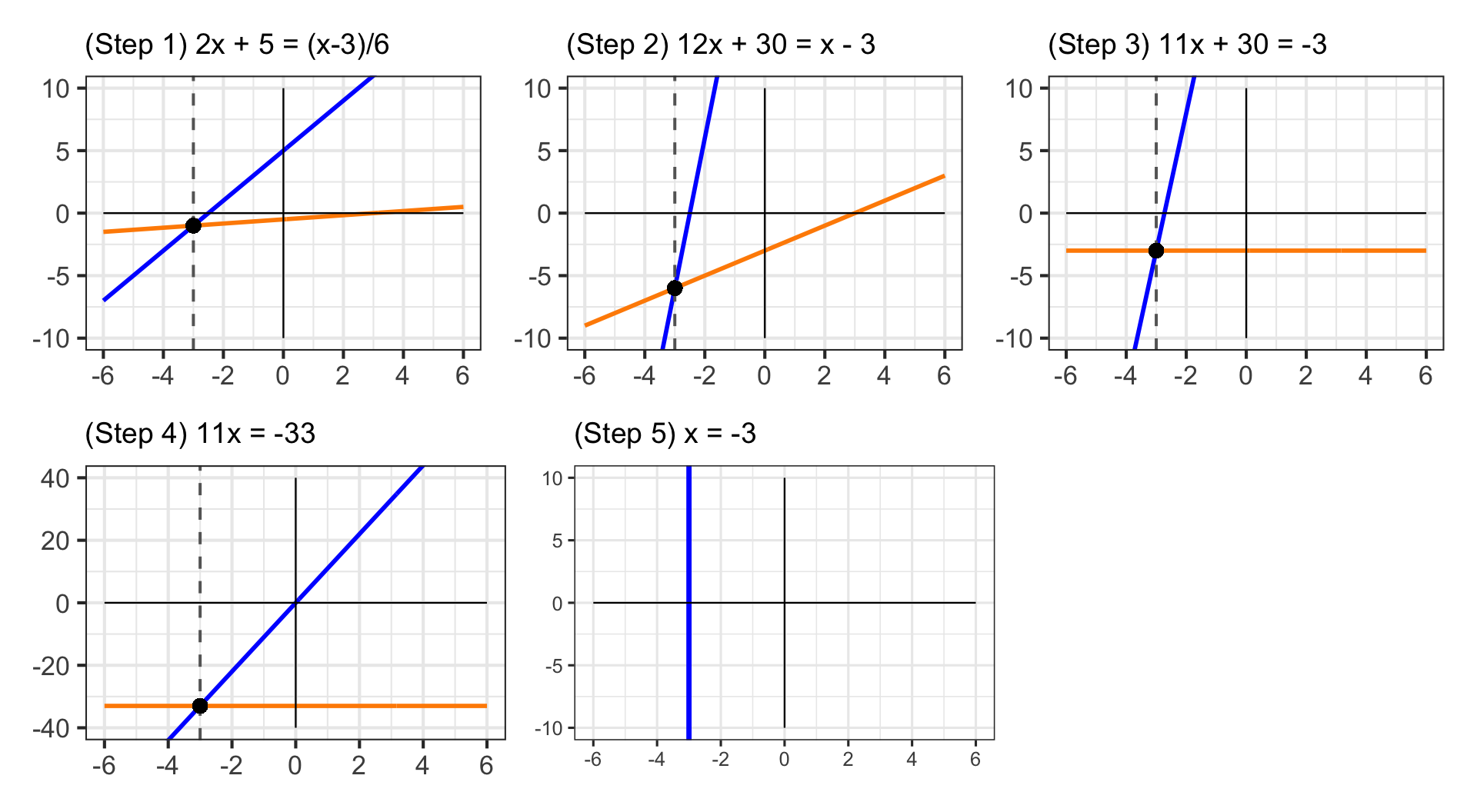
Every algebraic manipulation we make when solving an equation has a geometric interpretation.

  • The solutions to \(\text{expr}_1 = \text{expr}_2\) are the \(x\)-coordinates of any points of intersection between the graphs of \(f\left(x\right) = \text{expr}_1\) and \(g\left(x\right) = \text{expr}_2\).
  • The solutions to \(\text{expr} = 0\) are the roots (\(x\)-intercepts) of the graph of \(f\left(x\right) = \text{expr}\).

Each legal algebraic step changes the form of the equation – and with it, the shape of the geometric question – but never changes the location of the solution.

Geometry of Solving Equations

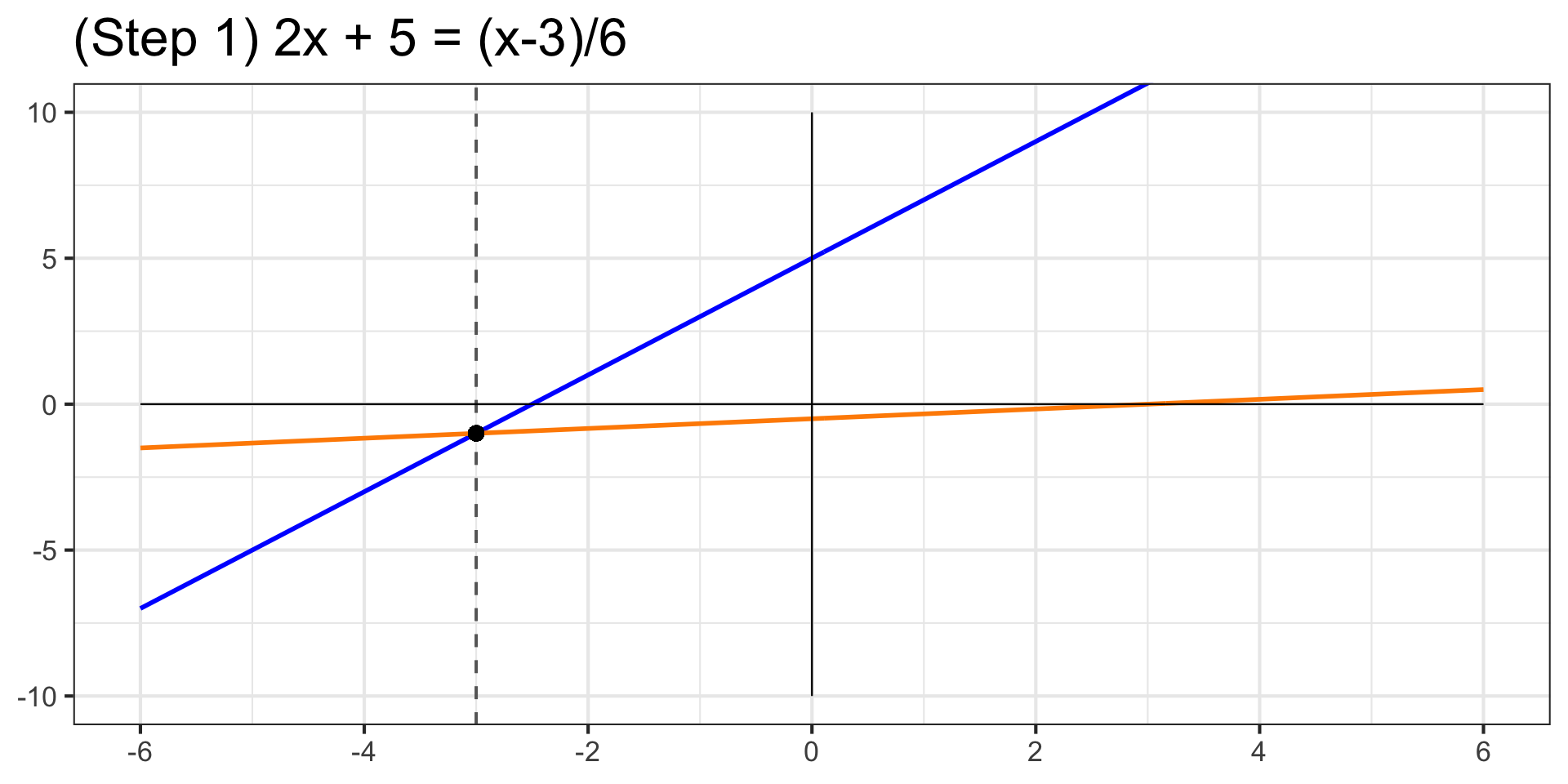
Example 11: Solve \(\displaystyle{2x + 5 = \frac{x - 3}{6}}\) and illustrate each step geometrically.

Solution.

\[\begin{align} 2x + 5 &= \frac{x - 3}{6} & \left(\text{Step } 1\right) \end{align}\]
Geometry of Solving Equations

Example 11: Solve \(\displaystyle{2x + 5 = \frac{x - 3}{6}}\) and illustrate each step geometrically.

Solution.

\[\begin{align} 2x + 5 &= \frac{x - 3}{6} & \left(\text{Step } 1\right)\\ \implies 12x + 30 &= x - 3 & \left(\text{Step } 2\right) \end{align}\]
Geometry of Solving Equations

Example 11: Solve \(\displaystyle{2x + 5 = \frac{x - 3}{6}}\) and illustrate each step geometrically.

Solution.

\[\begin{align} 2x + 5 &= \frac{x - 3}{6} & \left(\text{Step } 1\right)\\ \implies 12x + 30 &= x - 3 & \left(\text{Step } 2\right)\\ \implies 11x + 30 &= -3 & \left(\text{Step } 3\right) \end{align}\]
Geometry of Solving Equations

Example 11: Solve \(\displaystyle{2x + 5 = \frac{x - 3}{6}}\) and illustrate each step geometrically.

Solution.

\[\begin{align} 2x + 5 &= \frac{x - 3}{6} & \left(\text{Step } 1\right)\\ \implies 12x + 30 &= x - 3 & \left(\text{Step } 2\right)\\ \implies 11x + 30 &= -3 & \left(\text{Step } 3\right)\\ \implies 11x &= -33 & \left(\text{Step } 4\right) \end{align}\]
Geometry of Solving Equations

Example 11: Solve \(\displaystyle{2x + 5 = \frac{x - 3}{6}}\) and illustrate each step geometrically.

Solution.

\[\begin{align} 2x + 5 &= \frac{x - 3}{6} & \left(\text{Step } 1\right)\\ \implies 12x + 30 &= x - 3 & \left(\text{Step } 2\right)\\ \implies 11x + 30 &= -3 & \left(\text{Step } 3\right)\\ \implies 11x &= -33 & \left(\text{Step } 4\right)\\ \implies x &= -3 & \left(\text{Step } 5\right) \end{align}\]
Geometry of Solving Equations

Below are all the graphical representations of the steps to solve the equation.
Applied Problems

Applied Problem 1: A gym membership with 2 personal training sessions costs $125; with 5 sessions it costs $260. What is the cost per session? If the gym offers $5 off per session for members signing up for 10 sessions, how much would that membership cost?

Solution. Model the cost as \(C\left(n\right) = mn + b\) where \(n\) is the number of sessions.

\[\begin{align} m &= \frac{260 - 125}{5 - 2} = \frac{135}{3} = \$45 \text{ per session} \end{align}\]

Solve for \(b\) using \(C\left(2\right) = 125\): \(\quad 125 = 45\left(2\right) + b \implies b = \$35\)

So \(C\left(n\right) = 45n + 35\). For the discounted 10-session package, the rate drops to $40 per session:

\[C_{\text{discounted}}\left(10\right) = 40\left(10\right) + 35 = \boxed{~\$435~}\]

Applied Problems (Cont’d)

Applied Problem 2: A town’s population has been growing linearly. In 2003 the population was \(45{,}000\), and has been growing by \(1{,}700\) people per year. Write a function \(P\left(t\right)\) for the population \(t\) years after 2003.

Solution. We know the slope (\(m = 1700\)) and a point (\(t = 0\), \(P = 45000\)), so:

\[\boxed{~P\left(t\right) = 1700t + 45000~}\]

Applied Problem 3: Average annual income for 1990–1999 is modeled by \(I\left(x\right) = 1054x + 23286\), where \(x\) is years after 1990. Which statement correctly interprets the slope?

  1. As of 1990, average annual income was $23,286.
  2. Over the ten-year period, income increased by a total of $1,054.
  3. Each year in the 1990s, average annual income increased by $1,054.
  4. Average annual income rose to $23,286 by the end of 1999.

Exit Ticket Task

Navigate to our MAT142 Exit Ticket Form, answer the questions, and complete the task below.


Note. Today’s discussion is listed as 8. Linear Functions and Equations

Task: Find the equation of the line passing through \(\left(2, -1\right)\) and perpendicular to \(y = \frac{1}{4}x + 3\). Write your answer in both point-slope and slope-intercept forms.

Summary and Next Time…

Ideas From Today
  • A linear function has the form \(f\left(x\right) = mx + b\); slope \(m\) is the rate of change, \(\left(0, b\right)\) is the \(y\)-intercept.
  • Slope-intercept form \(y = mx + b\) is easiest for reading; point-slope form \(y - y_0 = m\left(x - x_0\right)\) is easiest for constructing.
  • Point-slope form is the transformations framework applied to \(f\left(x\right) = x\).
  • Parallel lines have equal slopes; perpendicular lines have slopes with product \(-1\).
  • Solving a linear equation is equivalent to finding the intersection of two lines or the root of a function.
  • Each algebraic step changes the form but preserves the solution location.
Resources
Next Time:
Polynomial Functions
Homework:
Complete Homework 6 on MyOpenMath