Newton-Cotes Formulae
March 5, 2026
Almost surely, integration was introduced to you in a way that was inherently numerical.
Integration was introduced to you as a way to calculate area accumulation.
You broke complex regions into rectangles and noted that the area of the region was approximately the area of the rectangles – more rectangles generally meant better approximation.
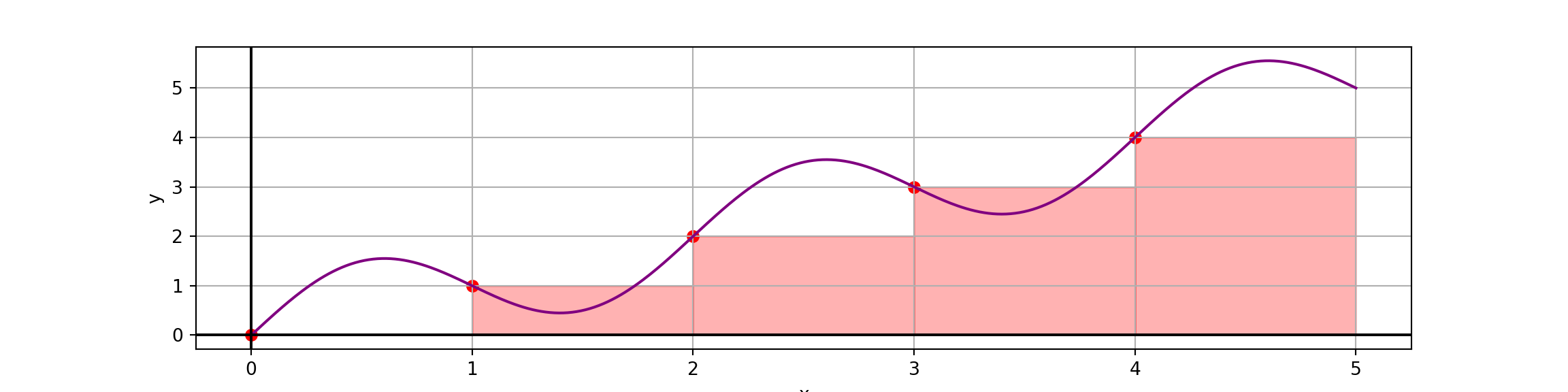
Almost surely, integration was introduced to you in a way that was inherently numerical.
Integration was introduced to you as a way to calculate area accumulation.
You broke complex regions into rectangles and noted that the area of the region was approximately the area of the rectangles – more rectangles generally meant better approximation.
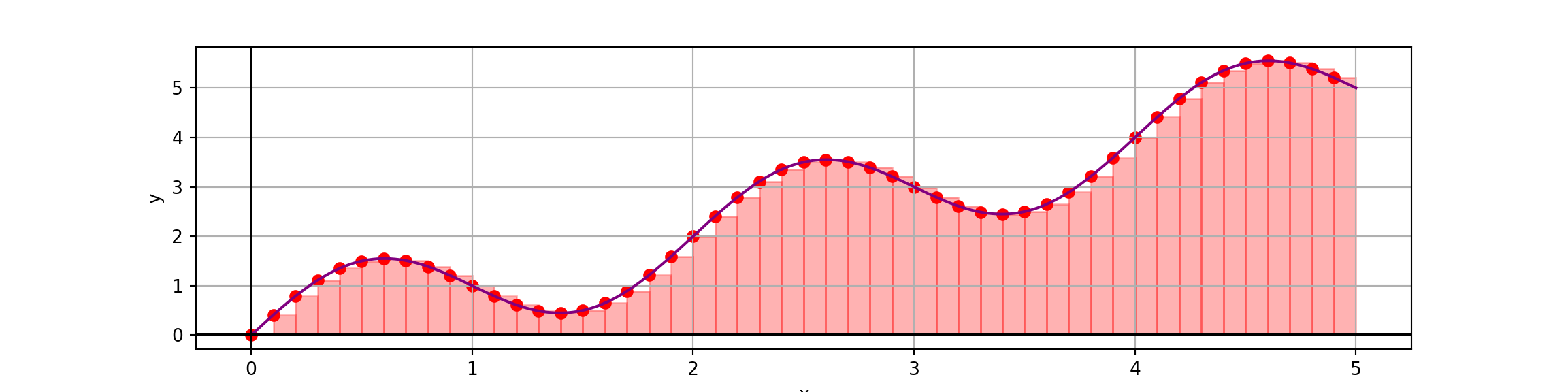
The following table gives several methods which you were probably introduced to in order to approximate \(\displaystyle{\int_{a}^{b}{f\left(x\right)dx}}\), where \(x_0 = a\), \(x_n = b\), and \(x_0 < x_1 < x_2 < \cdots < x_n\).
| Name | Expression for Approximating Integral |
|---|---|
| Left-Endpoint Method | \(\displaystyle{\sum_{i = 0}^{n - 1}{f\left(x_i\right)\Delta x_i}}\) |
| Right-Endpoint Method | \(\displaystyle{\sum_{i = 1}^{n}{f\left(x_i\right)\Delta x_i}}\) |
| Trapezoid Method | \(\displaystyle{\sum_{i = 0}^{n - 1}{\frac{f\left(x_i\right) + f\left(x_{i+1}\right)}{2}\Delta x_i}}\) |
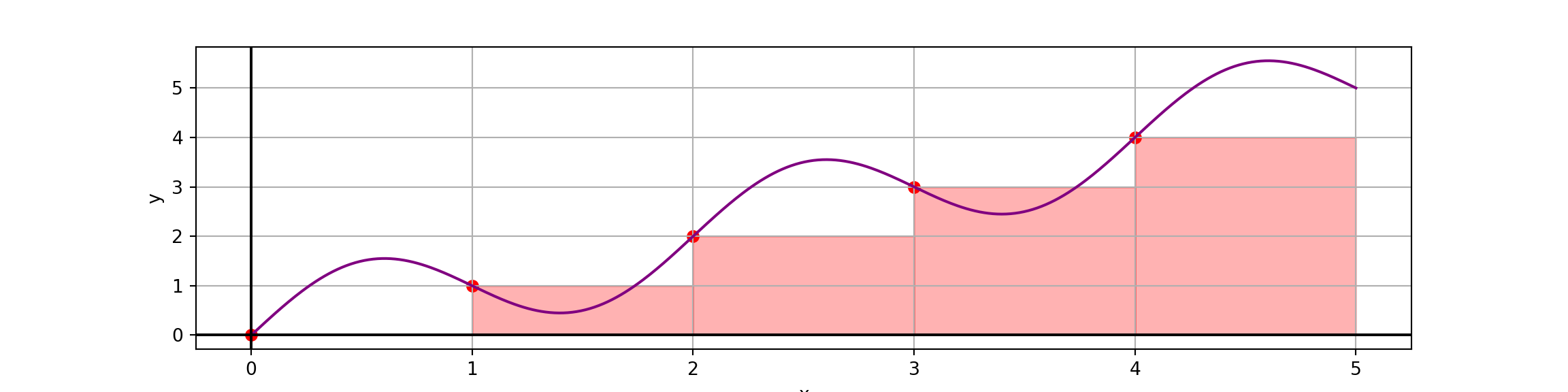
The following table gives several methods which you were probably introduced to in order to approximate \(\displaystyle{\int_{a}^{b}{f\left(x\right)dx}}\), where \(x_0 = a\), \(x_n = b\), and \(x_0 < x_1 < x_2 < \cdots < x_n\).
| Name | Expression for Approximating Integral |
|---|---|
| Left-Endpoint Method | \(\displaystyle{\sum_{i = 0}^{n - 1}{f\left(x_i\right)\Delta x_i}}\) |
| Right-Endpoint Method | \(\displaystyle{\sum_{i = 1}^{n}{f\left(x_i\right)\Delta x_i}}\) |
| Trapezoid Method | \(\displaystyle{\sum_{i = 0}^{n - 1}{\frac{f\left(x_i\right) + f\left(x_{i+1}\right)}{2}\Delta x_i}}\) |
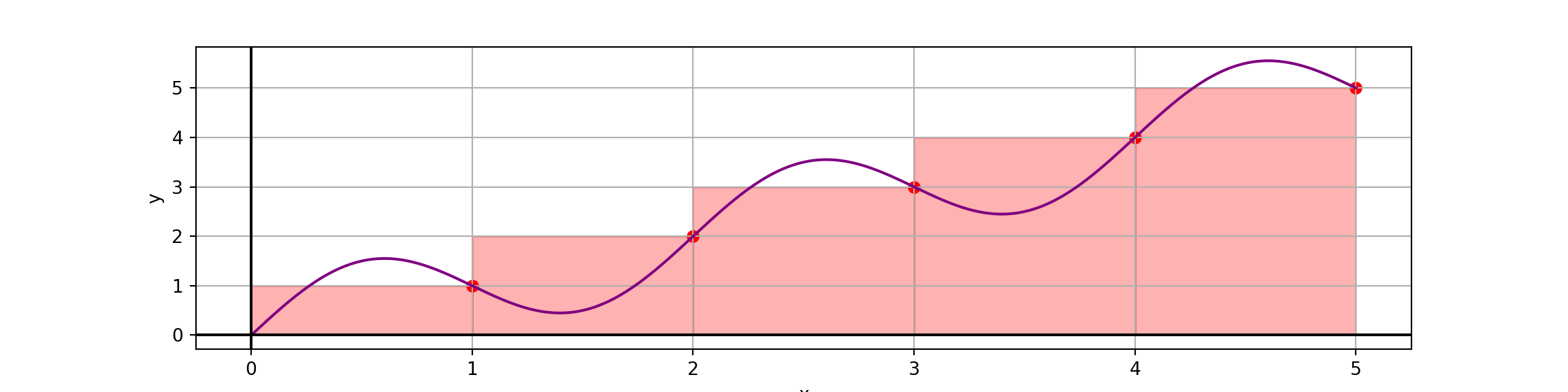
The following table gives several methods which you were probably introduced to in order to approximate \(\displaystyle{\int_{a}^{b}{f\left(x\right)dx}}\), where \(x_0 = a\), \(x_n = b\), and \(x_0 < x_1 < x_2 < \cdots < x_n\).
| Name | Expression for Approximating Integral |
|---|---|
| Left-Endpoint Method | \(\displaystyle{\sum_{i = 0}^{n - 1}{f\left(x_i\right)\Delta x_i}}\) |
| Right-Endpoint Method | \(\displaystyle{\sum_{i = 1}^{n}{f\left(x_i\right)\Delta x_i}}\) |
| Trapezoid Method | \(\displaystyle{\sum_{i = 0}^{n - 1}{\frac{f\left(x_i\right) + f\left(x_{i+1}\right)}{2}\Delta x_i}}\) |
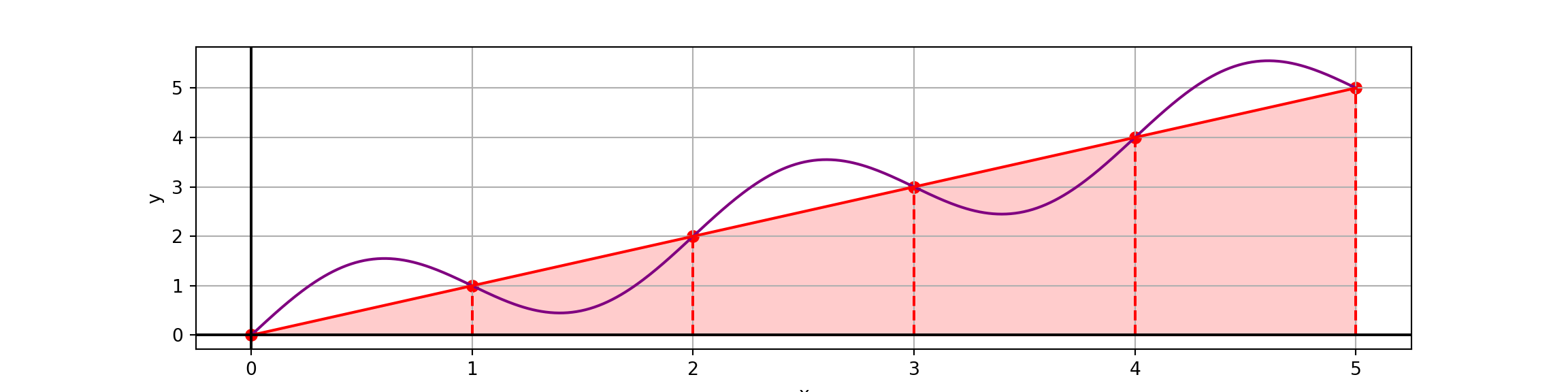
The following table gives several methods which you were probably introduced to in order to approximate \(\displaystyle{\int_{a}^{b}{f\left(x\right)dx}}\), where \(x_0 = a\), \(x_n = b\), and \(x_0 < x_1 < x_2 < \cdots < x_n\).
| Name | Expression for Approximating Integral |
|---|---|
| Left-Endpoint Method | \(\displaystyle{\sum_{i = 0}^{n - 1}{f\left(x_i\right)\Delta x_i}}\) |
| Right-Endpoint Method | \(\displaystyle{\sum_{i = 1}^{n}{f\left(x_i\right)\Delta x_i}}\) |
| Trapezoid Method | \(\displaystyle{\sum_{i = 0}^{n - 1}{\frac{f\left(x_i\right) + f\left(x_{i+1}\right)}{2}\Delta x_i}}\) |
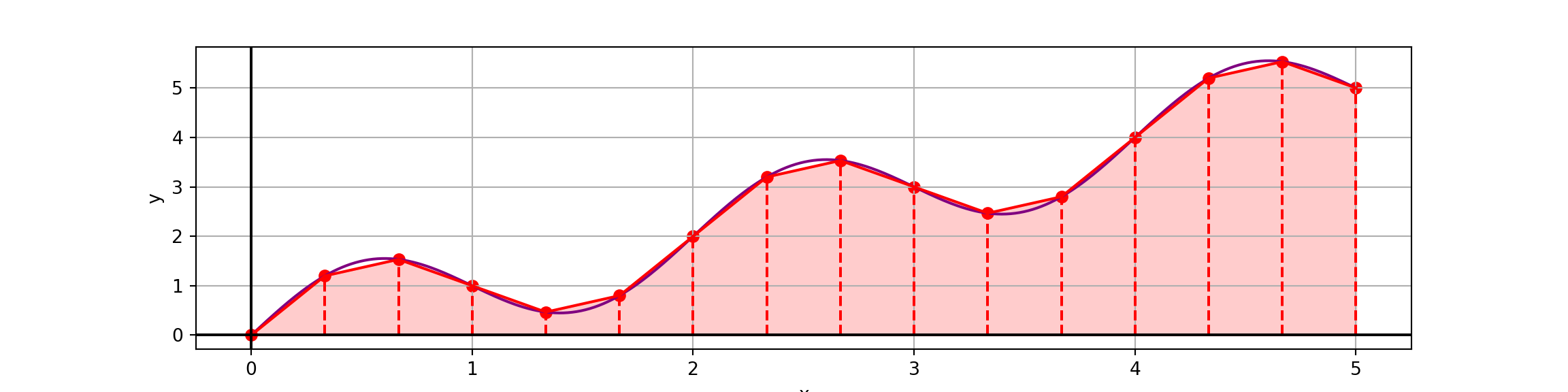
The Newton-Cotes Formulae are a set of strategies which try to approximate \(\displaystyle{\int_{a}^{b}{f\left(x\right)dx} \approx \sum_{i = 0}^{n}{A_if\left(x_i\right)}}\), where…
Newton-Cotes Formulae include the left- and right-endpoint methods (using rectangles), the trapezoidal method, and others.
\(\bigstar\) These methods construct interpolants through the abscissas.
In order to approximate \(\displaystyle{\int_{a}^{b}{f\left(x\right)}}\), Newton-Cotes Formulae take the following steps:
Divide \(\left[a, b\right]\) into \(n\) equal intervals of width \(h = \frac{b-a}{n}\).
The nodal abscissas are the endpoints of the intervals resulting from the step above.
Approximate \(f\left(x\right)\) by a [perhaps piecewise] polynomial of low degree that intersects all of the nodes.
Integrate the piecewise polynomial as an approximation for \(\displaystyle{\int_{a}^{b}{f\left(x\right)dx}}\).
As a reminder, a Lagrange Polynomial of degree \(n\) is defined as
\[P_{n}\left(x\right) = \sum_{i = 0}^{n}{f\left(x_i\right)\ell_i\left(x\right)}\]
where \(\ell_i\left(x\right)\) are the cardinal functions evaluating to \(1\) at \(x_i\) but evaluating to \(0\) at any of the other nodal abscissas.
Because the Lagrange interpolating polynomial matches \(f\left(x\right)\) at the nodes, we approximate the integral of \(f\) by the integral of its interpolant.
This means that we can obtain an approximation for \(\displaystyle{\int_{a}^{b}{f\left(x\right)dx}}\) as follows:
\[\begin{align*} \int_{a}^{b}{f\left(x\right)dx} &\approx \int_{a}^{b}{P_{n}\left(x\right)dx}\\ &= \sum_{i = 0}^{n}{\left[f\left(x_i\right)\int_{a}^{b}{\ell_i\left(x\right)dx}\right]}\\ &= \sum_{i = 0}^{n}{A_if\left(x_i\right)} & (\bigstar) \end{align*}\]
where \(\displaystyle{A_i = \int_{a}^{b}{\ell_i\left(x\right)dx}}\).
The equations to the left and above are referred to as the Newton-Cotes formulas.
The Trapezoidal Rule is obtained by the Newton-Cotes Formula when \(n = 1\).
In this case, remember that the cardinal function \(\displaystyle{\ell_0\left(x\right) = \frac{x - x_1}{x_0 - x_1} = \frac{b - x}{h}}\) and \(\displaystyle{\ell_1\left(x\right) = \frac{x - x_0}{x_1 - x_0} = \frac{x - a}{h}}\).
From here, we can obtain
\[\begin{align*} A_0 &= \frac{1}{h}\int_{a}^{b}{\left(b - x\right)dx}\\ &= \frac{1}{2h}\left(b - a\right)^2\\ &= \frac{h}{2}\\ A_1 &= \frac{1}{h}\int_{a}^{b}{\left(x - a\right)dx}\\ &= \frac{1}{2h}\left(b - a\right)^2\\ &= \frac{h}{2} \end{align*}\]
Plugging these weights into the \((\bigstar)\) equation from above gives us that
\[\begin{align*} \int_{a}^{b}{f\left(x\right)dx} &\approx \sum_{i = 0}^{1}{\frac{h}{2}f\left(x_i\right)}\\ &= \frac{h}{2}\left[f\left(a\right) + f\left(b\right)\right] \end{align*}\]
Note that this is for a single trapezoid.
We’ll see how to adapt this efficiently for more trapezoids, via the composite trapezoidal rule, shortly.
As with nearly everything we do in numerical methods, there will be error in our approximation.
The error in approximation using the Trapezoidal Rule is
\[\begin{align*} E &= \int_{a}^{b}{f\left(x\right)dx} - \frac{h\left[f\left(a\right) + f\left(b\right)\right]}{2} \end{align*}\]
It is possible to show that the error in interpolating a function with an \(n^{th}\)-degree polynomial is given by
\[\begin{align*}f\left(x\right) - P_{n}\left(x\right) &= \frac{\left(x - x_0\right)\left(x - x_1\right)\cdots\left(x - x_n\right)}{\left(n+1\right)!}f^{\left(n+1\right)}\left(\xi\right)\\ \implies \int_{a}^{b}{f\left(x\right) - P_{n}\left(x\right)dx} &= \int_{a}^{b}{\frac{\left(x - x_0\right)\left(x - x_1\right)\cdots\left(x - x_n\right)}{\left(n+1\right)!}f^{\left(n+1\right)}\left(\xi\right)dx} \end{align*}\]
As with nearly everything we do in numerical methods, there will be error in our approximation.
The error in approximation using the Trapezoidal Rule is
\[\begin{align*} E &= \int_{a}^{b}{f\left(x\right)dx} - \frac{h\left[f\left(a\right) + f\left(b\right)\right]}{2} \end{align*}\]
Since we are using a linear function as our interpolant, we have
\[\begin{align*}f\left(x\right) - P_{1}\left(x\right) &= \frac{\left(x - x_0\right)\left(x - x_1\right)}{2!}f''\left(\xi\right)\\ \implies \int_{a}^{b}{f\left(x\right) - P_{1}\left(x\right)dx} &= \int_{a}^{b}{\frac{\left(x - x_0\right)\left(x - x_1\right)}{2!}f''\left(\xi\right)dx}\\ &= \int_{a}^{b}{\frac{\left(x - a\right)\left(x - b\right)}{2!}f''\left(\xi\right)dx}\\ &= \frac{1}{2}f''\left(\xi\right)\int_{a}^{b}{\left(x^2 - \left(a + b\right)x + ab\right)dx}\\ &= \frac{-h^3}{12}f''\left(\xi\right) \end{align*}\]
So the error is influenced both by the interval width (\(h\)) and by the second derivative (curvature) of the original function on the interval.
So far, the Trapezoid Rule we’ve discussed approximates the area under \(f\left(x\right)\) along \(\left[a, b\right]\) by a single trapezoid.
The trapezoid rule that we usually think of (and the one from our earlier plots) breaks up the interval \(\left[a, b\right]\) into many sub-intervals and use a trapezoid on each interval, summing the areas of all of the trapezoids together in order to approximate the area.
This process results in the Composite (or Generalized) Trapezoid Rule.
\[\int_{a}^{b}{f\left(x\right)dx} \approx \sum_{i = 0}^{n-1}{\frac{f\left(x_i\right) + f\left(x_{i+1}\right)}{2}\Delta x}\]
From what we computed previously, the truncation error in approximating the integral on each individual sub-interval is \(E_i \approx \frac{-h^3}{12}f''\left(\xi_i\right)\)
The total error is then \(\displaystyle{E \approx \sum_{i = 0}^{n-1}{\frac{-h^3}{12}f''\left(\xi_i\right)}}\)
Which, after using the Mean Value Theorem and some algebra, can be rewritten as \(\displaystyle{E \approx \frac{-\left(b - a\right)h^2}{12}f''\left(\xi\right)}\)
Note that the error here is now \(\mathscr{O}\left(h^2\right)\) rather than \(\mathscr{O}\left(h^3\right)\), but we benefit from having smaller interval widths (\(h\)) here.
In the interest of efficiency, let’s see if we can identify patterns in evaluating the Composite Trapezoid Rule that could be exploited in our code.
Consider the composite trapezoidal rule using \(2^{k-1}\) subintervals. If \(k\) is increased by \(1\), the number of subintervals is doubled. For convenience, let \(H = b - a\), and notice the following:
\[\begin{align*}\int_{a}^{b}{f\left(x\right)dx} \approx \left[f\left(a\right) + f\left(b\right)\right]\frac{H}{2} \end{align*}\]
\[\begin{align*}\int_{a}^{b}{f\left(x\right)dx} &\approx \left[f\left(a\right) + 2f\left(a + \frac{H}{2}\right) + f\left(b\right)\right]\frac{H}{4}\\ &= \frac{1}{2}\left(\left[f\left(a\right) + f\left(b\right)\right]\frac{H}{2}\right) + f\left(a + \frac{H}{2}\right)\frac{H}{2}\\ &= \frac{1}{2}I_1 + f\left(a + \frac{H}{2}\right)\frac{H}{2} \end{align*}\]
In the interest of efficiency, let’s see if we can identify patterns in evaluating the Composite Trapezoid Rule that could be exploited in our code.
Consider the composite trapezoidal rule using \(2^{k-1}\) subintervals. If \(k\) is increased by \(1\), the number of subintervals is doubled. For convenience, let \(H = b - a\), and notice the following:
\[\begin{align*} \int_{a}^{b}{f\left(x\right)dx} &\approx \left[f\left(a\right) + 2f\left(a + \frac{H}{4}\right) + 2f\left(a + \frac{H}{2}\right) + 2f\left(a + \frac{3H}{4}\right) + f\left(b\right)\right]\frac{H}{8}\\ &= \frac{1}{2}\left[f\left(a\right) + 2f\left(a + \frac{H}{2}\right) + f\left(b\right)\right]\frac{H}{4} + \left[2f\left(a + \frac{H}{4}\right) + 2f\left(a + \frac{3H}{4}\right)\right]\frac{H}{8}\\ &= \frac{1}{2}I_2 + \left[f\left(a + \frac{H}{4}\right) + f\left(a + \frac{3H}{4}\right)\right]\frac{H}{4} \end{align*}\]
\[\begin{align*} \frac{1}{2}I_{k-1} + \frac{H}{2^{k-1}}\sum_{i = 1}^{2^{k-2}}{f\left(a + \frac{\left(2i - 1\right)H}{2^{k-1}}\right)} \end{align*}\]
In the interest of efficiency, let’s see if we can identify patterns in evaluating the Composite Trapezoid Rule that could be exploited in our code.
Consider the composite trapezoidal rule using \(2^{k-1}\) subintervals. If \(k\) is increased by \(1\), the number of subintervals is doubled. For convenience, let \(H = b - a\), and notice the following:
\[\begin{align*} \frac{1}{2}I_{k-1} + \frac{H}{2^{k-1}}\sum_{i = 1}^{2^{k-2}}{f\left(a + \frac{\left(2i - 1\right)H}{2^{k-1}}\right)} \end{align*}\]
Using this recursive rule doesn’t actually require any additional operations beyond calculating the area using the composite trapezoidal rule directly.
The benefit that is provides is that it allows us to monitor the convergence of the total area estimate by tracking changes between \(I_{k-1}\) and \(I_k\).
We can terminate the process when \(\left|I_{k-1} - I_k\right| < \text{tolerance}\).
We are now ready to write a recursive trapezoidMethod() routine.
def trapezoid(f, a, b, Iold, k):
if k == 0:
Inew = (f(a) + f(b))*(b - a)/2.0
else:
n = 2**(k-1)
h = (b - a)/n
x = a + h/2.0
sum = 0.0
for i in range(n):
sum = sum + f(x)
x = x + h
Inew = (Iold + h*sum)/2.0
return Inew
def trapezoidMethod(f, a, b, k):
Iold = (f(a) + f(b))*(b - a)/2.0
for i in range(1, k + 1):
print("The number of subdivisions I made is ", i, ", resulting in ", 2**i, " trapezoids")
Inew = trapezoid(f, a, b, Iold, i)
diff = Inew - Iold
print("The difference in approximation between using ", 2**(i-1), " trapezoids and ", 2**i, " trapezoids was ", diff)
Iold = Inew
return InewOur implementation of the recursive, composite trapezoid method consists of two routines.
A helper function trapezoid(), which takes in the function whose integral to approximate (f), the left and right endpoints (a and b), the previous integral estimate (Iold), and a parameter k associated with the number of subintervals to create.
trapezoid() directly.The trapezoidMethod() routine, wich takes in f, a, b, and k whose descriptions are the same as those above.
trapezoidMethod() routine.Example: The picture below shows the trapezoidal rule with \(16\) subintervals being used to approximate \(\displaystyle{\int_{0}^{10}{x + x\sin\left(2x\right)dx}}\). Use the routine defined on the previous slide to compute the estimated area.
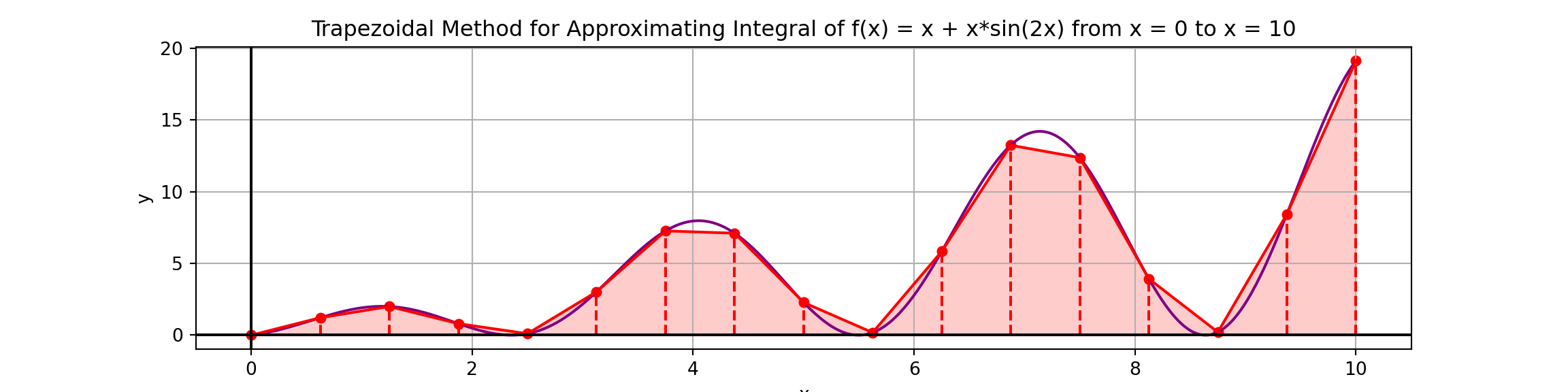
The final estimate for the area was about 48.5 units.
The difference between the previous estimate (8 sub-intervals) and the final one (16 sub-intervals) was still quite large – we haven’t reached convergence yet.
The number of subdivisions I made is 1 , resulting in 2 trapezoids
The difference in approximation between using 1 trapezoids and 2 trapezoids was -36.42415904042494
The number of subdivisions I made is 2 , resulting in 4 trapezoids
The difference in approximation between using 2 trapezoids and 4 trapezoids was 1.5880685383230997
The number of subdivisions I made is 3 , resulting in 8 trapezoids
The difference in approximation between using 4 trapezoids and 8 trapezoids was -11.26264765870998
The number of subdivisions I made is 4 , resulting in 16 trapezoids
The difference in approximation between using 8 trapezoids and 16 trapezoids was -1.0556411183138792
np.float64(48.49288325725569)
In this notebook we developed the Newton-Cotes Formulae. These are a set of approaches to numerical integration satisfying:
\[\begin{align*} \int_{a}^{b}{f\left(x\right)dx} &\approx \sum_{i = 0}^{n}{A_if\left(x_i\right)}\\ A_i &= \int_{a}^{b}{\ell_i\left(x\right)dx} \end{align*}\]
Techniques such as left-hand and right-hand Riemann Sums, the Trapezoidal Rule, and Simpson’s Rule all fall under the category of Newton-Cotes Formulae.
We implemented a routine trapeoidMethod(f, a, b, k) which can be used to approximate \(\displaystyle{\int_{a}^{b}{f\left(x\right)dx}}\) using \(2^{k-1}\) sub-intervals.
Next Time: We’ll move on to solving initial value problems resulting from ordinary differential equations.